DD
MM
YYYY

PAGES

DD
MM
YYYY

spot_img

PAGES

Home Blog Page 5224

Elevate the Perceptions of Customers and WIN

0

I will execute and the numbers will do the talking. Interestingly, you can execute, but the numbers will not help you. Simply, how you make money and where you make money are more important than the actual numbers on the balance sheet and P&L.

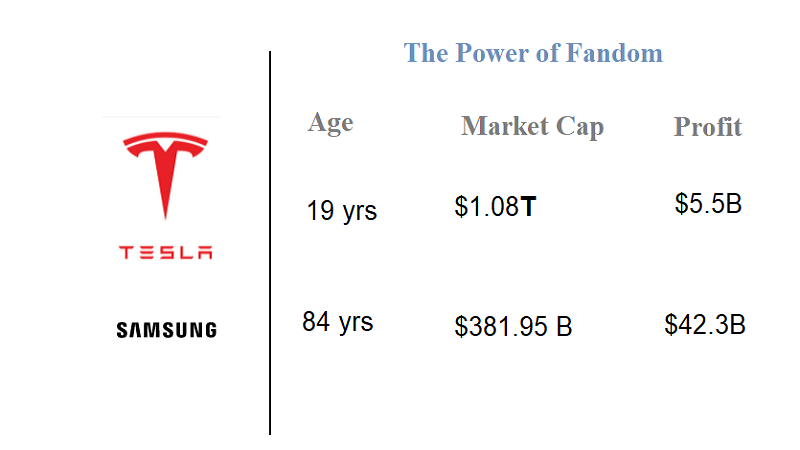
Tesla is a car company which sells “software subscription” and emission credits, and makes all its competitors look lost, even though most are delivering “better automobile numbers”; Toyota sells close to 9 million cars than Tesla, but Tesla is valued at close to 4x more.

Look into your business, move beyond needs and expectations. Elevate the perceptions of customers, set new basis of competition and unlock value.

Look at the profit of Samsung, but see how the market has valued Tesla; it goes beyond absolute $$. Tesla has turned customers into FANS and created a fandom in markets.

Comment on Social Media Feed

Comment: Tesla is overvalued. Their market cap isn’t justified.

My Response: They have been saying that for 6 years when it was worth about $120B. But if you do the math, its profit grew six-fold in 12 months. That is an exponential growth, and that is why it is not overvalued.

Elevating National Unity Via Sporting Activity As The World Marks Int’l Day Of Sport

0

It’s noteworthy that April 6 annually, the global community commemorates the International Day of Sport.

On 23rd August 2013, the 67th session of the United Nations (UN) General Assembly decided to proclaim April 6 of every year as the International Day of Sport for Development and Peace.

Previously, the 58th session of the assembly proclaimed 2005 as the International Year for Sport and Physical Education to promote education, health, development and peace.

Sport is a form of usually competitive activity that requires physical effort and skill, which through casual or organized participation, tends to maintain or improve the said ability and skill. It equally provides entertainment for the participants as well as the spectators.

Sport has indeed been confirmed as the only common language spoken by mankind irrespective of age, background, race, status, or social, political and religious affiliations, due to its universality, entertaining nature and unique economic value. This is why it is being referred to as one of the backbones of the socio-economic state of any nation in existence.

Considering the overall impact of sport on both individual and national developments, there is no gain reiterating that it has contributed immensely in the uplift of the socio-economic state of most individuals, communities or nations across the globe through various avenues such as rejuvenation of physical fitness, human capital growth, provision of entertainment, and most importantly, promotion of unity, just to mention but a few.

It’s noteworthy that, the physical fitness and thorough entertainment derive from, either participation in or observation of, sporting activities have helped tremendously in uplifting and sustaining the healthy living status of the concerned individual, thereby helping to intensify the number of available manpower in the affected country.

The recent total commercialization of sports has enabled the activity to be universally recognized as a lucrative profession. No doubt, most human capital developments recently witnessed among young ones are mainly attributed to sports, or the entertainment industry at large.

Taking the Nigerian football league as a case study, on the average, a player on a monthly basis smiles to the bank with not less than half a million naira (#500,000).

Sports have equally succeeded in booming the global broadcasting industry owing to its lucrative nature. This has made many potential investors to venture into broadcasting business. It’s worthy to note that most media firms, both print and electronic, were established for the sole purpose of publishing or transmitting sporting activities having acknowledged the consequent financial benefit of such investment.

Above all, the level of unity being derived from sports cannot be overemphasized. Sport arguably remains the major engine room behind international unity among most countries.

Survey shows that presently, sport is the only tool that truly unites the gathering involving millions of individuals from diverse backgrounds, races, or affiliations. And it’s only absolute unity that guarantees thorough peace and development among any group of persons, which remains the paramount desire of any existing society.

To this end, we are expected to embrace sport as a major tool for cordial unity or relationship among individuals or nations, thus ought to be taken seriously by any individual, government, or authority, as the case may be.

Therefore, its teachings in every citadel of learning at all levels should be considered paramount and sacrosanct. More so, every parent or guardian is required to encourage his/her child, or ward, in sports participation regardless of age, considering its social, cultural, health and economic consequences.

Governments at all levels ought to in their various capacities not hesitate to finance any sport activity or competition taking place within their jurisdictions. The various schools ranging from primary, secondary, to tertiary, on their part, should intensify efforts on the usual annual hosting or organization of sport competitions in their respective schools, and should endeavour to reach out to the entire public whenever such event is being organized.

It’s obvious that in Nigeria recently, sport has been politicized by most concerned stakeholders. In view of this pathetic anomaly, the lawmakers ought to enact a strict law that would sanction or severely penalize a member of any sport governing body in the country, such as the Nigerian Football Federation (NFF), that is found guilty of any fraudulent or selfish act while discharging his or her official duty.

On the other hand, the civil society should endeavour to consistently condemn or criticize the ongoing fanaticism witnessed among sport lovers. They should be meant to understand that fanaticism, which invariably leads to extremism, is a cankerworm that might end up eradicating the prime essence of sports which remain unity, peace and development.

Statistics indicate that sport fanaticism has succeeded in killing thousands of people as well as maimed millions of them across the globe. Hence, the authorities must introduce a measure that would ensure that such lifestyle is holistically jettisoned.

Sports are undoubtedly a recipe to mankind’s growth and development, so should be granted the support it requires by all concerned.

Tekedia Live – Financial Performance Management

0

Tekedia Live tomorrow will be super-amazing. Our Faculty is one of the most respected women business leaders in African finance and investment domains. A c-suite executive and business leader with key forte in treasury and investment, financial performance management, and international trade with a track record of linking performance to business strategy while focused on the 4Ps (people, performance, productivity and profits).

Kehinde Wole-Olomojobi, the Treasurer of Greenwich Merchant Bank,  will teach Financial Performance Management tomorrow at Tekedia Mini-MBA. Come and master how to drive that financial performance in your business from one of the best in the game.

Tekedia Mini-MBA >> learn from the best. Zoom link in the Board.

West African Region Faces Worst Food Crisis Due To Impact Of The Russian-Ukraine War

0

The ongoing war between Russia and Ukraine has in no doubt affected national economies, food supplies as well as global energy markets. One negative thing about war is the fact that it brings about food shortages and also disrupts economic activities. It was recently disclosed that the West African region is currently facing the worst food crisis which has seen the price of food skyrocket as well as a shortage of food availability, which is a result of the impact of the Russia-Ukraine war on the region.

According to a report, it was disclosed that about 27 million people are suffering from hunger in the region, and it is estimated that the number could rise to 38 million by June, a 40% increase from last year and a historic high. Amid the ongoing Russia-Ukraine war, the food and agriculture organization of the United Nations (FAO) disclosed that the prolongment of the war will In no doubt increase the number of malnourished people globally as a result of food shortage.

The surge in food prices is already leading to food security problems around the world, especially in West Africa. Already, the African continent has been suffering from climate change which has drastically reduced Agricultural production. An estimate of over 100 million people in Africa lives in extreme poverty, due to the adverse effect of climate change on their lives and livelihoods. Now the Russia-Ukraine war has intensified the suffering in Africa, most especially in the West African region as some countries have been pushed into famine.

In times of warfare, every country is affected either developed, developing, or underdeveloped. One edge the developed nations have over the rest is that in times of war, they have strong economies that can sustain them from food crises and hunger. It is quite unfortunate that both Russia and Ukraine are two of the most important Agricultural commodity exporters in the world. In 2021, Ukraine ranked among the top three global exporters of wheat, maize, and rapeseed, while the Russian Federation also stood as the world’s top exporter of Nitrogen fertilizers.

It is a known fact that one of the basic needs of man is food, and once the supply of food or cultivation of crops is affected, then human existence is threatened. The prices of wheat have skyrocketed since the war began, and it was disclosed that wheat is a significant staple food in most countries with East Africa importing about 90% of its wheat from Russia and Ukraine. Also, six West African countries import 30-50% of their Wheat from Russia.

With no one having a clue about when the war between Russia and Ukraine will be over, there needs to be serious intervention to help the plight of those in regions severely affected by the war. Developed countries should swing into action to help solve the food crises that the war has brought upon such regions. They should see the need to extend helping hands to nations greatly affected, most especially nations in the West African region by supplying them with humanitarian materials as it will help to mitigate and reduce hunger as well as lower the proposed high death rate.

Deconstructing the Most Common Ramadan Fasting Impact Misconceptions

0

Without spirituality, no religion exists. Attaining a high level of spiritualism entails carrying out specific actions as prescribed by Holy Book sayings and teachings (Quran and Bible). In some cases, Christians and Muslims follow their leaders’ instructions in order to get closer to God. Fasting is one of the ways to achieve spiritualism in both religions, and it is one of the ways to receive favorable responses or answers from God.

In terms of costs and advantages to individuals and nations, this means has been perceived differently by people all around the world. Ramadan, which is both a month and a name for fasting in Islam, has elicited more conflicting sentiments throughout the years about its costs and advantages than lent, which is fasting in Christianity. The fact that Ramadan is a month that is highly prominent and respected by Muslims may explain why people and organizations pay so much attention to it.

Apart from that, because Ramadan is a fasting month, Muslims must strengthen their spiritual commitments and social connection with both Muslims and non-Muslims at this time. Allah in Quran 2 verse 183 says: “O you who believe, fasting is prescribed for you as it was prescribed for those before you, that you may develop God-consciousness.”

Meanwhile, the purpose of this piece is not to tell the audience what they already know about the principles of fasting throughout Ramadan. Its goal is to dispel some common misconceptions about the month’s costs and advantages. Our analyst recently expressed his opinions on how Muslim employees should be accommodated during Ramadan [the thoughts are here]. Readers were prompted to ask a series of questions in response to the ideas. The basic premise of the submission is that businesses and countries lose money during the month. As a result, our analyst looked into numerous perspectives on the subject.

There are a lot of studies that reveal mixed costs and advantages from the perspective of academic research. In terms of productivity, health and economic research show that fasting diminishes labor working capacity, affects persons with chronic ailments, and lowers the Gross Domestic Product of countries, particularly those dominated by Muslims, due to low employee productivity. Some of the findings of these research agree with Nigerians who told our analyst that having to get up before dawn and eat breakfast, as well as undertaking some activities, has an impact on employees’ productivity when they get at work.

On the subject of health, some people who have certain health problems often experience complications before the fasting period is over. Despite these submissions, our analyst points out that the Quran outlines the rationale for fasting as well as how it should be done and who should not participate. The Quran also specifies what Muslims who are unable to participate due to health issues should do. Therefore, the findings of research pointing to harmful effects of the Ramadan on Muslims’ health should be utilized with caution.

Several medical professionals have stated over the years that limiting food intake during the day can aid in the prevention of health problems and the improvement of mental health. Because the month provides spiritual capacity to reflect on habits and behaviors, the mental health of every Muslim who actively participated in various activities linked with the month is predicted to improve greatly. Therfore, enhanced mental health is guaranteed throughout the month. Increased interpersonal relationships, increased attention to the poor, and increased equality between the rich and the poor are only a few of the social benefits that cannot be erased during the month.

Researchers should re-examine the claim that the month affects economic growth due to decreased staff productivity. This is necessary since a single variable cannot completely reveal the month’s economic effects. Increasing Muslim spending is likely to have a favourable impact on the economy and, invariably, consumer stocks. For example, between 1989 and 2007, market returns in 14 mostly Muslim countries were much higher and less volatile during the month than the rest of the year. Ramadan promotes self-discipline, self-control, sacrifice, and empathy, among other things.