DD
MM
YYYY

PAGES

DD
MM
YYYY

spot_img

PAGES

Home Blog Page 5225

Transport Minister Rotimi Amaechi Joins Nigeria’s Presidential Race (full text of his speech)

0
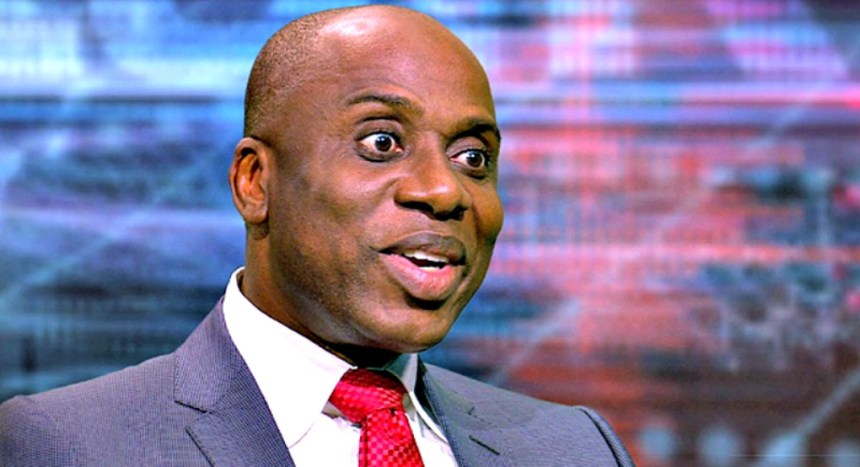
Nigeria's minister of transport

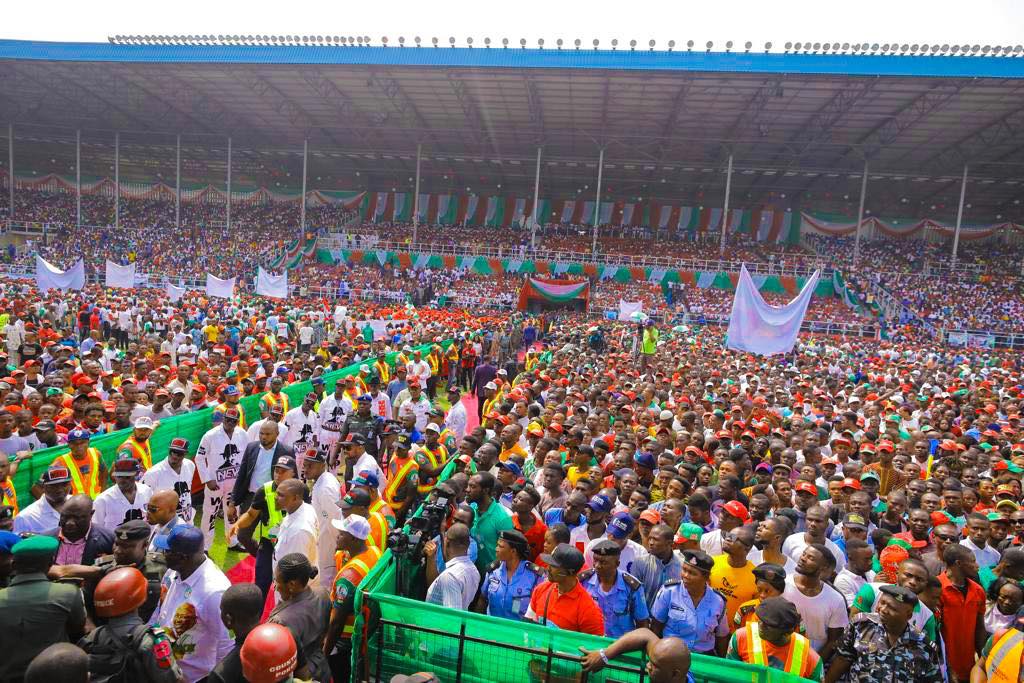
As the race for the office of Nigerian president heats on, many more Nigerians are declaring interest to occupy the most important office in the world’s most popular black nation.

The latest person to join the race is the Minister of Transport, Rotimi Amaechi. In his declaration on Saturday, the two-term former governor of Rivers State said he will use his years of experience in public service to tackle Nigeria’s spiraling problems.

Read the full statement below:

THE DECLARATION Forward with Courage

Fellow Nigerians, I stand before you today to declare my intention and submit my application to serve as your next President. I did not come to this decision lightly. I have served our nation for the last seven years as Minister of Transportation. For 8 years before that, I served as Governor of Rivers State.

In the preceding eight years before that, I was Speaker of the Rivers State House of Assembly. These 23 years of service have equipped me not only with great experience in governance and public service but also compassion for the ordinary citizens of our dear country.

After more than two decades in the public arena, I had wanted to go on holiday and spend more time with my family before charting a new course outside politics. But at 56, and a member of the generation born after independence who has seen the good, the bad and the ugly of Nigeria, I am compelled by the urgency of our present challenges to place my experience & proven capacity at the service of the nation at the highest level.

Those who know me can testify that I have always been a straight talker. This trait has not always made me popular, but I speak truth with conviction. So, allow me to speak the truth here today. We are facing some very serious challenges as a country. These are problems of insecurity, challenges of greater accountability in governance, youth unemployment and the scourge of spiraling poverty.  These problems are however not the exclusive preserve of Nigeria.

We live in a troubled world. The reality we used to know has altered in nearly every nation. Climate change has brought about food scarcity in some places. Population explosion has produced unusual pressure on resources and supplies. Poverty has become a challenge all over the world especially in the developing world. The Covid crisis has placed unanticipated burdens on the budgets of nations and put pressure on available resources. Trans-border crises have erupted in unusual places and placed the internal security of many nations under pressure.

We are part of the Sahel, an area of the world that is subject to frequent terrorist attacks. Let us look at our current challenges as part & consequences of these global trends. I admit that Nigeria’s problems did not begin today. And they will not be solved overnight but they are not beyond the capacity of our people to solve. Fortunately, that process has already started. There is an ancient proverb that “a society grows great when old men plant trees under whose shade they know they’ll never sit.”

The current administration under the able leadership of President Muhammadu Buhari has planted many such trees in Nigeria’s future. We have invested billions in infrastructure, human capital development & made reforms that will pay off over time in terms of socio-economic growth and stability. We have invested heavily in projects and initiatives that will secure a brighter, better future for Nigeria. I am proud to have been part of this success story. It has been an honour overseeing the Ministry of Transportation in reviving the moribund railways, and working tirelessly to create an integrated national transportation system that will positively impact our economy, trade, employment, business, and national cohesion.

Have we achieved everything we set out to do? Off-course not. Could we have done more undoubtedly, there is always room for improvement. On reflection, the notion of running for President would have been far beyond the imagination of the young lad running around the streets of Diobu or our small compound in Ubima. Not to talk of the young indigent student… leader, mobilizing peers at the University of Port Harcourt. But my aspiration is not about fulfilling any personal ambition. I am contesting for office because I believe that it is my moral duty to give what I can in the service of my country.

To sustain and intensify present efforts at solving our national problems, our democracy must ensure the emergence of a leadership that is equipped with broad experience in governance to ensure stability and continuity. To sustain our democracy and preserve our unity, we need a steady hand and a passion for success in a nation that remains united to pursue prosperity for all Nigerians. It is this combination of experience and patriotic passion that I bring to the table. I have been in the political arena for 23 years.

I have served at every level of government – local, state, and federal. I have served both as a political appointee and an elected official. I have served both as an executive – as Governor of Rivers State and as a legislator – as Speaker of the State House of Assembly.

In these capacities, I did not just fill vacant posts. As a Speaker, I managed the legislative process in a difficult transition from military rule. As Governor, I defeated mercantile militancy and restored security. As a minister, I can modestly claim to have justified the trust f Nigerians. I do not come from a privileged background. I grew up poor. I understand how it feels to go without some meals in a day. I know the pain of lack and the agony of want. I know what it means to see your parents toil just to keep a roof over your family’s head.

I know what it is to feel the weight of expectation when you are are the only one in your family who enjoys the opportunity to attend university. Subsequently, I funded the education of my siblings to be university graduates as well. I know what it is to scrimp & save & struggle. In spite of all odds, I have journeyed to this point. I could not have come this far without my parents, Fidelis, & Mary, who sacrificed so much for me. I could not have come this far without the support of my siblings. I could not have come this far without the mentors, friends and sponsors who have believed in me. I could not have come this far without the precious wife of my youth and my best friend, Judith, and my children who mean everything to me. I could not have come this far without the support of Dr. Peter Odili and his wife.

I could not have come this far without the support of Chief Rufus Ada-George. Neither could I have come this far without the support of President Muhammadu Buhari. Above all, I could not have come this far without the Grace of God. The next leg of my political journey will be tough. But I am excited to go out and engage with Nigerians from every walk of life. I am ready to go from Maiduguri to Makurdi, from Sokoto to Sagbama, from Yola to Oyo, from Badagry to Birnin Kebbi. To each town and village, I will have one message: Hope is around the corner.

I look forward to meeting you in your towns, villages, cities, campuses, and creeks. I want to hear your desires, needs and pains. I want to know what matters most to you. I want to listen and learn. I will be coming with one assurance: I will be welcome everywhere because the blood of every Nigerian flow in my veins. I shall be the president of all and every Nigerian. I believe that despite our cultural differences, we remain one people under God.

We may speak different languages or worship in different ways, but we all want the same things – a better life for our children, the ability to support our families, the freedom to live in peace without fear for our lives or properties. I have never been the type who folds his arms and complains about inadequacies I see around me. I have always jumped in with both feet to do whatever I can to help, to try and bring relief to those suffering, to work to make things right where I see wrong.

If you elect me as your President, I promise to play my part to the best of my ability. Every day I will rise and go to work for you. I will never forget the fact that I am there to serve you. Today, I stand as an aspirant to the position of President because of that same passion for people; that same drive for results. More than ever before, I am burning with the zeal to make a decisive difference in the lives of all Nigerians. No matter the darts and arrows that come my way, I will remain steadfast because the stakes are too high.

We cannot afford to fail. We cannot afford to veer off-course. I pledge my heart, mind and soul to the task of building a Nigeria in which every child can go to school, every young person can find work or support to start a business, every citizen can travel safely around the country and sleep at night knowing that law and order prevails and every Nigerian feels included, heard, and respected. The road ahead will be long and arduous. But we go forward with faith. Forward with courage. Forward with compassion. Forward with hope.

Forward with pride for who we are as a people and who we are yet to become. The future is bright because of YOU. God bless you and God bless the Federal Republic of Nigeria. CHIBUIKE ROTIMI AMAECHI.
No refund after payment: The position of the law

1

On the 10th of February, 2021, one Mr. Patrick Chukwuma was traveling and he decided to make use of the Peace Mass Transit (a Nigerian renowned transport company) for this trip.

He purchased a ticket for the trip and due to the unavailability of passengers and other travelers, Mr. Chukwuma was forced to wait for hours for the vehicle to fill up.

He got tired of waiting for the vehicle to fill up so he changed his mind about the trip and asked for a refund for the ticket fee he had purchased since he no longer wants to embark on the journey due to the time wasted.

The company’s ticketing officers clearly told him that they don’t refund money after a customer had purchased a ticket. They drew his attention to the caveat behind the vehicle ticket slip which emphasized the company’s no refund policy. The caveat reads: “no refund of money after payment”.

The passenger insisted that his money should be refunded to him. A heated argument ensued between the passenger and the Peace Mass transit company staff became rude and nasty to the passenger and they rained insults on him and those that are in support of him getting a refund and at the verge of physically assaulting him before the passenger decided to leave the scene but promised that the company will hear from him subsequently and he must be refunded his money.

Coincidentally, the passenger Mr. Patrick Chukwuma is a lawyer and with his knowledge of the law, he is aware that the company’s no refund policy contravenes relevant sections of the law and he decided to take the transport company to court to determine and enforce his rights.

The sole issue for determination was “whether the Peace Mass Transit company policy of “no refund of money after payment” is in violation of Section 120 of the Federal Competition and Consumer Protection Act 2018 especially when the contractual obligation to convey the Plaintiff to his preferred location was terminated”.

He prayed the court to declare that the no refund of money after payment rule of the Transport company and other companies who enforces this policy contravenes the relevant sections of the law especially s 120 of the Federal Competition and Consumer Protection Act of 2018 which ambiguously provides that, “ A customer shall have the right to return any advance booking, reservations order for any goods or services subject to a reasonable charge for the cancellation of the order or reservation by the supplier or service provider”.

Delivering its judgment, the High Court in Enugu through his Lordship Hon. Justice C.O. Ajah declared the no refund policy is unlawful, illegal, null, and void in light of the provisions of Sections 120, 104, 129 (1) (a) and (b) (iii) of the Federal Competition and Consumer Protection Act, 2018.

The court further ordered the transport company to pay the sum of N500,000 as damages to the Plaintiff.

By the implication of this recent judgment, every seller, vendor (both online vendors), service provider, etc who insist on the “no refund of money after payment” is engaging in an unlawful and illegal sales policy.

The no refund after payment policy has been stated by the court in line with the FCCP ACT, 2018 to be unlawful, illegal, null, and void.

Welcome Ekiti State University and Bamidele Olumilua University to Tekedia Institute

0

Tekedia Institute welcomes students from  Ekiti State University, Ado Ekiti, Nigeria and Bamidele Olumilua University of Education, Science and Technology Ikere Ekiti. Ekiti State. And by  this, EKSU has sent the largest number of students to our program – and most of them via scholarships, provided by their alumni. Indeed, those professors and PhDs in Ekiti State really like school.

People, it is what it is: you give what you have. Yes, there is a clear likelihood that extremely educated people will offer a gift of learning over other options. We are seeing that from data on Ekiti State.

Students, welcome again.


Tekedia Institute welcomes scholars from Bamidele Olumilua University of Education, Science & Technology, Ikere-Ekiti and Ekiti State University under a generous scholarship funded by Opeyemi Lisbon Ogunsanmi. These scholars will spend the next 8 weeks at Tekedia Institute, and deepen their mastery of the mechanics of markets and business systems.

We thank Mr. Ogunsanmi for his generosity by funding the FUTURE. Through citizens like him, thousands of learners have attended Tekedia Institute and many have great testimonies on how our programs have prepared them for the opportunities of the future.

Learners – on behalf of our Faculty, Team and other Learners in Tekedia Institute, welcome. The photos of the scholars here.

Abuse Of Elections In Nigeria By The Electorate

0

It’s noteworthy that any democracy is required to embrace an electoral process. Election apparently represents the collective decision of the people otherwise known as the electorate.

In elections, the voters or electors are presented with alternatives that they can choose among a number of proposals designed to settle an issue of public concern. Hence, in such an exercise, electors are expected to act as kingmakers. Elections are apparently central to the existence, stability and development of democracy.

On December 28, 1978, the leaders of the then Nigeria’s five political parties issued a unanimous pledge to the nation, to keep elections free and fair. The leaders in question promised that their leadership to the country would curb excesses in speech and behaviour by their party members.

They further stated they would restrain their members from engaging in political thuggery and ensure nothing was done to disrupt the peace of any community where election is to be conducted or upset the unity of the nationhood. Above all, they disclosed they would accept the verdict of the electorate in the elections which they would help to make peaceful, free and fair.

Recalling the recent Nigerian electioneering eras, even the blind could attest that several things are no longer at ease as against what it used to be. The assertion that things have fallen apart is not unconnected with the fact that practices to include but not limited to thuggery, election rigging and vote buying are now the key attributes of most elections. It becomes pathetic when realized that the supposed kingmakers (electors) are the primary cause of the ongoing unfortunate situation.

If the above perception is anything to go by, then a sane person would wonder the reason a ‘kingmaker’ would partake in any action targeted at rigging a scheduled election let alone indulging in such dirty act as thuggery. It’s more baffling to acknowledge that those electors – particularly the youth – who sell their birthright would stand to gain nothing, not even reasonable cash.

Even those who would not want to associate themselves with activities that could lead to election rigging would prefer to act like mere onlookers as long as the election lasts. Funnily enough, most of them would be present at the polling unit just to engage in frivolous interactions like issues bordering on sports, emotional relationship or what have you, and not to cast their votes. When scrutinized further, you would observe that the majority could not even boast of a voter’s card.

Owing to the acknowledgement that electors are ostensibly the kingmakers, the constitution of most countries across the globe, which Nigeria’s isn’t exceptional, captioned a clause that relates to ‘Vote of no-Confidence’. The aforementioned term is a constitutional matter that empowers the electorate, or the governed, to recall any elected officer if found wanting or culpable.

In such cases, the concerned electors are required to act as a body by collectively endorsing a written document, stating they no longer have confidence in a particular elected official thus ordering him/her to return home. This tool shows the electors are meant to be in charge, both in the pre and post–election eras.

It is as well worthy of note that the teeming Nigerian electors have equally abused such a lofty democratic tool. They are often marred by apathy when expected to act as one indivisible body, thereby allowing themselves to be cajoled into a state of mockery by the elected officers who they have apparently chosen to worship.

The primary consignment of a lawmaker is to air the collective view of his constituents in the Assembly where he/she had been sent to represent the people in question. It suffices to say that there is no tangible reason a legislator who does not have a befitting constituency office would not be recalled by his/her constituents.

It isn’t anymore news that most of the present lawmakers in countries like Nigeria cannot boast of a constituency office in their various constituencies let alone observing ‘Constituency briefing’ as a priority. Some don’t even know the ward chairmen of their respective political parties; they are invariably interested in acquiring such information when elections are around the corner.

Worse still, the affected electors would claim ignorance of the injury they have collectively incurred in the process. In spite of the hurdles and hardship occasioned by their representative, they would still wear a ‘happy slave’ physiognomy, pretending that all is well with them, especially when they encounter the physical presence of the politician in question.

This trending unwarranted and mind-boggling attitude of most Nigerian electors has continued to rape the god-sent democracy. The gravity of the unending rape is arguably colossal than we could think of.

It is, therefore, needless to state that rebranding Nigeria’s electoral system is indeed long overdue. The Independent National Electoral Commission (INEC) needs to start taking some pertinent actions as regards the country’s electioneering activities. It ought to be willing and ready to sanction any political party caught in any anti-election acts, especially while a certain election is being awaited.

Similarly, there’s a compelling need to carry out an all-inclusive sensitization among these individuals known as the electorate before the worst is witnessed. Their mindset needs to be restructured to enable them realize that power actually belongs to them. 

Social Media: Its Features And Challenges

0

Social Media, otherwise referred to as the ‘New Media’ have apparently dominated the information sector. In many aspects, the platform is distinct from other existing media networks such as print and broadcasting.

It operates in a dialogic transmission mode – many sources to many receivers – in contrast to print and electronic media that operate under a monologic transmission mode, one source to many receivers. It can simultaneously connect as many sources and receivers as possible.

There are numerous positive roles of social media networking in nation building. Though it’s a relatively new advancement in technology, it has made the world seem like just a minute clan owing to its ability to simultaneously connect millions of people from different localities across the globe as well as spread news within a shortest time frame.

Hence, it makes information go viral that it could be assessed from any locality. It enables one to reconnect with his or her old time friend or schoolmate. In addition, it helps people to stay connected to each other at all times.

Social networking is a great way to meet entirely new individuals and entities. One can easily discover persons or groups that are into his social/business interests. Online dating is currently more common than the traditional pattern of dating, and it’s worthy of note that many happily married couples today met online.

On the other hand, social media is at the moment the fastest and easiest way to promote goods and services; and it gives such products a different dazzling look, thereby encouraging the audience to patronize them.

Entertainers these days don’t need to be on television or radio before they can be heard. They can globally market their brands online with ease. The most fascinating part of it remains that the brand in question would be known by countless countries within a twinkle of an eye.

Social media equally helps to catch and convict criminals. People are usually ignorant of the consequences of what they post online. Oftentimes they post, albeit ignorantly, pictures or videos of themselves doing illicit things. In the same vein, they also place bragging posts regarding various ‘minor’ crimes they have committed.

The law enforcement agencies invariably visit these sites towards fishing out the bad eggs as well as to trace a suspected culprit. The sites also assist the agencies while prosecuting any suspect in their custody.

However, it’s imperative to note that there are equally negative impacts of social media on mankind and the society at large. There are several falsehoods on various social media platforms; such information or propaganda can stir up panic and severe misinformation in the affected area.

For instance, in the 2019 general elections conducted in Nigeria, the social media were deeply involved in misinforming the people as regards collation cum announcement of election results, which remains the statutory obligation of the electoral umpire, thereby overheating the polity.

Although they help to start new relationships, they have on the contrary succeeded in ruining or terminating various other existing relationships. The ability to easily share people’s privacy, such as nude pictures and videos, on social sites has constituted several nuisances in people’s real life. It suffices to say that it puts trust to a limit.

Cyber bullying is not left out. Having access to people’s lives at all times is not encouraging, because such avenues help many online fraudsters to lure their potential victims into their net, hence taking advantage of their vulnerability.

In the same vein, people are duped through social networking under the guise of ‘buying and selling’. The fact that you are not seeing who you are conversing with is enough reason to worry.

Prospective employers use social media to scrutinize, and consequently discriminate against their intending employees. They would delve into the profile of the job seeker and by doing so, would acquire all the needed private information about him or her. Employers always use this mechanism to their advantage and in most cases, to the detriment of the applicant.

One of the greatest plights attached to social media remains that people are fast becoming addicted to it. This kind of craze causes a lot of distractions for people in their respective fields of endeavour. Many people invariably sleep on the platform on a daily basis.

Moreover, social media is not always reliable as regards availability. This may be due to temporary failure from the network providers. Sometimes, it could be a worldwide phenomenon emanating from the central server, as it was witnessed a few days ago when there was an outage of some of the platforms including Facebook, WhatsApp and Instagram.  Any of these experiences may occur when the platform is mostly needed, hence the need for the teeming users to always have an alternative means of communication within their reach.

On the other hand, most people while conveying messages on social media prefer using symbols, smileys, abbreviations or what have you, to writing words in full. This syndrome, which is an aberration, has gone a long way in causing a great decline in the people’s grammatical ability.

Hacking is another worrisome factor that can’t be overlooked while discussing social media. Internet hackers can intercept your account under a certain guise or by gaining access to your password. Considering that most users of social media aren’t professionals indicates that people are liable to constantly fall victim.

It would be ideal to regulate the day-to-day usage of social media with a view to sustaining decency and legality. All stakeholders to include families, communities, schools and religious bodies are required in implementing the proposed regulation.

The leadership of the above key institutions can institute a law binding the users of social media within their respective jurisdictions. The parents/guardians, for instance, can determine when and where cell phones should be used by their wards. Self-control will also help to avert several misfortunes that could befall the users of the platform.

Above all, individuals, groups and corporate organizations are advised to maintain a complicated password on their various accounts and endeavour to change it regularly, to avoid hacking.

Social media is undoubtedly a viable and remarkable platform for all forms of communication and information dissemination. However, its numerous intrigues, and challenges call for thorough caution.