DD
MM
YYYY

PAGES

DD
MM
YYYY

spot_img

PAGES

Home Blog Page 5242

Promoting Nigeria’s Science and Technology

0

No doubt, technology is solely dependent on science, hence the former requires the latter towards its uplift or growth.

There has been a tremendous decline in the rate of seriousness among most science students in various levels of learning on the African continent, particularly Nigeria. Such a scenario has over the years served as a nuisance in the field of science and technology.

However, some of the students who are truly ready to acquire the needed knowledge and experience are not privileged to find themselves in the required learning environment or to get acquainted with the needed facilities.

It’s noteworthy that development is required in every individual to every nation, in every aspect of human endeavour. And for development to take place, science and tech must go hand in hand.

Science is fundamentally noted as the study of knowledge, which is made into a system, and depends on analyzing facts. Tech is the outright application of this scientific knowledge. In other words, tech transforms knowledge from science into reality.

The fact is, for any successful economy – especially in today’s quest for knowledge based economies – science and tech are the primary requisites. If any nation relegates the two recipes to the background, the chances of getting itself developed becomes far-fetched, thus stands to be classified as an undeveloped nation.

A country or society that’s not able to prosper on these grounds would not be able to sustain the lives in it, and might have to depend on other societies for survival alongside other life’s requirements.

Taking a close view of the above exegesis, it’s therefore needless to reiterate that any country is supposed to take sciences very seriously as if its whole life depends on it. It, therefore, becomes so pathetic and mind-boggling when realized that Nigeria as a nation is taken aback regarding acquiring science knowledge, or its implementation.

The lingering anomaly, which calls for great concern, can be observed in virtually all existing citadels of learning across the federation regardless of level, ranging from primary to tertiary.

In our primary schools, the pupils are now invariably preoccupied with the notion that science subjects, such as Mathematics and Basic Science, are very difficult to understand owing to the orientation they met in the system.  Such an appalling circumstance is usually occasioned by the mode of teaching of the class teacher.

Sometimes, fear would be inculcated into the pupils’ mindset by their teacher who would, rather than participate in the actual teaching as expected, take much time to lay uncalled emphasis on why the pupils should see science subjects as tough and different from others. By doing so, the affected pupils would live to consider sciences as monsters, thus would prefer to pay more attention to arts.

In the secondary schools, only a few students see subjects like Physics, Mathematics and Chemistry as friendly. Those who detest these subjects have nurtured their mentality or psyche with the view that sciences generally are only meant for a certain group of select individuals. Those who mistakenly chose to be in the science department, in the long run, tend to lose interest in the field and would want to dissociate themselves from the circle.

Funnily enough, in most cases, students would choose to be in the science department when they get to the senior section simply because some of their intimate friends or classmates had chosen to be in that field.

This aspect of influence remains one of the major attributes of apathy noticed among various science students in most Nigerian secondary schools. This set of learners often become dropouts as a result of inability to cope with the studies.

Nowadays, virtually none pay good attention to the teachings of Pure Mathematics let alone Additional/Further Mathematics. And virtually most existing science-oriented disciplines, such as Engineering, in the tertiary institutions, basically depend on the knowledge of Further Mathematics on their day-to-day thrive.

This has caused an enormous decline in the number of persons seeking to study engineering and other related courses. The few that managed to secure admission to read these courses, perhaps due to their background, usually fumble as the journey progresses.

The way out from this conundrum entails three prime approaches. One, the various primary and secondary schools ought to endeavour to engage qualified teachers that would imbibe the required mindset and knowledge into the pupils and students, as the case may be.

Guidance and counseling that has almost gone into extinction ought to equally be revived in these schools. A functional and viable mentorship mechanism would enable the learners to go for only the needful as well as what would be suitable for their future.

Parents and guardians, on their part, are expected to pay more attention to whatever their wards do as regards academics. Learning begins from home, thus the needed parental support mustn’t be overlooked.

Inter alia, governments at all levels among other relevant stakeholders should endeavour to provide the required facilities that would enable the affected people to appreciate science teachings. The management of the private learning citadels must also be mandated to follow suit.

For this growing apathy and lack of the needed parameters to become a thing of the past, every concerned stakeholder as mentioned above must note that science is the only tool that can fast track the anticipated economic diversification.

At this juncture, Nigeria is enjoined to henceforth endeavour to improve the country’s technological worth by inculcating the required scientific knowledge among our young ones via apt education. This ought to be seen as the only way forward.

The concerned authorities must, therefore, revisit the existing policies to ensure holistic review of the existing curricula in a bid to make amends where need be.

Apple Makes History, Becomes the First Streamer to Win Academy Award

0

Besides gadgets, Apple is finding a new path in movies, claiming a place among Hollywood finest. The Cupertino giant, who launched its TV subsidiary in 2007, has recorded significant success and has been well recognized with multiple awards. The 2021 Academy Award is the latest.

Apple made history at the Academy of Motion Picture Arts and Sciences by becoming the first streamer to win the award for Best Picture for “CODA”. The movie, which is available on Apple TV+, also won the Best Supporting Actor for Troy Kotsur, and Best Adapted Screenplay for Siân Heder.

“On behalf of everyone at Apple, we are so grateful to the Academy for the honors bestowed on ‘CODA’ this evening,” said Zack Van Amburg, Apple’s head of Worldwide Video.

“We join our teams all over the world in celebrating Siân, Troy, the producers, and the entire cast and crew for bringing such a powerful representation of the Deaf community to audiences, and breaking so many barriers in the process. It has been so rewarding to share this life-affirming, vibrant story, which reminds us of the power of film to bring the world together.”

In addition to today’s Academy Award honors, the globally beloved film has received numerous history-making accolades since its debut, becoming the first motion picture with a predominantly Deaf cast to receive a SAG Award for Outstanding Performance by a Cast in a Motion Picture.

At this year’s PGA Awards, “CODA” became the first film with a predominantly Deaf cast to receive the Darryl F. Zanuck Award for Outstanding Producer of Theatrical Motion Pictures, recognizing producers Philippe Rousselet, Fabrice Gianfermi, and Patrick Wachsberger.

Troy Kotsur is the first Deaf male actor to ever receive an Oscar, a BAFTA Award, a SAG Award, a Film Independent Spirit Award, and a Critics Choice Award for his moving performance in the Supporting Actor category. “CODA” writer-director Siân Heder was also recently recognized with this year’s WGA Award and BAFTA Film Award for Best Adapted Screenplay.

At the Sundance Film Festival in 2021, where the Apple Original Film had its world premiere, “CODA” was honored with an unprecedented four awards, including the Special Jury Award for Ensemble Cast, the Directing Award, the Audience Award, and the Grand Jury Prize, making it the first top Sundance winner to achieve an Oscar for Best Picture. “CODA” has also received an AFI Award, an NAACP Image Award for Outstanding Independent Motion Picture, and four Hollywood Critics Association Film Awards, including Best Picture, Best Adapted Screenplay for Siân Heder, and Best Supporting Actor for Troy Kotsur, as well as an HCA Spotlight Award.

Since the debut of Apple TV+ just over two years ago, Apple’s series and films have earned 240 wins and 953 nominations, including recognition from the Academy Awards, SAG Awards, BAFTA Film Awards, Critics Choice Awards, Critics Choice Documentary Awards, NAACP Image Awards, Daytime and Primetime Emmy Awards, and more.

Revisiting Nigeria’s Tourism Sector  

0

Tourism has over the years showcased its huge capacity in the area of job creation and human capital development, yet it’s often undervalued. Survey reliably reveals that tourism presently provides about 15 percent of the entire world’s jobs.

In spite of the above revelation, it’s appalling that the tourism sector of most countries across the global community, particularly on the African continent, is currently moribund or forgotten.

It’s noteworthy that observing a beautifully-looking environment remains one of the prime desires of every sane being. This is the reason every able-bodied man works assiduously to ensure that his or her immediate surroundings appear enticingly.

Tourism as an area of life or human endeavour is a sector that has over the decades pays an optimum attention to how attractive our surroundings look. This makes the area globally recognized.

Concisely, tourism is the business activity connected with provision of accommodation, entertainment, and other hospitable services for people who are visiting a place for pleasure. In other words, a tourist can be described as a person who is traveling or visiting a certain locality for the sake of pleasure.

Tourism has been proven to be an outstanding industry that can guarantee absolute relaxation for mankind irrespective of background. This implies that no one is exempted when it calls for the essence of tourism among mankind.

In the past, our various heritages were being used by our ancestors as a means of entertaining themselves, and their guests. Presently, the tourism industry has shown that these endowments can equally be utilized as business ventures by upgrading them to international standard.

Noting the positive impact of the tourism industry the world over, it is of no need reiterating that it has contributed massively to the socio-economic development of most nations in existence. Analysts are of the view that the industry currently represents about eleven (11%) of the global Gross Domestic Product (GDP), and that it is a key revenue sector for developing and emerging economies.

Indeed, tourism plays a very vital role in building blocks of a more sustainable future for all, which is community development. Above all, it is widely acknowledged for its capacity to respond to global challenges. In view of this, there is an urgent need for Nigeria and the  likes to follow suit to ensure that the world tourism industry that helps to foster global unity and complete rest of mind is granted preferential treatment at all cost.

Nigeria can encourage the commendable crusade by ensuring that her countless socio-cultural resources are optimally rejuvenated. This proposed measure would not only help to encourage the world tourism industry, but would go a long way to elevate the country’s Gross National Product (GNP), thus strengthening her ongoing sagging economy.

More so, as the world is fast embracing technology and its numerous benefits, it’s imperative for the concerned authorities to consider how to aptly deploy tech measures towards harnessing and showcasing the country’s countless tourism potentials.

To actualize this, we need to first acknowledge the impact of tech on our various activities. Then, we can proceed in engaging capable hands that truly understand the nitty-gritty of the said tool with a view to inculcating it into the sector in question.

Hence, the cognoscenti must be well consulted for the way forward. Also, we must reconsider the country’s policy direction in the area of tourism to ensure that tech measures are duly enshrined therein.

Nigeria as an independent state is made up of over two hundred and fifty ethnic groups, and each of these groups is tremendously blessed with various socio-cultural endowments. These cultural resources including dancing, masquerading, dressing, hunting, fishing, wrestling, and molding of sculptures, just to mention but a few, if well harnessed, would definitely help to revive the nation’s tourism sector, thereby boosting her socio-economic ego.

It’s worth noting that the timing of the World Tourism Day is appropriate, because it comes at the end of the high season in the Northern hemisphere and at the beginning of the season in the Southern hemisphere, when tourism is of topical interest to hundreds of thousands of people worldwide.

The UN Conference on Sustainable Development Goals (SDGs) held in 2012 emphasized that well-designed and appropriately managed tourism can make a significant contribution to the economic, social and environmental dimensions of sustainable development.

The then Secretary General, Mr. Ban Ki-moon further highlighted that tourism, which remained one of the world’s largest economic sectors, was specially well-placed to promote environmental sustainability, green-growth, and human struggle against climate change through its relationship with energy.

Ever since its inception, the World Tourism Day has been celebrated to foster awareness among the global community on the essence of tourism and its social, cultural, political and economic value. The celebration seeks to highlight tourism potential as regards promotion of the SDGs, as well as how it addresses some of the most pressing challenges the global society is currently faced with.

So, as Nigeria joins the rest of the world to celebrate the remarkable day, we are all expected to contribute our quota toward ensuring that our respective environments or surroundings become globally recognized as attractive and human friendly localities, so that, generations yet unborn would  live to remember that an attractive environment is a society we all yearn for.

The truth remains that everywhere in Nigeria bears tourism potentials, thus all that is required of the government, among other concerned stakeholders, is to swing into action headlong with the sole aim of doing the needful.

The authorities are, therefore, encouraged to revisit the existing policies guiding the country’s tourism sector with a view to making amends where need be. Apt policy formulation and implementation as well as formidable maintenance culture are other inevitable factors.

It’s high time we quit retrogressive debates and discussions regarding tourism towards focusing solely on progressive ones. Mind you, the goal cannot be aptly and holistically actualized if we continue to jettison tech value.

The tourism sector has strongly proven to possess enormous and formidable economic potentials, hence countries that are still lagging behind such as Nigeria, have to earnestly key into the moving train.

Nigeria Needs A New Strategy To Drive Growth

0

First, when I post things here, let us not see my posts from any political angle. I do not belong to any party and I have no party affiliation. In my village in Abia State (Ovim), they voted against PDP in the governorship election for APC,  voted against APC for PDP in the presidential election, and voted against all incumbent parties in the Senate and House.

Simply, they voted against all incumbent parties! That is how free we are because Ovim does not need anything from any government. We build our clinics, send government money to run our public schools, etc.

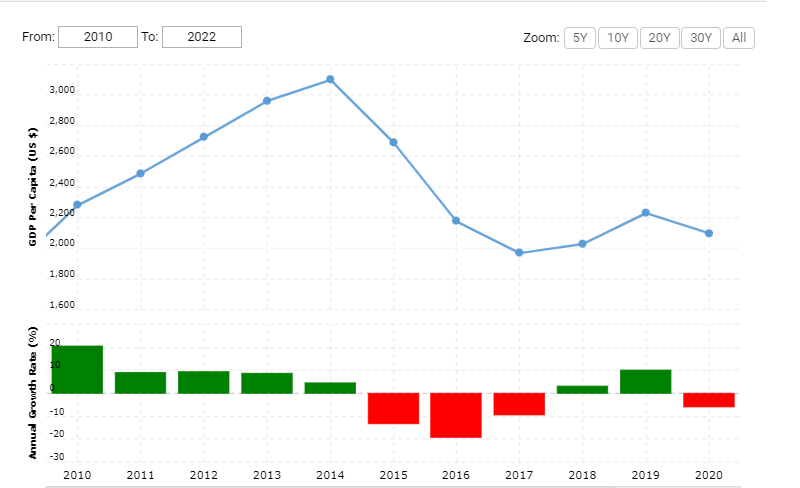
That said, this is one plot that shows that whatever the government APC leadership is doing is not working. Why? Check the slope of the Nigeria per capita income since 2000, they stopped the trajectory, when they came in.

Sure, you can accuse the World Bank of using “fake data” but the latest report was clear: “According to the Washington-based bank, the number of poor Nigerians is projected to hit 95.1 million in 2022. They further disclosed that the reduction of poverty in the country had stagnated since 2015, given Nigeria’s rapid population growth.”

Check all economic indicators: the inflection point was in 2015. Irrespective of your party affiliation, we need to ask why?

Comment on LinkedIn Feed

Comment 1: 100% correlation with oil prices with less abrupt changes.

My Response: That is not true. What Nigeria did not make from oil money, it covered via borrowing. So, do not equate this on availability of resources, but rather efficiency on the utilization of resources. In 2014, the national budget was N4. 962 trillion. In 2016, it was N6.08 trillion. Now, it is N17 trillion for 2022.

Even when you compensate for the exchange rate, Nigeria since 2015 has spent most money per year. So, do not rely on oil price since what was lost in oil revenue was borrowed.

I have a more detailed plot on this, picking other indicators and extracting the secondary impacts; from all data, Nigeria has not been prudent on aligning resources to growth. It is not lack of funds, it is lack of execution.

Comment 2: Average Annual crude oil price
2010……….79.47
2011……..111.63
2012………111.63
2013……….108.58
2014………..98.79( at this point we started asking questions, where did all the money saved from oil go?)
2015……….52.32 (Aug 2015, the collapse of oil price is already taking its toll on the Nigerian Economy. PDP made the budget for 2015)
2016……….43.67 (This Government created started to make moves through the budget to diversify the economy because oiloney was no longer viable)
2017……..53.27
2018………..71.34
2019……….64.3
2020………41.93 (covid)
2021……….70.68
2022……..91.82*

My Response: Plot the annual borrowing and at the end, data will tell you that Nigeria was spending more because despite not getting more oil revenue, it borrowed more. Naira is naira whether from oil or debt. The issue is this: what did you do with it?

Comment #3: The APC was actually meant to be opposition party, they were great there, it was never meant to be a ruling party, so when the lot mistakenly fell on them in 2015, they became confused, and it has been a struggle ever since.

On the other hand, the PDP which was never built as opposition party has found itself in unknown territory, and they have lost their way ever since; whatever they tried out as opposition party never worked, because they were not trained in the art.

It takes something extraordinary to be consistently unfortunate, that is exactly where both the APC and PDP have found themselves, albeit for diverging reasons.

Both our problems and solutions are heaped in one basket, and that makes it very difficult to make the right pick whenever we dip our hands inside that basket…

Number Of Poor Nigerians Will Rise To 95.1 Million In 2022 – World Bank

0

Recently, the world bank disclosed that more Nigerians will fall below the poverty line in the year 2022. According to the Washington-based bank, the number of poor Nigerians is projected to hit 95.1 million in 2022. They further disclosed that the reduction of poverty in the country had stagnated since 2015, given Nigeria’s rapid population growth.

According to a report, it was revealed that the covid-19 pandemic that ravaged nearly the whole world, pushed over 5 million more Nigerians into poverty in 2022. The covid-19 crisis skyrocketed the poverty rate in Nigeria, pushing millions of them into extreme poverty, with the GDP growth being negative in all sectors in the year 2022. Those who were slightly above the poverty line before the covid-19 pandemic, saw a lot of them fall into poverty as many more are still estimated to fall.

Had the covid-19 crisis not have occurred the poverty headcount rate would have remained unchanged with the number of poor people set to rise from 85.2 million in 2020 to 90.0 million in 2022, partly due to the population growth. What this implies is that the covid-19 pandemic drove additional millions of Nigerians into poverty. I once tweeted on the Twitter platform that with the way things are going in the country, with millions of people falling into poverty, there might likely not be a middle class in the country anymore. It might unfortunately be a case of, either you are rich or poor.

It is disheartening that a nation like Nigeria that God has blessed with abundant natural resources which are meant to make the country a place of Eldorado and envy to many nations has a large percentage of its citizens living in poverty. This shows that the elected political leaders have been woeful in their performances as they merely mount power for selfish interest, thereby impoverishing the lives of the people. As a result of extreme corruption, even the poverty reduction programs suffer from no funding and have failed to give the needed remedy to this country. The youths in the country are faced with massive unemployment which the President one time described as “lazy youths”. Such a statement is flawed because the same government refused to provide them with adequate jobs.

Due to being idle, so many of them have subscribed to all sorts of vices in society. Yet the irony of everything going on in the country is that there are abundant natural resources, emerging and industrious citizens, a diversified economy which is indeed needed to move a developing country forward. Yet the leaders fail to utilize these resources in improving the lives of the people. Due to the hardship faced in the country, some households have adopted dangerous coping strategies which include; reducing education, scaling back food consumption, etc, which all of these could have negative long-run consequences for their human capital.

If indeed the government is hell-bent on curbing the poverty rate in the country, their efforts will be felt and visible. But rather, they treat the issue with levity as long as they continue to take home huge sums of money as salaries and allowances. Much needs to be done to help lift millions of Nigerians out of poverty because it is often said that “a hungry man is an angry man”. There are ways which the government could go about it, such as;

  • Boosting the health and education sector in the country
  • Expanding social projection
  • Establishment of skill acquisition Centers
  • Provision of jobs
  • Reform of the Agricultural sector
  • Reforming expensive subsidies (including fuel subsidies)

All these above-mentioned and many more if well implemented, will ensure the reduction of poverty in the country. Achieving all these is not rocket science, with clear-cut strategies, they will be effectively implemented.