Presently, any sane individual or entity that truly means well for Nigeria ought to be concerned with the required remedy for the country’s myriad of economic challenges.
In any circumstance, while searching for the most viable way of putting a holistic end to any menace, it’s imperative to first ascertain the origin of the plight. In view of this, there’s a compelling need to look inwards towards unraveling the genesis of this apparently poignant state.
In some quarters, people are of the view that the predicaments are attributable to the 16-year ‘misrule’ of the People’s Democratic Party (PDP). Whilst many persons are preoccupied with a belief that the plights are attributed to so many promises made by the current ruling party, the All Progressives Congress (APC).
In other quarters, most individuals are of the notion that most of the ongoing crises were occasioned by Nigeria’s unending sole dependence on the oil sector. Among all, some schools of thought are strongly of the opinion that the origin of the state of poignancy is particularly traceable to the presumed high level of docility that marred the Goodluck Jonathan-led leadership.
Notwithstanding, there are two major factors responsible for the tantrums and brouhahas currently ravaging all facets of Nigeria’s socio-economic and political space. First, those who are negatively affected by the ongoing anti-graft war or who have perceived a ‘witch-hunt’, as the case may be, had vowed to make the country ungovernable.
The second factor is skepticism on the part of the governed. Most Nigerians had been and are still skeptical over the established notion that President Muhammadu Buhari was the awaited Messiah; they are still in doubt over the sincerity surrounding the ongoing anti-corruption war; the electorate are doubting the ability of the present administration to lead the country to the anticipated promised-land.
It’s invariably the prerogative of everyone to nurture any opinion. But for the interest of Nigeria who is already crying foul, we are not meant to be concerned or bothered over people’s personal opinions, rather how to salvage them from this untold hardship irrespective of whose ox is gored. Thus at this juncture, the most consequential and rational question becomes, what’s the panacea?
For the present administration to be thoroughly described and recognized as a responsible and responsive government, it must be ready to absorb constructive criticism, which remains an inevitable veritable tool in nation-building. It’s expected to spread its hands open for any form of criticism that is aimed at addressing any anomaly or ill.
In the same vein, the leadership must at all cost be willing to adhere to the principles guiding the rule of law. If anyone detained by the Economic and Financial Crimes Commission (EFCC) or the Department of the State’s Service (DSS), or other related agencies, has reached or tendered all the required conditions to be bailed, he should be released without much ado prior to when next he would be needed for further scrutiny or interrogation.
It’s only the military that does not understand the language of bail. To restrict the person’s movement afterwards, they ought to endeavour to seize his/her International Passport coupled with other traveling documents.
Similarly, anyone who is still in detention that pleads to be allowed to see his doctor abroad or claims to be passing through a severe medical condition, should be allowed to travel out, but in custody of a reliable security team. Better still his doctor should be invited to attend to him in the cell.
It’s noteworthy that the person’s health condition is very crucial in such a situation; a detainee must be medically sound to enable them pass through any stress during arraignment. In other words, one must be alive to attend to any query.
More so, the government ought to be prepared to charge accused persons to court without much ado. Constitutionally, it’s only the judiciary that has the immunity to tender justice. Alleged looters or corrupt individuals cum organizations shouldn’t just return stolen monies and be allowed to get away scot-free. If such practice is being upheld, subsequently public office holders would attempt to steal funds in their custodies since they would only be asked to return them if caught in the process.
In the same vein, the judicial custodians or members of the bench must endeavour to give speedy hearing to any prosecution with a view to salvaging the electorate from the bondage of unending suspense invariably witnessed during court proceedings.
Regarding the renewed Biafra agitation, the government is enjoined to handle the matter with optimum diplomacy. First, it ought to endeavour to unravel what actually prompted the reemergence of a protest believed to have faded off long ago. It ought to equally be noted that the aggrieved group has a constitutional right to ask for freedom if it felt marginalized, hence the need to grant its members a fair hearing. Thus, the treasonable felony established against the leader of the Indigenous People of Biafra (IPOB), Mr. Nnamdi Kanu should be reviewed in earnest for the interest of Nigeria at large.
It’s worth noting that the budget remains the bedrock of any nation’s quest for development. Taking into cognizance that currently, none of Nigeria’s fiscal budget could be aptly financed without indulging in borrowing, it’s obviously highly time the government thought outside the box. To ensure a feasible budget, the government must not compromise every effort targeted towards diversification of the country’s economy as it has unabated been sung in various quarters and fora by well-meaning analysts and social commentators.
Against this backdrop, I enjoin the government to take sectors such as education, health, power, science and technology, tourism, agriculture as well as solid minerals, as priorities. These areas that have hitherto been maltreated and relegated need to be strengthened and resuscitated headlong.
Taxing the poor masses by outrageously hiking their electricity tariffs as well as imposing stamp-duty charges on their transactions isn’t the panacea. Honestly, if the needful is done or taken care of as expected, there won’t be any need to sub-charge ordinary citizens; also, the ongoing continuous decline of the crude-oil value would be seen as a blessing in disguise.
The education arena requires a drastic upgrade or total overhaul in order to encourage entrepreneurship among our young ones. Isn’t it ridiculous that among the best one thousand universities in the world, no Nigerian university is included? Yet, on a daily basis, millions of naira are being transported to foreign countries by most Nigerian parents or guardians, who are mostly serving/past government officials, to cater for their wards’ tuition fees.
The health sector too, cannot be neglected because billions of naira are equally invariably sent to foreign nations by the rich, for payment of medical treatments at the expense of our foreign reserve.
Nigeria is tremendously blessed with enormous cultural heritage, thus it’s time she harnessed the viable and lucrative ones for the sake of tourism. Similarly, it’s so pathetic that the farmers are still using farming implements used by their forefathers.
The governors, rather than depending solely on the federal allocation, ought to be mandated to follow suit as regards diversification of the Internally Generated Revenues (IGRs) in their respective states, to enable them not to see payment of the current national minimum wage as a far-fetched consignment as it’s presently witnessed.
Inter alia, the leaders are expected to note that Nigeria requires meritocracy in a bid to actualize her anticipated change or economic turnaround. People should be considered important and relevant based on their abilities and competence rather than their wealth, social statuses or political affiliations.
The electorate on their part must desist from a cantankerous lifestyle. They can’t continue sitting on the fence and expect miracles to happen.
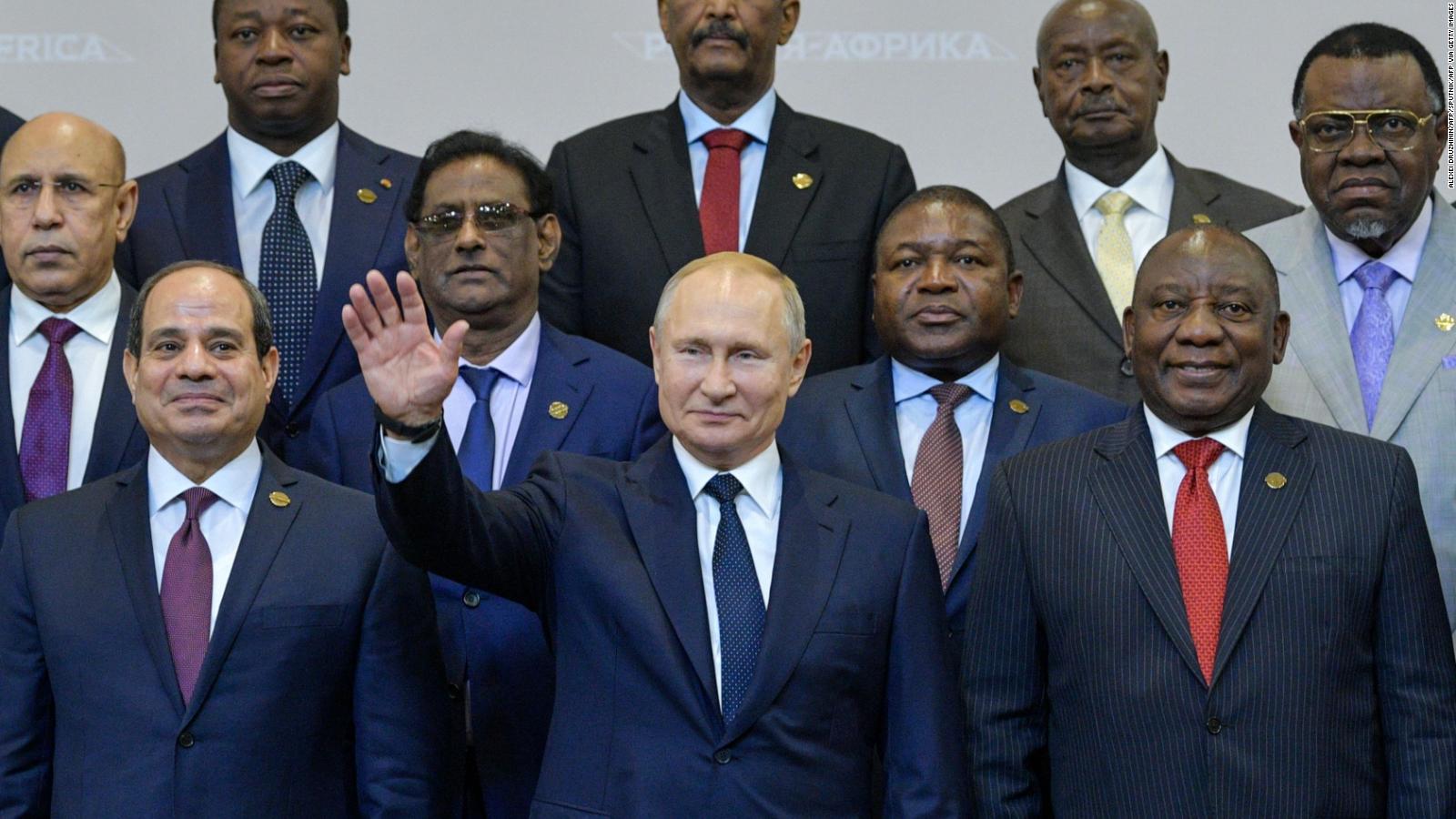
Amid the ongoing Russian-Ukraine war, South Africa President Cyril Ramaphosa recently thanked Russian President Vladimir Putin following a phone call between the two where the South African president sought to gain an understanding of the situation unfolding between Russia and Ukraine. Ramaphosa disclosed that his country was asked to mediate in the Russia-Ukraine crisis, but he refused to disclose who made the request.
Cyril Ramphosa via a tweet, had this to say “Thanking his excellency, Vladimir Putin for taking my call today, so I could gain an understanding of the situation that was unfolding between Russia and Ukraine. I outlined our position on the conflict that has unfolded as well as our belief that the conflict should be resolved through mediation and negotiation between the parties and if need be, with the help of agencies that can help bring a solution to the conflict. President Putin appreciated our balanced approach. We believe this position enables both parties to subject the conflict to mediation and negotiation. Based on our relations with the Russian Federation and a member of BRICS, South Africa has been approached to play a mediation role”.
Although Ramaphosa disclosed that his call to Putin was to mediate and gain an understanding of the situation, as well broker peace. Unfortunately, his actions didn’t sit too well with many, as he received backlash even from his countrymen who accused him of being Pro-Russian and taking the side of the oppressor. Some stated that if he wanted to mediate between Russia and Ukraine, he wouldn’t have called only Putin, but also Zelensky. Cyril Ramaphosa had earlier disclosed that South Africa has remained neutral in the Russia-Ukraine war of which they were among the 35 countries that voted to abstain during the recent UN resolution that saw the global body condemn the Russian Invasion of Ukraine.
People have however suggested that Ramaphosa has chosen the side of the oppressor which is Russia, knowing full well that Putin is at fault, yet he refused to condemn his actions. If we look at this issue with a holistic approach, one will be tempted to say that Ramaphosa might have placed a call to Putin to protect his country’s relationship with Russia. It is a known fact that Russia and South Africa have both had a cordial bilateral relationship that stems from the Soviet Union era when they trained the anti-apartheid activists during the cold war. Many have said that if Ramaphosa was playing the role of a mediator, the first thing he would have done was to tell Putin to stop the atrocities he is committing against Ukraine, and to immediately call for a ceasefire.
On the other hand, I feel people should cut Ramaphosa some slack as he earlier hinted that based on South Africa’s position as a member of BRICS, they were approached to play a mediation role. This move might not necessarily have been initiated by him. Asides from the fact that Russia and South Africa have a very strong relationship, one wouldn’t expect Ramaphosa to condemn Russia’s act immediately, to avoid putting their relationship with Russia in jeopardy. South Africans have however warned that Ramaphosa’s love for Europe must be monitored lest he gets them involved in something messy.
Some have opined that Africa must adopt a strict policy of non-alignment in the light of the Russian-Ukraine war, and they must not take sides but rather condemn both sides if need be. They disclosed that there should be a call for peaceful co-existence. Some South African politicians have made it clear that the country needs to play its part to ensure President Putin is brought to the negotiating table, as his violation of Ukrainian territory is a direct infringement of international law and should not be allowed to stand.
The vice president of Nigeria, Professor Yemi Osinbajo recently described the Igbo apprenticeship model otherwise known as ‘Igba-boi’ as a good way of building wealth among people. He disclosed this while speaking virtually from Abuja to participants of a national summit in Awka, who convened to understudy the model, which is said to have produced several millionaires in Nigeria, especially in the Eastern part.
Speaking on the model of Igbo Apprenticeship System which is popularly known as ‘Igba-boi’ in Igbo Language, Osinbajo harped on the need to encourage the scheme to ensure continuation. In his words, “The Igbo Apprenticeship Scheme ‘Igba-boi’ has become the most popular indigenous Nigerian economic institution, globally recognized as the world’s largest business incubator. The scheme has the full potential to do for the Nigerian economy what similar apprenticeship schemes have done in many parts of the world, especially in Germany and India. I commend the organizers of the event, and I am hopeful that the summit will improve the growth and possibilities for the Igbo apprenticeship scheme”.
While speaking on the theme, ‘Repositioning the Igbo apprenticeship scheme for sustainable Economic Development’, the keynote speaker Dr. Obiora Okonkwo recommended that the scheme should be institutionalized. He attributed his success in life to the Igbo apprenticeship scheme which he said he engaged in during the early days of his life at Onitsha main market Anambra state.
It is a known fact that the Igbo apprenticeship System has been recognized as the largest business incubator in the world, as thousands of ventures are developed and established yearly through it. It is interesting to know that the Igbo Apprenticeship system, ‘Igba-boi’ is studied at Harvard Business School London, which was proposed by erudite Professor Ndubuisi Ekekwe. Taking it beyond Harvard Business School, Professor Ndubisi also runs Tekedia Institute, where he unveiled the first academic program on ‘Igba-boi’, the Igbo apprenticeship system.
Upon graduation, the institute awards an advanced diploma certificate in ‘Igba-boi’, the Igbo apprenticeship system to those who enrolled in the program. This is indeed a laudable initiative from Prof. Ndubisi as he deemed it fit to take the Igbo apprenticeship system beyond the shores of Africa, to make it globally recognized. It is not just enough for the government to acknowledge and encourage the scheme, they need to take a cue from this and institutionalize the Igbo apprenticeship System if they are hell-bent on building the economy of the country. It is time to walk the talk.
I see no reason why they should dilly-dally on implementing and improving the system when it is already studied abroad. It is displeasing to note that the Igbo apprenticeship system to date is still undocumented in the country. It is time to upgrade the system by documenting it for secondary and tertiary institutions, and also for the global business world. To properly ensure the improvement in the economy of the country, like the Israeli’s mandatory national military service, the government should consider making the Igbo Apprenticeship System mandatory for secondary and Tertiary institutions by including it in their curriculum.
It has often been said in the country that the Igbo apprenticeship system has produced more millionaires in Nigeria than the entire University system. The scheme has been pivotal in the reduction of poverty, especially in Igbo land by mass scaling opportunities for everyone, as it focuses on community and the distribution of wealth. Adopting the system by the government will greatly help in the circulation of wealth in the country thereby reducing poverty and unemployment. More successful entrepreneurs will be created through the system and their economic activities will aid development in the country, thereby boosting the economy.
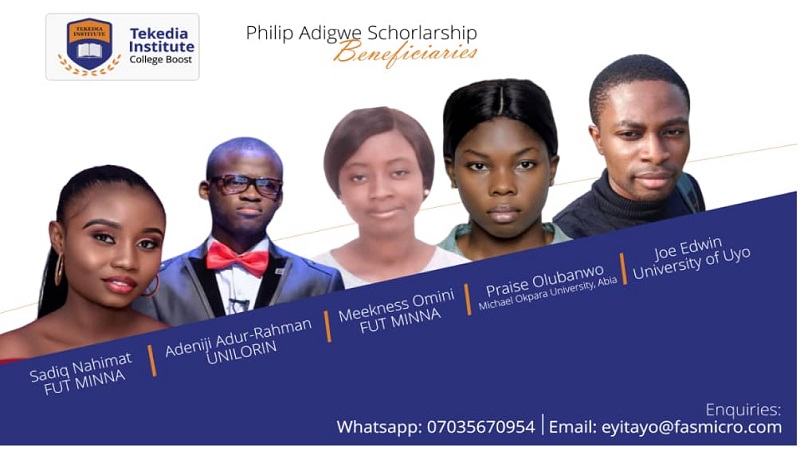
Join me to thank Philip Adigwe who provided full scholarships to enable five scholars to attend Tekedia Institute CollegeBoost, a mini-MBA designed for students. The generosity of citizens like Mr. Adigwe is the reason hundreds have access to our world-class business education where some of the finest business leaders teach. Thank you Philip Adigwe, and open doors in 2022 and beyond.
You want to sponsor a student or students? Reach out to our CollegeBoost Program Manager, Eyitayo Adeleke.
Tekedia CollegeBoost is an Advanced Diploma in Business Administration designed for students in colleges. It involves an 8-week program.
Things are tough in Nigeria. When things are tough in tight families a bread winner may not just be concerned for their ‘nuclear family’, there may be wider dependencies.
Such it is for me. Should income become intermittent, there are nieces and nephews who do not get to go to school. There is a need for me to be frugal as the certainty of income from the Nigerian Market is always in question.
In my recent excursion to begin a journey of competence development in Web 3 (aka Web 3.0) I started by registering a Web 3 class domain. The domain doesn’t actually formally become owned by the registrant though, until it is ‘minted’ to a blockchain, producing an ‘NFT’
It was with well intended sentiment attached to my circumstances, that somebody very close to Tekedia told me:
‘That NFT stuff is not for people who are occupied with food and clean water. Not sure it will be durable in Africa’
A Journey that explains my decision:
The first step is to understand what ‘NFT’ is. It stands for ‘Non Fungible Token’ which is a ‘certificate of ownership’ to something ‘Non Fungible’, meaning it doesn’t retain value when spilt up into smaller portions.
For instance, if you take 1000 Naira and exchange 500 for something, you will get 500 back, and the item. The 1000 Naira is said to be ‘Fungible’ because it can be partially exchanged while retaining value in the part not exchanged.
If you go to a market, and there is a big side of goat meat, you can buy 3 kgs of meat from it. But if you go into a furniture store, you see a table there, you cannot purchase a piece of the table. If the store owner cuts a piece off the table and sells you, the rest becomes worthless.
The table is an example of something ‘Non Fungible’ It would be possible to register your ownership of this table on a blockchain if you wanted to. The alphanumeric string of characters resulting from the process is called an NFT and represents your ownership.
On the blockchain however, minting something ‘physical’ can create risks for buyers unless title and right to sell is made prescriptively clear. There may be a competing representation of title that exists in the ‘physical’ world, and which the legal world, and judiciary better understand.
For example, if someone ‘minted’ five plots of land in Badagry and sold an NFT representing that land, then there is dispute when the purchaser tries to assume occupancy… the situation goes to court… one produces a C of O, the other takes out a phone and shows the NFT, we can guess how this will end!
So for now, at least, NFTs are best used to represent virtual assets, so there cannot be an alternative definitive proof of ownership. NFTs are very suited as a certificate of ownership in the Digital World.
It is important though to understand an NFT is just that, a certificate of ownership. It is not the actual item itself. So when NFTs change hands, it is the title, the certificate of ownership that is changing hands, but the VALUE is determined by the ITEM, not because NFT has been chosen as the certification medium.
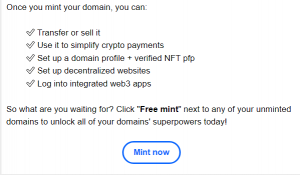
So, if you want a domain which is Web 3 (aka Web 3.0) it needs to be minted on a blockchain as an NFT.
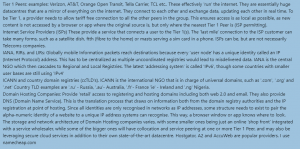
Web 2.0 Rapid Read : Web 2 or the internet as we currently know it, operates because certain tech businesses carry out certain tasks. Actors in Web 2.0 Architecture:
So, when a web3 domain is minted on a blockchain as an NFT, it is the equivalent process as to going to a domain housing/vendor, and registering a domain for web 2.0
WHAT IS VALUE REALLY?
The Teraverse – A virtual world of New Colonialism
Now I want to revisit the age of colonialism for a few paragraphs.. In the age of maritime intercontinental colonialism, four nations stood out… the English, the Spanish, the French and the Dutch.
Each one had its particular strengths (though I use this word in the most liberal of senses). The English strength was immigration. They had more people willing to leave on ships as free colonists accompanying soldiers and traders. The French had the best assimilation skills. They tended to form diffuse and smaller colonies with simple stockades (but more of them) rather than large imposing forts and fortresses, and this made it easier to co-exist with natives. The Spanish were the most brutal of all, more frequently conducting ethnic cleansing manoeuvres in order to secure vacant possession of lands in which to settle their civilians. And lastly, we come to the Dutch, whose strong point was their ability to bargain and trade.
Along with the dyes and spices the Dutch got from Asia, they also developed the ability to make multi-coloured glass beads, though there is some suggestion the skills originally came from Italians. These formed much of what they traded to native populations in the Americas and Africa.
They targeted precious metals and gems in trade, and history does not look kindly on it in retrospect, as a form of exploitation. But what they actually exploited was differences in the PERCEPTION of what value is, between native communities in far away lands, and domestic markets at home, along with whatever other colonial powers they were from time to time, at peace with.
Gold was never a useful metal, being too soft to hold any shape as any kind of a functional tool, and unable to hold a sharp blade for any practical period of time. Its functional value rose dramatically from the end of the second world war forward with breakthroughs in inventions needing super-conductors and electronics, though it didn’t really start showing full value until a PC market for the masses came in the 1990’s. This was far too late to influence trade and the perception of value in the colonial era.
Precious gems on the other hand have been formed under the pressure of extreme geo-events, but in terms of their fundamental composition – they are just carbon!
An Englishman who encountered Native Americans, saw them roll up a leaf, stick it between their lips, and set fire to the other end. An absurd action it would seem, but this became the global tobacco industry!
When we see that the United States Bullion Depository, often known as Fort Knox, was built in 1936 to house tons and tons of the shiny heavy metal at a massive cost to that country’s taxpayer, to build, and to operate, at a time when it had no particular great application…
It’s rational to question whose value compass was sensible, Africans and Native Americans, or Europeans?
Stretching this questioning a little further.. If the royal court of Holland at the time had said:
‘Enough of all our people wasting valuable industrious time making glass beads, for our galleons to be travelling to these exotic, faraway places, and bringing back this pointless yellow shiny metal and these sparkling lumps of carbon.. We should be focusing on leather-goods equipment for our horse saddles, timber work for our coaches and thick clothing for our cold winters… instead of fickle indulgences that we craft into a band on our finger, or an attachment we add to a hole we pierce in our ear or nose!
This is just ‘Capital Flight’ year 1600 style! It is now banned and outlawed!
No they didn’t … Why? It didn’t matter that the value compass was subjective – trade was good; people were happy!
Does this sound like anything familiar in our modern era? What about the FGN/CBN ban on crypto-currency?
Yes, for a short instant in time, Nigerian speculators were riding the crest of a wave in a global space and leading against any trading competition. They commanded the data space where crypto exchanges live as those Dutch galleons did more than four hundred years ago, and they were winning in the global trade exchanges against competitors, including North Americans and Europeans.
Fintech and DeFi expertise in Nigeria shot up almost overnight, followed by some amazing indigenous start-ups.
Then a crypto-ban killed the ‘party’. The evidence is that some trading is still continuing covertly, and several Nigerian newtechs have moved abroad, for example, Patricia to Estonia, but the ‘first strike’ advantage Nigeria had is no more.
When we think of what could have been..
This is the kind of wealth and influence that made Jan De Witt one of US founding fathers, Cornelius Vanderbilt one of US earliest business oligarchs, and Theodore Roosevelt a US President!
So… to some extent the crypto boat has sailed and the Nigerian one is stuck at the port…
Can Web 3 be the next thing for Nigeria, or indeed, Africa?
Honestly, I can’t say with a full degree of certainty.
ALTERNATIVES TO ICANN/ccTLD DOMAINS:
Alternatives to the ICANN/ccTLD regime for websites is not new. About 20 years ago, I had a ‘trial’ site with New.net. New.net was an alternative DNS root system which was enabled via NewDotNet, a DNS hijacker application. The top-level domains New.net provided included: .agent, .arts, .auction, .chat, .church, .club, .family, .free, .game, .golf, .inc, .law, .llc, .llp, .love, .ltd, .med, .mp3, .school, .scifi, .shop, .soc, .sport, .tech, and .video
The problem was, to view the site, anybody else had to also download the DNS hijacker app as a browser plug-in. Having to liaise with potential viewers on an individual basis to secure a site visit was a real disadvantage. It also meant my site wouldn’t show up in any search engine results. New.net promised browser support ‘in the near future’ but it didn’t happen during the free trial period, so I left it go. Later ICANN approved new TLD’s… .travel, .kids, and .xxx , which New.net had added to their portfolio a few years earlier. The resulting DNS resolution conflicts lost many customers and New.net ceased operations in 2012.
THE CURRENT BLOCKCHAIN DNS TLD MARKETPLACE
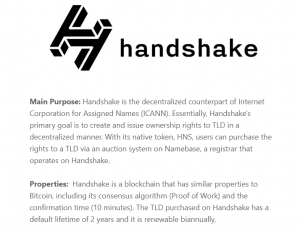
Handshake Domains
The Handshake coin blockchain was founded by Joseph Poon and Andrew Lee. It currently has a live market cap of $87,072,322 USD. It has a circulating supply of 469,742,516 HNS coins and a max. supply of 2,040,000,000 HNS coins. It is a PoW (Proof of Work) system.
There are a couple of reasons why I am not a fan of ‘Handshake Domains’. The main reason is that it seems reminiscent of the old new.net with a more modern ‘blockchain’ twist. But there is no point of having a product or service aligned with a newer technology unless it is delivering superior benefits.
One of the big things is this need to have some sort of browser extension or plugin to enable browser compatibility and access to Web 2.0 search engine support. This then just pushes the solution back to the dark ages of the demise of new.net
A smaller problem is the almost limitless range of ‘Handshake TLDs’ that can potentially start mushrooming.
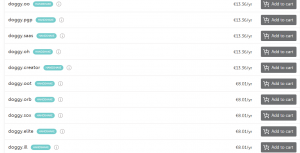
A search with one provider (namecheap.com) alone shows 10 different options with the word ‘doggy’ at the ‘second level domain’. There is no evidence this provider will stop at having 10 handshake TLD’s and there are multiple other providers. This cheapens the product in my eyes, and namecheap.com is only one handshake vendor.
101domain.com has eight different options with several starting at $31.49 annually, with the most expensive one, ‘.gin’ priced as starting at $335.99 PA! Doing the check with ‘doggy’ didn’t work out well. Though I tried to search on what was supposed to be the dedicated ‘handshake domain’ page, it spat out options that started with regular Web 2.0 ICANN and ‘ccTLDs’ first, which mostly had a button saying ‘inquire’ next to them. After scrolling through, and clicking the ‘see more recommendations’ about six times and reading over 100 options, and yet no handshake option, I gave up!
The value of Handshake domains is degraded further when it’s clear the domain is leased and not owned.
Being leased rather than owned means that if the domain isn’t renewed on time, it can be leased by someone else. A small bit of absentmindedness or being distracted with other issues at renewal time can cause a domain to be lost and make it very difficult to get back, so it is not just about the annual cost.
Currently, typical exposure to Web 2.0 for Handshake domains include Bob Wallet and LinkFrame, both of which are available for Chrome. For Firefox, an add-on called Resolvr is available.
The reality is that Web 2.0 reign in information extraction, and nobody selling Web 3.0 has made definitive statements about search engine integration.
https://www.youtube.com/watch?v=x-lSkXVzzBg
Trust Domains
Trust domains is a provider that offers second level domains off the .bnb, .cfx, .defi and .heco blockchain TLDs. It describes TokenPocket, BitKeep, HuobiWallet, ConfluxPortal, MoonSwap, DAppBirds, OpenSea and ConfluxDapp as its ‘ecosystem’.
I did the ‘doggy’ search first on the Brave browser and couldn’t get a response. I swapped over to try on Opera and Edge but got no response there either.
Tezos blockchain TLD (.tez)
Tezos have their own crypto (XTZ) and have their own blockchain. They also have a blockchain TLD (.tez). I became perplexed at one point in my research as I also found ‘Tigeriz Foundation’ have a token named ‘TEZ TOKEN’. The Tez Token is at ‘Pre-sale 2’ stage and won’t be launched until next month. $3.06
Tezos claim Temple, AirGap, Kukai, Spire, Legend, Galleon, Taquito, Beacon, and Baking Bad (along with some of their stable entities) as their ecosystem.
The pricing of domains depends on the length: five-letter domains and longer cost 1 , four-letter domains cost 25 and three-letter domains cost 100 XTZ per year. There is a ‘secondary market’ in domains.
The search for ‘doggy’ revealed doggy.tez to be taken but a Tezos marketplace peer was offering ‘doggydao.tez’ for 10k XTZ. With XTZ trading at $3.06 thats $30600!, though it’s probably unfair to judge the TLD merit itself on marketplace behaviour. As a 5+ letter domain, this would be 1 XTZ to renew, so a little over $3. XTZ reached a high of $12.19 (October 2021), so if the fortunes of the coin shot up again, renewal of a 3 letter domain, (like job.tez), could cost over $1000 a year!. This is not competitive unless someone is in the very rare position to need to see all other value through an XTZ lens!
The site has a strong focus on the needs of developers, but that is probably because Tezos is built in an obscure language (Michelson). The most common language for smart contracts is Solidity, with Rust, Vyper and Yul also in the mix. Crypto pundits have already cited the potential challenges of attracting developers as an obstacle to the use of the blockchain scaling and the XTZ price recovering.
Since .tez is the sole TLD on offer, it’s clear offering blockchain TLDs isn’t Tezos focus. The legacy of Verisign birthing .com, and .net with .org quickly following, created precedent expectations that a TLD held context. ‘.tez’ isn’t indicative of anything. A marketing platform with one TLD means single dictionary words and obvious ‘urban’ combos will exhaust really quickly. Interoperability with web 2.0 is a huge concern with no reference made to browser support at all. The uncertainty of renewal costs expressed in FIAT currency leaves the.tez blockchain TLD prospect as much a concern as a solution.
Unstoppable Domains
Unstoppable have in excess of 130 different wallets, exchanges, and other blockchain entities in their ecosystem.
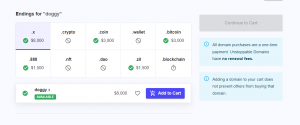
They currently have 9 different TLD’s – .crypto, .coin ,.888, .wallet, .bitcoin, .x, .nft, .dao,and .zil, with .blockchain (pending). The .x domain has the highest starting price at $100, with .coin, .bitcoin and .crypto at $40 and the rest at $20. Single dictionary names attract ‘premium’ prices. Large dictionary words can cost several thousand dollars to register, while four letter words cost between $50k and $100k USD.
A search with ‘doggy’ had several options already taken, while five of them remained available at prices between USD $1500 and $8000. The search system was quite intuitive and offered a wide range of options combining another dictionary word with ‘doggy’, all available at the standard prices. For instance, ‘partydoggy’ is available on all of the TLD’s at their respective entry level prices $20-100.
There are different minting options for the domains once purchased. If they are minted to the Etherium chain then they will need to be renewed annually due to gas fees. However, minting to the Polygon blockchain is free forever. The exception is domains on the .zil TLD which are solely minted to the Zilliqa blockchain.
The support information is the best I’ve seen from what I have found, and Unstoppable Domains have also published a lot of content to youtube.
Browser-wise, UD have native support on Brave and Opera, while at the moment Edge, Firefox and Chrome require plugins, though UD are actively working with the browsers.
ENS (Etherium Name Service)
ENS is the oldest blockchain DNS service. It provides domains on the TLDSs – ‘.eth’ and ‘.test’. The model is quite similar to that of the Tezos (.tez) mentioned earlier, which isn’t surprising since the core activities of both is the provision of a cryptocurrency, and blockchain domains are to some extent a sideshow.
ENS is likely to be more popular than Tezos simply because Etherium is the second most well known crypto after Bitcoin, and the ticker for trading Etherium is ETH, the same as the domain TLD. Tezos crypto ticker on the other hand is XTZ while the domain TLD is .tez
There is a sort of community culture built around Etherium ownership, and while it isn’t as big as the Bitcoin community, it’s much bigger than the community around other cryptos. It is likely this community will be drawn to owning a domain with .eth and that can build capacity for ENS.
Again, just like Tezos, ENS charges annually depending on the string length of the 2nd level domain – $5/year for .ETH names that are 5 characters or longer, $160/year for 4 characters, and $640/year for 3 characters (1–2 character .ETH names are not available for registration).
Also ENS requires payment in the native currency ETH as Tezos does with XTZ.
Unusually, ENS offers the option to import Web 2.0 (ICANN) domains into the ENS system to be minted on the Etherium blockchain.
ENS doesn’t charge protocol fees for imported Web 2.0 domains – ‘This is because the fees for .ETH names are an anti-squatting mechanism, and DNS names imported to ENS already have a fee on the DNS side. As a non-profit public good, the ENS protocol is optimized for usability, not revenue generation.’ – brantly.eth Dir. of Operations at ENS
However, this doesn’t make a lot of sense to me, as once the Web2.0 domain has been minted to ENS, it functions with the same interoperability challenges and lack of native website management/authoring tools, widgets and plugins that are currently common to Web 3.0 domains.
If the owner still has to pay annual domain management fees to the hosting company in the Web 2.0 ‘world’ – what’s the point?
Though if the ENS newbie already has a Web 2.0 domain that they don’t have an existing use for, and all they need is a really memorable address to replace their long string of characters as a wallet identity, then a four or less character 2nd level Web 2.0 domain would cost less annually than a .eth
It’s unlikely that many would have such available and unused in the world of ICANN.
Being on the Etherium Blockchain, ENS has a similar array of blockchain tools and resources in their ecosystem as Unstoppable.
ENS has a huge technical library which gives deep explanations, though for novices that only understand WYSIWYG technology in the Web 2.0 world, it can be a bit overwhelming.
The ‘doggy’ search simply said it was taken, and it didn’t suggest alternatives.
WEB 3.0 AND BLOCKCHAIN DNS FINDINGS
There are a couple of myths surrounding Web 3.0.
There was a recent post in which one Corrales Cachola claimed ‘Web 2.0 is on life support’. Now if you are a genuine advocate of Web 3.0, you don’t say things like this. And when sub-communities get together on platforms like LinkedIn (so it’s probably even worse on Twitter!), and say quirky stuff to the converted, it isn’t winning friends at scale, which is necessary to get the sort of ICT systems revolution they are looking for.
And all the while, the individual is turning up every day, putting in huge effort on platforms that operate on what? …. err… Web 2.0!
It’s like having a pressure group arguing we should all go back to the age of sailing ships, but you hold the event in a convention centre based in a major global airport, and you arrive by private jet!
One of the things we have known historically about the ICT space is that success has more to do with human behaviour than technological advancement. When people invest time, effort and money into both livelihood and lifestyle, they are adverse to replacing it with something else unless its replacement is not only technically superior, but also protects their existing material, intellectual and emotional investments.
This is why hardware and software developments have tried hard to offer ‘backward compatibility’. Change is organic. People gradually let go of what is legacy themselves as they explore new ways, and they grow with them. Legacy support is only withdrawn from technologies well after the user-base has crashed below the commercial critical mass needed to justify its continued provision.
Web 3.0 isn’t an ‘evolution’ of web 2.0 in the traditional sense of what we understand evolution to be. It has no ‘backward compatiblity’ with Web 2.0. Beyond each having a registry identification process (Web 3 uses blockchain, Web 2 uses ICANN, ccTLD’s etc), Web 3 not only doesn’t have a readily available metaverse community to scale the exposure of owner content attached to Web 3 domains (such as browsers and search engines), but it is also not immediately backward compatible with the various providers in the Web 2 space the way Web 2 was when it embarked on its journey from Web 1.0
There is therefore this huge usability issue with Web 3.0
One other issue is this notion of democratizing and freedom. There are inaccurate statements about big companies like Google, Amazon, Meta, Microsoft etc. dominating Web 2.0. The stack and architecture players in the Web 2.0 system are already covered above in the Web 2.0 ‘Rapid Read’ section. These companies are just users. Big and powerful users, but users all the same.
If anything, these companies are challenging the stack and architecture players. There are many things happening already challenging the status quo before blockchain domains. DNS bypass, Direct IP Addressing, and via API node to server access are growing in prevalence as 61% of all WAN (Wide Area Network) traffic now either originates or terminates (or both) at a smartphone. Google, Meta, Microsoft and Amazon, for example, own a wide range of portals, platforms, social media and OTT environments while at the same time owning services such as AWS, Azure, Google Cloud, etc. They are all building out on their architecture, constantly building new datacenters and laying new submarine cable routes. At physical layer, it won’t be long before they have completely self-sufficient DCNs (Data Centre Networks).
In 2018, former Google CEO, Eric Schmidt predicted the internet will split in two by2028 , but with Ukraine in the current conflict asking ICANN to shut down Russia, this dynamic may carry pace. Moxie Marlinspike, creator of signal earlier this year, claimed Web3 is not as decentralized as it appears to be. He cited consolidation in the cryptocurrency field – Blockchain application programming interfaces are mainly controlled by Alchemy and Infura, while cryptocurrency exchange traffic is primarily dominated by Binance, Coinbase, MetaMask and Opensea.
Much of the Web 3.0 space is being led by businesses in the U.S. It has shown itself to be vulnerable to influence from U.S. foreign policy. Users have voiced their discontent with inability to access blockchain assets. Until a collector in Syria, can buy an NFT from one in North Korea, and sell it on to one in Iran, using an exchange incorporated in U.S. (irrespective of ‘Uncle Sam’ policy in the moment), then we don’t have a fully decentralized blockchainverse and by inference, Web 3.0
How can there be true decentralization if the sovereign authority at an exchange location can successfully prevent it from carrying transactions representing other locations it doesn’t like?
The ‘democratization’ notion of Web 3.0 as an angelic saviour overtaking the centralized demon, Web 2.0 is clearly blurred.
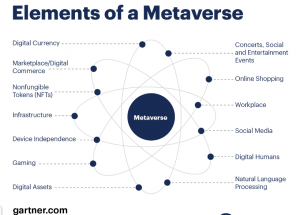
On the other hand, it is probable that on the long term, the Gartner model will only be one metaverse and there will be many different metaverses operating on interaction of a collective of different elements, but also interacting with each other in what is to be known as a ‘TERAVERSE’ – a sort of a virtual cosmos, where one metaverse is merely a virtual solar system.
‘Most companies hosting websites want users to have an easy experience, and most people want to type in google.com and have a functional webpage. Whatever does that the simplest and fastest is ideal, and overall, using a complicated decentralized service is a very big switch for something that most regular everyday users couldn’t care less about.’ -Cloudsavy-IT
We are headed into a vast unknown space with value to unlock and a Blockchain Domain is a key. Whose key gets used will depend a lot on how fast providers accelerate ease of use, and interoperability with Web 2.0
There will be so many metaverses in the teraverse (virtual cosmos) they will be tiny specks. Some may be as the Gartner Model, some maybe not!
Authors Choice: Unstoppable Domains
While UD is a strong advocate for decentralization, its owners are also pragmatic on the issue of interoperability between Web 3.0 and 2.0 Out of all the options available, they stand out as being the most active in closing these gaps.
That doesn’t mean UD is where it wants to be with this, but the other contenders are playing catch up. UD accepts payments in FIAT, unlike the native TLD’s of blockchains. It’s core product is these decentralized TLD’s and unlike the ‘Handshake’ providers it doesn’t have Web 2.0 products as its bread and butter.
It puts a lot of effort into publicity, creating content and providing public information. It has far more content on the topic of Blockchain Domains on youtube than anybody else. It rates highly in reports by pundits. It’s premium domains are a bit expensive, but I see that as ok, because this kind of new technology provider needs to be able to secure revenue to fund service improvements.
Its Layer 2, often referred to as “scaling solutions” is what makes it possible to mint on Polygon, it does not go through the Etherium miners, and therefore does not incur a ‘gas fee’. This is what makes the domains a one off fee, with no renewal fees ever.
It’s got the widest ecosystem in terms of wallets, exchange compatibility and dApps.
The Unstoppable registration was made as simple as it could be, and the website describes things quite simply.
Evidence of Minting
I minted my domain (ehneftee.nft) within a few minutes in Polygon, collected it in a Metamask wallet and further ported it to a wallet on the Brave browser. I contacted the live help chat a few times to clarify some things. I’ve been in DM with three operators, Charlie, Andrew and Andy, all of which were professional and efficient and answered me in under a minute.
Live support, especially in an emerging technology space is a huge plus.
Honourable Mention: ENS (Etherium Name Service)
ENS domains are native to the Etherium blockchain and so it is a very secure and relatively mature option. It has an ecosystem comparable with UD.
Documentation and process doesn’t appear as straightforward as UD. Having only two TLD’s , choices of any remarkable domains seem to have evaporated fairly quickly.
Needing to purchase ETH first and then use the ETH to pay for domains is a big downside.
The option to mint Web 2.0 domains and operate them as if they were an ENS domain is a unique and novel option, but it is hard to see it improving the value proposition.
It doesn’t appear to have live support. It has undertaken to provide ‘Layer 2’ technology at some point in the future but no date has been given. When that happens, annual ‘gas fees’ may disappear and if they work faster than UD at Web 2.0 interoperability moving forward, then ENS may give UD some competition.
At the moment, it is hard to see it attracting huge interest beyond Etherium coin (ETH) speculators, traders and fans.
PARTING BULLETS (NOT SILVER)
*Online comparison articles about Blockchain DNS/Domains can be misleading. Some mix ICANN hosting and registration providers with Web 3.0, some also compare different Blockchain related providers but not all of them provide Blockchain Domains. Exercise caution.
*All Blockchain DNS/Domains are a means of representing your identity inside a decentralized asset wallet. My domain ‘ehneftee.nft’ is much easier to remember than something that looks like
‘be70b8e637e2a3e46c000054a90e0d9e9d217483e13c55b531f5c4004dd41531bc1qwfgdjyy95aay2686fn74h6a’ This is the aspect of Web 3.0 domains that works right away.
*If you have worked with things like WordPress on a Web 2.0 site, understand this won’t work in Web 3.0, native browser support is a work in progress and Web 2.0 search engine integration for W3 domains is some way off.
*The W3 teraverse revolution will gather pace. It is a good idea to start learning. This is about up-skilling and being an early adopter of uncommon knowledge, not speculating and getting rich quick.
*Look for cheap ways to enter the W3 ecosystem. Make your learning mistakes with virtual assets of negligible value.
*Look for good features and signs from a provider – active with web 2.0 browser engagement; Layer 2 (mints to a blockchain that wont charge annual fees); easy set up process; concentrates on Web 3.0 domains as its sole or core business; a strong online presence in YouTube, social media, third party articles; accepts multiple payment options; live chat support
*DISCLAIMER – Article is not a formal endorsement of any provider and a valid opinion only at time of writing; understand cutting edge services spaces are rapidly evolving; Do your own research and never be influenced by just one source or opinion.
HAVING A FUTURE PROOF STRATEGY, MEANS HAVING AN INSATIABLE CURIOUSITY FOR WEB 3.0
Final word to my Tekedia friend is that this is an opportunity to invest in myself, taking another journey in accumulating uncommon knowledge and capabilities.
I think it is worth the twenty dollars !
Maybe Nigeria will travel with me.
Please visit johnmckeown.eu
All URLs accessed between 06-03 and 14-03 2022
Lead illustration photo: Tosin Balogun www.linkedin.com/in/brandwithtosin/