DD
MM
YYYY

PAGES

DD
MM
YYYY

spot_img

PAGES

Home Blog Page 5312

What are you building?

0

Here is the deal: this is one of the few periods in the African continent where the combinatorial powers of digital technologies are meeting innovators with capabilities to fix market frictions at scale. For all the technologies which have come, none has this massive low barrier of entry, enabling young people  to not just dream but live in reality.

In the 1990s, the new generation banks emerged and they did well. In the 2000s, voice telephony transformed Africa with better communication. In the 2010s, it was the age of the mobile internet. In this 2020s age, this is the application utility age where market frictions would be fixed and technologies will redesign the architectures of African economies. The fusion of software and cloud computing, piped via mobile internet will redesign a continent, across industrial sectors and market territories.

But you know what? We are still at infancy. This will be decades-long; anything you think that is big today is nothing. Begin to #build because abundance is in the future. Do not just talk about the problems, fix them – and capture your moments.

What are you building?

Join Tekedia Live on Saturday to discuss this and more.

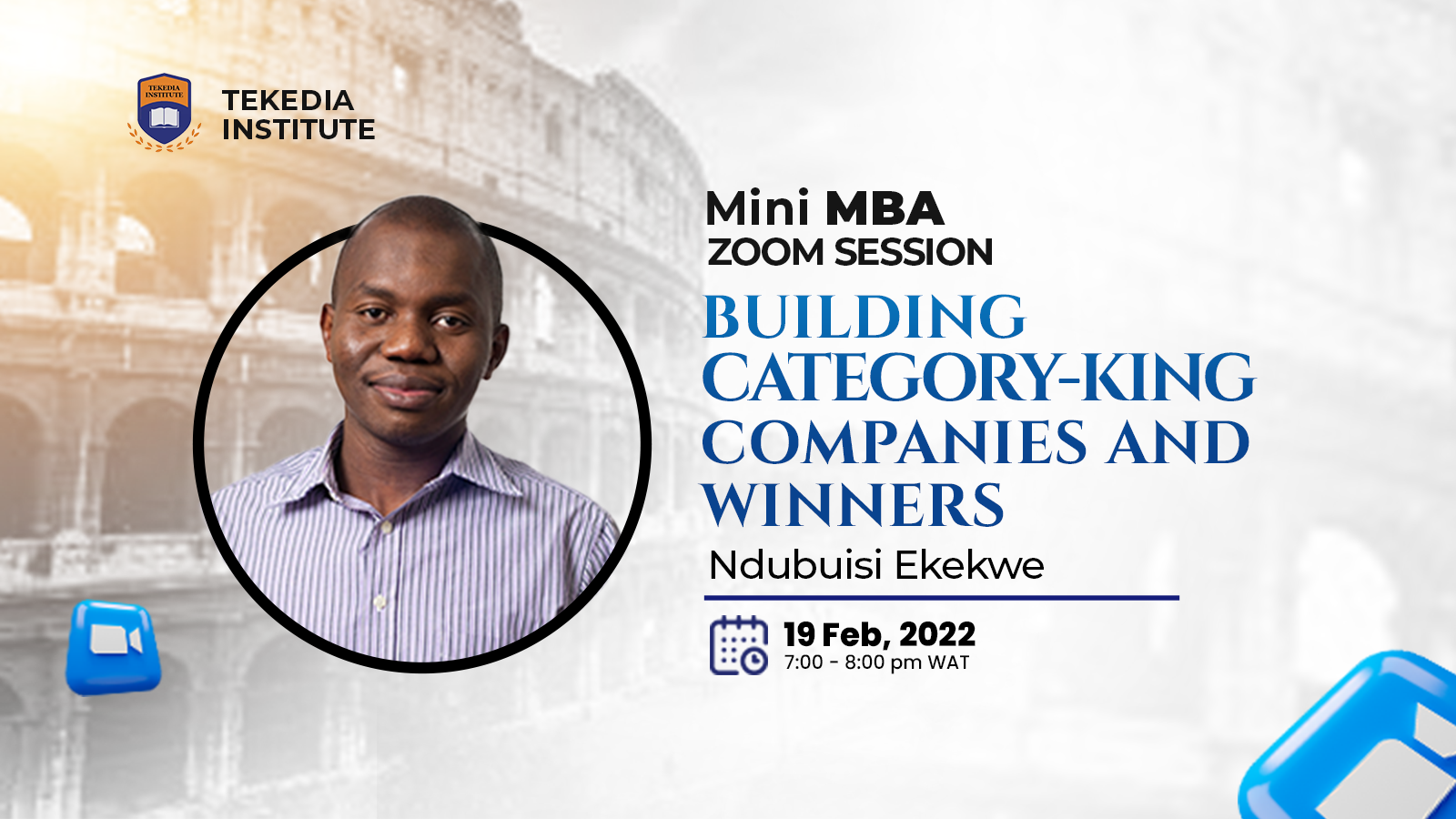
Today’s session on Design Thinking from an SAP business leader was super-amazing. On Saturday, I will continue the excursion into the mechanics of markets in another session, focusing on how to build category-king companies. Zoom link in the Board school.tekedia.com

Experience Vetifly – Arrive in Style, Move Different

0

We’ve opened the playbooks for all people, all companies, and all communities. We’re expanding in the continent and handling some of the most critical assets in banking, mining, agriculture and more. At Vetifly, we’re redesigning logistics and transportation by deploying new assets (helicopters, Boeing aircrafts, etc) to serve you,  your company and your community.

Visit Vetifly.com and ask our team on how to offer these services:

  • a. Intracity flights from VI to Ikeja airport and vice versa (10 minutes or less travel time)
  • b. Intercity flights to any destination in Nigeria
  • c. Private jet charters
  • d. Cargo airlifting logistics; both local and international

With clusters of companies operating at the last-mile, we deliver end-to-end services at scale. I also welcome all our bank partners.

Vetifly – air freight across Africa | helicopter services | More

Ndubuisi Ekekwe

Member of Board

Art+Com Vs Google Case: What every inventor should know about patent rights

19

In 1993, a set of German University students who doubled as artists and computer hackers led by Jachim Sauter and Juri Muller developed a 3D world mapping software program which they called “Terravision”. It was an offshoot of their tech and art  company;  ART+COM in Berlin as a “networked virtual and graphical representation of the earth in 3D graphics. Juri Muller was the Chief programmer of the software  and inventor of the algorithms for the software,  while Joachim Sauter focused on the designs and the art of the Terravison program and It was an incredible fusion of art and technology.

This software program blew the mind of the whole world in the early 90s as there’s no thing like it as at that time in the world of technology and internet. An example includes Zintego Google Docs Receipt Maker and many other software solutions.

The Terravison program  gave the young students the spotlight and fame they needed and it gave them the opportunities to get invited to science and technology exhibitions around the world to present their 3D masterpiece  program.

During the course of their  traveling for exhibitions, they visited Silicon Valley in California, the world renown home of tech and startups. In Silicon Valley, they met Brian McClendon; an American software engineer who worked as the chief engineer in Silicon graphics at that time. The German programmers quickly bonded with the American silicon graphics engineer and at the cause of their friendly discussions, Juri Muller, the Chief programmer of the Terravison program got carried away and divulged everything there is to know about the algorithms of the Terravison software program  to Brian McClendon.

Brain McClendon, being a smart programmer, picked up the information about the Terravison algorithms, went ahead and designed something very similar to Terravison in collaboration with Google, the program which they called “Google Earth”. Yes, the famous google earth you know of.

In 2014, ART+COM, the company for Terravison filed a lawsuit against Google, claiming its product called Google earth and other related software products made in 2001 infringed on the patent rights of their product Terravison which was invented in 1993 .

Two years later, the case was decided in favor of Google as the jury of the United States District Court for the District of Delaware said that after diligent  consideration of the case, they found that Google Earth did not in any way  infringe on the patent rights of Terravison. The German programmers lost the case to the tech giant, Google.


Intellectual property theft and “copycatting” are words that are quite familiar to the invention world. The tech and invention world, as exciting as it could be, is smeared with a lot of cases of intellectual property theft, patent right infringements, copying of inventions and passing off of inventions.

Counterparts are always stealing and copying algorithms for computer programs, softwares, inventions and ideas in the tech world.

…and this is why you need to get a patent right on every one of your inventions before you share the idea or disclose information on the invention to anybody.

To better understand patent law, you need to hire professionals who have studied law at university. To study law, you need to work very hard, so students often seek property law assignment help by EduBirdie. This does not prevent them from doing their job well in the future and can advise you on patent and property law so that cases similar to Terravison do not arise.

No matter how much you cry foul that your invention or algorithm was stolen by your competitor(s), it will be difficult for you to prove that the stolen invention or algorithm was actually yours unless you can show that you have a patent right to those inventions. So the way to protect your inventions and algorithms is to get patent rights on them:

A patent is a right granted to an inventor by the government that permits the inventor to exclude others from making, selling or using the invention for a period of time. It grants  the inventor the monopoly on the product for a specific number of years.

It should be highly noted that being the first person to invent the product doesn’t count; neither does it matter in law; what counts is who is the first person to apply for the patent of that product. This collaborates the legal principle that says “the first  in time takes priority in law”.

This is also the provision of S.2 (I) of  the Patent and Design Act, 1971 which reads:

Right to patent

(l) Subject to this section, the right to a patent in respect of an invention is vested in the statutory inventor, that is to say, the person who, whether or not he is the true inven- tor, is the first to file, or validly to claim a foreign priority for, a patent application in re- spect of the invention.

This section of the law is to the effect that a statutory inventor is the one that is recognized by law as the legal owner of the invention; whether or not he is the original inventor of the product is not the business of the law but inasmuch as he is the first to file for patent on the product, he is thereby deemed to be the statutory and rightful owner of the product.

Finally, inventors should take note that, you cannot protect or patent an idea, you can only protect or patent an expression of an idea; this means that mere ideas are not patentable, you can only get a patent right when that fabulous idea of yours have been expressed to become an original or a new invention or product.

Your Digital Impression Is Your First Impression

0
A woman looks at a NFT by Mad Dog Jones titled "SHIFT//" during a media preview on June 4, 2021, at Sotheby's for the Natively Digital: A Curated NFT Sale Online Auction to take place June 10, 2021. - They are technology enthusiasts on the hunt for opportunities in the Wild West market surrounding NFTs: the popular certified digital objects that have spawned a new generation of collectors convinced of their huge potential. (Photo by TIMOTHY A. CLARY / AFP) / RESTRICTED TO EDITORIAL USE - MANDATORY MENTION OF THE ARTIST UPON PUBLICATION - TO ILLUSTRATE THE EVENT AS SPECIFIED IN THE CAPTION

We are gradually drifting from the days when our first impression was all about physical appearance, our demeanor, how we talk, things we say, etc. Now it is mostly done in the digital space. When we go for interviews or when networking with people, we always ensure to go prepared because we know full well that we will be judged on certain criteria and the impression we create. With the constantly evolving world, there has been a paradigm shift as regards creating impressions, all thanks to the digital world. When the covid-19 happened it triggered the shift of impression from physical to online. Now socialization is mostly done remotely more often than in person.

Seeing all these changes occurring in the digital space, it is not far-fetched to say that your digital impression is your first impression. It is very important and highly beneficial to have a reputable digital impression because it is often used as a yardstick to how you are perceived, and also to know if you are competent for a certain position or not. It might interest you to know that all of us have a digital impression, yes we do! Once you have a social media profile on any of the social media platforms, either Facebook, Twitter or Linked In, etc that is your digital impression.

If someone searches your name on any of the platforms you are registered on, all your public posts, current, and past work will be visible on your timeline, and all that make up your digital impression. This is the reason why you need to be intentional about the content you put out for public consumption. I have often heard of people who got jobs without being interviewed simply because the recruiter was impressed with their digital impression.

So how can you make your digital impression count? Check out these two insightful tips below;

Solidify Your Online Brand: When I say online brand, I am talking about personal branding. Personal branding is very important. The term “branding” used to be reserved for businesses, but with the advent of social sites, personal branding has become fundamental. A personal brand is the unique combination of skills and experiences that make you who you are.

For example, if you are a writer, you need to constantly showcase your writing skills, projects you have worked on, some of your written articles, etc, that way you are creating a very good digital impression. If eventually, you decide to apply for a writing position, when recruiters visit your page they can get to see some of your works and hopefully get you employed. Your post can show current and future employers, colleagues, the type of person you are, and the work that you do.

Invest More In Digital Life: With almost everything now happening in the digital space, it is a very reasonable thing to invest more in your digital life. You need to form an online presence, showing people that you are engaged with digital acceleration. When you show interest and participate in digital trends, new digital experiences, and the overall digital community, you are building trust. If you take a thoughtful approach to online life, you can create a digital impression that supports your career goals, sets you up for success in new endeavors, and helps you build a network of people that you can learn from and grow alongside.

Final Thoughts

Lately, most recruiters use applicants’ social media profiles as criteria to measure if they are qualified for certain positions. Once an applicant doesn’t have a good digital impression, it automatically limits them to various opportunities and also disqualifies them for several positions they applied for. Imagine being a graphic designer without showing some of your works on your profile.

You will only be doing yourself a disservice if you do not put out those contents of what you do online. The world is evolving, you need to move with the pace of the world to avoid experiencing redundancy, missed opportunities, stagnation, etc. A good digital impression can open doors you never imagined.

The Nigeria’s N-Power Initiative And The Government’s Perspective

0

Many within the shores of Nigeria may still be ignorant, or perhaps claim ignorance, of the term ‘N-Power’. Hence, it’s a youth empowerment scheme sponsored by the Federal Government (FG) as the slogan goes ‘Empowering Nigerian youths for posterity’.

N-Power is targeted to address the challenge of youth unemployment while linking its core and outcomes to fixing inadequate public services and stimulating the larger economy. It aspires to provide a platform where most Nigerians can assess skills acquisition and development.

Its target beneficiaries are Nigerian citizens between the ages of 18 and 35. The modular programmes under the scheme ensure that each participant learns and practices most of what is necessary to find or create work. It’s broadly classified into two categories namely, N-Power Graduate Category and N-Power Non-Graduate Category.

At the 2018 Convocation and 70th Foundation Day Ceremonies of the revered University of Ibadan (UI), Oyo State, the Nigeria’s Vice-President, Prof. Yemi Osinbajo boldly and proudly described the ongoing N-Power initiative as a veritable technology platform that’s boosting the education sector.

Prof. Osinbajo, who represented President Muhammadu Buhari as the Visitor to the institution, said “The N-Power employment and training scheme of the Federal Government provides a technology platform to boost education”. He categorically boasted that it offers a technology platform to train teachers quickly and efficiently, aside the existing traditional training institutes.

The number two citizen of the country disclosed thus “N-Power, our employment and skills training programme, now employs 500,000 young men and women who were hired using a technology platform developed by young Nigerians” as he went further to tender that under the initiative, the FG have had the collaboration of the Massachusetts Institute of Technology (MIT), the Oracle Academy, Microsoft, Cisco Academy and International Business Machines (IBM) Corporation.

As we as a people have apparently come to realize that the modern-day education cannot be said to be whole if technology is missing or it fails to be tech-driven, it’s equally pertinent for us to acknowledge wholly that the best way to inculcate technology into a given system is to commence from the foundation.

In view of this, we mustn’t overlook the elementary study stage in the country known as the primary school coupled with the secondary. Time has really come for our young learners to be fully brought very close to technical knowledge to enable them squarely face the realities of life when they eventually encounter them in the near future. So, our various schools’ curricula need to be reviewed to suit this quest.

It’s noteworthy that China as a country is where she is today simply because the governments at all levels therein were able to engage the growing ones into technologically-oriented disciplines. Parents in such a nation are saddled with the responsibility of discovering the talents of their respective wards from day-one. By doing so, they would be duly encouraged by all means to develop the skills.

Talking about collaboration, it has also become imperative for the government, particularly the various coordinators of the N-Power, to start looking inwards with a view to ensuring that the country’s indigenous patents are given a sense of belonging. Time has gone when the universities among other tertiary citadels of learning were seen as places where only teaching takes place, forgetting that research works supposedly begin from such areas.

In the said speech, the law professor further hinted that in the next few years, both teachers’ training and teaching would be largely driven by technology with university education – especially scientific research – made easy by virtual reality and artificial intelligence tools.

It’s however worthy of note that such an anticipation can only be actualized by revisiting the extant policies that bind the system in question. The bitter truth remains that most of the policies guiding the country’s education sector are archaic and outdated, hence require urgent review towards overhauling them. This can be well achieved by wearing the required political will not unlike clothing.

I’m glad in his words, Prof. Osinbajo candidly acknowledged that there had been a gap in the country’s educational attainment. He disclosed, therefore, that such a lapse had made it clear that we have to change both the substance of education our children receive and the methods by which they are taught.

If this avowal actually came from a sincere mindset, then it’s needless to reiterate that there’s a compelling need to start taking our laboratories, libraries, workshops, learning curriculums, as well as other learning facilities very seriously as this is arguably the only way we could attain our dream society as regards education imbued with technology.

Regarding funding, Prof. Osinbajo equally noted that education could not be left to the government alone, opining none of the world’s leading universities depend solely or even substantially on government’s funding. He thus added that all have evolved innovative means of financing and investment to meet their funding needs and become financially sustainable.

If the above assertion holds water, then it’s unequivocally preposterous to include the said institutions in the ongoing Treasury Single Account (TSA) policy that forbids financial autonomy among the FG’s establishments. They ought to, henceforth, be liberated in this regard.

The public was equally notified by the vice-president on the said occasion that the government’s policy was to develop and introduce science, engineering, arts and mathematics education curriculum in primary and secondary schools. According to him, the curriculum covers training in skills in cross disciplinary, critical and creative thinking, problem solving and digital technologies, coding, digital arts, design thinking as well as robotics.

We must take into cognizance that no matter how much we make effort to inculcate technically-oriented teaching via introduction of viable policies, the rules and regulations can never be aptly adhered to if proper monitoring teams and mechanisms aren’t established in respect of such lofty motives.

Summarily, as the N-Power scheme ostensibly continues to gain momentum and reportedly gathers accolades, the government must comprehend that wholesome policies and enabling environments are the best factors that can make the acclaimed achievements of the initiative speak volumes.