DD
MM
YYYY

PAGES

DD
MM
YYYY

spot_img

PAGES

Home Blog Page 5324

The Nigeria’s Rising debt profile

0

Nigeria’s debt profile keeps galloping and taking the upward trend according to datas from the debt management office (DMO) but it is unfortunate that there’s nothing to show for it. When you think about it and analyze how much Nigeria has borrowed and who and whom Nigeria is owing you will wonder where the money has been entering and what the money was spent on.  As of december, 2021, Nigeria’s public debt profile is said to have hit N38 Trillion.

It was also reported that as of 31 March 2021, Nigeria’s external debt stock was about US$32.9 billion. Inside this total figure Nigeria is owing, debt to multilateral institutions such as the World Bank accounted for 54.3%, commercial debt accounted for (33%), bilateral debt accounted for (12.7%) and promissory notes which accounted for (0.55%).

The United States, World Bank, the UK, France, Switzerland, Japan, China etc are some of the countries Nigeria has borrowed from and currently owes. Latest data from the Debt Management Office reveals that Nigeria is owing China alone about  $4.1 billion as of September 2021.

It should be on record that borrowing is not bad; borrowing is good and it’s advisable. Best investment and business experts  advise that you should take a loan to fund some projects. It’s okay to borrow but what is not okay is to borrow for recurrent expenditures.

When an investor or a business man borrows, he is expected to plough that loan into some long or short term capital investments that would generate money subsequently so he can be able to repay back the loan. It becomes foolish when the so-called investor or business man uses the loan he got for recurrent expenditures like throwing parties, buying new cars or even paying salaries of workers.

Mr. Peter Obi, the former chief executive officer of Anambra state and former chairman of a top tier bank in Nigeria has been emphasizing on the point that the  Nigerian government should stop borrowing for recurrent expenditures. In his words, what develops a nation is education, health and things that can pull people out of poverty, so Nigeria should either borrow to invest in those or they shouldn’t borrow at all.

The borrowed funds are always looted by the kleptomaniacs is a hackneyed phrase. Nobody can account where and what  the 32.9 billion dollars Nigeria is currently owing was spent on. Nobody can show what sector it was invested into.

Subsequent borrowing should be put into long term expenditures; the government should invest in education with the borrowed funds, the government should invest in small and medium enterprises (SMES) to pull people out of poverty, the government should invest in security in other to attract foreign investors that will drive the foreign reserve upwards, invest in road networks; road networks that would link the rural and the urban areas in order to help peasant farmers and rural traders. 

Nigeria Needs Big Data-Driven National Strategy for Ritual Killings Management

0

From the south to the west, and from the east to the north, being prosperous, secure, and protected among the majority requires the sacrifice of human and animal blood. Those who think this feel that human blood is more effective than animal blood in the majority of circumstances. This has been a major factor in the rise in the number of people killed for rituals throughout the continent over the years.

Suffice to note that, according to various sources, ritual killings are common in Nigeria, Uganda, Swaziland, Liberia, Tanzania, Namibia and Zimbabwe. However, the focus of this piece is not to x-ray the killings in all the countries. Our analyst’s attention was on Nigeria, which recently had exponential growth in the killings. Since 1999, the ritual killings have been on the increase in many states, especially in Lagos, Ogun, Kaduna, Abia, Kwara, Abuja, Rivers and Kogi states.

When looking at the different types of persons who participate in the horrible deed, our analyst observes that the ‘value chain of ritual killings’ is complicated. According to accounts in the media, the majority of those who benefit from ritual killings are not those who hunted and harvested human parts. They enlist the help of vulnerable children, youths, and adults by promising them large sums of money, usually in the thousands or millions of Naira.

Several contacts with people also suggest that the Herbalists, Alfas, and Wolis [Pastors] sometimes force the main beneficiaries to be the ones hunting and harvesting the required parts. As previously stated, the victims of the killings have primarily been the poor, persons with mental problems, the elderly, and people with disabilities. Women and children are frequently targeted.

The Failed Systems

In one of our past assessments, our analyst looked at how to make two systems function for every Nigerian, where he emphasized the importance of long-term social and judicial systems after uncovering various flaws. He has also concluded that weaknesses in these systems are supporting the killings in all dimensions, based on the rise in ritual killings across the country and the results of various evaluations of difficulties and needs in the family, religious, and media systems.

Every day, the quality of parenting deteriorates. Parents and guardians are no longer keeping a close eye on their children. The pressures of materialism have continued to weaken many parents’ and guardians’ responsibilities. Some parents and guardians aid and abet bad behavior. Parents and guardians, particularly female ones, are the recruiters of Herbalists, Alfas, and Wolis for their children, according to our analyst’s experience. Religious principles are not being instilled in the minds of many children, teens, and adults, despite the proliferation of churches and mosques in every nook and cranny of the country. Rather than focusing on defending principles and accepted norms, the media is chasing immorality and praising the wealthy by playing up framing and publicizing financial disparities in ways that make many people vulnerable to unlawful activity.

Over the years, the Criminal and Penal Codes in the country have not been used judiciously for curbing the scourge. The Criminal Code (1990), which is expected to be usable in the southern part of the country, says a person who commits a murder will be sentenced to death (Nigeria 1990, Sec. 319(1)). Similarly, subjecting a person to a “trial by ordeal” that results in death is also punishable by the death sentence (ibid., Sec. 208). A person found in possession of a human head or skull within six months of its removal from a body or skeleton can be sentenced to five years in prison (ibid., Sec. 329A (1)).

Strategic Options

Since Nigeria does not have a comprehensive and synchronised crime database, concerned stakeholders need to leverage big data that are being churning out from the news media coverage of the killings across the country. Profiling of perpetrators through news stories is highly imperative. In addition to this, public searches on Google search engine and others could be harvested and used to determine locations where ritual killings are likely to occur. For instance, Between 2017 and 2021, a substantial number of Nigerian internet users were interested in ritual money in order to learn more about what Herbalists and Alfas may do to get rich fast. According to our findings, a 1% interest in ritual money converted into 89.9% and 89.4% interest in Herbalists and Alfas, respectively. It was over 46% for Woli [Christian Clergy].

Our findings show that the more people were interested in Wolis, the more they were interested in Herbalists. On the other side, the more interested they were in herbalists, the more interested they were in Alfas. These findings suggest that Herbalists, Alfas, and Wolis were thought to play a role in succeeded ritual killings during the period. Insights such as these could be used by the stakeholders for developing and executing various intervention programmes, especially for behavioural and beliefs change among the perpetrators and their enablers or supporters. Our analyst’s proposition is that to curb the increase in ritual killings, the government should thoroughly explore the digital and data-driven intelligence-gathering approaches.

POLICY BRIEF:How Nigerian Media Can Assist the Government in Creating a Long-Term Social Justice System

0

Several reports have suggested that Nigeria’s social and justice systems are insufficient to ensure a just society and an equitable allocation of available resources. This has remained the key reason preventing the country from being seen as a place where everyone’s rights are well respected. The bulk of reports and experts have indicated that building a sustainable social and justice system is everyone’s responsibility, from state players to non-state actors. Media has a key function as the fourth estate of the realm, reflecting its position as the fourth in line of social governance.

All over the world, journalism has been used to reveal secrets prominent people and institutions preferred to hide from the public. It has also been used to expose societal decays with a view to calling the relevant people and institutions to accountability. In Nigeria, very few mass media embark on these journalistic roles, although many always educate, inform and entertain the masses. Our analyst and his colleague compared two forms of journalism- investigative journalism (that takes a long time to conclude) and social justice journalism (that aims to enshrine social justice)- within the lenses of ‘Fisayo Soyombo’s style of journalism. They were interested in which of his journalism practices got more attention and reactions from his targets, and which one Nigeria needs to fight social injustice.

They have produced a policy brief based on several analyses of the data collected from Soyombo’s Foundation for Investigative Journalism news website and other sources, pointing out what the concerned stakeholders, most notably government officials, private media administrators, and journalists, need to learn from the emerging insights.

Download the full policy brief here

CBN Issues Guide on How to File Complaints Against Financial Institutions

0

Sequel to the downward review of financial transaction charges contained in the new guideline to financial institutions, the Central Bank of Nigeria has released a guide for bank customers and others on how and where they can lodge complaints against financial institutions under its regulation.

The guide has become necessary due to an increase in complaints against players in the Nigerian financial industry. The financial institutions include commercial banks, microfinance banks, primary mortgage institutions, and discount houses.

From ATM dispense error to unsuccessful POS transactions, the weekly complaints have become a cause for concern that the financial regulator could no longer ignore. Nigerians say they lose thousands of their hard-earned money to failed ATM, POS and card transactions, owing mainly to the insouciant response of responsible financial institutions, especially the banks.

Although the CBN said that it had earlier issued a circular directing all banks to expand their existing ATM help desks to handle all types of consumer complaints, the challenge remains.

Some Nigerian bank customers said that it’s only when they escalate the issue of failed transactions, either by involving the central bank or a lawyer, that the banks step up to refund their trapped money. It is thus believed that Nigerian financial institutions deliberately overlook cases of failed transactions in order to embezzle customers’ funds.

Last year, in an attempt to curtail the banks’ lackluster approach to cases of ATM dispense error, the central bank initiated a policy under Consumer Protection Regulation, to fine responsible banks N10,000 for every failed transaction not reversed within 24 hours. But that did not change much as most banks’ customers don’t know how to escalate the matter to the CBN.

Thus, in a move believed to be geared toward making the policy effective, the CBN issued this guide that will help customers to escalate their complaints against regulated financial institutions. Read below:

“Therefore, if you have a complaint against your bank, you must first report the complaint at the bank/branch where the issue originated and then allow two weeks (it might be less or more in some cases) for the issues to be resolved.

“You have the right to escalate the complaint to the Director, Consumer Protection Department (CPD) of the CBN after lodging a complaint, when the bank fails to acknowledge within three days or issue a tracking number, or fails to resolve the complaint within the timelines as stipulated by the Consumer Protection Regulation.

“You can only direct your complaints to CPD upon the failure of your bank/financial institution to resolve your complaint within the timeline stipulated by the Consumer Protection Regulation.

“You can contact the CPD through the following channels: Emails: cpd@cbn.gov.ng (address your letter to) The Director, Consumer Protection Department, Central Bank of Nigeria, Central Business District, Garki Abuja. You can submit your letter at the CBN Head Office or at any of the CBN branches nationwide.”

Mc Keowns’ Hierarchy of Business Evolution©

0

I created an article in 2020, ‘Idea and a Piece of Paper’ where I looked at the challenges facing young Nigerian Entrepreneurs. Over the ‘festive season’, it was suggested to me by Tekedia, that  ‘Mc Keowns’ Hierarchy of Business Evolution©‘ would be something worth bringing out as a main topic.

At the time, on top of the usual challenges of the time of year, I was also involved in preparing my last piece on Predictions of the Decade, so could not detour to do it immediately.

In fact, the Predictions of the Decade article was fulfilling another undertaking that I had given at least six months earlier, when I was having a debate by LinkedIn ‘DM’ on how at some point in the ‘medium term’ future, various ‘value instruments’ and ‘investment vehicles’ in the world would suffer collective collapse (though not entirely for the same reasons. This would then ‘conspire’ (unwittingly) to diverse and unrelated options in different parts of Africa as being the ‘safest options’ left in an ‘investment intolerant’ world.

In an age when all IMF basket currencies collapse or at least become severely degraded, keeping ‘money’ is not avoiding making investments, it becomes perhaps, the most risky asset retention strategy of all! This leads to my final prediction of the decade : WHEN AFRICA BECOMES THE ONLY SENSIBLE INVESTMENT STRATEGY POSSIBLE’

This is probably a good point to head into ‘Mc Keowns’ Hierarchy of Business Evolution©‘ because the mechanisms necessary to achieve at different levels of ascendancy on the hierarchy pyramid vary according to separate local industry profiles and dynamics. There are many complicated dependencies that aren’t visible at first glance. It is not strictly a ‘climbing the ladder’ effect, but the tiers on the pyramid do not have complete autonomy from the others either.

This is a dynamic that varies from one African nation to the next.
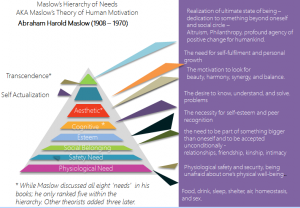
The first thing to understand about ‘Mc Keowns’ Hierarchy of Business Evolution©‘ is that it takes lead from  Maslow’s ‘Hierarchy of Need’.

The importance of Maslow is underscored by the direction taken by Tekedia Mini MBA Faculty Member Edward Hudgins in his lectures on Exponential Technologies and Business Opportunities in the Age of Singularity – ‘The final arena for the entrepreneur is ‘The arena of self’. You are the entrepreneur of your own life… You are the CEO of ‘self’… To be an efficient entrepreneur in the market… you really have to change and work first and foremost on yourself’.
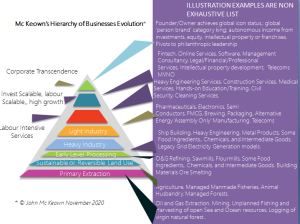
As human beings are capable of transcending though different levels of ‘need’, so too,  the business ecosystem is capable of supporting elements within it. which are at various stages of upwards transcendence.

The common factor is that businesses are a product of human behaviour.

The ‘transcendence’ converges in both models, with a realization for the individual in Maslow, and a realization for the business leader in the Hierarchy of Business Evolution.

One of the major differences though is that in Maslow, it is a journey of human beings in a lifetime, and many will become arrested at various stages of progression.

In the Business Evolution Hierarchy, businesses exist at various levels of the pyramid, some locked in dependencies of symbiosis.

The Mc Keown pyramid is fairly fluid, particularly among the middle rungs. Not all ‘Light Manufacturing’ or ‘Intermediate Goods’ are in the same place on the pyramid.

Much depends on automation levels, digitization, use of robotics, AI, and other transcendence catalysts.

Ascending the pyramid is mostly about SCALING.
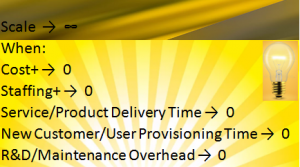
The more a business can scale, the higher a position it deserves in the ‘Mc Keowns’ Hierarchy of Business Evolution©

We can come up with many variables that can impact on a business’s ability to scale, but the primary drivers are cost, and pace of delivery. Most additional considerations are a function of one or both of these variables.

A third variable may be ‘Quality’.

The more revenue generating volume can be added while driving down impact on cost, delivery time to customers, or reduction in QoS (Quality of Service) or UX (User Experience), then the more scalability is improved. As additional overheads tend to 0 with growth expansion, then scalability tends to infinity.

Virtual businesses can be great for scalability, but that end-to-end ‘metaversity’ is only as scalable as the least ‘virtual’ component in the business model, or the most ‘bricks and mortar’ aspect of it, depending on perspective.

Dependency and Symbiosis.

Back in March of last year, Prof. Ndubuisi Ekekwe released a piece on Tekedia – The ‘Illusion of Leapfrogging – And Africa’s Missing Link’ which illustrates perfectly some of the characteristics of Dependency and Symbiosis.

Writing on Amazon, ‘Prof’ says: ‘Simply, behind the websites, great things are happening. So, if you just see the shiny website, you may not understand that Amazon is powered by the old economy which must run very well for the new economy to thrive.’

He goes on to introduce Tekedia Faculty Member, Dr.Henry Chan, explaining the dependencies and symbiosis of Alibaba’s activities in China.

His domestic reflection states: ‘The websites of Nigeria, and Africa cannot advance the region unless we still fix that power, water and support makers to make things in our economy.

So, when you see those posts, postulating on how an app could help Africa leapfrog the West, think again. When you download an ambulance finder app, remember that someone needs to have an ambulance in the city before the app offers any value.’

I have frequently made reference to the power dependency myself, though my favourite ‘go to’

is probably the burden of ‘metered’ internet access in Nigeria, particularly smartphone users and how it prevents OTT from being competitive.

This is the single most issue while services such as DsTV/Multi-choice etc, can survive in Nigeria without being usurped by services like Netflix, which reign in countries where affordable unmetered service is available with fit for purpose data transfer rates.

I was in DM with Emmanuel Saleem relating it is important that business persons looking at OTT within the Nigeria space do not pay attention to Macro data made available by so called global statistical data companies.

‘When they provide data on percentages of population with internet access, they are including people in possession of a smartphone making ex-contract ‘recharge card’ purchases as part of the ‘connected community’.

We all know this form of data use is cost prohibitive..‘. the conversation continues….
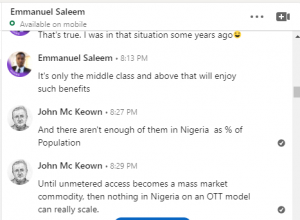


The DsTV/Multi-choice model survives.. at least for now… because they provide their own content delivery infrastructure, supported in part by independent connectivity solution operators providing additional federal backbone and international capacity circuits as and when needed.

Subscription based OTT vendors cause two cost centres, one for the subscription itself, and another from the data package to support the transfer, which the Nigeria based subscriber needs to provide.

That dependency reduces the scalability, and will not improve until 4G operators in Nigeria offer unmetered packages with fit for purpose transfer rates.

A good example of a ‘bricks and mortar’ impediment for end-to-end service scalability for example, would be the state of the Nigerian postal service compared to the standard many take for granted outside Africa.

For now, my advice to entrepreneurs in Nigeria’s virtual space is to look for models that can appeal to a global, rather than local market, so that the local market is not critical to the business model, and can grow in relevance at its own pace. Otherwise scrutinize and re-scrutinize the model for Scalability, Dependency and Symbiosis issues.

The local market has some way to go before businesses high on the pyramid can reach the resilience and robustness needed to realistically command that position within the  ‘Mc Keowns’ Heirarcy of Business Evolution©