
DD
MM
YYYY

PAGES

DD
MM
YYYY

spot_img

PAGES

Home Blog Page 5374

Supreme Court Reverses Earlier Judgment on Innoson Vs GTB Case, to Revisit the Bank’s Appeal

0

The Innoson Vehicles Manufacturers (IVM) vs Guaranty Trust Bank (GTB) legal tussle has taken a new turn following the decision of the supreme court of Nigeria to revisit the case.

The Supreme Court in a fresh ruling has overturned its previous decision which dismissed an appeal by GTB (now a subsidiary of Guaranty Trust Holdings Company plc, GTCO). A Federal High Court in Ibadan had awarded N2.4 billion (700,000,000 plus accrued 22% interest per annum until the final liquidation) in favor of Innoson against the Nigerian Custom Service in 2010, ordering the bank to release NCS’ fund in its care to Innoson by way of garnishee order.

A garnishee order is one of the options open to a judgment creditor to enforce a judgment made in its favor.

GTB did not accept the judgment and appealed. Consequently, on February 27, 2019, in a judgment marked SC/694/2014, the Supreme Court, however, dismissed GTB’s appeal and affirmed the judgment of the Federal High Court. And again, the bank filed an application seeking the re-listing of the appeal on the grounds that it was wrongly dismissed.

In the new turn of events, a five-member panel led by Justice Olukayode Ariwoola, on Friday, delivered a unanimous judgment which admitted that the Supreme Court erred its ruling that dismissed GTB’s appeal.

In the lead judgment written by Tijani Abubakar but read by Abdu Aboki, the court held that it was misled by its registry, who failed to promptly bring to the notice of the panel that sat on the case on February 27, 2019, that GTB had already filed its appellant’s brief of argument.

The Supreme Court stated that if the panel hearing the case on February 27, 2019, had been informed of the availability of the appellant’s brief of argument, the judgment would not have been issued.

Relying on Order 8 Rules 16 of the Supreme Court Rules, the apex court held that it has the power to set aside its decision in certain circumstances, like any other court. The Court cited circumstances that may warrant reversing its decision, including when the parties obtained judgment by fraud, default or deceit; where such a decision is a nullity or where it is obvious that the court was misled into giving a decision.

Thus, Justice Tijani held that the circumstances of the GTB case fall into the category of the rare cases where the Supreme Court could amend or alter its own order on the grounds that the said order or judgment did not present what it intended to record.

“I am convinced that at the material time that the appellant’s appeal was inadvertently dismissed by this court, there was in place, a valid and subsisting brief of argument filed by the applicant.

“It will be unjust to visit the sin of the court’s Registry on an innocent, vigilant, proactive and diligent litigant.

“It is obvious from the material before us, that there were errors committed by the Registry of this court, having failed to bring to the notice of the panel of Justices that sat in chambers on the 27th February 2019 that the appellant had indeed filed its brief of argument.

“This is a case deserving of positive consideration by this court.

“Having gone through all the materials in this application, therefore, I am satisfied that the appellant/applicant’s brief of argument was filed before the order of this court made on the 27th of February 2019 dismissing the applicant’s appeal.

“The order dismissing the appeal was therefore made in error. It ought not to have been made if all materials were disclosed. The application is, therefore, meritorious and hereby succeeds,” Justice Tijani said.

Therefore, the court set aside its previous ruling and ordered that the appeal marked: SC/694/2014 “be relisted to constitute an integral part of the business of this court until its hearing and determination on the merit.”

The Innoson Vs Nigerian Custom Service and GTB legal saga has lingered for over a decade. This new development means it may take many more years to reach conclusion. And with 22% yearly accrued interest tied to the litigation, which has now surpassed N32 billion, the prolongation of the case may cause the bank more financial harm.
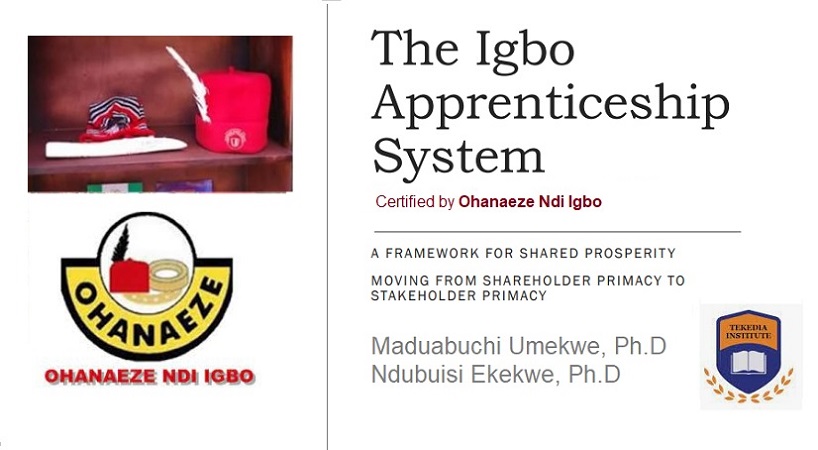

We’ve Sent The Igbo Apprenticeship System Course to Ohanaeze Ndi Igbo for Certification

4

Good People, Tekedia Institute has submitted the Igbo Apprenticeship System course to the custodians of Igbo Culture, the venerable Ohanaeze Ndi Igbo, for certification. After the article in Harvard and interests from around the world, Dr Maduabuchi Pascal Umekwe, PhD, PMP and my humble self got into action to create a course to educate, train and prepare people on this framework which posits stakeholder capitalism over just shareholder primacy.

But tradition demands that we follow procedures. Yes, for everything we think we know, there are custodians who know better. So, we want the blessing of Ohanaeze to make sure that we get it right. I have spoken with leaders of the Igbo Nation including the Worldwide Sec General of Ohanaeze.

Once Ohanaeze Ndi Igbo has finished its work, we will open up the course. It will run for 8 weeks with business cases, manuals, pre-recorded videos and live sessions. The Japanese have Kaizen. China Confucius. Africa has Ubuntu and Igbo Apprenticeship System.

The Igbo Apprenticeship System is a business philosophy of shared prosperity where participants co-opetitively participate to attain organic economic equilibrium where accumulated market leverageable factors are constantly weighted and calibrated out, via dilution and surrendering of market share, enabling social resilience and formation of livable clusters, engineered by major participants funding their competitors, with success measured on quantifiable support to stakeholders, and not by absolute market dominance.

10 Must-Have Skills For An Entrepreneur To Be Successful

0

Being an entrepreneur is difficult because it requires one to pave their own way. Therefore, an entrepreneur does not need one skill but should be a master of skills to ensure that the start-up that they are working on does great. An entrepreneur can first master the skills and then proceed with the start-ups or can pick up the skills required throughout their entrepreneurial journey. The latter is inevitable because new challenges will teach new lessons to an entrepreneur throughout their entrepreneurial journey. Here are 10 must-have skills for an entrepreneur. 

1. Problem-solving skills 

An entrepreneur starts a start-up with the aim to solve a problem. Therefore, problem-solving skills are a must for an entrepreneur. Not only an entrepreneur but also someone appearing for the Sarkari Exam should be equipped with problem-solving skills. Different problems require different tactics and therefore, it is a good idea to go through different case studies to know how to solve a problem. 

2. Networking skills 

Working with a start-up requires networking skills. For instance, if you want to start a business, you will need guidance for the same. With the help of networking skills, you can find a mentor who has already worked on your niche. Networking skills can also help you in preparing for an interview after a Sarkari Result. This skill will help you not only to start a business but also in growing the business. 

3. Communication skills

Communication skills and networking skills go hand in hand. Communication skills are very handy when one needs to pitch their business to investors or communicate with the audience. With great communication skills, one can ensure that they are able to communicate their vision well with the masses and hence, gain confidence for their business. 

4. Money management skills

The ultimate aim of any business is to make money and therefore, money management skill is a must-have skill for any entrepreneur. Cash flow, how accessible the money is and what to do with the profit is something that an entrepreneur should know to avoid the problem of financial crunch in the future. Money management skills also come in handy when one needs to cut costs and make difficult decisions. 

5. Team management skills

To build a successful business, it is important that an entrepreneur has a good team with talented people and people filled with motivation to work towards the vision of the business. However, it is crucial to realize that the vision of your business matters to the founder of the company the most and therefore, he/she has a task in hand to ensure that the team members are also motivated to work for the business and stay aligned with the vision of the company. 

6. Sales skill

Starting any business means that one has to sell something, it can either be products or services, but the bottom line is that sales skill is important to ensure that a business is running. Not everyone is equipped with the skill to sell because it requires the strength to convince people to buy their products and services and this is something that an entrepreneur should learn. 

7. Concentration power

Intense concentration is required to start a business and solve the problems that a business may encounter. Getting distracted with tiny notifications on the phone is never an option for an entrepreneur. Also, the ability to concentrate hard allows one to think clearly which is extremely helpful for business scenarios. 

8. Learning ability

Learning ability is a skill that everyone should possess. The ability to learn, to be curious, empower one with knowledge. The best part is that the learning ability of a person is not only helpful in professional life but in managing all aspects of life. Whenever encountered with a tough situation, it’s a good strategy to check what exactly you can learn from it. 

9. Leadership skills 

Even if an entrepreneur is facing a situation where is doubting the business, an entrepreneur cannot show it to the team members. All that an entrepreneur can do is work towards the problem and inspire others to do the same and that is what leadership skill is about. Leadership skill is all about ensuring that everyone around them is motivated. 

10. Stress management skills

The life of an entrepreneur is not easy. Even though there are wins in the journey, it is filled with many setbacks. The setbacks are sometimes enough to impact the mental and emotional state of an entrepreneur and in such a scenario, one needs to know how to manage the stress to stay strong and focus on the problem instead of engaging in self-pity. 

A combination of all these ten skills will help an entrepreneur to succeed in their entrepreneurial journey and create a name in the start-up ecosystem. 

How To Use The Profit From Business To Expand The Business Further?

3

A successful business often results in a profit. However, the time frame to actually make a profitable business might differ from one business to another. When a company makes a profit, the owner is presented with multiple choices on how the profit is used. Mostly, business owners either take the profit out of the business or retain the profit in the business itself. The first way allows one to pay a dividend to the shareholders of the business and by making the second choice, the business owners invest the profit again into the business. How the business owner wants to use the profit depends upon the objective of the business. If your business is making a profit and you don’t know what to do with the profit, then here are a few things that you might consider. 

1. Business improvement 

It is a good strategy to invest the profit that is earned from the business to reinvest it in the business. This will help to improve the business without any additional investment. The improvement that you want to make in the business with the profit that you earned should align with the strategic plan of the business. 

2. Invest the profit in yourself

If you are a business owner, you have the liberty to take an entire or small amount of the profit and invest the same in yourself. You can use the money to make further personal investments like Lottery Sambad and Dhankesari. One can also use this money to pursue courses. The courses can be something related to your personal interest or professional interest. 

3. Save the money for tough times

It is important that you save some amount of the rough time, consider it as a rainy-day fund. Businesses always go through a cycle of ups and downs and therefore the profit collected during the good times should be saved for the time when the business runs dry. This emergency expense can prove to be very helpful during the revenue slowdown. 

4. Invest in marketing

Marketing is extremely important for any business and therefore, investing in marketing can be a very good strategy for improving the business in general. On the basis of the requirement of the business, one can invest either in online or offline marketing. One can also set a budget for marketing and use the same for targeting more customers.

5. Build a better team 

Having a good team is extremely important for running any business. Investing in hiring the right member will always pay in the long run for the business as they are the people who will ensure that the business reaches new heights. 

5. Research and development

If you are running a business that uses technology, you can invest the profit that you have earned in research and development. This also holds true for business in general that does not use technology but requires research. Investing in research and development will improve both the efficiency and productivity of the business. 

6. Acquire other companies 

A humongous amount of profit can be used for acquiring other companies, especially the competitors and the potential customers. The same is reflected by the case of double-click and Google AdSense. Double-click emerged as a strong competitor of Google AdSense and to remove it from the competition, Google AdSense purchased Double Click. 

7. Use it to expand your market

When you start a business, the market that you work with is very limited. However, as the business expands, the market also expands and this expansion is important to expand the business. Also, while working in the business world, it is important to diversify the market with the products and services of the business to ensure that there are multiple sources of income. For instance, stores that have both online and offline presence managed to survive the impact of COVID-19. 

The best decision about what to do with the profit earned can be best decided while having a discussion with the team members. It is a good idea to list down the objectives of the business and then create a budget for the same. Secondly, whether there is money to reach that objective or not should be figured out and then, finally, the best use of the money earned through profit can be decided. 

How To Manage An Inventory-Based Business?

0

Running inventory-based management required proper evaluation and monitoring of the business. Whether the inventory of the business is managed properly or not can be checked by shooting questions like whether the product was available or not when it was required, the business loss that occurred because the items ran out of stock or the loss that occurred because of excess stock and so on and so forth. Inventory management is required for the smooth running of any business and it helps the business owners to have the right products at the right time and that too in the right quantity. Proper inventory management ensures that there is no excess inventory or stock outs status. Here is how an inventory-based business can be managed. 

1. Do proper forecasting 

Proper forecasting is important for ensuring that the projected sales are as close to the actual sales as possible. Proper forecasting will help you to ensure that the inventory available is enough to meet the requirement of the sales with very little to no out of stock items or extra items. Proper forecasting will enable the business owners to ship out the product quickly by using logistic services of companies like XpressBees. There are many software available out there that on the basis of the historical sales figures, the future projection can be predicted and this will make it easier to manage the inventory. 

2. The products that are first in should be first out

Depending upon the demand of the products, items are most of the time purchased in chronological order. The items that are first purchased should generally be the first that should go out of inventory. This rule is generally true for perishable commodities where the items if not moved out of the inventory to the customers can actually become perished and result in business loss. One way of implementing this principle is that the new inventory should be added from the back and the old stock should be placed at the front to ensure that the old products are moved out first when one needs to ship out products quickly with the help of services of Pakistan Post and other logistic services. 

3. Figure out how to sell the low-turn stock present in the inventory 

On the basis of the demand for the product, you will be able to identify both high-turn and low-turn stock present in the inventory. One should smartly deal with the low-turn stock. Firstly, they should stop stocking the low-turn stock items because the previous stock has not been sold yet. One can also run special promotions or discounts for these products to ensure that there is a flow of such stock. 

4. Use real-time inventory management 

Real-time inventory management helps the business to provide the business owner with the information required about the inventory to manage it well. For instance, much real-time inventory management software provides the users with daily notifications about the items that are running low in stock or are already out of stock. Also, it makes it easier to identify the expensive stock that needs to be sold for a business profit. 

5. Ensure that the quality of the stock is maintained 

It is important to ensure that the quality of the product that is present in the inventory is maintained. It is crucial that the products of the inventory look great even if they have been present in the inventory for a long time. For doing so, one will require a time-to-time examination of the stock present in the inventory. Signs of damages need to be fixed as soon as possible. 

6. Keep a track of the product information

All the products which are present on the inventory should be properly tracked. Information that should be contained in the system should include barcode data, SKUs, lot numbers and suppliers. This information will be helpful in knowing how scarcity and seasonality will affect the business. 

7. Update the inventory totals on a daily basis

The sales that occur each and every day should be monitored to know which products were sold and the inventory totals should be updated daily. This data will be helpful in knowing which items are selling faster and which items are selling at a slow rate. Further, it will help one to identify patterns if any. For instance, one can check if any products are sold together most of the time.

By following these tips, one can ensure the smooth functioning of an inventory-based business.