DD
MM
YYYY

PAGES

DD
MM
YYYY

spot_img

PAGES

Home Blog Page 5420

Who Would You Be in 2022?

0

People and businesses have used the last 356 days to do one thing or the other for personal and corporate benefits. We have also seen people and businesses that used the days to create challenges or problems for other people and businesses with the intent of gaining financial and non-financial value.

Issues and challenges, the world experienced in 2021 will not be different in 2022. A number of global issues were carried over from 2020 into 2021. This will also occur in 2022. Our analyst expects business and political leaders to continue working on the best approaches and practices for reducing or eliminating challenges in the areas of health, education, mobility, and employment creation among others. Significantly, we expect countries, businesses, and individuals to experience issues in the areas of religious and human rights, environment, international political economy and security, gender equality and rights of girls and women.

Looking at the possible global humanitarian crisis in 2022, our analyst notes that food insecurity is more likely to fuel a number of conflicts in “troubled countries.” Already, “the United Nations Office for the Coordination of Humanitarian Affairs (OCHA) has warned that 274 million people could be in need of humanitarian assistance in 2022, with the world currently battling the worst hunger crisis this century. This is up from 235 million people in 2020 and 168 million in 2019. ”

In all, who would you be? Are you ready to use the skills and knowledge you acquired in 2021 to advance or destroy humanity? Do you believe in creating solutions based on the need to address global concerns without getting huge profits from the users? How would you feel when your services and products are created purposely to exploit the less privileged?

As long as the pandemic continues wreaking havoc on business operations and people’s movement, information and communication technology will continue to be a key factor in value creation and delivery. How sure are you that your ICT skills and knowledge will be applied to advance humanity, not destroy it?

It’s not too late to give the gift of Tekedia Mini-MBA

0

In a constantly changing business ecosystem in the emerging world, you need a compass to master the mechanics of entrepreneurial capitalism. Markets are vector quantities with sizes and directions, and your company cannot afford to be a scalar (no direction). Besides your firm, you have loved ones, students, friends and associates. You can make them better.

Simply, there has never been a better time to gift a Tekedia Mini-MBA. Your gift unlocks ideas that will spark solutions, new models, strategies and big wins.

When you gift Tekedia Mini-MBA, you provide tools to win the markets and career opportunities of 2022. Go here (on click) and do it, and send our team the recipient’s email via the email on the page.

Then relax, you will see impact in the person’s ascension because every Tekedia Mini-MBA gift unlocks futures.

Mentornaut Raises €200k Fund from EstBAN to Expand Edtech to Kenya

0

Edtech has continued to gain popularity in Africa, with more startups securing investments to expand online education. Covid pandemic, which has continued to limit in-person activities, accelerated the use of digital platforms for education since 2020. By 2026, the market is estimated to be worth $202 billion.

As such, Africa has seen an uptick in the number of startups offering online classes. Like others, the continent has also witnessed growing investors’ interest.

The Estonian Business Angels Network EstBAN has led a €200,000 funding round in Mentornaut, an online tuition platform. The program will debut in Kenya with the goal of increasing access to tailored education.

Mentornaut has a number of investors, including Superangel, United Angels VC, and a number of EdTech advocates, including Bolt co-founder Martin Villig, IT visionary Linnar Viik, and Clanbeat co-founder Kadri Tuisk.

Mentornaut is working on an online learning network that will connect K-12 kids with a large number of accredited private tutors in their local education systems to assist students bridge knowledge gaps and achieve their full potential in school. It was founded in 2020, at the peak of the pandemic by Markus Meresma and Gregor Mändma, when about 1.5 billion children around were forced to learn remotely.

“Superangel invests in forward-thinking entrepreneurs who are working to make the world a better place.” Mentornaut’s vision of local educational standards becoming empowered is inspiring.

“Personalised education for African children is still largely unaddressed, but it is critical to the development of better economies and societies,” said Veljo Otsason, a co – founder at Superangel and also an early investor with tech startups such as Bolt, Veriff, Starship, and Monese.

Parents are becoming more amenable to private tutoring to help their children overcome learning gaps as distance and remote learning become more widespread around the world.

Mentornaut has seen 2,500 private courses booked on its website since its launch in Estonia last year. Mentornaut distinguishes out by delivering a full service – from bookings to payments – and is praised by its many users.

“Thanks to our vast range of private teachers, we’ve seen a lot of positive feedback from our clients who have rediscovered the fun in learning,” Meresma added.

In the first few hours after the company opened in Kenya, tutor onboarding resulted in more than 120 sign-up requests. The average pupil-to-teacher ratio in African elementary schools is 42:1, necessitating the need of private additional tuition.

Mentornaut takes a proactive approach to expanding its tutoring pool, bringing on students, schoolteachers, and experienced private tutors to broaden the pool and make individualized learning more accessible to more individuals.

The fresh funds will be utilized to improve the platform’s automation in order to speed tailored education for parents, children, and private tutors throughout Africa and Eastern Europe.

The company’s long-term goal is to develop an adaptive learning system that will help shape the establishment of individualized learning paths and assist studies in schools.

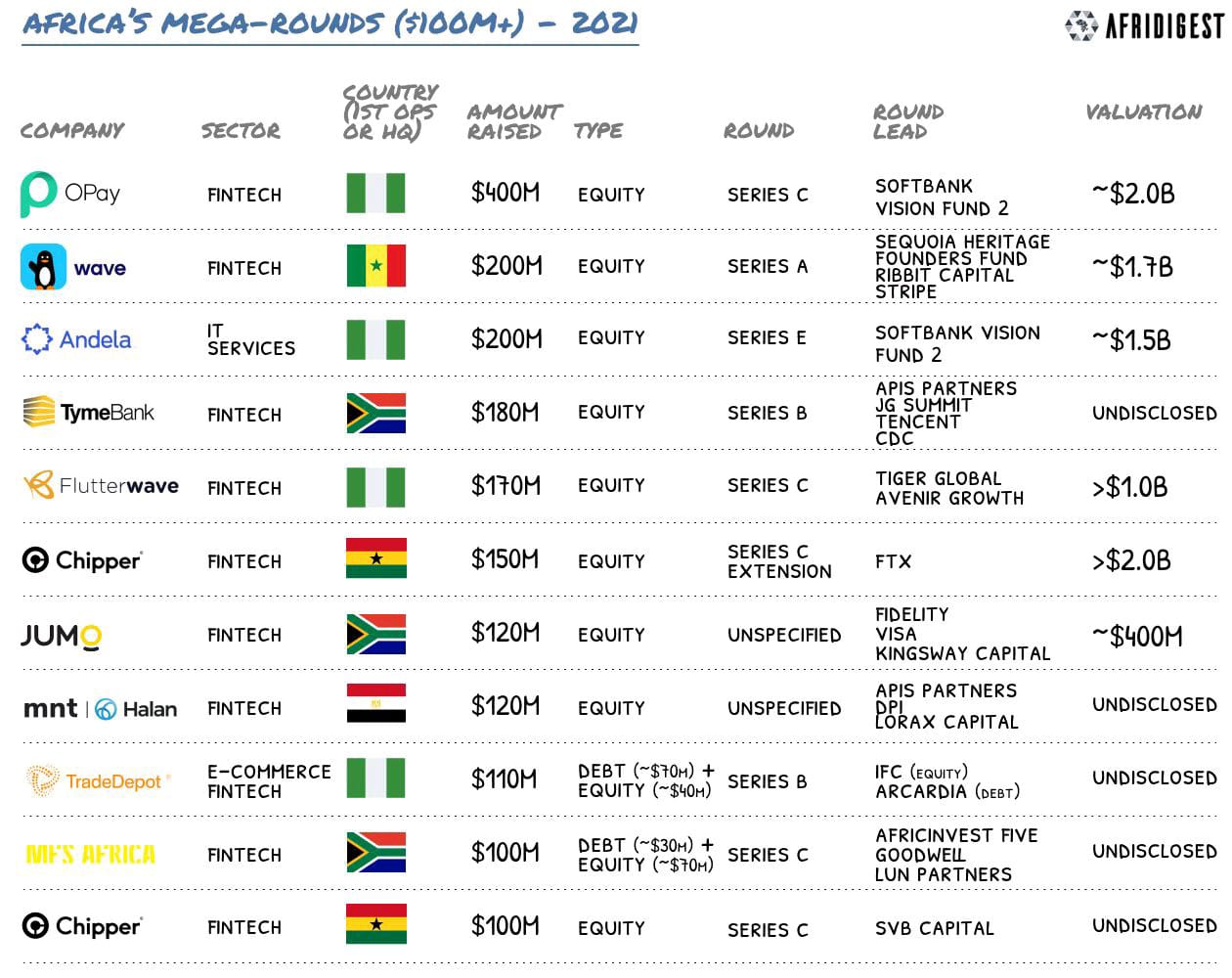
These are the $100 million+ raises for African startups; truly remarkable numbers

0

These are the $100 million+ raises for Africa; truly remarkable numbers. Tekedia Capital is providing a path for ordinary people to be part of this massive redesign. This is the time; learn more how we can help you.

From the chart, we can see that Fintech leads. There is a reason for that, I explained in a comment on LinkedIn.

This is expected. The key friction in business is how to be paid. Once that is done, other domains open. If you are in Lagos offering a service to someone in Aba, the first thing is this: how will this person pay me? It is after that is sorted out that the transaction will move ahead.

So, you need to fix fintech before you can fix other things. If not, a doctor, carpenter, etc will work and will be unable to receive their promised pays. I expect fintech to unlock values in healthcare, education, etc as an operating system over the next few years. In Kampala, in a major speech, I called it the Operating System of Africa’s Digital Future.

ByteDance Becomes the World’s Largest Unicorn – Thanks to TikTok

0

When TikTok was released in 2016, the world of social media had no idea it’s going to see the amount of disruption the short-form video app has caused so far. It came like a storm, smashing and creating records – and remarkably, making users creating contents on its platform, millionaires.

From Jan. 2018 to July 2020, TikTok has seen 1157.76% increase in global user base. During the same period, TikTok creators amassed up to 100 million followers, raking in up to $5 million a year, according to data from Backlinko.

As the social media app burgeons, its parent company ByteDance leaps at valuation. ByteDance reached a $280 billion valuation in August 2021, following TikTok’s growing popularity. Now SCMP reports below that ByteDance has smashed a new record.

ByteDance has surpassed Ant Group to become the world’s largest unicorn, with start-ups from the US and China continuing to dominate the landscape, according to the latest Hurun Global Unicorn Index. This is despite Chinese companies coming under regulatory scrutiny both at home and in the US.

Of the 1,058 unicorns – start-ups valued at more than US$1 billion – globally as of November this year, China had 301 start-ups, the most after the 487 in the US, according to this year’s index released by Shanghai-based Hurun Research Institute on Monday.

Beijing-based ByteDance, whose flagship app TikTok has 1 billion monthly active users globally and is viewed as a serious challenger to Facebook, saw its valuation surge nearly 30 per cent to US$350 billion, from US$270 billion last year.

Ant Group, an affiliate of Alibaba Group Holding and operator of online payment platform Alipay, was valued at US$150 billion. Analysts behind Ant’s US$39.5 billion initial public offering that was withdrawn at the last minute in November last year had pegged its then near-term valuation between US$350 billion and US$450 billion.

“2021 is officially the most successful year for start-ups ever,” said Rupert Hoogewerf, chairman and chief researcher of privately held Hurun Report. “The countries with the most unicorns give a picture of which countries have the world’s best start-up ecosystems.”

The top 10 largest global unicorns made up 25 per cent of the overall value of the world’s unicorns of US$3.7 trillion, according to the report. Four of them were from the US, three from China, while Australia, UK and Sweden had one each.

SpaceX, the aerospace company founded by electric vehicle giant Tesla’s CEO Elon Musk in 2002, moved up two places to rank as the third most valuable start-up in the world. The Los Angeles-based company is now valued at US$100 billion, making it the largest unicorn in the US.

While the US and China dominate the global unicorn scene with a share of 74 per cent, the rest of the world grew their share to 26 per cent this year compared with only 17 per cent two years ago, according to the Hurun report. India and the United Kingdom ranked third and fourth in the global unicorn league, with 54 and 39 unicorns, respectively.

Among global cities fostering the most unicorns, San Francisco topped the list with 151 unicorns, overtaking Beijing’s 91. New York, Shanghai and Shenzhen rounded off the top five with 85, 71 and 32 unicorns, respectively.

While half of the world’s unicorns have their origins in fintech, SaaS (software as a service), e-commerce, artificial intelligence, health tech and cybersecurity, the metaverse – the latest sector that has caught the imagination of many companies – has yet to see a related unicorn, according to Hurun Research.

“A unique feature of China’s start-up ecosystem is the ability of big tech companies to spin off unicorns, with 49 of the world’s 50 ‘spun-off’ unicorns coming from China,” said Hoogewerf, citing the example of Ant Group’s spin-off from Alibaba in 2014.

“Curiously, the ‘World’s Big 4’ on the Hurun Global 500 most valuable companies, Microsoft, Apple, Amazon and Alphabet, are not as active as their China counterparts when it comes to investing into unicorns,” he added.

China has been on a months-long regulatory crackdown targeting the country’s internet giants. Since the record 18 billion yuan (US$2.7 billion) fine on Alibaba in April, Beijing has introduced a series of regulatory policies ranging from antitrust issues to data security.

Didi Chuxing, the third-largest unicorn in last year’s Hurun list, was among the tech giants that was taken to task by Chinese regulators. Within days of the ride-hailing firm’s debut on the New York Stock Exchange (NYSE) in June, the company was investigated by China’s cyberspace regulators for potential national security violations. Earlier this month, Didi said it would delist from the NYSE and seek to relist in Hong Kong.

For months now, both TikTok and its parent, ByteDance, have been free from both U.S. and China scrutiny. With its high-flying growth rate, TikTok is expected to hit two billion monthly users at the end of 2022.