DD
MM
YYYY

PAGES

DD
MM
YYYY

spot_img

PAGES

Home Blog Page 5432

PROLOGUE: Shophouse as an Urban Poverty Escape Strategy

0

The submission from professionals and non-professionals had always been that rural areas or communities are full of various forms of poverty. Largely, unemployment and lack of basic social amenities have driven and still driving a huge number of youths from rural areas to urban centres. But economists and political scientists believe that urban areas are not exempt from different forms of poverty as well.

With this conflicting presentation of rural and urban areas, our analyst notes that it is difficult for anyone to conclude that indeed human beings are in a great dilemma of where to live and explore opportunities for sustainable living. Apart from the poverty factor, there are other contributors to the incessant rural-urban migration in every country in the world.

Between 2010 and 2020, rural-urban migration growth in Nigeria in the context of urbanization was alarming. From 43.48% in 2010 to 51.96% in 2020, it is obvious that Nigerians want better living conditions. Hence, the need to move from locations where opportunities and access to basic social amenities are limited to where sustainable opportunities could be pursued without fear and unnecessary uncertainties.

After some years of being in the new locations (urban areas), people with financial strength usually bought or built personal houses. This single act has continued to help the host communities to expand socially and economically. Various sources indicate that Nigerians who migrated to urban areas and indigenes of the areas have been borrowing ideas from some countries in the South East Asia regarding shophouse construction.

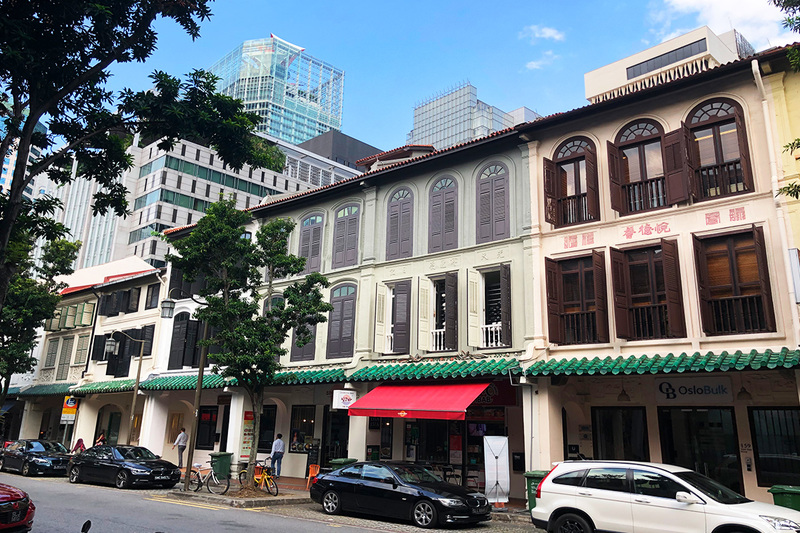
Shophouse is a building that has residential and commercial business purposes. In the region, shophouse has “an opening onto the pavement and also used as the owner’s residence.” This has been the tradition since 1950s. Several reports in the region and outside indicate that shophouse remains one of the elements of the urban economy. It is also an economic opportunity for homeowners.

According to our preliminary results of the ongoing observational and longitudinal studies, shophouse is being used as an urban poverty escape strategy. In our investigation, we found that Nigerians are building shops as part of their residential building when it is obvious that their locations are strategic to residents and visitors. We also discovered that places that are not in core urban areas, homeowners are constructing shops to augment their monthly income. In another perspective, a number of homeowners are not necessarily constructing the shops for rental purpose. They are making the shops available to their wives as a way of reducing the stress associated with working in corporate organisations and uplifting them financially.

In 2022, our analyst will report significant insights from the studies which are being carried in Lagos, Oyo, Ondo and some states in the eastern region. Our expectation is that concerned stakeholders in small and medium scale business management and development would learn from the insights. For instance, it is expected that government agencies and enterprise support organisations would see reason for developing policies and programmes towards sustainable urban poverty elimination.

Tekedia Live

2

Only the first 100 participants will join via the Zoom link below. Others will watch via YouTube Live here which will be posted on Saturday.

We invite you to join Tekedia Institute’s annual outlook for the year ahead. The event is scheduled as follows:

  • Topic: The 2022 Outlook – Nigeria, Africa, Global: Potency of Entrepreneurial Cambrian Moment
  • Date:  Saturday, Dec 18, 2021
  • Time: 4pm – 5.30 pm WAT
  • Presenter: Prof Ndubuisi Ekekwe, Lead Faculty, Tekedia Institute
  • Zoom Link:  Click this Zoom link

About Tekedia Institute

Tekedia Institute offers an innovation management 12-week program, optimized for business execution and growth, with digital operational overlay. It runs 100% online. The theme is Innovation, Growth & Digital Execution – Techniques for Building Category-King Companies. All contents are self-paced, recorded and archived which means participants do not have to be at any scheduled time to consume contents.

We offer Tekedia Mini-MBA, Tekedia Advanced Diploma Programs, Tekedia Startup Masterclass, etc. You can register and join any of these programs here.

Find your OWN customers and FANS

0

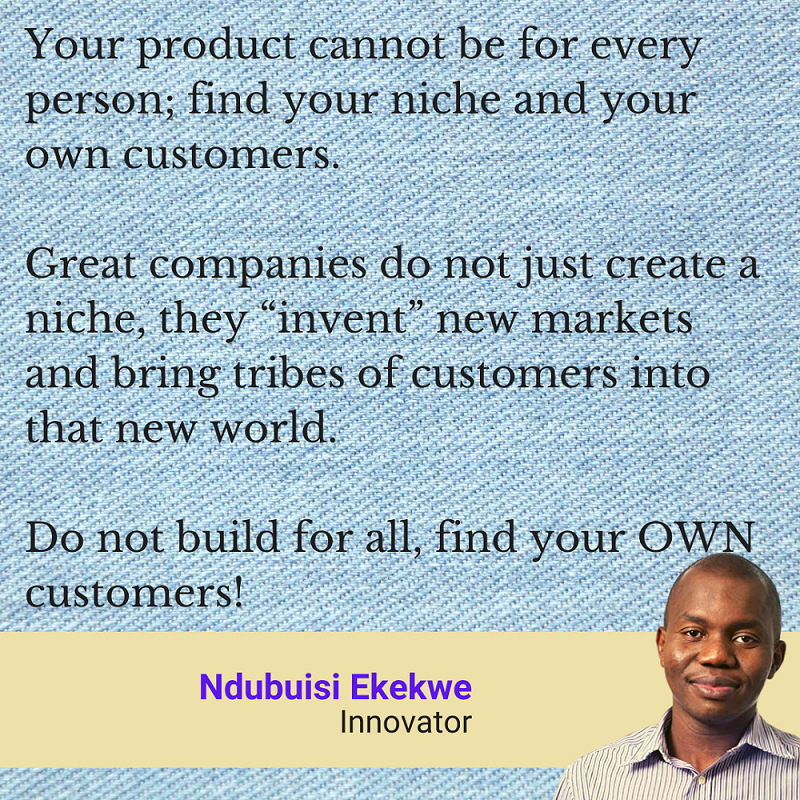
Find your OWN customers and FANS. Great companies turn customers into FANS. Create a fandom in that market.

Your product cannot be for every person; find your niche and your own customers.

Great companies do not just create a niche, they “invent” new markets and bring tribes of customers into that new world.

Do not build for all, find your OWN customers!

Comment on LinkedIn Feed

The world’s winning companies are often those who sell Lifestyle, not those who sell Products and Services.

Apple sells Class, not Gadgets.
Tesla sells the Dream, not Cars.
Nike provides you with Inspiration, not Shoes
Instagram curates your Fantasies, not your Media.
Meta sells Experience, not Communication.
Tiktok is Funsville, not a Short Videos Platform.
Andela offers a Life of Opportunity, not Computer Training.
Xiaomi preaches Simplicity, not Eectronics.

Create a Unique Lifestyle through Business Model Innovation and your FANS will not only locate you, but they’ll stay loyal to you because you’re their right kind of crazy.

Nigeria Moves to Reciprocate Canada, Saudi and UK’s Travel Ban

0

The Nigerian government is moving to reciprocate the decision of the United Kingdom, Canada and Saudi Arabia, to place Nigeria on covid red list.

The decision, which has been widely criticized, has become a bone of contention between Africa’s most populous nation and the UK, who in addition, has placed Nigeria on visa ban till further notice.

It has been a week since the decision went into effect, a period of time considered long enough for Canada, Saudi Arabia and the UK to rescind their travel restrictions given the amount of backlash that has followed it.

Now, the Nigerian government says it will take reciprocity steps, which will include stopping airlines from those countries coming into Nigeria; Sahara Reporters reported, citing an audio recording of the Minister of Aviation, Hadi Sirika, it obtained on Saturday.

According to the report, the minister noted that if the countries placed Nigeria on a red list, they lacked a moral right to have their airlines coming to Nigeria for commercial services.

“There is also a case of Saudi Arabia that put Nigeria on the ban list; Canada. Today, there was a meeting in which I participated from the COVID-19 Task Force.

“We have given our input that it is not acceptable by us and we recommend that those countries – Canada, UK, Saudi Arabia and Argentina – be also put on the red list.

“So, like they did to us, if they don’t allow our citizens into their country; who are they coming as airlines to pick out of our country?

“So, they are not supposed to come in. I am very sure in the next three days; Monday or Tuesday, all those countries will be put on the red list of COVID-19.

“Once they are on the red list, which means they are banned, their airlines will also be banned. I am so sorry we are going through difficult times, but it is in the interest of our country,” he said.

This is coming a day after the federal government of Nigeria had taken a retaliatory decision against Emirate Airline over United Arab Emirate’s decision to limit Nigeria’s airline, Air Peace, to one weekly flight to the UAE, whereas Emirates got the Nigerian Civil Aviation Authority (NCAA),s approval for 21 weekly flights to Nigeria.

So far, Nigeria has only six confirmed cases of Omicron variant compared with the UK’s over 633 cases. This evidently lends credence to the discrimination description of the travel ban placed on Nigeria by the UK and others.

The Nigerian government has been applauded for taken a reciprocity step in response to UAE’s decision to narrow Air Peace’s flight into the country to one. It is believed that the decision will send a warning message that Nigeria, Africa’s largest economy, can no longer stand and watch its political and economic interests being discriminatorily derided by developed countries.

While concerns remain about the economic impacts of the reciprocity, the move to take retaliatory travel ban measures against Saudi Arabia, Canada and the United Kingdom has also been applauded.

EU Goes After Gig Economy, Pushes Legislation to Ensure Classification of Gig Workers As Employees

0

The tide is increasingly changing for Uber, Deliveroo and other companies operating the gig business model in Europe. In a new move, the European Union is building on court rulings in Europe to mandate gig economy players to give workers employee treatment.

This means, Uber and Deliveroo are expected to ensure that workers get the minimum wage, access to sick pay and holidays. The EU is working on a new law that will tackle what has been described as ‘fake self-employment’ that has become a lingering problem between gig companies, their workers and the authorities.

To permanently put to rest the controversy, the European Union on Thursday, published a draft legislation. It is meant to give workers’ rights and benefits to ride-hailing and delivery drivers, who have been asking courts to compel gig companies to recognize them as employees.

In the U.S., the state of California had in January last year, enacted the AB5 law. Designed to compel Uber, Lyft and other companies in the state, to declassify their drivers as independent contractors. Though President Joe Biden has hinted on a possible U.S. government’s action against the gig business model, Congress has not considered legislation that will change the status quo.

Like in antitrust cases, where the European Union leads in holding the Big Tech accountable, the bloc is stepping forward against the gig economy.

Nicolas Schmit, EU commissioner for jobs and social rights, told the Guardian and other European newspapers that internet platforms “have used grey zones in our legislation [and] all possible ambiguities” to develop their business models, resulting in a “misclassification” of millions of workers.

The Guardian reports on the draft-legislation.

Companies that did not allow people to work for other firms, or had rules about appearance and how to carry out tasks, could be classed as employers, under the proposals, under criteria used to determine employment status. The new rules would not apply to genuinely independent contractors.

In the EU’s 27 member states, about 5.5 million workers are misclassified as self-employed, when they should be treated as employees with benefits and protection, such as accident insurance, according to the commission. Firms would only have to pay minimum wages, where they already exist. About 28 million people work for platforms in the EU, but this is expected to reach 43 million by 2025.

The proposals are an attempt to provide legal certainty, after European courts have been asked to settle about 100 disputes relating to gig economy companies. France, Italy, Spain, Greece and Portugal tightened up domestic laws, but EU officials believe no government has fully addressed the problem.

Since Brexit, the UK government has no obligation to follow EU laws, while judges have been left to clarify employment law for a new generation of internet companies. In 2016 an employment court found that Uber drivers are not self-employed and should be paid the minimum wage, a verdict upheld by the Supreme Court in February.

Tim Sharp, senior employment rights policy officer at the Trades Union Congress, said there had not been any “significant government intervention in the UK” to address what unions see as abusive and problematic aspects of platform working.

“If the European Union is seen to be taking a robust approach on platform operators, I think there will be more pressure on the government here to take measures to protect vulnerable workers,” he said.

The EU proposals will be amended by national ministers and MEPs before they become law.

Schmit, a former labour minister in his native Luxembourg, said some services might cost “a bit more”, but argued consumer convenience should not be at the expense of workers.

Services, such as food delivery, were not free, he said. “I cannot consider if somebody brings the pizza at 11 o’clock in the evening to my home … that I have not to pay for that. This is a service. And if it’s a service, the guy who performs the service also has rights.”

Under the directive, workers would also gain rights over algorithms, to stop situations where people are denied jobs, working hours or even fired as a result of machines’ decisions. Instead, workers would have the right to receive explanations for and contest automated decisions, while companies would have to ensure access to a human contact for anything that would have a significant impact on the person.

The European Trade Union Confederation’s Ludovic Voet said the directive should “signal the end of the free for all” for companies such as Uber, Deliveroo and others. “For too long platform companies have made huge profits by dodging their most basic obligations as employers at the expense of workers while peddling the lie that they provided choice to workers,” he said.

Companies in the gig economy have taken different approaches. Just Eat Takeaway, a Dutch company that is one of the world’s biggest food delivery firms, announced last year that gig workers would become employees with benefits.

MoveEU, a body representing ride-hailing apps, such as Uber, has argued EU action could cost jobs. “Platform work is very diverse, and a one-size-fits-all approach could carry weight on the business model of platforms and ultimately negatively affect the many independent workers relying on them,” it said in a recent paper.

George Maier, a specialist on digital technology at the London School of Economics, said companies would have to adapt to stay in markets. “For a lot of these platforms, because they are realizing their model is not profitable, there is a big question over what change they can do and what change they can’t do.”

“We have seen some evidence of platforms trying to get around the tightening grip of legislation by changing their business model. The alternative is to pull out of a country where they don’t see a profitable future.”

If the legislation becomes law, it will likely set a precedent that may compel countries outside Europe, especially the U.S., to take a legislative approach in addressing the matter.