DD
MM
YYYY

PAGES

DD
MM
YYYY

spot_img

PAGES

Home Blog Page 5452

Tekedia Mini-MBA Edition 6 Final Week – “The Call to Business Execution”

0

We are in the final week of Tekedia Mini-MBA edition 6 after 12 weeks. It has been a wonderful journey with all co-learners and faculty. Here are the programs for this final week.

At 7pm WAT today,  Tekedia Live will focus on “The Call to Business Execution”. Largely, it is ACTION time and we need to go to the markets, and apply the constructs, capabilities and frameworks we have mastered. Until it is done, it has not been done!

How do we get things done? How do we execute in markets? 

  • Thur, Dec 2 | 7pm – 8pm WAT  | The Call to Business Execution – Ndubuisi Ekekwe

Registration for the next edition of Tekedia Mini-MBA (Feb 7 – May 7, 2022) continues. It is $140 (or N60k) for the 12-week program which is self-paced and wholly online. Join us here.

Yassir, Algerian Mobility Startup, Raises $30m in Series A

0
Yassir Lester

The African tech ecosystem has witnessed a significant leap in recent years. The burgeon has been pillared by the fintech sector that has attracted more than $2.5 billion in investments in 2021 alone. But recently, transport startups have been revving to fintech, raising millions of dollars in funding.

Algerian ride-hailing startup, Yassir, has announced that it has raised $30 million in a Series A funding round to build an African Super app.

The investment round was graced by notable investors and VCs such as WndrCo, DN Capital, Kismet Capital, Spike Ventures, Quiet Capital, Endeavor Catalyst, FJ Labs, VentureSouq, Nellore Capital and Moving Capital. Also participating are angel investors such as Cleo Sham of Uber; Thomas Layton of Upwork, Opentable and Metaweb; Rohan Monga of Gojek; and Hannes Graah of Spotify and Revolut.

This is coming a few weeks after Nigeria’s shared-mobility startups Treepz and Shuttlers raised $1.6 million seed each to expand their services in Africa.

Yassir was founded in 2017 by CEO Noureddine Tayebi and Mahdi Yettou as a ride-hailing business, designed to serve densely populated places that have been impacted by inefficient transportations. But it has since then onboarded a host of other services including last-mile delivery services, creating an ecosystem of related services bringing drivers, couriers, merchants, suppliers and wholesalers and individual users on one platform.

Tayebi says the plan is to use the marketplace model to offer payment services to all parties involved and create a super app in the process.

The company says it intends to use the new funds to consolidate its growth in its existing markets by launching new products and improving existing ones. It also plans to increase its engineering team.

Tayebi told TechCrunch in an interview that the plan is to offer many service to the underserved.

“Our approach of solving the unbanked population problem is unique in the region by offering more of a ‘banking as a platform’ solution where daily services are at the heart of it all via a super-app marketplace.

“Such services not only build trust for all the sides of the marketplace but also use them as channels to offer these payment services, which we think is the approach that is most suited to the region. Most of our competitors are either on-demand services — ride-hailing or last-mile delivery only — or pure payment solutions. This gives us an edge over them as we build the network, the channels and the trust that are all key ingredients for the adoption of payment services at large scale,” he said.

Yassir was the first Algerian startup to get into the Y Combinator accelerator program (Winter batch) in 2020, receiving $150,000 in seed funding. It has recorded tremendous growth visible in its customer-base. Yassir now has more than 2 million users and 40,000 partners and is available in 25 cities across Algeria, Canada, France, Morocco and Tunisia and is continuously expanding.

The startup’s growth is gradually putting Algeria in the map of African countries pulling in huge investments from their tech ecosystems.

Zimbabwe Introduces $50 Tax on Every Newly Purchased Cell Phone

0

African governments are grappling with revenue shortfalls exacerbated by covid-19, and have heavily impacted economic status of many countries. From Nigeria, the largest economy in the continent to Burundi, the smallest, wretched government purses is driving a range of policies aimed at increasing revenue generation.

With gross domestic products (GDP) not in par with population growth, many African states have taken to borrowing, multiple taxation and tax increment as means to upset their revenue shortfalls.

Following this trend, Zimbabwe has introduced a raft of new tax measures, including a 5% levy on imported dairy products, a US$50 levy on all new mobile phones, and an increase in sin taxes on tobacco as well as energy drinks, Innovation Village reports.

The report says Finance Minister Mthuli Ncube is seeking new revenue streams as he nearly doubled the country’s proposed spending in its annual budget this week.

But against government’s push to increase revenue generation through taxation are people crying out from a side of dwindling earnings.

The report said that Zimbabweans have long complained that they are already heavily taxed, while their disposable incomes are shrinking. Labour unions also complain that salaries and wages in Zimbabwe lag behind those of regional peers, even as continued dollarization of the economy and weakness of the local currency drive up the cost of living. It is against this backdrop that the Minister is proposing a raft of tax measures to boost government’s revenue stream in his 2022 budget statement.

Some of the measures – including a 5% levy on dairy product imports – have been criticized for being protectionist against the backdrop of the coming into effect of the Africa Free Continental Trade Area (AfCFTA), the report said.

It also noted that Zimbabwe has also hiked sin taxes, with the excise duty on cigarettes going up from 20% + US$5.00 per 1 000 cigarettes to 25% + US$5.00. A flat excise duty on energy drinks at a rate of US$0.05/litre has also been introduced in the 2022 budget. But where the biggest challenge lies is on mobile phones.

“Other revenue enhancement measures include a new $50 levy on all new smartphones used in Zimbabwe. This is in addition to a 25% customs duty on imported handsets. Ncube said that Zimbabweans have been avoiding this levy through smuggling smartphones into the country,” the report said.

Household average income in Zimbabwe across all provinces range between US$27 and US$45 and US$63 and US$102, according to data published by Zimbabwe Vulnerability Committee (ZimVac). This means the $50 new mobile phone tax has come off as oppressive.

“We just talked about the ridiculous 2% IMTT. Well, compared to the $50 duty, the 2% is the most reasonable tax in the world. The $50 does not take into account the price of the phone being registered. You could buy a $50 phone and the government would still want its $50 cut making for a 100% tax. If you got a bargain for a budget android phone for less than $50, you would pay more in tax than you did for the phone. Ridiculous,” a concerned Zimbabwean said.

The government plans to implement the tax by requiring mobile network operators – including Econet Wireless and NetOne – to collect the $50 levy on each smartphone prior to registration. But that poses a “how would it work?” question that was not answered in the budget. However, the report provided a practical suggestion on how it can be implemented.

It would just be that mobile network operators will have to prevent devices that haven’t been used on their network before from working. Econet, NetOne, and Telecel can tell which device you are using and so it shouldn’t be hard to comply with the new directive.

When you insert an Econet SIM card in your phone, the phone has to communicate with them so that they know which bands it supports, whether it supports 3G, 4G, or 5G, and serve it accordingly. They can get the IMEI, serial number, and device manufacturer this way. So, they could just maintain a database of the devices on their network, something they probably already do.

What this means is that when a device that has never been on their network is detected, they simply withhold service until the user proves they paid duty for the device. For this to work, the mobile network operators would have to share device information in a central database. This is so that if it’s just a case of the user switching sim cards, the user is not denied service.

When things are not working in that firm, check if your business model has expired

0

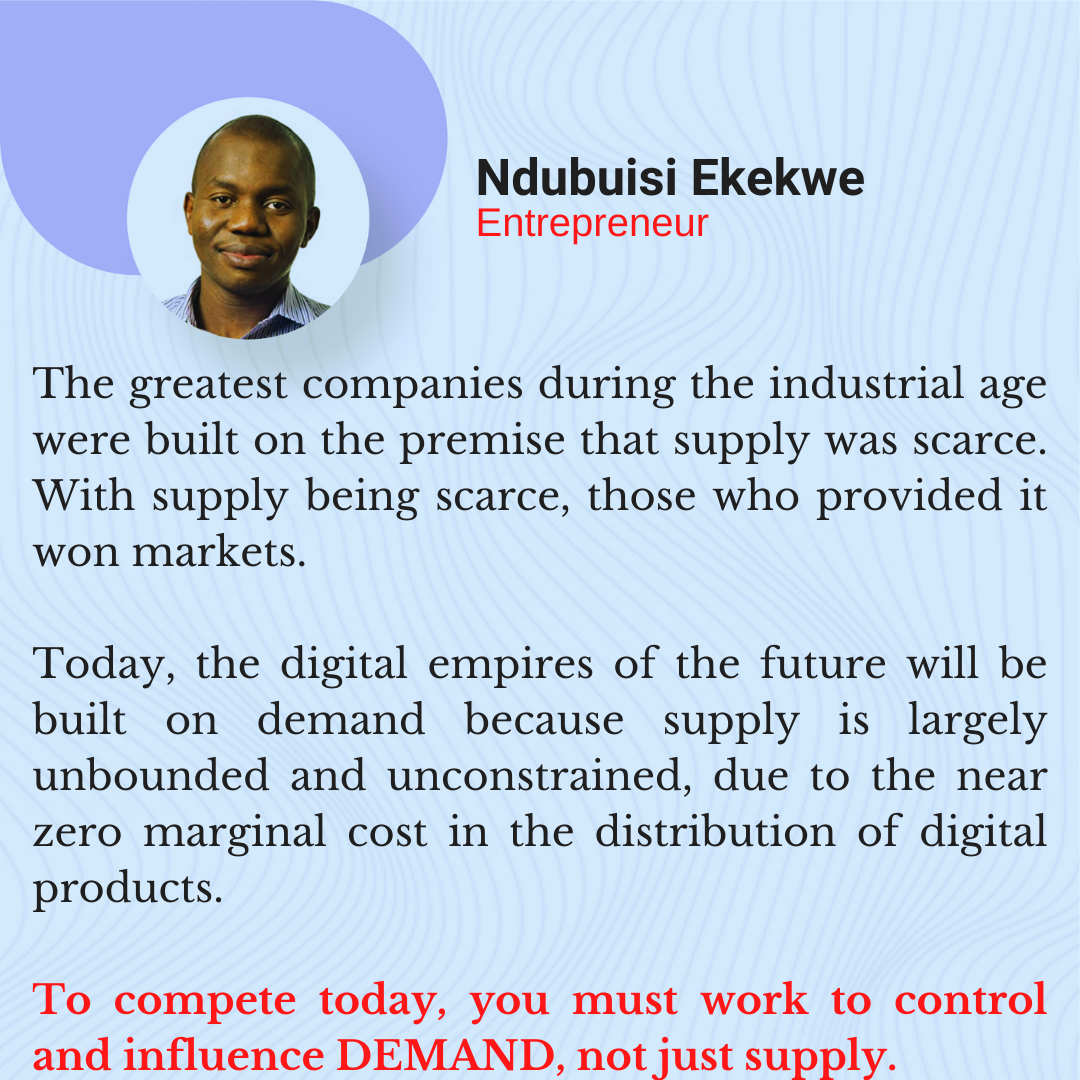
As markets mature removing the information asymmetry in the demand-supply relationship, DEMAND will shape the future of digital markets and more. To win the future, build business models which work to create leverages and deepen competitive advantages around DEMAND control, not supply. 

There is a reason why the more the world gets connected, the more Apple, Facebook, Microsoft, Amazon, Tencent, Alibaba, etc, become more dominant. It is not just that these firms are better operators. What is happening is that their business models are asymptotically attaining stability for the model of the era.

When things are not working in that firm, check if your business model has expired. Many have indeed expired! Blame mobile internet but it is your call.