DD
MM
YYYY

PAGES

DD
MM
YYYY

spot_img

PAGES

Home Blog Page 5474

Your personality does not expire in the minds of people even when titles and workplaces go

0

The greatest professional resilience is making sure that your job title and where you work do not define your personality and relationship with people.

Those two things are ephemeral, and if you allow men and women to relate with you, through them, the day they go, you will be looking for water in the boundless ocean.

Your personality does not expire in the minds of people even when titles and workplaces go. Great attitude will make your post workplace-career better.

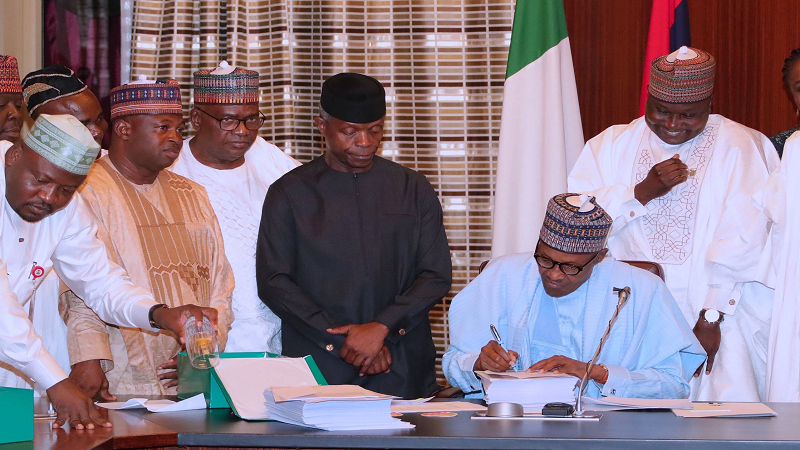
Senate Approves Buhari’s $17 Billion Fresh Loan Request

0
Nigerian leaders

On Wednesday, the senate approved $16,230,077,718 and €1,020,000,000 loans requests made by Nigerian President Muhammadu Buhari, broadening the country’s debt profile that has riled up criticism recently.

The upper legislative chamber also approved grant components of $125 million.

Nigeria’s debt profile has accelerated following the decline in oil revenue, the country’s main source of GDP (gross domestic products). Buhari’s administration has relied largely on loans to fund budgets as the government’s purse depletes.

The recent loan request is captured in the 2018-2020 borrowing plan that the government said is geared toward infrastructural and economic development.

The chairman of the senate committee on local and foreign debts, Clifford Ordia, said on Wednesday, that the ongoing projects contained in the loan request, are covered in the 2018-2020 borrowing plan and will result in infrastructural development as well as poverty alleviation.

“The projects will stimulate a rebirth of commercial and engineering activities and the consequent tax revenues payable to Government as a result of these productive activities will increase.

“It will be recalled that the senate at plenary in July 2021 approved financing for projects as recommended by the Committee above whilst the Committee continued further legislative action and consideration of the outstanding request.

“Subsequently, on the 15th of September 2021, the President of the Senate of the federal republic of Nigeria read another Communication from the President and Commander in Chief of the Armed Forces, Containing an addendum to the 2018-2020 External Borrowing (Rolling) Plan in the sum of $4,054,476,863, €710,000,000 and Grant Component of $125,000,000 for various projects and same was also referred to the committee for further legislative action.

“The committee notes that a good number of the projects in respect of which financing is being requested under the 2018-2020 external borrowing (rolling) plan are mostly ongoing projects and programmes in respect of which external borrowed funds have been spent in the past, including loans and grants.

“The committee found as a fact that out of a sum of over $22.8billion approved by the national assembly under the 2016-2018 external borrowing rolling plan, only $2.8billion, that is 10% has been disbursed to Nigeria.

“The committee observes that these projects, some of which require additional financing, will have a great multiplier effect on stimulating economic growth through infrastructure development, job creation, poverty alleviation, health care and improve our security architecture,” he said.

The external and domestic borrowing requests have been approved by the senate in addendum to the 2018-2020 borrowing plan. In July, the national assembly approved the sums of $8.3 billion and €490 million loans as initial requests from the plan.

The lenders have been the World Bank, African Development Bank, the French Development Agency (AFD), Islamic Development Bank, China-Exim Bank among others.

While Buhari and the Senate have justified the loans, saying they would stimulate the economic growth and create jobs, experts are concerned that the rising debt profile may mortgage the future of young Nigerians.

As of June 30, Nigeria’s public debt stock was at N35.465, trillion, (about $90 billion), according to data from Debt Management Office. This means, each Nigerian owes more than N157,907 or [using official rate] around $400, which is considered unsustainable in a country where over 40% of the people live on less than $2 daily.

The budget implementation report presented by Minister of Finance, Budget & National Planning, Mrs Zainab Ahmed in July, noted that the federal government spent 98% (N1.8 trillion) of the total revenue generated in the first five months of 2021 on debt servicing.

Against this backdrop, concerns are heightening that things could deteriorate. Critics say the economic and infrastructural development powered by the loans are not measuring up to the negative impact it is yielding.

How Great Is Nigeria In Technology?

0

A childhood friend of mine – who is incidentally a Nigerian presently residing in Japan – upon his last visit to Nigeria penultimate year, profusely greeted my presence with a series of lamentations.

The bosom pal, who often goes by the sobriquet ‘Jet’, disclosed to me that he was severely pained over the way and manner the Nigerian society was still wallowing in ignorance and ‘self-deceit’ as regards tech-driven issues. He had been a vocal type right from our secondary school days.

According to the returnee, on a sojourn though, it was seriously lamentable for a country that calls herself the Africa’s giant to be discussing how to produce “a mere pencil for four good years”, yet still finds it very difficult to come up with a prototype let alone a market sample.

He said when he was viewing the Science and Technology Minister on the Television while in Tokyo, as he was frantically and enthusiastically selling and boasting about the proposal, he didn’t hesitate to weep for Nigeria. He hastily added, “And now, they are promising production of solar cells, after failed pencil production.”

I was hitherto keenly interested in his stories pertaining to the country’s technological move thus far, not until a point where he unequivocally described Nigeria as a “nation with visionless leaders”, hence I abruptly lost attention therein.

Permit me to assert that Mr. Jet’s frank description of the country might not be mistaken if we must call a spade a spade. But owing to my unrelenting patriotic nature, I acted the way I did, which ostensibly didn’t augur well for his stance. Nevertheless, my patriotic features wouldn’t stop me from thinking as a realist afterwards.

What else would you expect to hear from a man who has spent a reasonable period in Japan, over eleven years if I’m not mistaken, than to look into the eyes of an average Nigerian and tell him or her that the country isn’t progressing, technology wise?

Come to think of it; we are talking about Japan that ordinarily ought, or deserve, to be rated as the king of tech across the globe. Even someone (returnee) from a nearby Ghana or thereabouts might still be tempted to toe the line of Mr. Jet, because the said West-African nation that initially dependent on Nigeria regarding power supply can currently boast of uninterruptible electricity to a reasonable extent.

Yes, there’s absolutely no doubt enthusing that Nigeria is a great country, but how greatly has she thus far fared in the area of technology? This is a candid and succinct question we must genuinely attend to if, as a people, we are truly determined to arrive at a definite destination.

If the gospel truth must be told in regard to the above enquiry, anyone who truly understands the situation here would boldly assert that Nigeria is nowhere to be found on the world map whenever tech-driven matters are being discussed.

This is the reason the concerned authorities are requested to sit up with a view to addressing the ugly and pathetic circumstance without further ado by facing the realities squarely at all cost, solely in the overall interest of the citizenry.

Facing the facts as expected would enable the relevant quarters to henceforth jettison every parameter or iota of temptation that would make the governments at all levels to continue to dwell on retrogressive issues when progressive ones are seriously needed.

For us as a nation to get it right, we are required to commence from the education sector. The area in question is presently bearing a deplorable and pitiable physiognomy, yet virtually no tangible step is being taken towards alleviating the obvious plight of the sector.

Nigeria has conspicuously grown of age that, by now, she’s meant to holistically realize that no existing nation becomes great, particularly in the field of technology, without duly embracing education. At her present age, she shouldn’t be reminded of the inevitable impact of education on a country’s quest for development and innovations.

Nigeria is unarguably not getting any younger, hence the compelling need for her to hold the bull by the horn in her apparent quest to reach the next level. It’s therefore high time she started doing the needful for the benefit of all.

The current administration led by President Muhammadu Buhari, not unlike the past ones, has laid so much emphasis on technology. It ought to be told, without equivocations, that the people are losing patience with regard to the numerous promises of the government in terms of technology.

In the 7th Tokyo International Conference on African Development (TICAD-7) held in Japan between 28th and 31st August, 2019, President Buhari stated, “Our administration has identified important sectors that are key drivers to the diversification of the economy.

“These include power, transportation, infrastructure, maritime/ shipping, agro-processing, mining, manufacturing, petrochemicals, food processing and textiles, among others. We consider these sectors as priority areas that will drive our economic agenda.”

Time has really come to start walking the talking. It’s imperative to acknowledge that this lofty agenda as presented in Tokyo cannot be well achieved without prioritizing technology, which depends majorly on research.

It’s indeed a shame that an average university in Nigeria, that’s supposed to be a research-oriented institution, can barely boast of the needed facilities to thrive in the area of creation of patents let alone commercializing them.

The country can at the moment hardly boast of functional technical colleges across the federation, yet the leaders keep ‘informing’ the world that they are doing the right things. These colleges used to be viable in the past, and tremendously helped in grooming our young ones in skills acquisition in various fields ranging from automobile, electrical/electronic services, sculpturing, wood work, to painting, and what have you.

It’s noteworthy that on a regular basis, Nigeria’s budget allocates about merely 9 per cent to the education sector, contrary to the 20% stipulation by the United Nations Educational, Scientific and Cultural Organization (UNESCO). We need to restore the lost glory of the country’s educational system by placing it as a priority.

A hub needs to be created by the governments towards enabling the youth to aptly thrive in the area of Information and Communications Technology (ICT), which is gradually dominating the global space, thereby making it look like just a village. ICT – popularly known as IT – has obviously come to stay, thus must be fully embraced by all and sundry.

The fact remains that the required talents as regards technology, or technically-inclined issues, are abundant in Nigeria. All the government needs to do is to create an enabling environment to allow the talented ones to wholly develop and sell their patents.

The country can’t be technologically great when the needful is being swept under the carpet on a daily basis. The concerned leaders must, therefore, be very courageous in their quest to get it right. 

Do Arts and Humanities PhD Students Need Better Understanding of Statistics? A Great Conversation from African-Early Career Researchers’ Academy

0

Throughout the world, doctor of philosophy is the last certificate anyone can earn from a university and feels being above others who do not have it. It is a certificate that confers enormous respect for the holders. Getting it requires a lot of processes. In some countries, PhD programme is being carried out using course work and research approach, while in others research approach is the most appropriate. In our experience, we have also seen countries where the programme is being done by publications. This means that students have to present a number of publications for the certificate.

However, this piece is not focusing on these approaches, it only presents some insights that emerged from a recent conversation on a digital platform of one of the African schools dedicated to skilling, reskilling and upskilling of early career researchers on the continent. Our analyst was part of the conversation, which was driven by an article shared by the founder and coordinator of the African-Early Career Researchers’ Academy, Professor Ayobami Ojebode of the Department of Communication and Language Arts, University of Ibadan, Nigeria.

Professor Ayobami Ojebode: Most of us have to deal with these statisticians from time to time …

Our analyst: It’s really important, especially when the researcher lacks proper understanding of those inferential statistics.

Professor Ayobami Ojebode: Look at you… why not, “especially when the statistician lacks proper understanding of the subject of research”

Our analyst: That is why researchers should employ action research approach even if the study doesn’t require it. As a statistician, I need to be carried along in your research design. I do tell most colleagues that without good statistical insights (qual or quant) research outcomes will not resonate with the intended purposes. Therefore, researchers need to understand some fundamentals of the statistics required for their researches.

Professor Ayobami Ojebode: Let’s discuss more after people have read the article… very interesting.

Rasheed Adebiyi: That some researchers lack proper understanding of inferential statistics is not debatable. However, what I found interesting is the angle of statisticians lacking a proper understanding of the subject of research. This happens when the statistician does not have a background in the discipline from where the research originates. There should be a balance somewhere.

Our Analyst: Yes. That should be a balance. That’s why researchers need to hire someone who has background knowledge of the field of the researchers instead of generalists. Despite this, researchers still need to engage the statisticians at the conceptualization stage not when data have been collected. I remember a case where a PhD candidate had collected data without knowing that a key demographic variable of the respondents is not included. To him, it’s not necessary. Unfortunately, he has a question that needs that.  Another angle to the discourse is that understanding of statistics helps in knowing how to frame questions towards appropriate statistics application.

Rasheed Adebiyi: Yes. It is important to hire a statistician that understands the discipline of the researchers. It is as well good to have an understanding of statistical applications. For instance, anyone who wants to measure influence or the extent of the relationship between two variables should know that he or she would use correlation. Equally, it is critical too to know that first level analysis as reflected by frequency counts and descriptive statistics may not yield much. What is important is that some of us as researchers need to drop our phobia for Mathematics transferred to statistics and seek to know more about these feared but not too difficult statistical terms.

Our Analyst: Let me add a great addition here. Do we know that emphasizing theories driven research questions/studies is not enough without analysing collected data using theories as well? For instance, using social construction theory requires that researchers use multivariate statistics not univariate ones. The theory also expects researchers to interpret the outcomes using propositions and existing empirical evidences, leveraging cross-validating approach.

Mustapha Adeitan: I agree that there should be a balance and the researcher should explain the basic essence of the research to the analyst in the basic language that a layman would understand irrespective of the background of the researcher. However, I think the curriculum in Arts and Humanities should include the basics of statistical analysis that will be enough to help the researcher in crafting good and easy to analysis research questions and data collection items. With that, balance will be met and both the researcher and the analyst will have an easy ride on the journey to do the analysis.

Our Analyst: Yes. We need to include statistics in our curriculum. In the United States of America, UK and South Africa, which I know, you don’t finish your PhD without knowing relevant software for analysis in your discipline. Before the inclusion, our supervisors need to help us. Even if I failed to state advanced ones in my work, I expect my supervisor to challenge me. With that I will believe that including it [when I know its usefulness to my study] will not be misconstrued. I have had experience, where a PhD student told me that his supervisor does not want advanced statistics when it is obvious that first level analysis is nothing in the current post-positivism research era.

Mustapha Adeitan: One thing I have seen recently is that some of our lecturers in Nigeria are yet to wake in the post-positivism research era. I have a friend whose supervisor refused to sign his project in a University in the North because he used advanced statistical analysis. The Oga (in our term) insist descriptive statistics is still the best in their area of study. So, I ask myself, how do we move research forward with such supervisors still in the system.

Our Analyst: We still need them in the system. Old soldiers never worn out completely. We need their experience. The key thing is that they need to have mindset shift. Let me share a story. One of my academic papers was rejected recently by a journal in Nigeria. I told my co-author that this work will be published in an international journal. We sent it out. The reviewer said the value addition of the paper is the statistical approach we used. Mindset shift and upskilling remains the best strategies.

Mustapha Adeitan: I agree we need them in the system as experience cannot be replaced with anything. However, early career researchers and we on the advance study level should see this as a challenge and face it seriously. No doubt, the elders will leave the stage one day for those behind them to also perform on the stage. How well are we preparing for our performance to meet the world standard research approaches?

Rasheed Adebiyi: There is a need to introduce statistical courses especially at the higher levels – Masters and PhD’s.

Our Analyst: We need statistical communication as a course. It is a big issue when postgraduate students do not know how to use Microsoft excel for simple data analysis and visualisation. How do we get our thoughts to the beneficiaries of researches?

Mustapha Adeitan: Statistical communication should be a big issue we should look at especially in our department. In the current world of Journalism, Data Journalism has come to stay and it’s gaining more attention by day. If a graduate cannot do simple analysis with Microsoft Excel, then, how would such graduate venture into Data Journalism. It will be a minus.

Reflective leadership in context

0
AU

The dynamics of leadership involve deliberate decisions and actions towards creating an environment where leaders and their cohorts can grow and thrive. In other words, the progress of every leadership endeavor is dependent on certain procedures and norms. One of these norms and practices that hold a vital role in leadership is referred to as Reflective Leadership (RL); an ageless term that has not gained as much influence as other forms of leadership despite its enormous role in the scope of leadership. In this article, I will share the various importance of reflective leadership to self-learning and problem solving.

REFLECTIVE LEADERSHIP AND RELATIONSHIPS:

The impact of Reflective Leadership can best be understood in the context of relationships, as our accomplishments reflect what our relationships have allowed us to achieve in connection with others, guiding and mentoring them as a natural outgrowth of good relationships (Suleyman,2012). This is exemplified among individuals in a group saddled with the responsibility of achieving specific goals while experiencing role and communication conflicts. By this an individual is made to pass through various self-discovery, team interaction and integration stages which makes reflective leadership instrumental. In the context of relationships, reflective leadership is practiced as a deliberate effort to integrate previous personal experiences of team members and pick out the useful lessons for the achievement of predetermined goals.

REFLECTIVE LEADERSHIP AND SELF LEADERSHIP:

It is imperative to note that Reflective Leadership is first an extension of Self-leadership, that encapsulates how an individual takes responsibility for his personal leadership growth and how he prioritizes and perceives his mental, physical, spiritual as well as emotional wellbeing. Reflective Leadership is a technique that facilitates a leader re-examining his/her basic beliefs in order to improve understanding and consciousness of why and what forms these beliefs and how it affects relationships. To maximize reflective leadership, the practice of deliberate and consistent meditation, critical thoughts and personal journaling must be appreciated. Here, personal questioning and analysis would be required. Overtime, it has been proven that reflective leadership has a positive impact on self-leadership, however students have not developed the techniques necessary to reflect on their performance as leaders (Flores, Matkin, Burbach, Quinn & Harding, 2012).

REFLECTIVE LEADERSHIP AND TECHNICAL RATIONALITY:

Schon (1983) and Comer (2016) gave a connection between Technical Rationality (TR) and Reflective Leadership (RL) using instances of students in school and professionals at work. They both believe these two concepts involves a few methodical and deliberate steps towards problem solving.  Schon (1983) refer to technical rationality as the instrumental and rigorous process of problem solving, by applying scientific theories and techniques. This implies that attention is usually focused on solving problems using standardized knowledge and processes, and for problems to be solved, one would first need to go through a special activity, called problem framing or problem setting.

While in school, students are taught models and frameworks expected to be transferred to their lifeworld after leaving the academic environment, and even though many of the practicality of these models are not tested while in school, beliefs are formed around them. Comer (2016) posits that the dynamic work environment is faced with unpredictable and unique challenges that would require a more analytical approach to resolve. Schon (1983) and Comer (2016) believe professionals, unlike students reflect on practice and modify their mental models based on experience. This reflection may be tacit or thoughtful, and the practitioners fit their teaching to their experience. They also assert that the thoughtful and purposeful reflection leads to more accurate and robust mental models of practice.

REFLECTIVE LEADERSHIP AND LEADERSHIP DEVELOPMENT:

Likewise, Reynolds (1999), opines that a commitment to questioning assumptions embodied in both theory and professional practice should be adopted by leaders, and reflection provides a meaningful way for leaders to gain genuine understanding on any leadership issue. The main objective for integrating reflection in leadership development programs is to maximize individual potential by allowing students to evaluate the significance of their experiences from a leadership perspective (Densten & Gray, 2001). It is therefore imperative to apply reflective leadership and by extension, technical rationality is every aspect of complex problem solving.

Densten and Gray (2001) notes that reflective leadership gives a leader the open-mindedness, responsibility and wholeheartedness needed to experience accelerated learning experience. It is observed that when leadership students approach learning from the standpoint of their previous experiences, and not just a predetermined curriculum, leadership growth will inevitably become the outcome as this would help in gaining insights and consider the complexities of situations. Furthermore, this process would encourage problem recognition and the development of hypotheses which are catalysts for further critical reflection.

As the demand for leadership increases across spheres, there is a need to ensure the adoption of reflective leadership as a tool for leadership development, problem solving and team integration. It is also recommended that more attention should be placed on Reflective Leadership (RL) as other forms of leadership have received. This will help leaders in achieving more successes, while maximizing past and present experiences, ideologies and situations.


References:

Densten, I. L., & Gray, J. H. (2001). Leadership development and reflection: What is the connection?

      International Journal of Educational Management, 15(3), 119–124.

Flores, K. L., Matkin, G. S., Burbach, M. E., Quinn, C. E. & Harding, H. (2012). Deficient critical thinking skills

among college graduates: Implications for leadership. Educational Philosophy and Theory, 44, 212- 

Reynolds, M. (1999), Critical reflection and management education: rehabilitating less hierarchical

approaches, Journal of Management Education, 23(5), 537-53

Schön, D. A. (1983). The reflective practitioner: How professionals think in action. New York, NY: Basic

Books, Inc

Suleyman D.G. (2012). Reflective Leadership in EFL. Theory and Practice in Language Studies, 2(7), 1355-  

     1362