DD
MM
YYYY

PAGES

DD
MM
YYYY

spot_img

PAGES

Home Blog Page 5484

Reflective leadership in context

0
AU

The dynamics of leadership involve deliberate decisions and actions towards creating an environment where leaders and their cohorts can grow and thrive. In other words, the progress of every leadership endeavor is dependent on certain procedures and norms. One of these norms and practices that hold a vital role in leadership is referred to as Reflective Leadership (RL); an ageless term that has not gained as much influence as other forms of leadership despite its enormous role in the scope of leadership. In this article, I will share the various importance of reflective leadership to self-learning and problem solving.

REFLECTIVE LEADERSHIP AND RELATIONSHIPS:

The impact of Reflective Leadership can best be understood in the context of relationships, as our accomplishments reflect what our relationships have allowed us to achieve in connection with others, guiding and mentoring them as a natural outgrowth of good relationships (Suleyman,2012). This is exemplified among individuals in a group saddled with the responsibility of achieving specific goals while experiencing role and communication conflicts. By this an individual is made to pass through various self-discovery, team interaction and integration stages which makes reflective leadership instrumental. In the context of relationships, reflective leadership is practiced as a deliberate effort to integrate previous personal experiences of team members and pick out the useful lessons for the achievement of predetermined goals.

REFLECTIVE LEADERSHIP AND SELF LEADERSHIP:

It is imperative to note that Reflective Leadership is first an extension of Self-leadership, that encapsulates how an individual takes responsibility for his personal leadership growth and how he prioritizes and perceives his mental, physical, spiritual as well as emotional wellbeing. Reflective Leadership is a technique that facilitates a leader re-examining his/her basic beliefs in order to improve understanding and consciousness of why and what forms these beliefs and how it affects relationships. To maximize reflective leadership, the practice of deliberate and consistent meditation, critical thoughts and personal journaling must be appreciated. Here, personal questioning and analysis would be required. Overtime, it has been proven that reflective leadership has a positive impact on self-leadership, however students have not developed the techniques necessary to reflect on their performance as leaders (Flores, Matkin, Burbach, Quinn & Harding, 2012).

REFLECTIVE LEADERSHIP AND TECHNICAL RATIONALITY:

Schon (1983) and Comer (2016) gave a connection between Technical Rationality (TR) and Reflective Leadership (RL) using instances of students in school and professionals at work. They both believe these two concepts involves a few methodical and deliberate steps towards problem solving.  Schon (1983) refer to technical rationality as the instrumental and rigorous process of problem solving, by applying scientific theories and techniques. This implies that attention is usually focused on solving problems using standardized knowledge and processes, and for problems to be solved, one would first need to go through a special activity, called problem framing or problem setting.

While in school, students are taught models and frameworks expected to be transferred to their lifeworld after leaving the academic environment, and even though many of the practicality of these models are not tested while in school, beliefs are formed around them. Comer (2016) posits that the dynamic work environment is faced with unpredictable and unique challenges that would require a more analytical approach to resolve. Schon (1983) and Comer (2016) believe professionals, unlike students reflect on practice and modify their mental models based on experience. This reflection may be tacit or thoughtful, and the practitioners fit their teaching to their experience. They also assert that the thoughtful and purposeful reflection leads to more accurate and robust mental models of practice.

REFLECTIVE LEADERSHIP AND LEADERSHIP DEVELOPMENT:

Likewise, Reynolds (1999), opines that a commitment to questioning assumptions embodied in both theory and professional practice should be adopted by leaders, and reflection provides a meaningful way for leaders to gain genuine understanding on any leadership issue. The main objective for integrating reflection in leadership development programs is to maximize individual potential by allowing students to evaluate the significance of their experiences from a leadership perspective (Densten & Gray, 2001). It is therefore imperative to apply reflective leadership and by extension, technical rationality is every aspect of complex problem solving.

Densten and Gray (2001) notes that reflective leadership gives a leader the open-mindedness, responsibility and wholeheartedness needed to experience accelerated learning experience. It is observed that when leadership students approach learning from the standpoint of their previous experiences, and not just a predetermined curriculum, leadership growth will inevitably become the outcome as this would help in gaining insights and consider the complexities of situations. Furthermore, this process would encourage problem recognition and the development of hypotheses which are catalysts for further critical reflection.

As the demand for leadership increases across spheres, there is a need to ensure the adoption of reflective leadership as a tool for leadership development, problem solving and team integration. It is also recommended that more attention should be placed on Reflective Leadership (RL) as other forms of leadership have received. This will help leaders in achieving more successes, while maximizing past and present experiences, ideologies and situations.


References:

Densten, I. L., & Gray, J. H. (2001). Leadership development and reflection: What is the connection?

      International Journal of Educational Management, 15(3), 119–124.

Flores, K. L., Matkin, G. S., Burbach, M. E., Quinn, C. E. & Harding, H. (2012). Deficient critical thinking skills

among college graduates: Implications for leadership. Educational Philosophy and Theory, 44, 212- 

Reynolds, M. (1999), Critical reflection and management education: rehabilitating less hierarchical

approaches, Journal of Management Education, 23(5), 537-53

Schön, D. A. (1983). The reflective practitioner: How professionals think in action. New York, NY: Basic

Books, Inc

Suleyman D.G. (2012). Reflective Leadership in EFL. Theory and Practice in Language Studies, 2(7), 1355-  

     1362

Mastercard Expands its Crypto-Payment Program to Asia-Pacific, As Nigeria Sidelines Itself from the Economic Boom

0

Mastercard has partnered with Asia Pacific-based cryptocurrency services platforms Amber Group, Bitkub, and CoinJar to launch payment cards, which will let users worldwide convert digital tokens into traditional fiat currency.

The move by the financial service provider is spurred by the growing adoption of cryptocurrency, taking the financial world by storm.

Though China opted out of the trend, preferring eCNY, its Central Bank Digital Currency (CBDC), the Asian region has opened its arms to the crypto evolution.

Mastercard’s data shows that 45% of Asia Pacific customers have plans to use cryptocurrency in 2022. It is one of four emerging payment methods, alongside QR codes, biometrics, and contactless, with 94% of consumers considering using at least one of them.

Mastercard is choosing the three crypto companies as its first partners in the Asian Pacific region, as it pushes the Mastercard global crypto card program. Amber Group has a presence in South Korea, Taiwan, and Hong Kong, while Bitkub and CoinJar operate in Thailand and Australia, respectively.

In July, Mastercard got trapped by the crypto enthusiasm, such that it announced plan to incorporate a crypto-powered service into its system globally.

That means, instead of directly transferring cryptocurrencies to a merchant, customers can use cards to instantly convert their cryptocurrencies into traditional fiat currency, which can be spent anywhere Mastercard is accepted, whether online and offline. The currency will always enter Mastercard’s network as traditional fiat currency.

“Cryptocurrencies are many things to people—an investment, a disruptive technology, or a unique financial tool. As interest and attention surges from all quarters, their real-world applications are now emerging beyond the speculative,” said Rama Sridhar, Mastercard’s executive vice president for digital and emerging partnerships and new payment flows for the Asia Pacific.

Although a large section of the world has embraced the cryptocurrency frenzy, others are yet to come in terms with it. And some governments are towing the China path while others are drawing regulatory policies that will keep the market in check.

For instance Nigeria, Africa’s largest economy, is embarking on an onslaught against cryptocurrency traders in the country, following the launch of its CBDC last month. The Central Bank of Nigeria (CBN), had earlier in the year, banned all regulated financial service providers from handling crypto-related transactions, forcing the teeming number of Nigerian crypto users, especially the youth, to Peer-to-Peer (P2P).

In addition, in a move seen as a measure to promote the newly launched CBDC dubbed eNaira, the central bank has directed banks to freeze accounts suspected of dealing with cryptocurrency. This means that Mastercard’s global cryptocurrency program is already prohibited in Nigeria, and the country is thus sidelined from the benefits, including financial inclusion.

Nigeria has a huge payment market that is adopting new payment methods in large volumes. Data from Mastercard shows that 96 percent of consumers in Nigeria are likely to consider using at least one emerging payment method in the next year.

The report also found that millennials were more willing, compared with the general population, to use and learn about cryptocurrency, a situation evident in the number of Nigerian youths who have embraced cryptocurrency.

Bitcoin on Monday reached all-time high above $68,000, putting the entire cryptocurrency market’s value above $3 trillion and further stoking the frenzy that has characterized the market in recent times.

Robinhood Market, a free financial service platform that helps everyone to buy and trade stocks, said on Tuesday that it has 1.6 million people on the waitlist for its cryptocurrency wallet, up from 1 million just a few weeks ago.

The leap is an indication of wide adoption of cryptocurrencies buoyed by the introduction of new features such as decentralized finance (DeFi), non-fungible token (NFT) and exchange-traded fund (EFT) to the blockchain system.

Though many countries are, like Nigeria, concerned about volatility and the use of cryptocurrencies to facilitate money laundering, unlike Nigeria, they are positioning themselves to grab a share of the multitrillion dollar economy that the burgeoning cryptocurrency industry has become.

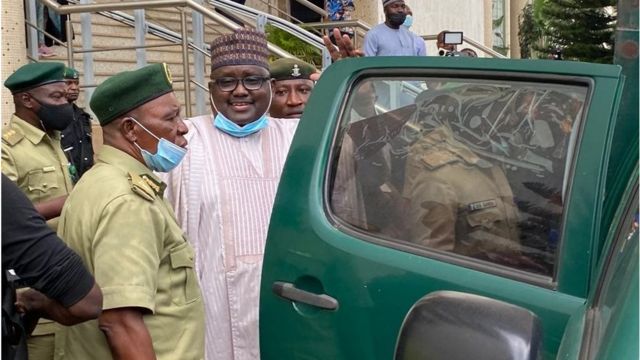
No matter how long it may take, justice will definitely be served: Abdulrasheed Maina and son a case study.

0

Mr Abdulrasheed Maina was appointed in 2010 to head the Pension Reform Task Team (PRTT) as it’s chairman. Due to his track record in public service, he came in highly recommended to effect positive change and carrying out necessary reforms as the team lead of the pension reform task force. 

In less than 2 years acting as the chairman of the pension reform task force, a man who was highly recommended to come clean up the mess lingering in the pension body and purge the black sheep ironically became the black sheep that needs to be cleaned up and purged out of the Pension Task Team as he was in numerous occasions fingered for corruption, embezzlement of the pension funds and money laundering.

In the years 2015, 5 years of him occupying the position of the executive chairman of the the Pension Reform Task Team, the Economic and Financial Crimes Commission opened his book of remembrance. He was charged to court for corruption, embezzlement and laundering of public fund worthing about N2 billion with his privies. 

Justice may seem to have been delayed as the corruption case against Mr. Abdulrasheed Maina lingered in court for about six years but the justice was definitely not denied as Maina finally got served hot justice and he got what he deserved. He was sentenced to 8 years imprisonment by his Lordship, Justice Okon Abang, on Monday, 8th November, 2021 at the Federal High Court, Abuja judicial division.

The sentencing of Mr Maina came exactly one month after his son Mr Faisal Maina who was fingered to be an accomplice to his father in money laundering and embezzlement was sentenced to 24 years in prison.

This should serve  as stern warning to politicians, political appointees, public servants and civil servants and eve private practitioners who feel that Nigeria is a no mans land and they can do any thing they like, embezzle public trust funds, steal collective resources  and launder money and get away with it.

Maina won’t see the light of the day for the next eight years while his son will spend atleast a decade around the four walls of the prison yard where they will both spend each day that passes in regret, agony and anguish. 

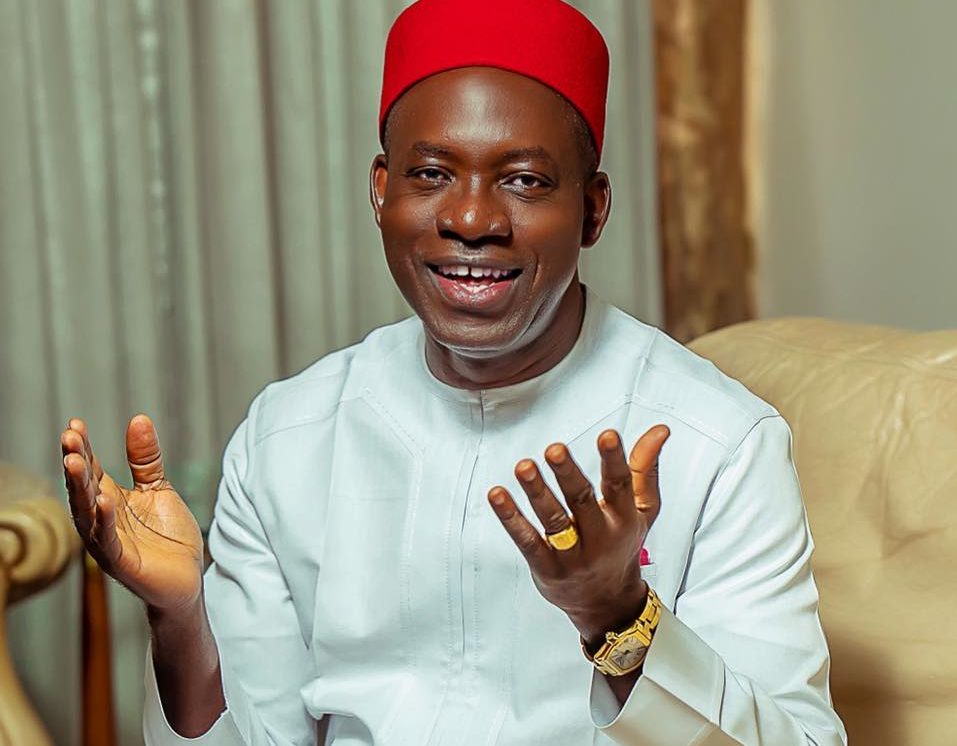
Chukwuma Soludo (APGA) Wins in Anambra State But It Was an Election NVPP Lost!

2

Soludo ga achi anyi [Soludo will lead us]. Yet, if there is another party [Non Voted Peoples Party, NVPP], any candidate representing it would have won. According to INEC which has called the election, Chukwuma Soludo (APGA), the winner of the November 6 governorship election in Anambra State, polled 112,299 votes, followed by Valentine Ozigbo (PDP) who scored 53, 807, and then Andy (APC) who closed at 43,285 votes.

Total accredited voters were 253, 388  with valid votes 241,523 and voided 8,108 (some possibly did not wait to vote).  The state has a total number of 2,466,638 registered voters!

Largely, if NVPP had mobilized more that 2.2 million registered voters who did not even care to show up, its candidate would have won. My point is this: Nigerians are not participating well in elections, and if people do show up, anything is possible.

This trajectory was the same during the last presidential election. If all the registered voters who did not vote were allocated to one special party, the party’s candidates would have won in all elections in Nigeria! This does imply that winning is indeed possible if those latent voters are stimulated, activated and mobilized to vote.

Mazi Soludo, congrats. Now, the work begins.

Update: This is Soludo Acceptance Speech

A Divine Journey Whose Time Has Come

Chukwuma Charles Soludo, CFR

Acceptance Speech following the Declaration of the Results of the Anambra State Governorship Election, November 2021, by the Independent National Electoral Commission (INEC): November 10th, 2021

With utmost humility and gratitude to God, I accept the results of the 2021 Anambra Governorship election as declared by INEC. This reflects the supreme will of the almighty God, and an overwhelming sacred mandate of the people. For 12 years since the massive clamour by the people of Anambra for us to serve them, we persevered to this Divine moment. This is a divine journey whose time has come. To God be all the glory and adoration!

We have a very long list of persons whom God used to make this moment a reality. In particular, we thank all members of APGA especially our national leader, HE (Sir) Willie Maduaburochukwu Obiano, our national Chairman, Ozonkpu Victor Ike Oye, members of the BOT, NEC, state Exco, etc for availing me the opportunity to fly the APGA flag and the cohesive party support.

Many thanks to our able Campaign Committee, our first rate legal team, and all other stakeholders who worked tirelessly and informally to see us through. We are grateful to all the stakeholders of the Anambra project— the clergy and the church, traditional rulers, ASATU, labour, market, trade and professional unions, youth and women organizations, non-indigene associations, businessmen and captains of industry, the Diaspora community, persons with disability, etc.

We thank all our donors, especially the hundreds of thousands of members of the 41 self-funding support groups who, for two years, put in their sweat and personal funds to propel this project. Never mind that all of you could not vote. The limited number that voted is still representative of the wishes of the people.

We are humbled by the massive support of stakeholders and Nigerians across the entire country. Your donations and goodwill are treasured. In particular, I thank my wife, Queen Frances Nonye Soludo, and children: Ozonna, Ifeatu, Chinua, Ekene, Oduko and Zikora for their love and sacrifices. Despite your deep reservations, you still allowed and supported me to step out in the service of our people. As I promised, I will work hard every day never to disappoint you.

At this moment, we must remember and will continue to remember all those who died in the course of this movement, especially the three policemen who were killed by unknown gunmen during our town hall meeting with youths in my ward. May God continue to grant their souls eternal rest.

The run up to this election and the election itself tested the resilience and integrity of our federal institutions. Many times there were tensions especially as one party boasted that it must “take” or “conquer” Anambra by all means. Our institutions proved again and again that this country can achieve eminent greatness when our institutions rise up to the occasion.

The judiciary, led by the President of the Court of Appeal and the Chief Justice of Nigeria, stood for the integrity of the judiciary. We salute the eminent justices of the Anambra High court, Court of Appeal and Supreme Court for standing up for justice. Your names will be written in gold. We thank President Buhari, the presidency, and our security agencies for ensuring a level playing field. We must particularly commend the Chairman, Management and staff of INEC for systematically striving to bequeath a legacy of free, fair and transparent electoral system to Nigeria.

The use of Bimodal Voter Accreditation System (BVAS) represents a massive improvement over the Card Reader and manual accreditation system. With a continuous refinement of the technology, upscaling of the skills of its operators, collaboration with telecommunication companies, improvement in logistical deployment and security, and stringent punishment for anyone involved in electoral malpractice, Nigeria will be on course to a robust and exemplary electoral system.

Aside from the initial glitches in the operations of the BVAS machines in some places including at my polling unit, the election has been adjudged as the most peaceful, free, fair and credible. There is joy in the land. Kudos to INEC!

To my fellow candidates in the election, I wish to congratulate you for the gallant contest. Our people have spoken overwhelmingly, and surely that loud voice is the voice of God. The ultimate winner is Anambra people: we are all winners. I hereby extend my hand of fellowship to all of you. I need all of you to succeed. Politics aside, we are all brothers. Let’s come together for the “Project Anambra”.

There is enough room for everyone to contribute in the service of our homeland. On February 7th, 2010, INEC declared as winner of the Anambra governorship election a candidate who had described the election as a sham on Channels TV and refused to vote in protest.

Two hours after the declaration, I addressed a press conference and congratulated him, and walked away without a legal challenge. I was probably the first candidate of a major political party to do that in Nigeria. In Anambra, we fight hard during elections but meet the next weekend at traditional weddings and funerals and throw banters and share drinks.

That’s the Anambra way! Let’s keep the “spirit of Anambra” alive and strong, and with it, collectively take our homeland to the moon. So far and even before the official declaration, I have received congratulatory messages from thousands of Ndi Anambra and Nigerians from around the world including some of my fellow candidates. I deeply treasure the massive goodwill.

To the estimated 17 million Ndi Anambra within and outside our homeland (state), this is your moment, seize it! This victory is your victory. My role will be that of your chief servant, and I will work every minute of the day with you to make you profoundly proud. I will need the guidance, advice and contribution of everyone to succeed.

Our state is one of infinite possibilities and humungous opportunities. Working in collaboration with other states, the federal government, and the international community, we have all that it takes to make our state whatever we collectively will that it can be. As we transit to a post-oil world and into the 4th Industrial Revolution, let us work together to build upon the foundations of our founding fathers and predecessors to create that livable and prosperous homeland that is the industrial, technology and leisure hub of West Africa. This is our manifest destiny, and collectively we shall get there!

Finally, let us work together to support our ably working Governor, Akpokuedike Aguleri, to finish very strong. Together, we can, and by the grace of God, we will!

Long live APGA!

Long live Anambra State!

Long live the Federal Republic of Nigeria!

I Stay Calm

0

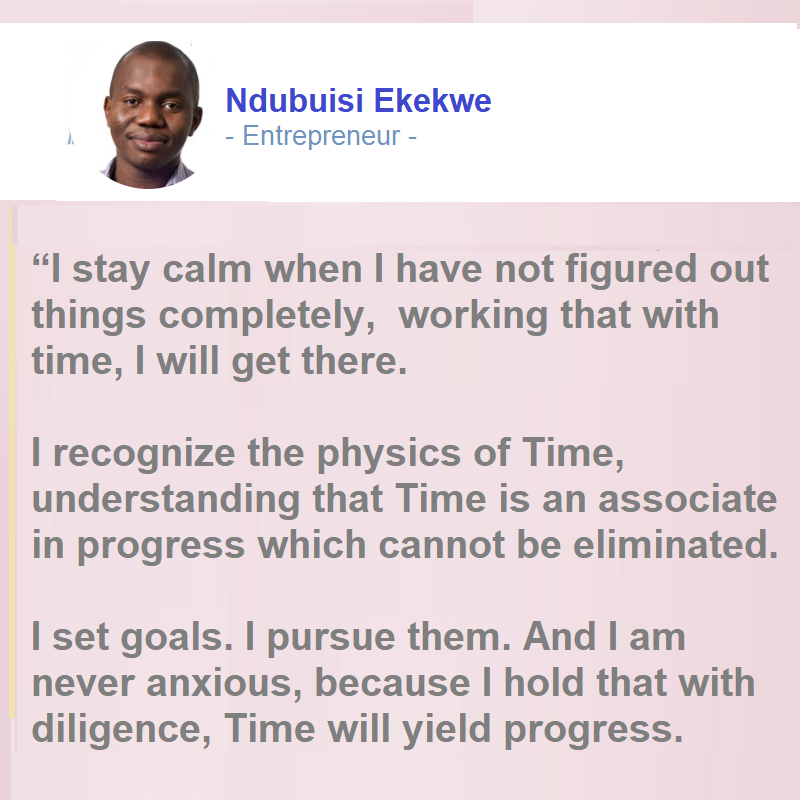
“I stay calm when I have not figured out things completely,  working that with time, I will get there. I recognize the physics of Time, understanding that Time is an associate in progress which cannot be eliminated. I set goals. I pursue them. And I am never anxious, because I hold that with diligence, Time will yield progress”. #calm