DD
MM
YYYY

PAGES

DD
MM
YYYY

spot_img

PAGES

Home Blog Page 5484

Understand The Relationship Between Quality and Price

2

Many US-focused ecommerce startups in Nigeria are struggling and closing. Yes, it is a nice vision: make it possible for Nigerians to buy shoes, bags, shirts, etc from Macy’s, JCPenney, etc as everyone wants quality things. However, when currency runs wild, bad things happen. It takes us to one of my core teachings: Product Minimum Viable Quality (PMVQ).

The deal is this: the construct of quality has no meaning until the price of the product is put into considerations. I always ask entrepreneurs to consider the Minimum Viable Quality (MVQ) bounded by the product target price which the market will respond to. You can build rockets to fly people around the world; that is an engineering possibility. But does that make business sense if no one can afford it? Ask the makers of Concorde Airlines for answers.

As apps mushroomed across Africa to help Africans dress like British and Americans, investors came along. But as currencies struggle, those apps are fading. Why? You may like Mercedes Benz over Toyota but can you pay for it? Etisalat had the best broadband service in Nigeria, but it priced many out – and ended up struggling. A crappy affordable service might have helped it because it is very hard to make money in places with limited money. Until you understand the relationship between price and quality, you will not make progress in the African business scene.

Sure, this does not mean making fake products. But it does mean finding a path to a market with things your target market can afford. It is the same company that makes those electric bulbs they use in airport towers and the ones we use at home. Those airport ones can go for $10k per unit while the home one is about $1. 

The airport versions can last for a decade because the real cost is the replacement cost while the crappy ones we use at home can go for 2 months and bust. A company which pursues quality, thinking that families will spend $10k to have an electric bulb that will last for 10 years has no mission! So what happens? You build for a minimum viable quality of $1 because that is what the market can pay!

Stretch it, you are outside the sweet spot of spending in Africa (see the plot).
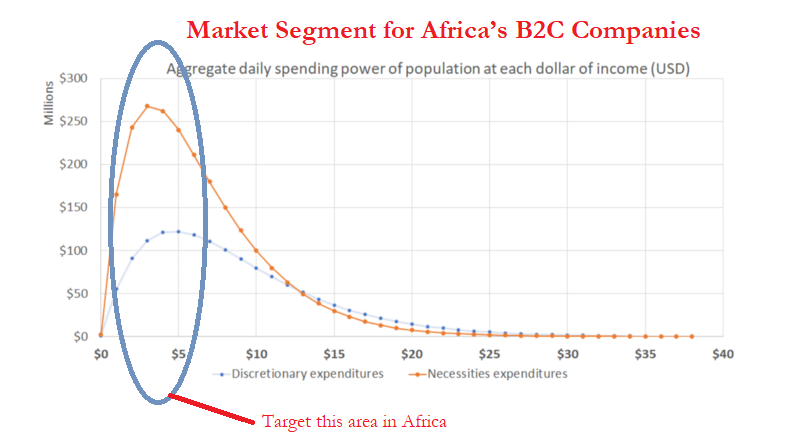
The Core Market Segment in Africa - Middle of the Pyramid - Tekedia

LinkedIn Comment on Feed

Comment: This reminds me of an observation made by one of my lecturers back then in the university. The Chinese by then had started flooding African markets with all sorts of cheap lookalike products to the ones we grew of consuming from Nigeria. Of course the Nigerian products were of better quality but before long, everyone started crying fowl of how quickly the cheaper Chinese products were getting bad. When i asked my lecturer back then why people kept buying the Chinese products only to complain afterwards, he smiled. I probed further…even America is complaining about Chinese products…why do they allow them do this…his response keeps resonating inybears till date. The problem in America is different from the one here in Cameroon. Over there, Americans are complaining of high quality products from China that sells cheaper than American products of the same quality. Here we have products with quality equivalent to what we can pay.

My Response: I have a video on this where  I used the Chinese toy industry and how that playbook made it possible for them to win markets across developing regions of the world. Who wants to spend $50 to buy a Christmas race-car toy from Germany when China offers one for $1 even though it may not last more than 2 hours on Christmas day. Because mothers are smarter: China’s $1 will win as they can save money for more important things. The kid has his toy even though it did not work for many hours!
Again, Despite Court’s Restraining Judgement, CBN Orders Freezing of Crypto-Trading Accounts

0

Again, the Central Bank of Nigeria (CBN) has ordered all Nigerian commercial banks to freeze the accounts of some individuals, who it said have been trading in cryptocurrency.

In a Post-No-Debit circular signed by the Director of Banking Supervision, J. Y. Mammanand, and addressed to the bank on November 3, the financial regulator directed that the funds belonging to Nnamdi Francis Okereke, Nwaorgu Kingsley Chibuzor, and a company called TVS Hallmark Service Limited be frozen.

“You are hereby directed to close accounts of the underlisted bank customers and place the funds in the accounts in suspense accounts for engaging in cryptocurrency trading in contravention of CBN Circular BSD/DIR/PUB/014/001 dated February 5, 2021.”

This is in continuation of the step taken by the apex bank early in the year, against those trading cryptocurrency in Nigeria.

In February, the apex bank ordered banks and other financial institutions to close all customer accounts used in trading cryptocurrencies and other related transactions.

The order was proclaimed through a circular distributed to deposit money banks, non-bank financial institutions and other financial institutions to “identify persons and/or entities transacting in or operating cryptocurrency exchanges within their systems and ensure that such accounts are closed immediately.”

Consequently, a host of individual and company accounts were suspended from carrying out any financial transactions. The CBN had banned all regulated financial institutions from dealing in any crypto-related transactions, on the allegation that cryptocurrencies pose a threat to Nigeria’s economy, and it’s being used to sponsor terrorism.

“Further to earlier regulatory directives on the subject, the Bank hereby wishes to remind regulated institutions that dealing in crypto currencies or facilitating payments for cryptocurrency exchanges is prohibited,” the CBN said in the circular.

Among the accounts frozen by the banks following the central bank’s directive were; Bamboo, Risevest, Trove and Chaka. These companies facilitate cryptocurrency trading and brokerage services for Nigerians to invest in foreign stocks, a service the CBN said it contravenes its circular.

However, these companies and other individuals, whose bank accounts were frozen based on the circular, filed a lawsuit challenging the banks’ action.

Last month, A Federal High Court sitting in Abuja vacated the interim order which directed the banks to suspend all funds belonging to the affected accounts.

In his ruling, the presiding judge, Taiwo O Taiwo, said the CBN failed to provide any law showing that it is illegal to deal in cryptocurrency in Nigeria.

“I have perused the counter affidavit of the Respondent and I see that the reason for freezing the account of the applicant is based on the alleged infraction of the circular of the CBN.

“The law is trite that any conduct that must be sanctioned must be expressly stated in a written law.

“Being unknown to law, circulars cannot create an offence because it was not shown to have been issued under an order, Act, Law or Statute,” Justice Taiwo said, and ordered the responsible banks, Zenith Bank Plc and Guaranty Trust Bank, to unfreeze the accounts.

Based on this judgment, CBN’s latest directive to banks to freeze the accounts of individuals, purportedly trading cryptocurrency, has been described as utter disregard for the rule of law.

It has also added to the culminating events, where the financial regulator has been accused of trampling on people’s rights and acting with impunity. One of those events occurred during the End SARS protest, when the central bank illegally blocked the bank accounts of some protestors, on the unfounded allegation of terrorism.

When Governors Become Emperors

0

I had almost gone to bed on the eve of 2016 Christmas when a phone call filtered in from Germany to engage me in an informal chat as usual.

The caller, Kunle, who happened to be my old-time friend, actually called to express his bitterness over what he observed on the television regarding one of Nigeria’s governors.

According to the buddy, he had on that very day watched a governor of one of the states in Southern Nigeria commissioning a Christmas tree worth over half a billion naira whilst the leader in question was reportedly owing workers and pensioners in the state for several months.

I thereafter wished Mr. Kunle would someday meet with my Dad whom I often refer to as a political philosopher. The old man – a well experienced octogenarian – one day informed me unequivocally that some states across the country were suffering from economic epilepsy, thus needed to undergo holistic lobotomy.

His seemingly candid view was informed by the way and manner in which some sitting governors invariably acted as if they were not accountable to anyone, and such an attitude had continued unabated.

To assert that currently some governors in Nigeria and other African nations operate not unlike an emperor isn’t in any way an overstatement, and such a weird custom is not peculiar to a particular state or region in the country. It suffices to say that virtually all the governors have been indicted of such bilious and nonchalant lifestyle.

Take for instance, a situation where a governor would refuse to conduct the Local Government (LG) council elections in his state and such scenario would linger till he leaves office. In most cases, he would put up a façade in the name of an election towards the expiration of his tenure, perhaps to prove to people that LG polls were eventually conducted under his watch.

This particular act of virtually all the sitting governors in Nigeria has ostensibly grounded the existence and functionality of the third tier government within the shores and caprices of the country.

Why wouldn’t such a governor be rated as an emperor when the officials of the other arms of government in the affected state such as the legislators and judicial custodians would remain a rubber stamp as the unfortunate scene prevails? Funnily enough, when a court orders the governor to without much ado conduct the long awaited LG polls, he would rather regard the legal directive as baseless, hence nothing to worry or be concerned about.

On a monthly basis, the Federal Government (FG) would release funds entitled by the third tier governments via the various states. In the process, the said allocation would be hijacked by the governors and such funds would never be utilized on the projects for which they were meant. Instead, they would be channeled toward the implementation of non-feasible projects.

The judicial system in the states suffering from the unruly behaviour is vulnerable, to assert the least. I have often witnessed a situation whereby an injunction is issued by a court of competent jurisdiction to stop a governor from taking a certain intended action, yet the latter would overlook the order with the notion that he alone has the final say in the state.

The vulnerability of the lawmakers in such states cannot be left out. Rather than act as independent elected officials, the legislators would be reduced to mere aides of the governor thus would invariably be left with no choice than to operate as they were instructed.

Similarly, the deputy governor would be seen subjected to function as the governor’s appointee, hence the former could be impeached or suspended anytime at will. What is left for this set of governors is to fence their states in order to possess it as their birthright or personal asset.

As the uncalled ill lingers endlessly, it’s noteworthy that the FG has a very vital role to play with a view to addressing it. There is a compelling need to, by law, scrap the various states’ electoral commissions.

By so doing, the conduct of the LG elections would become the prerogative of the Independent National Electoral Commission (INEC), or its like that may be consequently set up by the FG. This signifies it would no longer be the responsibility of the governors to determine when and how the said polls would be held in their respective states.

The anti-graft agencies such as the Economic and Financial Crimes Commission (EFCC) need to also shift their tentacles to the various states, to serve as a deterrent to all the public officers in the area. They must ensure they could boast of well-equipped branches in all the states across the federation, and such extensions must be manned by competent and trustworthy individuals who cannot compromise their statutory obligations irrespective of whose ox is gored.

The Fourth Alteration Act that grants financial autonomy to State Judiciaries and State Houses of Assembly recently signed into law by President Muhammadu Buhari is equally a way forward. Similarly, granting financial autonomy to the third tier government is long overdue.

Inter alia, it’s high time the electorate woke up from slumber. They need to fully acknowledge that they possess the constitutional immunity to recall any lawmaker who is not living up to the expectations. Also, they needn’t be reminded that it’s equally their right to say enough is enough whenever the impunity of their governor goes to extremes.

They must, therefore, bear in mind at all times that he is an elected official, not an emperor, hence the need to question his person when need be. 

Master Modern Markets And Value Creation At Tekedia Mini-MBA

0

Amazon vs Walmart and the power of efficient utilization of factors of production through modern business models. Investors look at compounding leverageable factors which posit a new economic order, throwing out expired valuation models, still used by some industrial age money-men and -women.

The same way Tesla which makes 500k cars per year is worth $1.2 trillion when Toyota which ships 10.5 million cars is worth just $290 billion.

What tools do you use to value companies? Unless you upgrade, you may not understand why Kuda is worth more than 7 banks in Nigeria combined! Or Why OPay is officially Nigeria’s most valued financial institution. Register for Tekedia Mini-MBA- and come to the future.