Tue, Nov 9 | 7pm-8pm WAT | Managing Operations for Productivity. Our Faculty is Modupe Olusoga, the Chief Operating Officer in Streamsowers & Köhn and a former HR Business Partner in KPMG.
When all the factors are ready, how do you manage them for productivity and business growth? Our Faculty will provide guidance on how to unlock new vistas in your company.
With the increasing access to smartphones, Internet data and social networking sites, fake news, misinformation and disinformation remain key disruptors in sustainable information creation and sharing ecosystem across the world. From the global north to the global south, individuals, organisations and governments are battling the menace. In the course of finding sustainable solutions to the problem, stakeholders in various political and non-political institutions have developed and still working on the right approaches and strategies for taming the trends of FMD.
From fact-checking spread FMD to training of information creators and individuals, a number of organisations in West Africa have done well when one looks at the number of fact-checked stories and trainings held between 2015 and 2021, our analyst notes. Some individuals who believe that providing solutions to the menace should not be the sole responsibility of the practitioners in the media industry and political leaders have initiated and executed various programmes. Some people and organisations have written reports and popular articles, educating people on the danger and cost of FMD.
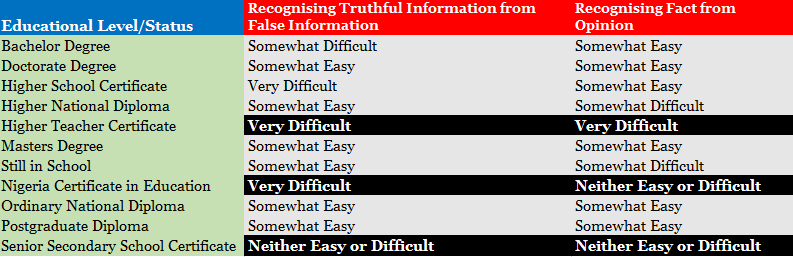
Our analyst points out that this is really surprising when one considers the low severity of the participants who believe that they know the difference between truthful information and false one. This is also applicable to citizens’ ability to separate facts from opinions. Our analysis largely indicates that female citizens are finding it somewhat easy to separate facts from opinions and truthful information from false information, while it is being somewhat difficult for male citizens.
Exhibit 1: West Africans’ Recognition of Truthful Information and Facts
Source: West Africa’s Fake News, Misinformation and Disinformation 2021 Survey; Infoprations Analysis, 2021
In other research, being carried out by our analyst in conjunction with other researchers in Nigeria, Russia and other countries in Europe, when Nigeria consumed and shared fake security and political news on Facebook and Twitter, they are not conscious of national unity. In terms of velocity [time of engaging with fake news, misinformation and disinformation], analysis reveals that Nigerians reacted to fake news that conformed with their readiness to spread information that could cause chaos and lead to disunity among ethnic groups, individuals and organisations.
As political leaders and non-governmental institutions, including individuals continue finding solutions to the menace, our analyst states that there is a need to consider critical thinking literacy as part of civic education subjects in primary and secondary schools. In higher education institutions [HEIs], stakeholders also need to consider it in the general studies courses. From the insights, it is obvious that West Africans need to be equipped with analysis, interpretation, inference, explanation, self-regulation, open-mindedness and problem-solving skills. These will help them in being conscious of what they read, watch, listen to and share.
Teaching critical thinking literacy, according to a number of experts in sociology and psychology, requires consideration of specific and general contexts in which FMD is being spread. Instead of teaching people the identified skills using general approach, tutors or trainers should take a critical look at the format of FMD. According to our analyst, if the FMD is mostly political or economic, teaching critical thinking in the context(s) requires specific consideration of the information in relation to the manifest and latent features that resonated with the political or economic environment of the people who spread the identified FMD.
Former Emir of Kano, Lamido Sanusi, has gone back to school. According to Premium Times, he has enrolled for a doctoral program in Islamic Law at the University of London, United Kingdom. The ex-king has since relocated to London to hit the books.
I like PhD and I recommend it: it is one of the best career insurance policies you can take, young people. That thing works wonders especially if earned from a great school; it opens doors. Those rich dudes have money and they really respect that appendage.
Certainly, Lamido does not need it for anything. He is probably bored and needs to invest his time in something tasking. I wish him good luck. And ABU Zaria Law should have an offer ahead!
By 2025, subscribers of mobile phone are expected to reach about 1o billion according to the International Telecommunications Union. The body cites increasing affordability of smartphones and accelerating technological adoption in sub-Saharan Africa. In Nigeria, these factors are not exceptions to the growth of mobile phone users and increase in subscribers of MTN, Glo, Airtel and 9Mobile that have been the key players in the mobile telecommunication service sector over the years.
However, the growth of the sector seems not to translate to delivering sustainable quality of service to the users across the country. Everyday, users and stakeholders are expressing mixed quality of service outcomes, calling on the concerned stakeholders to do more for users. Recently, MTN, the key player according to subscriber base, had a breakdown for days. The breakdown led to poor call connectivity and data usage among the subscribers. As the debate continues, this piece examines four quality of service metrics of the Nigerian Communications Commission. The metrics has a significant number of positive and negative performances of the four dominant brands between May, 2020 and April 2021.
The metrics include Commission Dropped Call Rate, Standalone Dedicated Control Channel Congestion, Traffic Control Channel and Call Set Up Rate.
According to the regulatory body, “Standalone Dedicated Control Channel Congestion is used in the GSM system to provide a reliable connection for signalling and SMS (Short Message Service) messages. A dropped call is a call that is prematurely terminated before being released normally by either the caller or the called party (i.e., the call is dropped before the exchange of Released Message “RL_M” and Released Complete Message “RLC_M” in the signaling flow). Traffic Control Channels (TCCH) are responsible for transferring control information between mobiles and the BTS.”
Interconnectivity of the Measured Quality of Service
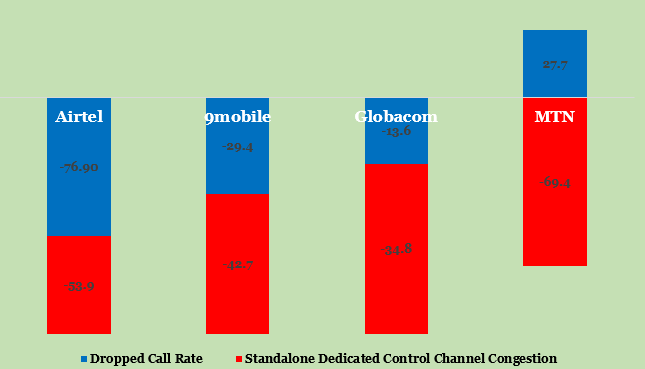
One of the surprising insights from our analysis is that the four brands performed well in 11 months out of the 12 months of data produced by the Nigeria Communication Commission. Throughout the 11 months, MTN was better than other service providers. Further analysis of the performance using average approach reveals that performance within the call set up rate and dropped call rate connected by 8.9% while 1.8% was recorded for connection between Standalone Dedicated Control Channel Congestion and dropped call rate 1.8%. It was 69.9% for traffic control channel and dropped call rate. These results indicate that the four brands struggled in their quest of providing better service to users during the 12-month period. For instance, the positive association of call set up rate and dropped call rate signifies that the more the brands prepared better call set ups for their subscribers, the more the subscribers experienced call droppings. It also suggests that subscribers had bitter experience when they replaced calling with sending messages.
Our analysis further reveals that MTN’s call set up performance seems not to help subscribers to experience quality service while calling because one percent of ensuring better call set up increased the extent to which users experienced call droppings during the period of analysis. On a surprising note, our analyst discovered that Airtel seems to have advantage over other brands in terms of the degree to which its ability to ensure and sustain call set up enhanced better calling experience [see Exhibit 1].
Exhibit 1: Place of Call Set Up Rate in Select Quality of Service Metrics
Source: Nigerian Communication Commission, 2021; Infoprations Analysis, 2021
Competitive Advantage in the Midst of Quality of Service Challenge
In our experience, we found a clear manifestation of QoS strategic game among the brands. Our analysis points out that the better the MTN’s QoS, the better the Glo’s QoS as well. This is also found for Glo and Airtel, Airtel and 9Mobile. However, the better the Glo’s QoS the less was 9Mobile’s QoS. This is also discovered for MTN and 9Mobile. Clearly, MTN seems to reinforce its market leadership by competing favourably with other brands. In all the metrics, are there differences? Our analyst asked this and found mixed surprising insights.
For the dropped call rate metric, there was no strong difference between MTN and Glo. A strong difference exists between MTN and Airtel. In this regard, Airtel was better than MTN in terms of less dropped calls. We also found a strong difference among MTN and 9Mobile [9Mobile is better in terms of less dropped calls], MTN and Glo [Glo is better than MTN], MTN and Airtel [MTN is better], and MTN and 9Mobile [MTN is better]. Analysis of difference for Standalone Dedicated Control Channel Congestion metric also reveals a strong difference between what MTN and Airtel recorded during the 12-months [however, Airtel is better], MTN and Glo [Glo is better], MTN and 9Mobile [9Mobile is better]. For traffic control, a strong difference exists between MTN and Airtel [however, Airtel is better], MTN and Glo [however, MTN is better], and MTN and 9Mobile [MTN is better].
As a need-driven sector, the conversation around ensuring better quality of service by the GSM brands is a continuous one between the service providers, subscribers and the regulatory body in Nigeria. This will ensure that the users have value for their hard-earned money in the course of meeting their communication needs. It is equally important that service users understand and use the service complaint framework put in place by the regulatory body. While the brands are advised to pay more attention to infrastructural deficiencies that contribute to their inability to fulfil subscribers’ telecommunication yearnings, the NCC should continue to be vigilant in ensuring that services promised by the telecommunication brands are the services delivered.
Shrugging off months of decline that saw half of its value wiped off, the cryptocurrency market is now worth more than $3 trillion.
Tesla’s CEO, Elon Musk’s decision to part ways with bitcoin earlier in the year, triggered a decline that resulted in mass selloffs. It was exacerbated by the crackdown on cryptocurrency in China. Now, a wave of new factors is driving a rally that has witnessed bitcoin and ether beat the all-time highs they set earlier in the year.
Bloomberg highlighted some of the factors driving the bull market.
The little more than a decade old market for digital assets has already roughly quadrupled from its 2020 year-end value, as investors have gotten more comfortable with established tokens such as Bitcoin and networks like Ethereum and Solana continue to upgrade and attract new functionality. Excitement about the possibilities of decentralized finance and non-fungible tokens is growing, and memecoins like Dogecoin and Shiba Inu continue to attract attention.
“Bitcoin appears to be pushing out of a bullish flag pattern, and Ether is likely to confirm a long-term breakout on a close above resistance this Friday,” said Katie Stockton, founder and managing partner of Fairlead Strategies, in a note.
As of 9:54 a.m. in New York, the overall market cap of cryptocurrencies hit $3.3 trillion, according to CoinGecko pricing. The third- and fourth-biggest tokens, Binance Coin and Solana, have added more than 20% in the past seven days; all of the seven biggest coins are up over the last week.
Bitcoin rose as much as 5.6% on Monday to $66,414, nearing its previous record of about $67,000. Ether advanced as much as 3% to a new high of $4,768.
Crypto companies such as miners Marathon Digital Holdings Inc. and Riot Blockchain Inc. each rallied more than 10% Monday. Coinbase Global Inc., the largest U.S. exchange, gained as much as 3.6%, a day before reporting third-quarter results.
Of course, crypto is notoriously volatile. The last time Bitcoin reached these levels, it fell back several thousand dollars, and it’s undergone multiple corrections that take it down by half or more. Other coins are even more volatile — the memecoins bounce back and forth wildly at times — and scams and hacks occur with some frequency.
Bitcoin’s current rally has been fueled by the U.S. trading debut of a Bitcoin-linked ETF as well as Elon Musk’s weekend Twitter poll, said Ben Caselin, head of research and strategy at crypto exchange AAX. “With Shiba and other memecoins having surged recently, and Facebook’s rebranding to Meta, interest in altcoins continues to rise.”
Crypto optimists had predicted $100,000 all-time high for bitcoin by December. The prediction is appearing increasingly possible as metaverse, web 3.0, NFT and EFT keep sustaining the market’s rally.