DD
MM
YYYY

PAGES

DD
MM
YYYY

spot_img

PAGES

Home Blog Page 5503

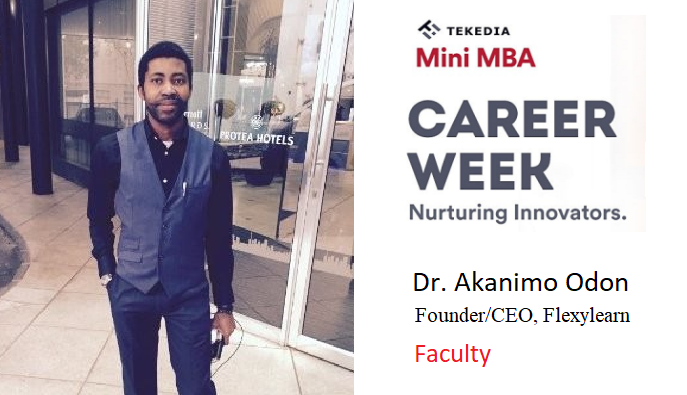
Dr. Akanimo Odon Will Speak Today At Tekedia Career Week

0

He has been an Adviser to the British Government on developing international education policies under the National Student Forum, On-call Education Partnership Consultant for British Council, and Business Development Consultant for the Grow Creative Scheme under the European Regional Development Fund (ERDF). He is a business consultant with deep experiences in education, manpower development. He is the founder/CEO of UK-based Flexylearn.

Dr. Akanimo Odon, a Tekedia Mini-MBA Faculty, will present during Tekedia Career Week today [Zoom link in the Board]. With a sub-theme Nurturing Innovators, Dr Odon will examine how we can plan our careers and build resilience during this age of disruption. Yes, as technology changes the rules of markets, and post-covid-19 becomes the new normal, we need insights on how to run that personal career playbook. The Week is not about helping our members to find jobs. Rather, we hope the insights would help them have great careers.

Tekedia Institute >> learn from the best.

Youth unemployment as a catalyst that drives conflict in West Africa

0

An Idle man is the Devil’s WorkshopProverbs 16:27 (king james version)

What is conflict?
Conflict simply put is a clash of interest. Conflict is a disagreement between two or more separate groups or individuals. These clashes of interest or disagreement may arise also out of divergent political views, divergent economic views, divergent social views, divergent ethnocentricviews or difference in religious views. Although some experts are of the opinion that greed is the major cause of conflict as it is what drives people to war rather than grievance. The greed for economic resources cum political advantage or dominance leads to a full-blown arm conflict when not resolved early.

Human relation experts has also claimed that in human relationship, there must always be clash of interest, disagreements, squabbles, quarrels, fights etc. which can either be over who controls or has the lion share in the limited available recourses or clash of political interest or clash of religious, ethnic or social interest. In the words of John Wesley, ‘we (humans) may disagree to agree’, hence, conflict is inevitable in the society be it advanced or less advanced society, developed or undeveloped but these conflicts can always be averted if different parties agree to come to the round table and resolve the differences as ‘all war is a symptom of man’s failure as a thinking animal’ according to John Steinbeck 

Having established what conflict is which is obviously an inevitable part of the society and human relationship, in its attempt to define, I delved into what causes it or what can lead to clash of interest between individuals. I highlighted earlier to be economic reasons, political reasons, religious reasons, ethnocentric reasons and social reasons. I will be dwelling mostly on the economic and political reasons of clash of interest as causes conflict since the focus in this essay is ‘the impact of youth employment on conflict in ECOWAS states. Making sense out of topic, I will rephrase to be ‘the implication of youths unemployment in west Africa’.

For the sake of emphasis, West African countries includes 16 countries: Benin, Burkina Faso, Cape Verde, Ivory Coast, Gambia, Ghana, Guinea, Guinea-Bissau, Liberia, Mali, Mauritania, Niger, Nigeria, Senegal, Sierra Leone and Togo (United Nations Statistics Division, 2012).

We would all agree to the fact that the major reason for conflict is unemployment. As we quoted the bible earlier that an idle man is the devils workshop, meaning that a jobless and unemployed youth can always be used as a tool by mischief makers to carry out social vices and cause conflict.  A busy and gainfully employed youth won’t have the time to engage and participate in conflicts as he will be busy with his work, too busy to engage or to get incited easily to engage in conflicts but the jobless and unemployed youths are easily exploited by either the corrupt political elite, the fanatical religious leaders or external political personas who want cause conflict and hit up the polity for their selfish interests and they are always available to get engaged with whatsoever thing whether good or bad. Unemployed young people, mostly male, who receive their income from informal economic actions and are prone to crime and violence, so also unemployed youths who don’t have a job whether formal or informal job they receive incomes from.

Mischief makers, corrupt political elites and corrupt influential individuals in the society has exploited and are still exploiting the desperation of the youths to make a living in so many ways by engaging them in social vices for their selfish interest instead of creating a well meaning jobs for them. 

It is at this juncture that I will say that high rate of unemployment equals to high rate of conflict’.

The countries with less jobs and high poverty rate are prone to constant conflicts as against countries that there are jobs for the youths and the youths are gainfully employed. For instance, in a country like Serra Leone where conflict have been ravaging for long, the world bank statistics shows that as of 2014 only 46% of the citizens of the country are employed and have one thing or the other to keep themselves busy, engaging in formal (white collar jobs) and informal jobs to make ends meet. This is to say that about 54% of the citizens of Serra Leone were unemployed (mostly the youths) and that rate of unemployment keeps being on the surge in the country, little wonder why the youths are quick to take up arms and go into war over a mere difference or disagreements that could be settled without resorting to violence. 

Also, in Nigeria which crown herself as the giant of Africa, statics also indicate that the unemployment rate is high in the Northern part of the country thereby creating huge poverty rate of about 67% (according to the world bank statistics). You don’t need a seer to tell you that there will be constant conflict in that region which has led to proliferation and uprising of different terrorist groups and banditry in that part of Nigeria. The infamous Boko haram which has turned a world a world class terrorist group started and brewed in that part of the country and their cohort called ‘the herdmen’ which are also turning into a night mare in Nigeria and other neighboring African countries.

Unemployment and conflict goes hand in hand. A jobless man will be easier to incite and excite to pick up arms and go to war than a gainfully employed man who makes ends meet. Therefore, when there’s jobs to engage the youth the rate of conflict will reduce drastically. When youths are gainfully employed and are into various activities, they won’t have the time and will be too busy to engage in conflicts hence the need for creation of more jobs for youths in individual Ecowas state as this has proven to be a catalyst that takes away conflicts, builds peace and utilize the youths’ energy, potentials, talents for better things other than conflicts. 


I will not fail to pass huge bulk of the blame to the political, religious and social elites and other respected and influential members of the society who are also stakeholders in the society. The African leader rule Africa states like their properties which made Williams Paul D to write, Siaka Stevens and his successor Joseph Momoh ruled Sierra Leone like their personal fiefdom from 1968 until a military coup in 1992’ These leaders would instead to create jobs and build up a system that accommodates and assimilate the youths to shine would rather buy arms and share to the youths prepping them for violence and social vices. It is no longer a rumor that arms are being shared to youths like peanuts by corrupt politicians during election period and incite them to use the arms to harass, intimidate, injure and even kill their political opponentsexciting and motivating them with tips and little amount of money. An illiterate and unemployed youth who has seen what he can do using guns and other arms will need therapy sessions and rehabilitation to make him to drop the arms. So this arms shared by the politicians end up being a tool the youths use for conflicts and cause social unrest even after election periods. 

For there to be peace, the leaders of the societies must create jobs which will accommodate the youths and get the youths busy, too busy to be incited for conflicts as high rate of unemployment equals high rate of conflicts.

The youths are leader of today and the leaders of tomorrow and are the pillars of the society and for any country to move forward the youths must be engaged and their potentials harnessed for good. These potentials can only be harnessed when they are gainfully employed hence keeping busy, utilizing their God given talents and energy, contributing to their quotas to the development of the society thereby staying away from conflicts. 

 X-raying The Many ‘Sins’ Of Nigerian Politicians

0

The last time I checked, virtually all the practising politicians domiciled in Nigeria – coupled with most other African countries – had profusely ‘sinned’ politically, hence in need of holistic cleansing.

We can’t boldly deny the conspicuous fact that the current physiognomy of Nigeria’s political terrain is freckled, yet millions are carried away by frivolities rather than being disturbed about how to eliminate the fathomless freckles.

It isn’t anymore news that Nigerian politicians have in the past decades been seriously feeding on the electorate’s ignorance, that, it has seemingly become not unusual to witness a scene whereby the former would be seen inducing the latter to support him at the polls with a mere peanut.

Insincerity has abruptly become synonymous with most politicians in this part of the world. They continually, especially during the electioneering era, tender speeches they do not really mean. They pleasurably do so with the sole aim of luring the ignorant, or perhaps vulnerable, electorate into their nets.

This set of people is deceitful. They have inadvertently, or probably knowingly, seen deceptive utterances or actions as acceptable. They invariably nurture such perception, believing they would never be found wanting at any time because they are ignorant of the view that power revolves around them.

An average practising Nigerian politician is desperate, hence at all times displays actions that are inimical to humanity. Owing to this kind of lifestyle, which has apparently been absorbed as a norm by the actors, many end up committing all sorts of atrocities in their bid to secure victory during elections. The funniest part of this feature is that the persons who bear it see their desired political positions as their birthright.

Our present days’ politicians, unlike in the past, see themselves as businessmen instead of stewards, hence would continue to see any position they are occupying as their vineyard. Once they clinched any post they had been clamouring for, the first thing they do is to hurriedly host a revelry with the notion that the days ahead would witness tremendous harvest.

They are arguably not conscience-driven. Those who practise these dance steps are ostensibly so myopic that they have apparently forgotten the Law of Karma. To them, since they are in charge of ‘every law’, there’s absolutely no other law that can turn or work against them. This is the reason they often individually murder their consciences.

Though virtually every active and practising politician domiciled in the country is made of these uncalled qualities, we ought not to forget in haste that there’s still a few that strongly believes in doing the needful although some tend to be negatively influenced in the long run.

Time has conspicuously arrived for our politicians to note that it pays to be ingenuous and do the right thing, and that the pains that accompany a fake life cannot be overemphasized. Hence, they are expected to wear good qualities like clothes.

Good and dependable politicians delight to serve the people and consider themselves as servants. They therefore see the people as their paymasters. They represent the hopes, aspirations and the interests of every citizen in the concerned society.

A Politician’s idiosyncrasies are his characters that are natural while some of the qualities are as a result of external influences. Promising politicians’ qualities are often backed by skills, experiences, intelligence, and integrity. All combined together to achieve their goals. The best qualities of a politician are honesty, God fearing and loving.

A good politician captures the essence of truth, displays sincerity, candor as well as practises what he/she preaches. He makes decisions and accepts responsibility for his words and actions. He makes promises and keeps them. He’s somebody people rely upon. He loves people with all his heart, might, mind, soul and is always striving to help them.

A good and responsible politician ought to appear as the image of his creator. He gives high regard for morality. He’s law abiding with no tendencies to corrupt even a single cent or kobo. The greatest strength of a good politician is deriving joy in serving people and not to steal taxpayers’ money. He acknowledges that a fulfilling and meaningful life is created through service to others.

To be an effective politician, your followers must have trust in you. And the very best way for a politician to build trust is to display a good sense of character and qualities composed of values, ideologies, traits and skills. Thus, a good politician should be a well disciplined personality that understands the language of selfless service.

Among all, a good political leader ought to be willing to appoint or contract people with great technical experience to solve the societal plights his administration contracted. Responsibility and party loyalty is another good quality of a responsible politician in a democratic state. A responsible and real politician is nearer to his people and always willing to meet them to comprehend their problems.

Only fake politicians are seen by voters when an election is near, or change parties as footballers change clubs. They will after taking the oath of office with the Holy writ and lousy thanksgiving services, use their powers against the people’s interests rather than for public good, thereby making them become barriers to the progress of their citizens.

As Nigeria is gradually nearing another pre-election era, the politicians who have ‘sinned and come short of God’s glory’ still have the privilege to seek forgiveness by ensuring they henceforth become repentant creatures.

The good news is that their teeming followers are seemingly damn ready to forgive them if their remorse is truly candid.

LinkedIn Launches Marketplace, A Feature for Freelance Services

0

LinkedIn has launched Service Marketplace, a new front in the job market for freelancers. The new feature, which has been in the pipeline for long, will let people advertise themselves for short-term engagements to those looking to hire people for such roles.

It is a major shift since the Microsoft-owned platform closed down in China. The new feature shares similarities with the likes of Fiverr and Upwork, skills and knowledge outsourcing platforms.

Per TechCrunch, Service Marketplace was first leaked out as a small test in February this year. Since then, LinkedIn has been running a quiet beta of the service in the U.S., which has already picked up 2 million users from among the nearly 800 million users (as of Wednesday’s earnings report) that LinkedIn now has globally.

The feature has gone live globally: to set up a freelancer profile, you go to your own profile page, find the button near the top and follow the script to set it up and flag what you might be interested in working on.

LinkedIn aims to use the new feature to expand its recruitment services. The company said in Wednesday’s earnings call, per TechCrunch, that confirmed hires on the platform increased more than 160% year over year, with advertising revenue overall up 61% in the same period. It is managing to upsell those doing recruiting to its wider suite of training content, too: LinkedIn Learning now has more than 15,000 enterprise customers.

Product manager Matt Faustman told TechCrunch in an interview that the Service Marketplace is launching with 250 job categories, and the plan is to expand that to 500. He thus explained how the feature will work.

“We are barely scratching the surface,” he said. Marketing has been one of the stronger categories to date on the marketplace, he added.

“Barely scratching the surface” may be the operative phrase here.

For now, there is no way of negotiating a fee for work, nor for invoicing, and those looking to find people are not required to give any specific guidance on fees until they get into a deeper conversation with a candidate.

When it comes to reviews, clients can review those they have engaged, but the individuals cannot leave a reciprocal review for the clients.

And, those listing their profiles on the Marketplace have no way of finding jobs themselves: they are there to be discovered, not to search for work.

Clients looking to fill jobs will be able to look for people by way of LinkedIn’s bigger drop-down search menu: for example, looking for specialists in brand marketing, you can start to type in that phrase in the search window, and LinkedIn will suggest “in Service Marketplace” as an auto-complete, which will take you to a list of candidates in that category.

In turn, those candidates will be sorted based on how closely you the client might be connected to each individual, either via a work or personal connection.

But again, those who are brand marketing specialists, as one example, will not be able to scan a wider list of opportunities. Faustman said that all the current limitations are intentional: they have, for now, built this for the client experience, and the idea is that by letting them make targeted tasks, they do not get inundated with applications that they then have to spend time triaging.

Over time this, plus all of the other features that are missing such as payments, will be re-evaluated, he said.

That will be critical if LinkedIn hopes to get the credibility of the workforce that it’s trying to cultivate here. Freelancers often suffer from a lack of transparency on rates, and run the risk of being exploited as a result through low-balling, a point Faustman acknowledged is an issue and said was a point of contention within LinkedIn’s product team.

“We will address the pricing point, but we decided not to for now,” he said.

Another interesting turn will be how and if LinkedIn will bring in other kinds of workers into the marketplace, covering the wider population of people who are working on the front line and other service jobs. There is no immediate roadmap to include them in the Service Marketplace, Faustman said, but “the long term is that we can extend this into any category that exists on LinkedIn.”

Mark Zuckerberg Explains His Metaverse Vision (full text)

0

Meta, a name that put the long-held anticipation of the planned new name for Facebook to a stop, was announced Thursday by the company’s CEO Mark Zuckerberg.

Zuckerberg, who in July announced the formation of metaverse product group, as he pushes to build something brilliantly different, which he believes will take the place of mobile internet, unveiled the metaverse plan on Thursday.

He explained his meta vision and what he aims to achieve with it. Read below.

We are at the beginning of the next chapter for the internet, and it’s the next chapter for our company too.

In recent decades, technology has given people the power to connect and express ourselves more naturally. When I started Facebook, we mostly typed text on websites. When we got phones with cameras, the internet became more visual and mobile. As connections got faster, video became a richer way to share experiences. We’ve gone from desktop to web to mobile; from text to photos to video. But this isn’t the end of the line.

The next platform will be even more immersive — an embodied internet where you’re in the experience, not just looking at it. We call this the metaverse, and it will touch every product we build.

The defining quality of the metaverse will be a feeling of presence — like you are right there with another person or in another place. Feeling truly present with another person is the ultimate dream of social technology. That is why we are focused on building this.

In the metaverse, you’ll be able to do almost anything you can imagine — get together with friends and family, work, learn, play, shop, create — as well as completely new experiences that don’t really fit how we think about computers or phones today. We made a film that explores how you might use the metaverse one day.

In this future, you will be able to teleport instantly as a hologram to be at the office without a commute, at a concert with friends, or in your parents’ living room to catch up. This will open up more opportunity no matter where you live. You’ll be able to spend more time on what matters to you, cut down time in traffic, and reduce your carbon footprint.

Think about how many physical things you have today that could just be holograms in the future. Your TV, your perfect work setup with multiple monitors, your board games and more — instead of physical things assembled in factories, they’ll be holograms designed by creators around the world.

You’ll move across these experiences on different devices — augmented reality glasses to stay present in the physical world, virtual reality to be fully immersed, and phones and computers to jump in from existing platforms. This isn’t about spending more time on screens; it’s about making the time we already spend better.

OUR ROLE AND RESPONSIBILITY

The metaverse will not be created by one company. It will be built by creators and developers making new experiences and digital items that are interoperable and unlock a massively larger creative economy than the one constrained by today’s platforms and their policies.

Our role in this journey is to accelerate the development of the fundamental technologies, social platforms and creative tools to bring the metaverse to life, and to weave these technologies through our social media apps. We believe the metaverse can enable better social experiences than anything that exists today, and we will dedicate our energy to helping achieve its potential.

As I wrote in our original founder’s letter: “we don’t build services to make money; we make money to build better services.”

This approach has served us well. We’ve built our business to support very large and long term investments to build better services, and that’s what we plan to do here.

The last five years have been humbling for me and our company in many ways. One of the main lessons I’ve learned is that building products people love isn’t enough.

I’ve gained more appreciation that the internet’s story isn’t straightforward. Every chapter brings new voices and new ideas, but also new challenges, risks, and disruption of established interests. We’ll need to work together, from the beginning, to bring the best possible version of this future to life.

Privacy and safety need to be built into the metaverse from day one. So do open standards and interoperability. This will require not just novel technical work — like supporting crypto and NFT projects in the community — but also new forms of governance. Most of all, we need to help build ecosystems so that more people have a stake in the future and can benefit not just as consumers but as creators.

This period has also been humbling because as big of a company as we are, we’ve also learned what it’s like to build on other platforms. Living under their rules has profoundly shaped my views on the tech industry. I’ve come to believe that the lack of choice for consumers and high fees for developers are stifling innovation and holding back the internet economy.

We’ve tried to take a different approach. We want our services to be accessible to as many people as possible, which means working to make them cost less, not more. Our mobile apps are free. Our ads model is designed to provide businesses the lowest prices. Our commerce tools are available at cost or with modest fees. As a result, billions of people love our services and hundreds of millions of businesses rely on our tools.

That’s the approach we want to bring to helping to build the metaverse. We plan to sell our devices at cost or subsidized to make them available to more people. We’ll continue supporting side-loading and streaming from PCs so people have choice, rather than forcing them to use the Quest Store to find apps or reach customers. And we’ll aim to offer developer and creator services with low fees in as many cases as possible so we can maximize the overall creative economy. We’ll need to make sure we don’t lose too much money along the way though.

Our hope is that within the next decade, the metaverse will reach a billion people, host hundreds of billions of dollars of digital commerce, and support jobs for millions of creators and developers.

WHO WE ARE

As we embark on this next chapter, I’ve thought a lot about what this means for our company and our identity.

We’re a company that focuses on connecting people. While most tech companies focus on how people interact with technology, we’ve always focused on building technology so people can interact with each other.

Today we’re seen as a social media company. Facebook is one of the most used technology products in the history of the world. It’s an iconic social media brand.

Building social apps will always be important for us, and there’s a lot more to build. But increasingly, it’s not all we do. In our DNA, we build technology to bring people together. The metaverse is the next frontier in connecting people, just like social networking was when we got started.

Right now our brand is so tightly linked to one product that it can’t possibly represent everything we’re doing today, let alone in the future. Over time, I hope we are seen as a metaverse company, and I want to anchor our work and our identity on what we’re building towards.

We just announced that we’re making a fundamental change to our company. We’re now looking at and reporting on our business as two different segments: one for our family of apps and one for our work on future platforms. Our work on the metaverse is not just one of these segments. The metaverse encompasses both the social experiences and future technology. As we broaden our vision, it’s time for us to adopt a new brand.

To reflect who we are and the future we hope to build, I’m proud to share that our company is now Meta.

Our mission remains the same — it’s still about bringing people together. Our apps and their brands aren’t changing either. We’re still the company that designs technology around people.

But all of our products, including our apps, now share a new vision: to help bring the metaverse to life. And now we have a name that reflects the breadth of what we do.

From now on, we will be metaverse-first, not Facebook-first. That means that over time you won’t need a Facebook account to use our other services. As our new brand starts showing up in our products, I hope people around the world come to know the Meta brand and the future we stand for.

I used to study Classics, and the word “meta” comes from the Greek word meaning “beyond”. For me, it symbolizes that there is always more to build, and there is always a next chapter to the story. Ours is a story that started in a dorm room and grew beyond anything we imagined; into a family of apps that people use to connect with one another, to find their voice, and to start businesses, communities, and movements that have changed the world.

I’m proud of what we’ve built so far, and I’m excited about what comes next — as we move beyond what’s possible today, beyond the constraints of screens, beyond the limits of distance and physics, and towards a future where everyone can be present with each other, create new opportunities and experience new things. It is a future that is beyond any one company and that will be made by all of us.

We have built things that have brought people together in new ways. We’ve learned from struggling with difficult social issues and living under closed platforms. Now it is time to take everything we’ve learned and help build the next chapter.

I’m dedicating our energy to this — more than any other company in the world. If this is the future you want to see, I hope you’ll join us. The future is going to be beyond anything we can imagine.