DD
MM
YYYY

PAGES

DD
MM
YYYY

spot_img

PAGES

Home Blog Page 551

Webinality – Your Digital Capital in the Age of Networks

1

In the industrial age, factories and machines were components of production. In today’s digital economy, your online persona has become one of your most important assets. I call it Webinality – a fusion of web and personality. It is the sum of how you appear, behave, and engage on the internet. In a world where first impressions increasingly happen online, a strong Webinality is not a luxury; it is a competitive advantage.

A well-crafted Webinality signals credibility, competence, and character. It is how you stand out in a noisy digital marketplace and become discoverable for your unique skills and capabilities. Just as companies build brands, professionals must build digital brands.

Here are some pillars to strengthen your Webinality:

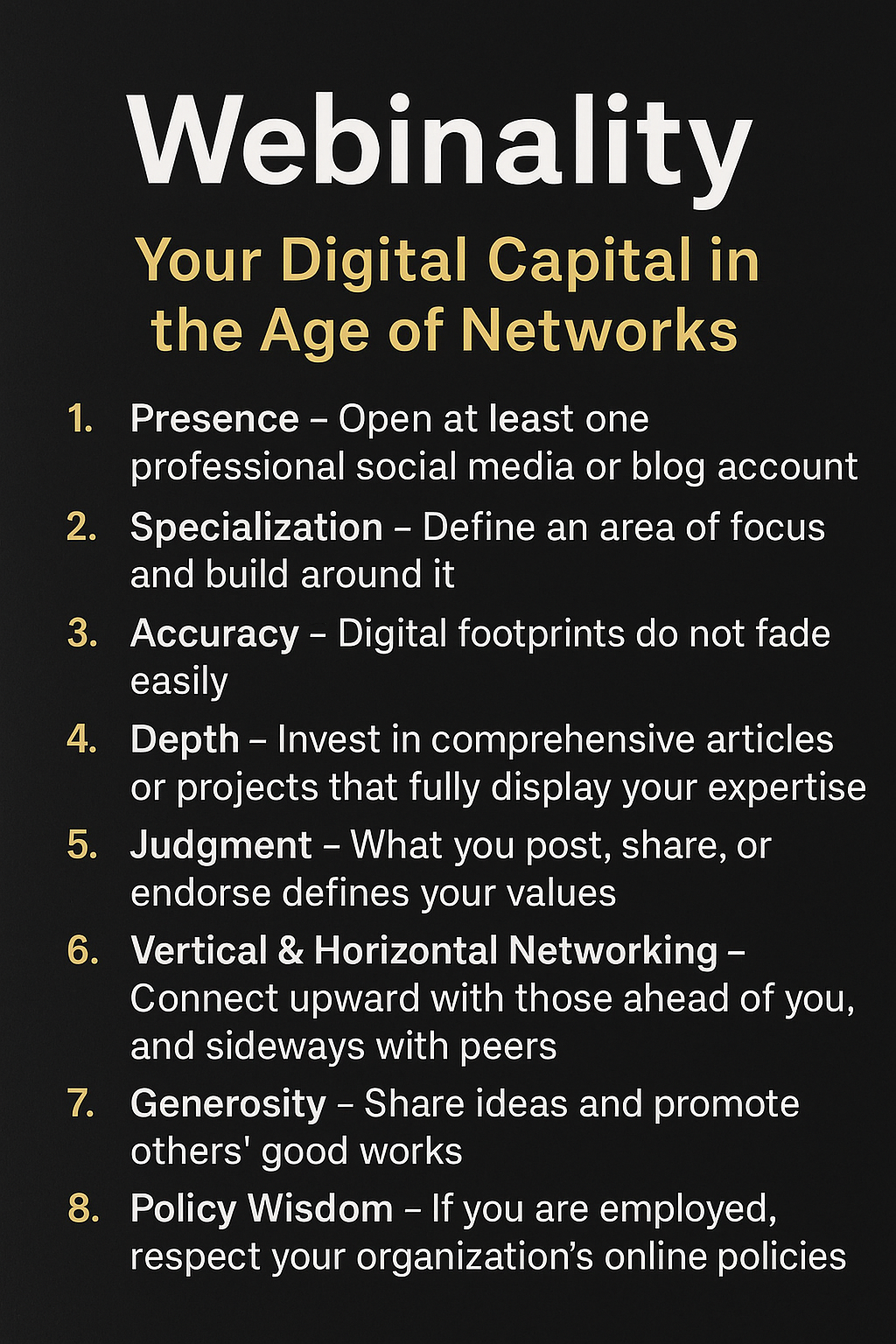
  1. Presence – Open at least one professional social media or blog account. If you are invisible online, you may be invisible in opportunity.

  2. Specialization – Define an area of focus and build around it. A five-minute online search should tell anyone exactly what you stand for. Differentiation is the beginning of relevance.

  3. Accuracy – Digital footprints do not fade easily. If you exaggerate your accomplishments, a former classmate or co-worker can challenge it instantly. Accuracy sustains trust.

  4. Depth – While micro-posts keep you visible, also invest in comprehensive articles or projects that fully display your expertise. Expand classwork, create thought pieces, publish deep insights. Half-baked content will not take you far.

  5. Judgment – What you post, share, or endorse defines your values. Employers want reliable, ethical team leaders. Let your Webinality reflect reliability.

  6. Vertical & Horizontal Networking – Connect upward with those ahead of you professionally, and sideways with peers. A network built in two directions creates opportunities in multiple directions.

  7. Generosity – Share ideas. Promote others’ good works. Write professional reviews of books and journals. In time, goodwill compounds into influence.

  8. Policy Wisdom – If you work for an organization, respect its online policies. Your personal profile should not become an accidental leak of competitive information. Separate your personal brand from your employer’s, where necessary.

  9. Continuity – Webinality is never “done.” It is a living system requiring constant updates of networks, content, and profiles. Nurture it like a garden.

In Igbo, we say “ihe e ji ama onye bu aha ya” – you are known by your name. In the digital age, you are known by your Webinality. Build it intentionally. In a marketplace of billions of IP addresses, that is your foundational factor of production.
LinkedIn Post

Webinality is a portmanteau of web and personality. It refers to your professional digital identity — who you are online, how the world sees your knowledge, values, and capabilities.

It is more than presence: it is how you are known in your absence. If people cannot recommend you when you are not in the room, your Webinality is weak.

Webinality involves building credibility, visibility, and trust via content, networks, and consistent alignment of what you say with what you do. It is about making your expertise discoverable.

In Tekedia Mini-MBA Personal Economy module, I do teach that this refers to your professional online persona or digital identity. In a world where first impressions often happen online, your webinality is considered one of your most important assets.

Indeed, a strong webinality is a competitive advantage that signals credibility, competence, and character. It’s how you stand out in the digital professional marketplace and become discoverable for your unique skills and capabilities.


 

Replit Hits $3bn Valuation With $250m Raise as AI Coding Race Intensifies

0

Replit, the fast-growing collaborative coding startup, has closed a $250 million funding round at a $3 billion valuation, marking one of the most notable financings in the developer tools and AI coding space this year.

The new funding was led by Prysm Capital, with participation from Amex Ventures and Google’s AI Futures Fund. Existing backers — including Y Combinator, David Sacks’ Craft Ventures, Andreessen Horowitz, Coatue, and Paul Graham — also contributed to the round.

With this raise, Replit has now brought in about $478 million in total funding, according to PitchBook estimates.

A Rare Gap Between Funding Rounds

Unlike many high-growth AI startups that turn to venture capital every few months, Replit has paced itself. Its last raise came in 2023, when it secured $100 million at a $1.16 billion post-money valuation. The new $3 billion valuation means its worth has nearly tripled in just over a year.

The decision to raise now comes amid surging demand for AI-assisted coding platforms.

Explosive Revenue Growth

Founded in 2016 by programmers Amjad Masad and Faris Masad, along with designer Haya Odeh, Replit has positioned itself as a go-to platform for developers experimenting with AI-assisted tools.

The company says its annualized revenue has skyrocketed from $2.8 million to $150 million in less than a year. By June, Replit had already reached $100 million ARR, CEO Amjad Masad tweeted at the time — underscoring its rapid monetization curve as AI coding gains mainstream adoption.

Big Tech Ties: Google and Microsoft in the Mix

Google’s involvement in the latest round is no surprise. Replit has long been a close partner with Google Cloud, and many “vibe-coded” apps built on the platform are hosted there.

Yet Replit’s rise has forced competitors to adjust. In July, Microsoft began offering Replit as an option on its Azure cloud platform, signaling the company’s growing importance in the broader developer ecosystem.

The dual embrace by Google and Microsoft highlights how central Replit has become in the race to integrate AI-powered coding into mainstream developer workflows.

Replit vs. Copilot and Claude Code

Replit’s trajectory differs notably from rivals in the AI coding boom. GitHub Copilot, owned by Microsoft, has leaned on its deep integration with GitHub and Visual Studio Code to win over professional developers. Its adoption is massive, but its growth has been tied to Microsoft’s bundling strategy across enterprise software.

Anthropic’s Claude Code, launched earlier this year, has taken another path by positioning itself as a safe and aligned AI assistant for coding, with uptake driven by companies that prioritize governance and AI safety in enterprise environments.

By contrast, Replit has married accessibility with scale. The platform began as a tool for hobbyists and students but has quickly grown into an enterprise-capable service, bridging the cultural gap between “vibe-coding” communities and serious professional development. Its rapid rise in ARR from $2.8 million to $150 million in under a year demonstrates a monetization curve few in the sector have matched.

This positioning gives Replit a dual advantage: cultural relevance among younger coders experimenting with AI and increasing credibility with larger organizations adopting it at scale.

Replit’s latest valuation places it in the same league as some of the most closely watched AI developer startups, though with a unique growth model. Where foundation model labs like OpenAI or Anthropic compete on building cutting-edge models, Replit has turned those models into practical tools that everyday users and enterprises can deploy instantly.

The $250 million injection also highlights the next wave of venture focus: not just the AI models themselves, but the platforms enabling millions to build on top of them.

Oracle Stock Jumps on Report of $300 Billion OpenAI Cloud Deal

0

Oracle shares surged in after-hours trading on Tuesday following reports that the company had secured several multi-billion-dollar contracts with major customers. Now, details are emerging that one of those customers is none other than OpenAI, the Microsoft-backed artificial intelligence company at the center of the current AI boom.

According to a report from the Wall Street Journal, OpenAI has agreed to purchase $300 billion worth of compute power from Oracle over a five-year period starting in 2027. If confirmed, the deal would represent one of the largest cloud contracts ever signed, placing Oracle in a commanding position within the fast-expanding AI infrastructure race.

Oracle declined to comment on the report, and OpenAI did not respond to requests for confirmation. Still, Wall Street reacted swiftly to the news, with the shares of Oracle climbing as investors digested the significance of a potential anchor contract that would rival or exceed the largest commitments ever disclosed in the cloud industry.

The deal also underscores a deepening partnership. OpenAI first began tapping Oracle for compute capacity in mid-2024, diversifying away from its heavy reliance on Microsoft Azure. In January 2025, the shift became more pronounced, with OpenAI moving further away from Azure as its exclusive cloud provider. The decision coincided with the launch of the so-called “Stargate Project,” a $500 billion initiative backed by OpenAI, Oracle, and SoftBank to build out massive domestic data centers over the next four years.

The reported agreement suggests that OpenAI is locking in as much long-term compute supply as possible, hedging against both soaring demand and potential bottlenecks in GPU and cloud capacity. Already this year, OpenAI has expanded its cloud footprint beyond Microsoft and Oracle, reportedly striking a deal with Google as well, according to Reuters. That move illustrated the paradox at the heart of the AI race: even fierce competitors are becoming infrastructure partners as the hunger for computing power outpaces what any single provider can supply.

Oracle’s Bet on OpenAI Could Redefine the Cloud Race

If confirmed, OpenAI’s $300 billion commitment to Oracle would cement the database giant’s transformation into a heavyweight contender in cloud computing—an arena long dominated by Amazon Web Services, Microsoft Azure, and Google Cloud. It would also position Oracle as one of the few companies directly enabling the compute-heavy workloads that underpin OpenAI’s ambitions, from training ever-larger models to deploying them at scale.

For Oracle, which has spent years lagging behind the big three cloud providers, the deal could prove pivotal. Analysts say the agreement would not only lock in revenue visibility but also establish Oracle as an indispensable partner in AI infrastructure at a time when the company is working to redefine its relevance in the cloud era.

A $300 billion contract spread over five years would deliver stable, recurring revenue on a scale previously unseen in Oracle’s cloud business. Combined with the Stargate Project, the contract could cement Oracle’s place as an indispensable partner for the most compute-intensive workloads in the industry.

For OpenAI, the benefits would be equally transformative: locking in access to massive compute resources would provide the security needed to train ever-larger AI models while insulating it from shortages and pricing spikes. In this scenario, Oracle’s stock could continue its rally as investors re-rate the company’s cloud prospects, while OpenAI secures the infrastructure necessary to maintain its lead in artificial intelligence.

However, there are challenges. For Oracle, the concentration of so much revenue from a single client could expose it to volatility if OpenAI changes course or runs into financial or regulatory headwinds. The deal’s sheer size raises questions about execution: can Oracle scale its infrastructure to reliably deliver $300 billion in compute capacity starting in 2027?

For OpenAI, spreading contracts across Oracle, Microsoft, and Google reduces dependency, but it also locks the company into long-term commitments at a time when AI compute efficiency is improving rapidly. Should breakthroughs lower the cost of training and inference, OpenAI could find itself bound to overpriced contracts. And with regulators in the U.S. and Europe increasingly scrutinizing AI concentration and cloud dominance, the partnership could draw political as well as financial risks.

However, OpenAI is sending a strategic message that it cannot afford to be dependent on a single provider if it hopes to sustain its aggressive growth and model development. By spreading contracts across Microsoft, Google, and Oracle—and anchoring massive projects like Stargate—the company is building a compute safety net that ensures it has access to the resources needed for its next leaps in artificial intelligence.

Klarna’s Soaring Debut Sets the Tone for BNPL and IPO Revival — But Risks Lurk

0

Klarna burst onto Wall Street with a dramatic 30% jump in its New York debut on Wednesday, its shares opening at $52 compared with an IPO price of $40. The surge gave the Swedish fintech a market capitalization of $19.65 billion, ending its years-long wait for a listing and marking the biggest debut by a Swedish company in the U.S. since Spotify in 2018.

The buy-now, pay-later lender, which helped reshape online shopping with its short-term financing model, sold 34.3 million shares at $40 each, above the marketed range of $35 to $37. That pricing valued the company at $15.1 billion, while selling shareholders—including Silicon Valley giant Sequoia Capital and Danish billionaire Anders Holch Povlsen’s Heartland A/S—raised $1.17 billion. Chief Executive Sebastian Siemiatkowski, who owns about 7% of Klarna, did not sell any shares.

“This (going public) is really an opportunity… primarily for new shareholders, our 111 million consumers and others to really partake in that journey to disrupt the financial services industry and be the next generation of personal finance,” Chief Financial Officer Niclas Neglén told Reuters.

The timing could not have been more symbolic. Klarna’s debut leads a slate of seven companies—including the Winklevoss twins’ crypto exchange Gemini—poised to go public in New York by Friday. It marks the busiest week for listings in years, reviving a U.S. IPO market that had been largely dormant amid tariff-driven volatility earlier in 2024. Klarna and others were forced to shelve flotation plans in April after turbulence slammed equity markets, delaying what many had hoped would be the sector’s recovery.

At its pandemic-era peak in 2021, Klarna was valued at $45.6 billion before crashing to $6.7 billion a year later under pressure from rising inflation and interest rates. Analysts noted the IPO pricing strategy reflected a more conservative stance designed to fuel strong aftermarket demand.

“$15 billion is far from disappointing given it was above Klarna’s price range and shows a continuing trend of issuers being conservative in initial valuation expectations to garner investor demand and to hopefully leave them wanting more,” said Samuel Kerr, head of equity capital markets at Mergermarket.

A BNPL Growth Engine

If Wednesday’s momentum holds, Klarna’s IPO could become a turning point for BNPL and the broader fintech sector. Analysts believe that the company’s model—focused on smaller-ticket items with an average order value of $101—makes it resilient in a climate where sticky inflation, labor market cracks, and slowing income growth are shaping consumer habits.

U.S.-based rival Affirm, valued at $29 billion, has surged 45% this year by targeting larger purchases with longer zero-interest financing. If Klarna continues to differentiate through high-frequency, smaller purchases, it could steadily eat into debit card use, a trend analysts believe will accelerate over the next several years.

The broader market implications are also significant. A strong aftermarket for Klarna could embolden other fintechs and high-growth companies to revive listing plans, reversing a near three-year drought in U.S. IPO activity.

“A strong aftermarket could convince other fintechs to take the plunge into public markets,” said Russ Mould, investment director at AJ Bell.

A Cautionary Tale

The risk, however, is that Klarna’s debut may set expectations too high. “The danger is that one good deal begets a few more and then a torrent of less good ones follows behind,” Mould warned.

If weaker IPOs ride Klarna’s coattails only to disappoint, investor confidence could sour again, choking off the market’s fragile rebound.

Klarna itself faces headwinds. Once profitable for its first 14 years, the company has posted losses in recent years as it expanded in the U.S. and other global markets. Its ability to manage costs, return to profitability, and prove that BNPL is more than a short-term pandemic-era phenomenon will be under scrutiny.

“Klarna’s IPO will be a thermometer, showing how hot, or not, investors think BNPL will be,” said Brian Jacobsen, chief economist at Annex Wealth Management.

The company’s leadership appears aware of the balancing act ahead. “Right now, we’re more focusing on bringing additional value to our existing user base than the growth of the user base, because the growth has been very, very consistent,” Siemiatkowski said.

IPO Market Barometer

For now, Klarna’s debut is a win not just for the company but for Wall Street’s listing pipeline, signaling that investor appetite is returning despite tariff shocks and economic uncertainty. But analysts say that Klarna cementing its rebound may depend on how it navigates profitability pressures and whether the BNPL sector can deliver on promises of durable growth.

Some believe that Klarna’s IPO is both a milestone and a test case. It shows that fintechs can command investor enthusiasm, but it also raises the question of whether this enthusiasm is built on solid fundamentals or a fleeting appetite for growth stories in a still-uncertain economy.

A Look At Eric Trump’s Forecast of Explosive Cryptocurrency Growth in the Next 12 to 18 Months

0

Eric Trump, executive vice president of the Trump Organization and a prominent advocate for cryptocurrency, recently forecasted explosive growth in the crypto sector over the next 12 to 18 months.

Speaking remotely from New York at the Upbit D Conference in Seoul on September 8, 2025, he described the industry as being “on the one-yard line” of a financial revolution, urging investors to get involved before the surge. He emphasized that Bitcoin’s fixed supply of 21 million coins makes it superior to traditional assets like gold and real estate, positioning it as the ultimate hedge against inflation and economic uncertainty.

Trump stated, The growth of this industry in the next 12, 18 months is going to be explosive, and predicted that in the coming decade, early adopters will be seen as pioneers who rewrote modern finance.

He argued that crypto is moving beyond niche DeFi circles into broader acceptance, with major banks launching digital asset divisions to avoid being left behind by exchanges like Coinbase and Binance.

Despite Bitcoin’s recent price surges, Trump insisted the market is still in its “earliest stage,” encouraging new entrants to participate. He praised South Korea’s leadership in crypto innovation and warned that nations ignoring digital assets, like parts of Europe hampered by high energy costs for mining, risk falling behind in the global financial race.

Trump compared crypto’s transformative potential to historical inventions like railways and automobiles. This prediction aligns with the Trump family’s deepening involvement in crypto. For instance, Eric Trump and his brother Donald Trump Jr. hold about 20% of American Bitcoin Corp., a mining firm that debuted on Nasdaq on September 3, 2025, valuing their stake at over $1.5 billion after shares more than doubled on the first trading day.

The family’s broader crypto ventures, including World Liberty Financial, have generated over $1 billion in revenue in under a year, contributing to their net worth exceeding $7.7 billion. Trump’s comments come amid a pro-crypto shift in U.S. policy under President Donald Trump’s second term, including executive orders allowing crypto in 401(k)s and support for stablecoin legislation like the GENIUS Act.

However, these moves have sparked ethics concerns from critics, including Democratic lawmakers and watchdogs, who argue the family is profiting from deregulation while influencing policy. On X (formerly Twitter), the statement has gone viral, with users sharing headlines and speculating on impacts for assets like Bitcoin and XRP, though some posts exaggerate details like specific bank launches.

While Trump’s optimism reflects bullish market sentiment—crypto adoption is indeed accelerating faster than the internet’s early growth—investors should note the sector’s volatility. His personal stakes underscore a clear incentive for his positive outlook, but the prediction substantiates ongoing trends like institutional entry and global expansion.

If Trump’s prediction holds, Bitcoin and other cryptocurrencies could see significant price increases, driven by growing institutional adoption and retail investor enthusiasm. Historical data shows Bitcoin’s price often spikes with bullish sentiment, as seen in its rise from $30,000 to over $80,000 in 2024-2025 following pro-crypto policy shifts.

Early adopters and firms like American Bitcoin Corp., in which the Trump family holds a 20% stake, could see substantial gains. This could widen wealth gaps if smaller investors enter late or face losses in a volatile market.

Trump’s mention of mainstream financial institutions entering crypto suggests increased legitimacy for stablecoins and decentralized finance (DeFi). Legislation like the GENIUS Act could accelerate stablecoin adoption, potentially reshaping global payment systems.

Critics, including Democratic lawmakers, argue the Trump family’s crypto ventures (e.g., World Liberty Financial, American Bitcoin Corp.) create conflicts of interest, as their financial gains align with deregulation policies. This could fuel political debates and calls for stricter oversight, potentially impacting public trust in crypto.

Eric Trump’s prediction signals a bullish outlook for crypto, with potential for significant financial gains, policy shifts, and cultural acceptance. However, it also raises risks of speculative bubbles, regulatory conflicts, and environmental challenges.