DD
MM
YYYY

PAGES

DD
MM
YYYY

spot_img

PAGES

Home Blog Page 5514

How the Economies of Africa have compared for the last 60 years

0

This article was prompted by a post I found on LinkedIn. An animation charted the proportion of GDP of the African Continent from 1961 to 2020. The space afforded by the comments section would not be sufficient for my thoughts.

There are a number of observations I would make, mostly about the two top performers over the period, which are South Africa, and of course, Nigeria which is my market and 85% of my LinkedIn Network.

GENERAL

  • – No country other than Nigeria and South Africa has held the pole position at any time between 1961 and 2020.
  • – The only country to never fall out of a podium position (1,2,3) over the entire period, has been South Africa.
  • – Countries to have held podium positions over the period are: Algeria, DRC, Egypt, Nigeria and South Africa.
  • – The only country to hold a podium position, and be completely off the pie chart by 2020 is DRC, ( best position: #2 in 1964 and 15% of the pie).
  • – The animation ends with South Africa relegated to third place. While Nigeria still leads the continent, at 18% it is barely over half its period high of 35% and the trend has been downwards. The combined portion of the pie occupied by other countries is rising. With Egypt share having recovered to 15%, perhaps the lead swapping monopoly of Nigeria and South Africa that has lasted 60 years may soon be over?

NIGERIA

  1. At Independence, Nigeria’s share of African GDP was 14% just over half of continent leader South Africa at 25%
  2. The high point of Nigeria’s African Dominance was 35% of Africa total GDP achieved in 1982. This was in the leadership of Shehu Usman Aliyu Shagari of the ‘Second Republic’
  3. During the years of an Independent Biafra, Nigeria’s contribution to Africa’s GDP was 9-11%
  4. The low point in Nigeria’s contribution to Africa GDP was 6% in 1994. This was under General Sani Abacha. Though to be fair, Abacha had only come to power since November 1993 after overthrowing an Interim Government of Chief Ernest Shonekan, who only led for 3 months. The ‘condition’ of Nigeria inherited at the time would have most likely been down to the military rule of Ibrahim Babangida, who led from 1985-1993.
  5. Nigeria’s share on Abachas departure in 1998 was 9%
  6. Nigeria’s high, post the recovery from 1994, briefly hit 22% in early 2015 in the final few months of the Goodluck Jonathan Presidency, though surprisingly, he did not achieve a second term.
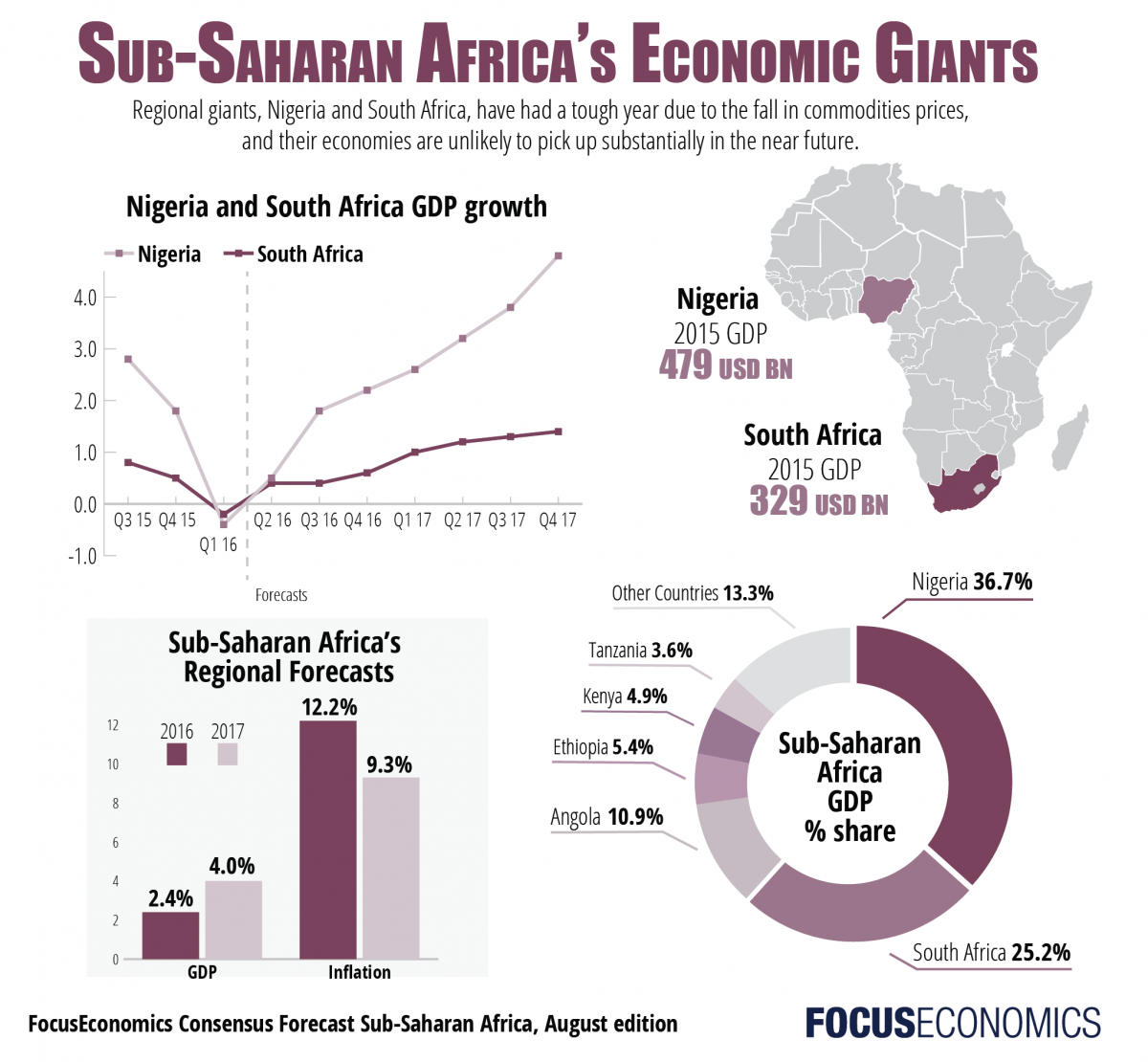
FOCUS ECONOMICS displays both Nigeria and South Africa performance taking a hit in 2016. This was after CBN made the decision to remove the Naira peg with the US Dollar

SOUTH AFRICA

  1. South Africa’s highest position was 29% in 1995, possibly benefiting from the ‘Mandela Effect’.
  2. South Africa’s highest slice of African GDP during apartheid years was at several points in the 1970’s when it intermittently rose to 26% and again 26% in 1992.
  3. South Africa’s highest point post Mandela was 24% in 2005 during the second term of the Thabo Mbeki regime. No leader post Mandela has equaled his high of 29% or even the 26% best of apartheid regimes.
  4. SA finished the period in third place on 13% behind Egypt. This is the lowest share of the continental GDP that South Africa has held for the period of the pie animation. The current President of South Africa is Cyril Ramaphosa who has been in power for 3 years and 9 months.
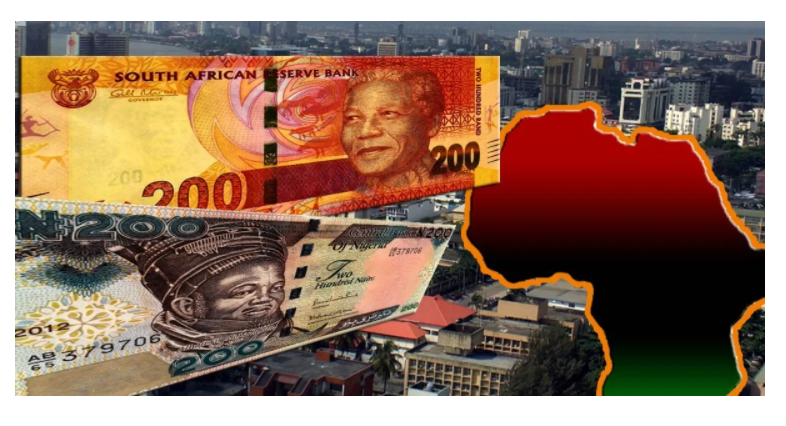
Illustration from Kenyanwallstreet site from article which claims ‘Africa poised to have USD 3-trillion economy by 2030’ overtly hints major players by featuring Naira and Rand notes

Closing comments:

It’s important to understand that the pie animation represents relative rather than absolute data. This means that without doing anything particularly remarkable, one country can rise position purely because of something bad happening somewhere else.

It can also mean modest improvements  in some countries don’t translate to ranking improvements due to something very remarkable happening somewhere else.

For instance, the ‘Mandela Effect’ a phrase sometimes used to refer to trade and investment benefits South Africa achieved following the end of the Apartheid Regime and the ‘honeymoon period’  the world was having with Nelson Mandela as the new leader of a ‘free’ South Africa.

There would have been nothing any other country in Africa could have done to counter that in terms of competing with SA for trade deals and FDI (Foreign Direct Investment) from outside the continent… at least in the first few years of the Mandela Presidency.

But all honeymoons end!

Links have been added at the end giving timelines of events in some of the countries that have influenced the ranking in the pie animation over time.

For those looking to invest, its also important to understand that choosing a country is a little bit like University Rankings. There are many universities with unremarkable rankings but they have niche expertise in a few very narrow aspects of subject matter or emerging technologies. For someone pursuing a course in these, then an unremarkably ranked university may be second to none.

Equally, Start-up investment destinations are not about overall metrics, they are about the metrics that are particularly important to the specific start-up.

Availability of suitable affordable labour, local demand for products/services, enabling capacity, support willingness and engagement flexibility  of Government Structures and Civic authorities, and other aspects of the business ecosystem – these need to be a fit for the investors intentions.

The animation pie starts a journey with much else to be discovered.

Thanks to Instagram Member ‘piechartpirate’ and to Inez Willeboordse for porting the content to LinkedIn where I got to see it.


Alignment of Nigerian and South African leaders with pie animation metrics has been courtesy of Wikipedia.

brainyhistory.com/topics/a/algeria.html

brainyhistory.com/topics/e/egypt.html

brainyhistory.com/topics/c/congo.html

brainyhistory.com/topics/l/libya.html

focus-economics.com/blog/africas-economic-giants-economic-growth-infographic

congo.org.uk/the-economies-in-africa-are-so-disjointed/

kenyanwallstreet.com/africa-poised-us-3-trillion-economy-2030/

 

The Pandora Papers and Data BGs in the Context of Two Nigeria’s Justice Systems

0

In the last three decades, political leaders and business elites have been putting on their toes in the areas of equitable resource distribution and social justice by the media and members of the civil society across the world. From the developing countries to the developed ones, stories about how the rich continue amassing wealth are being produced and reported every day.

The world has had Panama papers, which established a number of prominent global citizens in politics and business who have foreign businesses with the intent of evading taxes in their home countries or states. Information has it that “the Panama Papers 2016 divulgence is the largest leak of offshoring and tax avoidance documentation.” Select journalists across the world worked on a dataset with 11.5 million of documents with the aim of revealing injustices and establishing possible actions and policy directions for political and judicial leaders towards initiation and building of inclusive justice system.

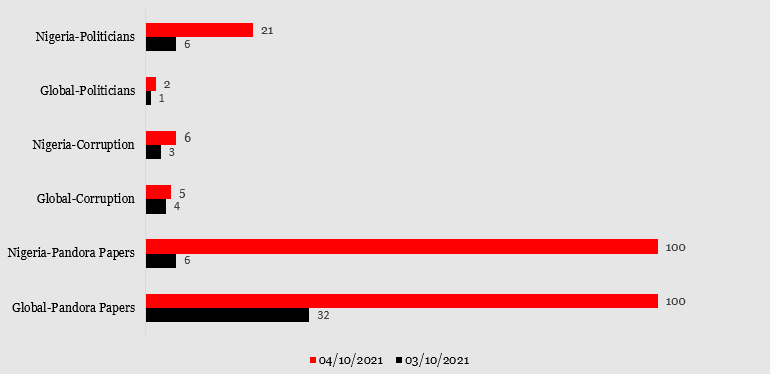
However, in some countries, the outcomes of the Panama papers led to introduce new policies and laws. In their quest of establishing a sustainable justice system, another set of global journalists worked on 11.9 million leaked documents with 2.9 terabytes of data. Outcomes of the investigation have been published since October 3, 2021 in Nigeria and other countries in the world. Between October 3 and October 4, the and Nigerian public interest in Pandora papers and Panama papers surged, representing a huge interest in Panama papers 5 years after. During the days, analysis also shows that the Nigerian and global public had interest in corruption and the Pandora Papers.

Exhibit 1: Global and Nigerian Population Interest in 2 Days

Source: Google Trends, 2021; Infoprations Analysis, 2021

The huge interest is not a surprise because Nigerians have been living with various forms of injustices over the years. Our analyst had earlier notes that “Like other countries in the world, Nigeria has two systems that are germane to its inclusive growth and development in all ramifications. To attain the desired peaceful environment across the country, criminal justice system devoid of ethnic, religious biases and social discrimination is imperative. For inclusive socioeconomic development, distribution and redistribution of economic resources without tribalism and ethnicity is a must.”

However, what is really surprising is the growth of data boys and girls, who are mostly youths being hired by the political and business elites for digital public relations purposes. They are being paid data stipend every month and used the data to create favourable status for them [the elites]. As the newspapers and journalists who worked on the Pandora Papers’ Project publish significant insights from their findings, our analysis has shown that the data boys and girls are not relenting in creating counter and alternative narratives of their paymasters’ involvement in the deals identified by the journalists.

Our analyst observes majority of the BGs, according to social networking analysis’ results, have direct and indirect relationships with the people who have been identified since the publication of stories from the Pandora Papers. Those who have direct relationship are the ones who share some family related features with the elites ‘found culpable’ by the journalists. BGs with the indirect relations are the ones who have been specifically hired by the elites for digital public relations, replying the perceived critics of their paymasters. As these relationships continue, our analyst notes that attaining sustainable social and economic justice systems would remain difficult because the youths who are expected to be the vanguards based on their digital power they possess have been hijacked by the elites.

‘I Am Right’ Syndrome And Its Damaging Effects

0

The last time I checked, millions of individuals across the globe were still hiding under the shell of a societal cankerworm known as “I am right” that’s liable to erode countless relationships found among the human race if not adequately and carefully addressed.

Few months ago, I ran into a childhood pal called Samuel somewhere in Lagos State, Nigeria. In the process of our conversation, I learnt he got estranged with his spouse a few weeks back. With the burning quest to ascertain what actually truncated a happy five-year-old marriage, I requested he had a drink with me at a nearby bar.

Summarily, the truth of the matter was that he battered the woman in question mercilessly, thus she decided to leave their matrimonial home based on her parents’ persuasions. It seemed that wasn’t the first time he would display such an attitude, but was reportedly the worst of all so far.

As I sipped my stout beer from the glass cup, just as he did with his lager, I enquired what really prompted the ruthless action. Mr Samuel claimed she gave him the insult of his life, stating he was called names.

Having gotten infuriated with the whole story, I therein unequivocally blamed the dude entirely, telling him that that was not an enough excuse. I further notified his person that insult of any kind shouldn’t warrant any iota of assault in a marriage, or any form of relationship. I observed he wasn’t pleased with my judgement but I didn’t bloody care.

To shorten the long story, I went further to inquire if he had showed remorse over the uncalled reaction. I learned till that moment, being about three weeks after the incident, he was yet to think of visiting his wife’s parental home let alone tendering an apology. To worsen it, my friend eventually told me he didn’t see anything wrong with what he did.

From the blunt response, I understood Mr Samuel was trying to hide under a certain norm that holds the thought that ‘a man is always right’. It’s not anymore news that in some African traditional settings, you cannot tell a man to his face that he is wrong when trying to mediate between him and his spouse. And, such an existing belief has ostensibly succeeded in beclouding the sense of reasoning of most men, particularly the young ones.

The fact is that the ‘I’m right’ syndrome has continued to endanger various healthy relationships. The paradox is that most of these staggering or pale-looking relationships were rightly built on a golden pedestal. But the inability to show remorse by any of the party involved, having erred, continually poses threat to the anticipated growth of the union.

Allowing your extremism mentality to control your actions would definitely make any relationship you are into crash on arrival. You aren’t supposed to strongly believe in everything. Don’t live the life of a fanatic. Sometimes, compromise is highly consequential, especially when it calls for a way forward.

Relationships are about compromise or sacrifice. Hence, you must be willing at all times to give up on a certain ideology just for peace to reign. If your ego is the problem, you must sacrifice it to enable other things you yearn for to flow. It’s noteworthy that ego had abruptly ended countless enticing unions than death did.

You must, therefore, be willing to give up that venom in your system that is unabated, posing a threat to your cherished relationship. One thing must give way to the other.

It’s always crucial to acknowledge that everybody can never be right at the same time. Someone must be wrong. And when you are right or wrong, your conscience will certainly communicate to you concerning where you belong. It suffices to assert that you are invariably expected to listen to the aforementioned feature (conscience), because it is the only tool that can lead you to the apt path.

Even when you are right, you can assume that you are wrong just for the sake of a way forward. It’s simply like a battlefield where someone must accept defeat. This is where maturity comes in. Honestly, it takes a mature mindset to keep a relationship going or alive. Maturity is like lubrication oil in any ongoing union.

Similarly, immaturity in a relationship is not unlike a bad tyre in a moving vehicle. The latter can never move properly until you change the former. And if the driver tries to manage the situation, it would surely draw the journey backwards; hence, he will never arrive at his proposed destination. Aside from not getting to the destination, it might even cause an accident in the process.

So, maturity is one of the key recipes in any relationship in existence, be it business, friendship, courtship, marriage, or what have you. It would make us possess a flexible mindset rather than a rigid one, thereby keeping us away from the dangers of fanaticism.

The said pattern of ideology (fanaticism) possesses venom that bears the potential of destroying, within a twinkle of an eye, what a man has suffered in building for years.

For crying out loud, you can’t continue to say ‘I am right’ even when aware that you’re wrong. Don’t cheat on your conscience if you truly want your relationship to excel. There are definitely no two ways about it.

‘I am sorry’ doesn’t really mean you are wrong. It rather means you truly cherish the relationship more than your ego. 

The Tiwa Savage’s Sex Tape Scandal; What The Law Says About Obtaining And Leaking Of Someone’s Nudes And Sex Tapes Without Consent.

1

The Tiwa Savage’s sex tape scandal; what the law says about obtaining and leaking of someone’s nudes, sex tapes and private contents without consent.

There have been numerous cases recently in Nigeria where persons become victims of losing their private videos and pictures to cyber criminals and the private contents getting leaked in the internet space without their approval or consent and it now seem that the order of the day is sextortion ie, obtaining or having someone’s nude or private videos or pictures and threatening to spread it across the internet if the victim refuses to agree to terms which is usually monetary terms or extortion. The negative impact of leaked sex tapes and nudes are always huge on the victim’s life and most times, the victim end up not recovering from the blow and the individual risk losing everything he/she have built and ever worked for.

In November 2019, a female student of a tertiary institution in Nigeria became a hot topic and trend across the internet platforms when her sex video got leaked and made its way to the internet. She lost her studentship as she was rusticated from the school which was a way of the management of the institution disassociating themselves from her. She didn’t just lost her public face, she also lost her family and friends as nobody ever wanted to Identify with her anymore, she lost almost everything she worked for as she was forced to start life afresh.

Recently, a popular female Nigerian pop star, was on the news that a cyber bully got a hold of her private intimate video where she was making out with her spouse and threatened to leak it to the internet if she didn’t pay the money she’s been asked of. She stood her grounds and refused to succumb to the threats of the sextionist, unfortunately the sex tape was released and it has been blazing through the internet like a wild fire.

We can’t pretend that this scandal won’t have a negative impact on the lovable singer’s career and reputation as she risks losing business partners, friends, fans, followers, business deals, contracts and even endorsement deals as most endorsement deals and brand ambassadorships come with moral and decency clauses that give the company right to exit the contract if the celebrity gets involved in any scandal that could tarnish the company’s reputation by mere associating themselves with the celebrity.

It won’t be far from the truth to say that the question bugging everyones’ mind at the moment is; ‘’is there no law in Nigeria put in place against this kinds of act of obtaining and leaking peoples’ nudes or sex tape without their consents, sextortion, cyberstalking and cyber bullying, voyeurism, unlawful surveillance, violation of person’s privacy and invasion of one’s privacy etc?’’

It is pertinent to note that although there’s a need for more legislations on issues like this but there are existing laws already in place covering issues of this nature; The criminal Code Act and the cybercrime Act of 2015 will be of interest to us here.

Chapter 33 of the criminal code Act makes provision for the offense of defamation of ones character and clearly states that defamatory matters are matters that are likely to injure one’s reputation and the defamator risk going to jail for this.

S.373 of the Criminal Code Act which is titled; defamation of character reads thus;
Defamatory matter is matter likely to injure the reputation of any person by exposing him to hatred, contempt, or ridicule, or likely to damage any person in his profession or trade by any injury to his reputation.

S. 374 of the Criminal Code Act further provides;
(1) For the purposes of this Code, the publication of defamatory matter is?

(b) ….the exhibiting of it in public, or causing it to be read or seen, or showing or delivering it, or causing it to be shown or delivered, with intent that it may be read or seen by the person defamed or by any other person.

Furthermore, S. 375 of the Criminal Code Act provides;
Subject to the provisions of this Chapter, any person who publishes any defamatory matter, is guilty of a misdemeanor and is liable to imprisonment for one year; and any person who publishes any defamatory matter knowing it to be false, is liable to imprisonment for two years.

Finally, S. 376 of the Act provides;
Any person who publishes, or threatens to publish, or offers to abstain from publishing, or offers to prevent the publication of defamatory matter, with intent to extort money or other property, or with intent to induce any person to give, confer, procure, or attempt to procure, to, upon, or for, any person, any property or benefit of any kind, is guilty of a felony and is liable to imprisonment for seven years.

These provisions of the Criminal code of chapter 33, specifically from s.373 to s.376 provides for punishment of 1-2 years for the offense of defamation while sextortion or publication of defamatory matter with the intent to extort the victim carry a punishment of up to 7 years.

The provisions of the criminal code act was reemphasized in the cybercrime act of 2015 and we will be highlighting the specific sections of the cybercrime act:

S.23 (2) Cybercrime Act of 2015 states;
Any person who knowingly makes or sends other pornographic images to another computer by way of unsolicited distribution shall be guilty of an offence and upon conviction shall be sentenced to One year imprisonment or a fine of Two Hundred and Fifty Thousand Naira or both. Also, S. 24. Of the Cybercrime Act further provides;
Any person who knowingly or intentionally sends a message or other matter by means of computer systems or network that –
(a) is grossly offensive, pornographic or of an indecent, obscene or menacing character or causes any such message or matter to be so sent; or
(b)…commits an offence under this Act and shall be liable on conviction to a fine of not more than N7,000,000.00 or imprisonment for a term of not more than 3 years or to both such fine and imprisonment.

These legislations have been judicially noticed in a recent case; suit number: MCI/2C/2012 where a boy of 20 years got hold of private pictures and videos of a well known public officer in Imo state, a state in Eastern part of Nigeria and was using the said private pictures to extort the man, the cyberbully was arrested and charged to court. The magistrate court sentenced him to 1 year imprisonment in accordance to s.373 to s.376 of the Criminal code Act and sections 23 & 24 of the cybercrime act 2015 both applicable in Imo state, Nigeria. The presiding magistrate while sentencing the accused was heard to have said; ‘this would serve as a deterrent to other people who may be threading on such dastard path’.

While we agree that due to recent cases of obtaining and leaking of people nudes and sex tapes, cyberbullying/ cyber stalking, invasion of privacy, sextortion, voyeursim etc, there’s a need for more encompassing laws on these issues with more stiffer punishments but individuals shouldn’t be ignorant of the fact that acts like this is not just a civil wrong but also a crime and the criminal risks a jail term of 1-7 years and when it involves an infant or a person who is under age, the punishment is more stiffer as the offender risks getting jailed for a term of 5- 10 years or N10-N20 million naira fine or even both the prison terms and the fine as it was clearly provided S.23 of the cyber crime act, 2015.

#EndSars Memorial: Remembering the Victims A Year After

0

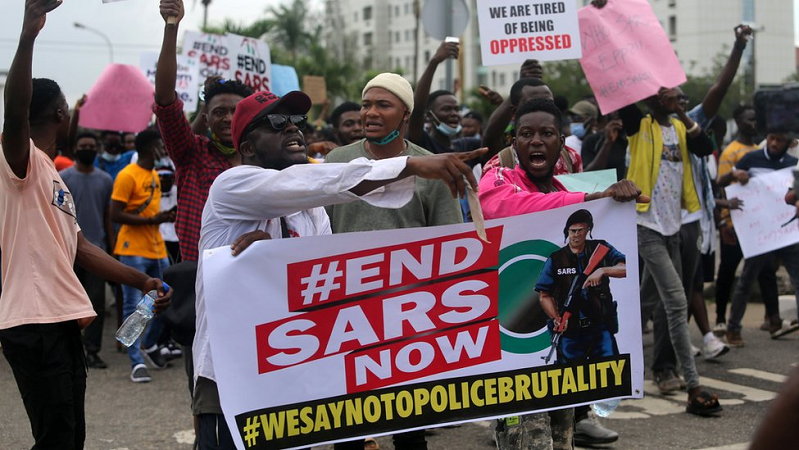
On this day, a year ago, Nigerian youths had gathered at the Lekki Toll Gate in Lagos, following days of protest against police brutality dubbed #EndSARS. The EndSARS protest, which unprecedentedly spiraled into a global movement, was described as the most successful demonstration in Nigeria’s history.

It was a situation the government, under President Muhammadu Buhari, did not want to see. In the eve of October 20, 2020, Nigerian soldiers had arrived at the Lekki Toll Gate and started shooting on the protestors, killing scores and putting the protest to a deadly end.

The shooting of October 20, 2020, has come to be known as “Lekki Massacre,” a bloody stain that has further strained the relationship between the Nigerian government and its young people. A year later, in remembrance of their brothers, sisters and friends, who sustained injury and those who lost their lives to the brutal firepower of those in uniform, Nigerians have convened #EndSarsMemorial, in outcry for justice for the victims and reforms for safe policing.

“On the first anniversary of October 20th, 2020, like many Nigerians, I have struggled with coming to terms with the sobering events of that day,” former President of the Senate, Dr. Bukola Saraki said. “My thoughts and prayers are with those who lost their lives, loved ones, and sustained injuries or other losses at the Lekki Toll Gate and at various locations in Lagos and around the country when security agencies were deployed to clamp down on the protests and non-state actors took advantage to cause chaos and mayhem.”

As the memories of the ugly incident reechoe through pictures, videos of the victims and blood stained Nigerian flags circulating on social networks, the pain deepens. Not only because no one has taken responsibility for what happened in Lekki Toll Gate nor because the victims of the massacre are yet to get justice, but also because one year after, not much has changed.

SARS was disbanded in an apparent attempt (which has been a ritual for years) to appease protesters, and a seeming move to meet their 5 for 5 demands. A new anti-robbery squad named SWAT was formed, in what many believe to be a whitewashing of the same characters that constitute rogue police units.

The 5 for 5 demands of EndSARS protestors are: (1) Immediate release of all arrested protesters; (2) Justice for all deceased victims of police brutality and appropriate compensation for their families; (3) Setting up and independent body to oversee the investigation and prosecution of all aspects of police misconduct (within 10 days); (4) In line with the new Police Act, psychological evaluation and retraining (to be ascertained by an independent body) of all officers of the defunct SARS before they can be redeployed and (5) Increase police salary so that they are adequately compensated for protecting lives and property of citizens.

Out of these five demands, none could be said to have been fully implemented. Although EndSARS panels of inquiry were convened across several states in the country, awarding hundreds of millions of naira in damages to a few victims of police brutality who summoned courage to file complaints, most of the officers involved in the crime are yet to be prosecuted.

A recent report noted that about 300 EndSARS protesters are still languishing in different correctional centers (prisons) across the country.

“It is worrying that despite the acceptance of the “5 for 5 Demands,” nothing has really been done to resolve the issues that caused the protest in the first place. None of the policemen accused of torturing and extrajudicially murdering Nigerian citizens have been brought to justice, there has been no marked improvement in the funding or quality of equipment available to the Nigerian Police Force and these incidents of torture continue in many security facilities nationwide,” Saraki said.

“None of the perpetrators of the attacks on Nigerians exercising their rights to peaceful assembly have been arrested or prosecuted, despite many of them being identified,” he added.

A typical evidence of this is in the statement issued by the Lagos State Police Commissioner, Mr. Hakeem Odumusu, warning that the police will not allow any kind of street protest. In his words, “the police will use legitimate means within their constitutional powers to suppress the planned protest… therefore, individuals or groups sponsoring such protest are warned to desist from such unpatriotic plan or face the full weight or wrath of the law.”

The question that many have not stopped asking is; which law was Mr. Odumusu talking about when he issued this statement?  Given that the right to protest is constitutionally enshrined in Section 38 of the 1999 Constitution of the Federal Republic of Nigeria, and the Court of Appeal ruling in IGP vs ANPP 2008, stated that it is the right of citizens to conduct peaceful processions, rallies or demonstrations without seeking and obtaining permission from the police.

Contrary to this constitutional provision, the Nigerian Police Force, like always, have taken their station at Lekki Toll Gate in their numbers, in a show of force designed to deter the commemoration of Lekki Massacre. Across other states where the protest is billed to take place, the measures are the same. Reports coming from the protest grounds say that many have been tear-gassed and arrested.

According to rights advocates and civil liberty organizations, the unfolding events in a democratic society is an indication that Nigerian security agencies have lost the capacity to learn or show the civility that their work requires. It is also an indication of failure by the Nigerian State, to modernize its institutions and educate its personnel to reflect democratic ideals in their operations.

At the high cost of blood and livelihood, the status quo has been sustained to the detriment of Nigeria’s young generation, who inadvertently have to reckon with the institutionalized brutality by those who are supposed to protect them.

“I can’t even describe how I feel seeing this picture (talking about a slain youth). This is one of the Many Untold Stories,” Actor Mr. Macaroni wrote on Twitter. “Pelumi Onifade, a 20 year old journalist, covered the viral video of a Nigerian politician shooting at protesters. He was arrested and killed in custody.”

For generations Y and Z who wanted a change and have given their blood and resilience for it, the backdrop indicates that they will have to wait longer for it.