DD
MM
YYYY

PAGES

DD
MM
YYYY

spot_img

PAGES

Home Blog Page 5519

Bitcoin Hits $66k All-time High, Buoyed By ETF

0

The much anticipated new bitcoin all-time high was reached on Wednesday after the cryptocurrency hit a record $66,000, amplifying crypto market value.

Bitcoin rose 3.7% to hit as high as $66,477 on Tuesday, bringing its gain for the year to almost 130%. The largest digital currency by market value gained more than 300% last year and 95% in 2019 after tumbling 73% the previous year.

The new high came following the successful launch of the first US bitcoin futures exchange-traded fund.

“Clearly, the launch of a Bitcoin futures ETF in the U.S. has sent prices soaring to these levels,” said Leah Wald, chief executive at Valkyrie Investments, which has an application out for a futures-based fund. “Traders and investors perhaps see this is precursor to the holy grail — a spot Bitcoin ETF — and their optimism is pouring into the largest cryptocurrency at a furious pace, with all money FOMOing into the trade from all corners of the market.”

Ethereum also rose 7.4% to cross back over the $4,000 level. The world’s second-largest cryptocurrency reached 4,104,61 on Wednesday.

ETF, the ProShares Bitcoin Strategy, which tracks bitcoin futures contracts pegged to the future price of the cryptocurrency, rose about 5% on its first day of trading Tuesday.

Bitcoin has found a place in the hearts of many investors looking for an inflation hedge, and they are betting big wads of cash on it.

“Bitcoin would be a great hedge. There is a plan in place for crypto and clearly it’s winning the race against gold at the moment … I would think that would also be a very good inflation hedge. It would be my preferred one over gold at the moment,” billionaire investor, Paul Tudor Jones told CNBC’s Squawk Box.

Bitcoin’s biggest proponents back controversial arguments that the virtual currency is a store of wealth and a hedge against the most potent threat from inflation in many years.

However, not every crypto investor is impressed, as several people in the market would prefer ETF that tracks spot prices rather than futures. But the ETF was a brilliant idea to many others. Bloomberg reported on the enthusiasm of investors across institutions.

Wall Street

Bank of New York Mellon Corp., Goldman Sachs Group Inc. and Morgan Stanley are among firms offering crypto-related services. Dawn Fitzpatrick, chief investment officer of Soros Fund Management LLC, said her firm holds some coins and that crypto “has gone mainstream.”

At the same time, there is still a long way to go. For instance, SkyBridge Capital founder Anthony Scaramucci said that while there’s a “feeding frenzy” in crypto among about 10% of financial-services firms, the vast majority are hesitant about the asset class.

Over the past few years, a whole new crypto-economy has formed. Non-fungible tokens or NFTs — which allow holders of digital art and collectibles to track ownership — have surged into the limelight.

Decentralized Finance

So has the decentralized finance — DeFi — ecosystem, which allows people to lend, borrow, trade and take out insurance directly from each other, without use of intermediaries such as banks.

With turnover of almost $1 billion, the ProShares fund debut was behind only a BlackRock carbon fund for a first day of trading, the latter ranking higher due to pre-seed investments, according to Athanasios Psarofagis at Bloomberg Intelligence. The total market value of cryptocurrencies exceeds $2.5 trillion.

Bitcoin has come a long way this year, defying China’s crackdown and the apathy stemming from its carbon footprint to record its all-time high. It is expected to surge further in November, as investors seek strong support on $65,000.

African Development Bank, MTN sign $500,000 grant agreement to study women’s access to financial services

0

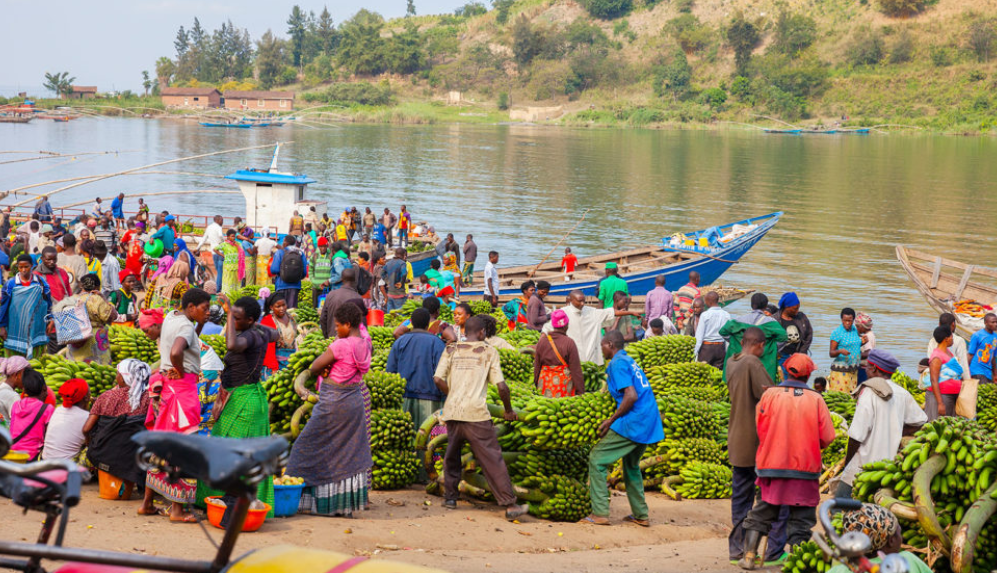
The African Development Bank (AfDB.org) has signed a grant agreement for $500,000 with Y’ello Digital Financial Services (YDFS), a fintech subsidiary of MTN Nigeria, to be used for a study into economic, religious, and social factors hampering access to finance for women in northern Nigeria.

The research, which includes a feasibility study, women-focused design and testing, will focus on both agents and customers to provide insights into women’s use of mobile money services, will be funded through the Africa Digital Financial Inclusion Facility (ADFI).

Despite being the continent’s largest economy, 55% of rural Nigerians still lack access to financial services [1]. The rate of mobile money adoption currently stands at 4% [2],  with an agent ratio of 228.8 agents per 1,000 adults [3]. Political instability and conservative cultural norms in parts of Northern Nigeria are thought to present barriers to women’s access to finance. Additionally, 80% of agents in the region are men.

“The African Development Bank, through the Africa Digital Financial Inclusion Facility (ADFI), is delighted to support this project, furthering our work to improve the quality of life for people in Nigeria and contribute to the Sustainable Development Goals, particularly as relates to poverty, and gender inclusion,” said Stefan Nalletamby, African Development Bank Director of Financial Sector Development.

On behalf of YDFS, Usoro Usoro, Chief Executive Officer, said, “We are truly excited about this partnership with the African Development Bank, and the possibilities for advancing financial inclusion in Nigeria, particularly for the traditionally excluded segment of women in Northern Nigeria.”

How the Economies of Africa have compared for the last 60 years

0

This article was prompted by a post I found on LinkedIn. An animation charted the proportion of GDP of the African Continent from 1961 to 2020. The space afforded by the comments section would not be sufficient for my thoughts.

There are a number of observations I would make, mostly about the two top performers over the period, which are South Africa, and of course, Nigeria which is my market and 85% of my LinkedIn Network.

GENERAL

  • – No country other than Nigeria and South Africa has held the pole position at any time between 1961 and 2020.
  • – The only country to never fall out of a podium position (1,2,3) over the entire period, has been South Africa.
  • – Countries to have held podium positions over the period are: Algeria, DRC, Egypt, Nigeria and South Africa.
  • – The only country to hold a podium position, and be completely off the pie chart by 2020 is DRC, ( best position: #2 in 1964 and 15% of the pie).
  • – The animation ends with South Africa relegated to third place. While Nigeria still leads the continent, at 18% it is barely over half its period high of 35% and the trend has been downwards. The combined portion of the pie occupied by other countries is rising. With Egypt share having recovered to 15%, perhaps the lead swapping monopoly of Nigeria and South Africa that has lasted 60 years may soon be over?

NIGERIA

  1. At Independence, Nigeria’s share of African GDP was 14% just over half of continent leader South Africa at 25%
  2. The high point of Nigeria’s African Dominance was 35% of Africa total GDP achieved in 1982. This was in the leadership of Shehu Usman Aliyu Shagari of the ‘Second Republic’
  3. During the years of an Independent Biafra, Nigeria’s contribution to Africa’s GDP was 9-11%
  4. The low point in Nigeria’s contribution to Africa GDP was 6% in 1994. This was under General Sani Abacha. Though to be fair, Abacha had only come to power since November 1993 after overthrowing an Interim Government of Chief Ernest Shonekan, who only led for 3 months. The ‘condition’ of Nigeria inherited at the time would have most likely been down to the military rule of Ibrahim Babangida, who led from 1985-1993.
  5. Nigeria’s share on Abachas departure in 1998 was 9%
  6. Nigeria’s high, post the recovery from 1994, briefly hit 22% in early 2015 in the final few months of the Goodluck Jonathan Presidency, though surprisingly, he did not achieve a second term.
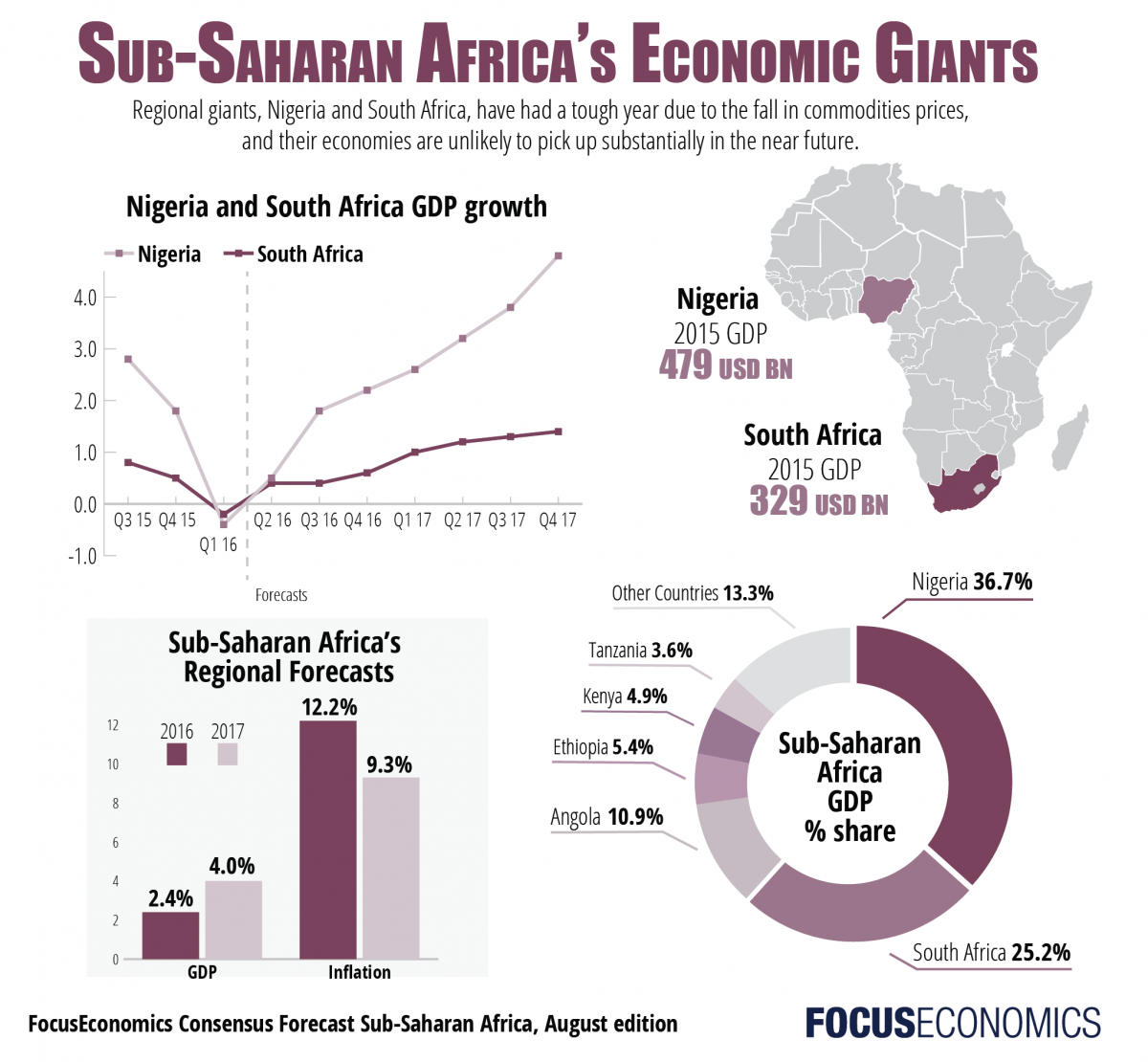
FOCUS ECONOMICS displays both Nigeria and South Africa performance taking a hit in 2016. This was after CBN made the decision to remove the Naira peg with the US Dollar

SOUTH AFRICA

  1. South Africa’s highest position was 29% in 1995, possibly benefiting from the ‘Mandela Effect’.
  2. South Africa’s highest slice of African GDP during apartheid years was at several points in the 1970’s when it intermittently rose to 26% and again 26% in 1992.
  3. South Africa’s highest point post Mandela was 24% in 2005 during the second term of the Thabo Mbeki regime. No leader post Mandela has equaled his high of 29% or even the 26% best of apartheid regimes.
  4. SA finished the period in third place on 13% behind Egypt. This is the lowest share of the continental GDP that South Africa has held for the period of the pie animation. The current President of South Africa is Cyril Ramaphosa who has been in power for 3 years and 9 months.
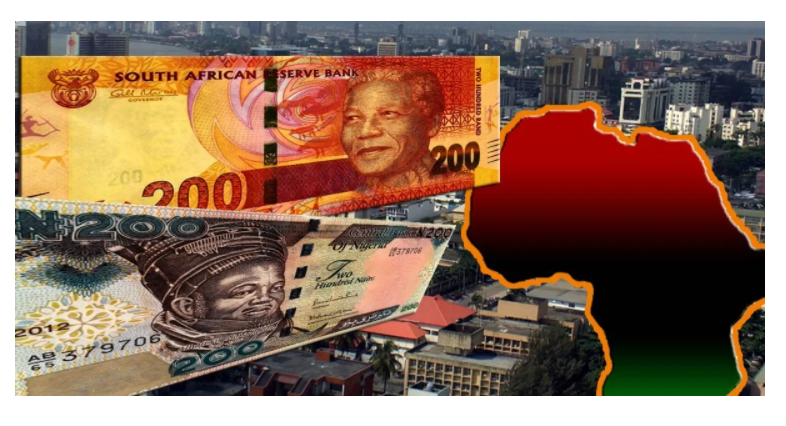
Illustration from Kenyanwallstreet site from article which claims ‘Africa poised to have USD 3-trillion economy by 2030’ overtly hints major players by featuring Naira and Rand notes

Closing comments:

It’s important to understand that the pie animation represents relative rather than absolute data. This means that without doing anything particularly remarkable, one country can rise position purely because of something bad happening somewhere else.

It can also mean modest improvements  in some countries don’t translate to ranking improvements due to something very remarkable happening somewhere else.

For instance, the ‘Mandela Effect’ a phrase sometimes used to refer to trade and investment benefits South Africa achieved following the end of the Apartheid Regime and the ‘honeymoon period’  the world was having with Nelson Mandela as the new leader of a ‘free’ South Africa.

There would have been nothing any other country in Africa could have done to counter that in terms of competing with SA for trade deals and FDI (Foreign Direct Investment) from outside the continent… at least in the first few years of the Mandela Presidency.

But all honeymoons end!

Links have been added at the end giving timelines of events in some of the countries that have influenced the ranking in the pie animation over time.

For those looking to invest, its also important to understand that choosing a country is a little bit like University Rankings. There are many universities with unremarkable rankings but they have niche expertise in a few very narrow aspects of subject matter or emerging technologies. For someone pursuing a course in these, then an unremarkably ranked university may be second to none.

Equally, Start-up investment destinations are not about overall metrics, they are about the metrics that are particularly important to the specific start-up.

Availability of suitable affordable labour, local demand for products/services, enabling capacity, support willingness and engagement flexibility  of Government Structures and Civic authorities, and other aspects of the business ecosystem – these need to be a fit for the investors intentions.

The animation pie starts a journey with much else to be discovered.

Thanks to Instagram Member ‘piechartpirate’ and to Inez Willeboordse for porting the content to LinkedIn where I got to see it.


Alignment of Nigerian and South African leaders with pie animation metrics has been courtesy of Wikipedia.

brainyhistory.com/topics/a/algeria.html

brainyhistory.com/topics/e/egypt.html

brainyhistory.com/topics/c/congo.html

brainyhistory.com/topics/l/libya.html

focus-economics.com/blog/africas-economic-giants-economic-growth-infographic

congo.org.uk/the-economies-in-africa-are-so-disjointed/

kenyanwallstreet.com/africa-poised-us-3-trillion-economy-2030/


The Pandora Papers and Data BGs in the Context of Two Nigeria’s Justice Systems

0

In the last three decades, political leaders and business elites have been putting on their toes in the areas of equitable resource distribution and social justice by the media and members of the civil society across the world. From the developing countries to the developed ones, stories about how the rich continue amassing wealth are being produced and reported every day.

The world has had Panama papers, which established a number of prominent global citizens in politics and business who have foreign businesses with the intent of evading taxes in their home countries or states. Information has it that “the Panama Papers 2016 divulgence is the largest leak of offshoring and tax avoidance documentation.” Select journalists across the world worked on a dataset with 11.5 million of documents with the aim of revealing injustices and establishing possible actions and policy directions for political and judicial leaders towards initiation and building of inclusive justice system.

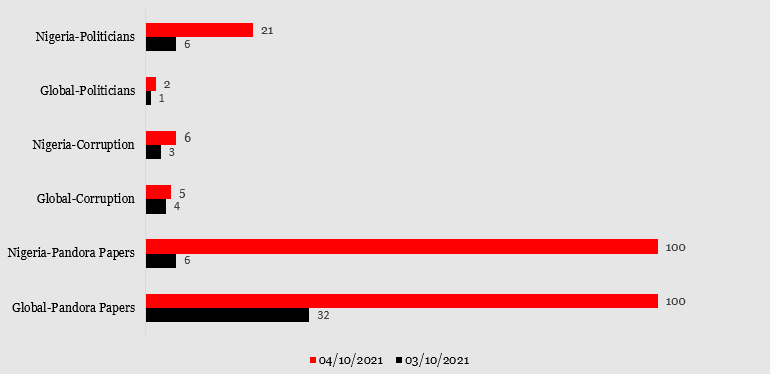
However, in some countries, the outcomes of the Panama papers led to introduce new policies and laws. In their quest of establishing a sustainable justice system, another set of global journalists worked on 11.9 million leaked documents with 2.9 terabytes of data. Outcomes of the investigation have been published since October 3, 2021 in Nigeria and other countries in the world. Between October 3 and October 4, the and Nigerian public interest in Pandora papers and Panama papers surged, representing a huge interest in Panama papers 5 years after. During the days, analysis also shows that the Nigerian and global public had interest in corruption and the Pandora Papers.

Exhibit 1: Global and Nigerian Population Interest in 2 Days

Source: Google Trends, 2021; Infoprations Analysis, 2021

The huge interest is not a surprise because Nigerians have been living with various forms of injustices over the years. Our analyst had earlier notes that “Like other countries in the world, Nigeria has two systems that are germane to its inclusive growth and development in all ramifications. To attain the desired peaceful environment across the country, criminal justice system devoid of ethnic, religious biases and social discrimination is imperative. For inclusive socioeconomic development, distribution and redistribution of economic resources without tribalism and ethnicity is a must.”

However, what is really surprising is the growth of data boys and girls, who are mostly youths being hired by the political and business elites for digital public relations purposes. They are being paid data stipend every month and used the data to create favourable status for them [the elites]. As the newspapers and journalists who worked on the Pandora Papers’ Project publish significant insights from their findings, our analysis has shown that the data boys and girls are not relenting in creating counter and alternative narratives of their paymasters’ involvement in the deals identified by the journalists.

Our analyst observes majority of the BGs, according to social networking analysis’ results, have direct and indirect relationships with the people who have been identified since the publication of stories from the Pandora Papers. Those who have direct relationship are the ones who share some family related features with the elites ‘found culpable’ by the journalists. BGs with the indirect relations are the ones who have been specifically hired by the elites for digital public relations, replying the perceived critics of their paymasters. As these relationships continue, our analyst notes that attaining sustainable social and economic justice systems would remain difficult because the youths who are expected to be the vanguards based on their digital power they possess have been hijacked by the elites.

‘I Am Right’ Syndrome And Its Damaging Effects

0

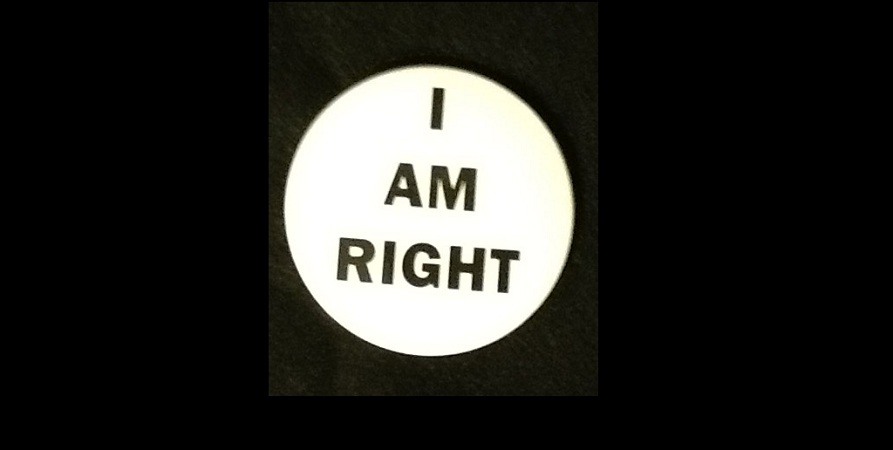
The last time I checked, millions of individuals across the globe were still hiding under the shell of a societal cankerworm known as “I am right” that’s liable to erode countless relationships found among the human race if not adequately and carefully addressed.

Few months ago, I ran into a childhood pal called Samuel somewhere in Lagos State, Nigeria. In the process of our conversation, I learnt he got estranged with his spouse a few weeks back. With the burning quest to ascertain what actually truncated a happy five-year-old marriage, I requested he had a drink with me at a nearby bar.

Summarily, the truth of the matter was that he battered the woman in question mercilessly, thus she decided to leave their matrimonial home based on her parents’ persuasions. It seemed that wasn’t the first time he would display such an attitude, but was reportedly the worst of all so far.

As I sipped my stout beer from the glass cup, just as he did with his lager, I enquired what really prompted the ruthless action. Mr Samuel claimed she gave him the insult of his life, stating he was called names.

Having gotten infuriated with the whole story, I therein unequivocally blamed the dude entirely, telling him that that was not an enough excuse. I further notified his person that insult of any kind shouldn’t warrant any iota of assault in a marriage, or any form of relationship. I observed he wasn’t pleased with my judgement but I didn’t bloody care.

To shorten the long story, I went further to inquire if he had showed remorse over the uncalled reaction. I learned till that moment, being about three weeks after the incident, he was yet to think of visiting his wife’s parental home let alone tendering an apology. To worsen it, my friend eventually told me he didn’t see anything wrong with what he did.

From the blunt response, I understood Mr Samuel was trying to hide under a certain norm that holds the thought that ‘a man is always right’. It’s not anymore news that in some African traditional settings, you cannot tell a man to his face that he is wrong when trying to mediate between him and his spouse. And, such an existing belief has ostensibly succeeded in beclouding the sense of reasoning of most men, particularly the young ones.

The fact is that the ‘I’m right’ syndrome has continued to endanger various healthy relationships. The paradox is that most of these staggering or pale-looking relationships were rightly built on a golden pedestal. But the inability to show remorse by any of the party involved, having erred, continually poses threat to the anticipated growth of the union.

Allowing your extremism mentality to control your actions would definitely make any relationship you are into crash on arrival. You aren’t supposed to strongly believe in everything. Don’t live the life of a fanatic. Sometimes, compromise is highly consequential, especially when it calls for a way forward.

Relationships are about compromise or sacrifice. Hence, you must be willing at all times to give up on a certain ideology just for peace to reign. If your ego is the problem, you must sacrifice it to enable other things you yearn for to flow. It’s noteworthy that ego had abruptly ended countless enticing unions than death did.

You must, therefore, be willing to give up that venom in your system that is unabated, posing a threat to your cherished relationship. One thing must give way to the other.

It’s always crucial to acknowledge that everybody can never be right at the same time. Someone must be wrong. And when you are right or wrong, your conscience will certainly communicate to you concerning where you belong. It suffices to assert that you are invariably expected to listen to the aforementioned feature (conscience), because it is the only tool that can lead you to the apt path.

Even when you are right, you can assume that you are wrong just for the sake of a way forward. It’s simply like a battlefield where someone must accept defeat. This is where maturity comes in. Honestly, it takes a mature mindset to keep a relationship going or alive. Maturity is like lubrication oil in any ongoing union.

Similarly, immaturity in a relationship is not unlike a bad tyre in a moving vehicle. The latter can never move properly until you change the former. And if the driver tries to manage the situation, it would surely draw the journey backwards; hence, he will never arrive at his proposed destination. Aside from not getting to the destination, it might even cause an accident in the process.

So, maturity is one of the key recipes in any relationship in existence, be it business, friendship, courtship, marriage, or what have you. It would make us possess a flexible mindset rather than a rigid one, thereby keeping us away from the dangers of fanaticism.

The said pattern of ideology (fanaticism) possesses venom that bears the potential of destroying, within a twinkle of an eye, what a man has suffered in building for years.

For crying out loud, you can’t continue to say ‘I am right’ even when aware that you’re wrong. Don’t cheat on your conscience if you truly want your relationship to excel. There are definitely no two ways about it.

‘I am sorry’ doesn’t really mean you are wrong. It rather means you truly cherish the relationship more than your ego.