DD
MM
YYYY

PAGES

DD
MM
YYYY

spot_img

PAGES

Home Blog Page 5535

Facebook’s Symphonic Innovation At Technology Stack

0

In the Innovation of Firms, a course in Tekedia Mini-MBA, I explained Symphonic Innovation thus: “Symphonic Innovation is innovation that is not domain-specific, but is anchored on a unified and harmonious approach in the deployment of technology components to accelerate productivity gains and cushion competitiveness. With Symphonic Innovation, you do not deploy and launch for blockchain, only to be tripped by AI or big data; you launch with a mindset that these technologies are like extended musical compositions which must be carefully organized to make the orchestra an unforgettable experience.”

What happened to Facebook Inc today revealed a case study on how to build modern technology stacks. You do not build in disparate structures with no order. Rather, you see your technology as a musical orchestra with instruments which must be harmonized to deliver an unforgettable memories across platforms and product nexus.

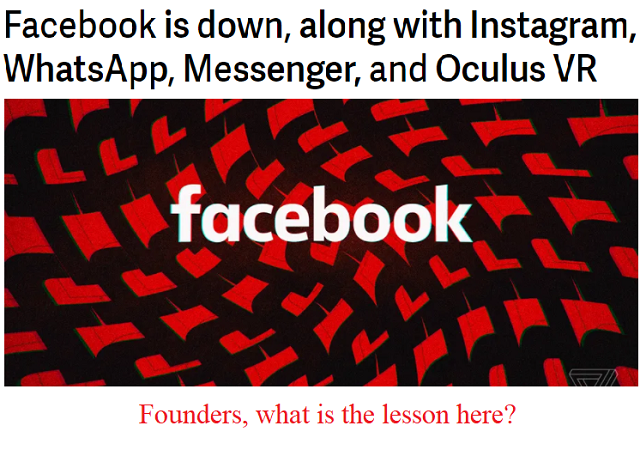
Facebook is back after a major outage that lasted for about six hours Monday. The outage impacted users across its suite of apps, in addition to its employees — internal systems and tools stopped working, as well. The social media behemoth faces mounting scrutiny — a whistleblower, who is set to testify before Congress Tuesday, told CBS’s “60 Minutes” Sunday that Facebook “amplifies hate, misinformation and political unrest.” The cause of the outage is still unknown, but security experts believe it could have been a Domain Name System (DNS) problem. (LinkedIn)

This is the age of unification and we have just learnt that Facebook, WhatsApp, Instagram, Oculus VR, Messenger, etc are powered under one unified stack making it easier for those great experiences we get across the platforms. Sure, the revelation came through a freeze but at least we know what they do at the highest level.

Go back to your office and ask your CTO and CIO if they can learn from this playbook, of course building redundancies to avoid a protracted failure when bad things happen.

The Lesson from Great Social Media Freeze

0

Nigerian and African founders, what can we learn from Facebook, Instagram, WhatsApp, etc going down at the same time. On Twitter, Facebook communications exec Andy Stone  has confirmed this Great Social Media  Freeze, “We’re aware that some people are having trouble accessing our apps and products. We’re working to get things back to normal as quickly as possible, and we apologize for any inconvenience.” Founders, what is the lesson here?

Sure – it is bad everything is down but if you look at the financial improvement on what Facebook Inc has done on stacking all the elements on one core, you will see why Facebook Inc is immensely profitable. I expect this to be DNS related, and it goes to the core infrastructure which runs the multi-billionaire-dollar empire.

It is a very risky technology strategy but despite the current offline show, it is certainly the best way to build modern tech systems: you invest to build the foundational stack, and then you can drop new things on top, making everything to become variable costs from there onwards. With that, you rack up marginal cost improvements across product lines, building moats which no one can compete with.

Hong Kong Exchange Suspends Evergrande Shares, Compounding the Conglomerate’s Troubles

0
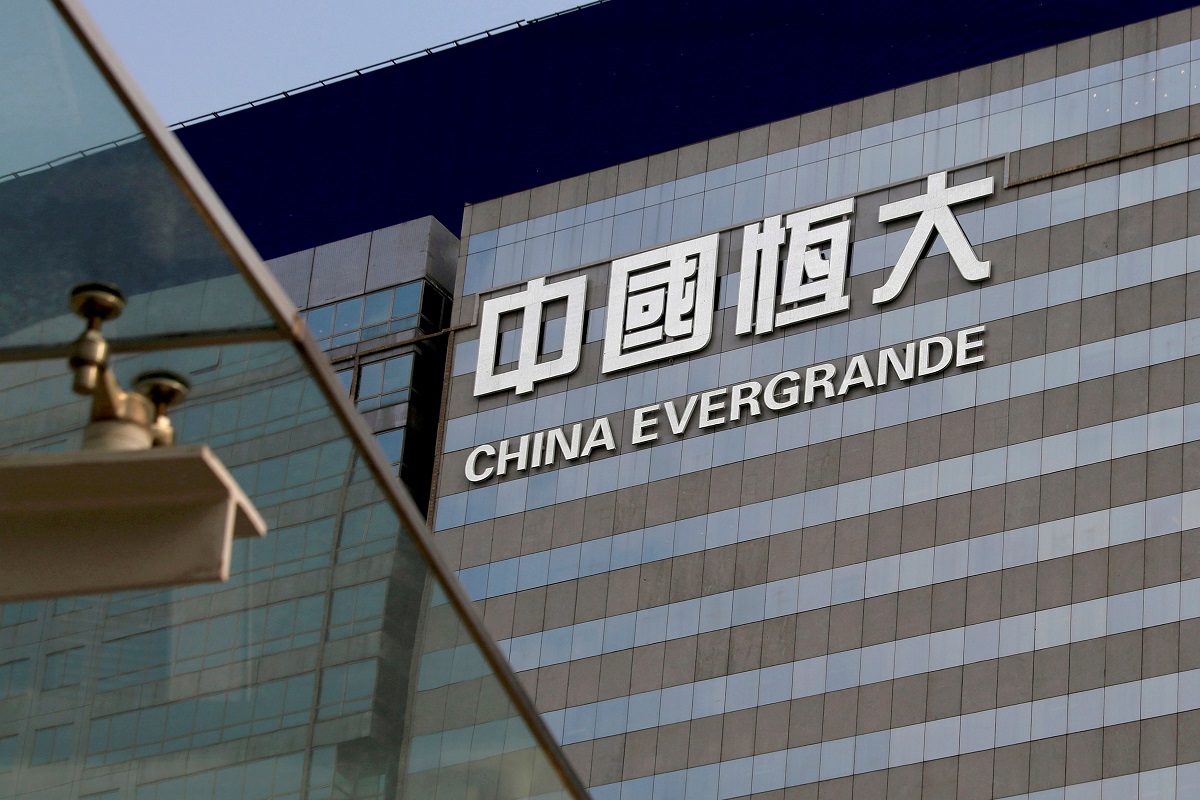
FILE PHOTO: An exterior view of China Evergrande Centre in Hong Kong, China March 26, 2018. REUTERS/Bobby Yip/File Photo/File Photo/File Photo

The troubles of embattled Chinese property conglomerate Evergrande, have taken a new turn. The company shares and its property management unit were suspended from trading in Hong Kong on Monday, a move that has left all hopes of recovery in further strains.

Evergrande is working on selling majority stakes as it has repeatedly missed payments. The company has watched helplessly as many subsidiaries crumble.

The shares were halted “pending the release by the company of an announcement containing inside information about a major transaction,” Evergrande said in a statement. The property services unit said the shares were suspended ahead of an announcement “pursuant to the Hong Kong code on Takeovers and Mergers which constitutes an inside information and a possible general offer for the shares of the company.”

Evergrande’s listed electric vehicle unit, also running out of cash, continued to trade, rising 13% on Monday afternoon, Nikkei Asia reports.

The company’s shares have lost 80% of their value this year as it has also missed payments to banks, suppliers, bondholders and other investors.

About two weeks ago, in an effort to calm the storm, Evergrande hired financial advisers to proffer solution, as it has exhausted all options available to the company.

To compound Evergrande’s woes, the Chinese authorities have kept their distance, only asking banks to support the property sector and supply the market with liquidity to contain the fallout. The shares’ suspension in Hong Kong Stock Market has however, taken Evergrande’s predicament to a new height.

The company has a debt profile of over $300 billion, and has been desperately trying to offset some of its liabilities compounded by the reforms in China’s property industry.

Evergrande said in a recent filing that it has 240 billion yuan ($37.2 billion) in total debts due over the next year, compared with cash and bank deposits of 161.6 billion yuan.

Having touted selling of stakes, the conglomerate has flagged shares in Evergrande Property Services with more liquidity than other subsidiaries, including the parent company.

Last week, Evergrande reached a deal to sell a 19.9% stake in regional lender Shengjing Bank for $1.5 billion to a state-owned company, but the bank has demanded that all the proceeds be set off against sums the developer owes it, the report says.

Per Nikkei, Evergrande Property reported a 68.6% rise in net profit in the first half of 2021 from a year earlier, while also posting a rise in area under management and cash on hand. Its shares have declined 40% this year though, dragged down by the struggles of its parent. Evergrande Group owned 60.96% of the property services unit as of May 18, according to Capital IQ data.

While over 15 other stocks were also suspended from trade Monday morning in Hong Kong, including fellow Chinese property company Hopson Development Holding, Evergrande has added to its existing worries, as it may impact the company’s chances of selling some stakes. Nikkei said some Chinese local media reported that Hopson had agreed to buy 51% of Evergrande Property in a 40 billion Hong Kong dollar ($5.14 billion) deal. If the deal succeeds, the value of Evergrande Property’s shares will stay at a premium of more than 40% to last week’s closing price.

Things have been falling wide apart as investors desert the troubled company. And with no help coming from China, Evergrande is watching its chances of payment get slimmer. The company warned investors last month that there is no guaranteed that it would beat its payment deadlines, unless it sells off enough assets or secure new investments.

It missed coupon payments on two offshore dollar bonds but has 30 days to make good on those debts.

Bloomberg reported on Monday that a $260 million bond guaranteed by Evergrande had matured without repayment a day earlier. The note was issued by Jumbo Fortune Enterprises, a joint venture involving Hengda Real Estate, Evergrande’s domestic property arm, Nikkei reported.

Other attempts by Evergrande, including offering apartments, parking lots and commercial space to suppliers and other creditors, to settle debts, has yielded little result as interest in properties, especially condominium, has waned due to rising concerns about its future.

Exacerbating the woes, Evergrande is also being confronted with desertion from partners. Nikkei reported that some longtime backers of Evergrande, such as Hong Kong developer Chinese Estates and its leaders, have also been deserting the company. And last month, Chinese Estates, the second-largest shareholder in Evergrande, flagged plans to exit its entire shareholding.

With the conglomerate taken hit on all sides, the world economies are beginning to double their readiness for the worst.

Registration for 6th edition of Tekedia Mini-MBA Closes Oct 5

0

Tomorrow, Oct 5, we will freeze enrollment into the 6th edition of Tekedia Mini-MBA. So, if you want to attend our world-class business school in 2021, you have just hours to get in. Midnight tomorrow  (WAT), we will close the registration. Tekedia Mini-MBA is an impactful business school. This week, we have business veterans from AXA Mansard and TrustBanc Capital  with my humble self leading the live editions in Zoom.

Go here and register.


Modern Education And The Role of Technology

0
Nigeria needs stronger education systems

Education can be described as the imparting and acquiring of knowledge via teaching and learning, respectively, especially at a school or similar institution.

In the words of G. K. Chesterton ‘Education is simply the soul of a society as it passes from one generation to another.’ No wonder every sane and rational society treats it as the fundamental factor required toward any meaningful development.

The earliest educational processes involved sharing information about gathering food and providing shelter; making weapons and other tools; learning language; and acquiring the values, behaviour, as well as religious rites or practices of a given culture.

Prior to the invention of writing and reading, people lived in an environment in which they struggled to survive against natural forces, animals, and other humans. At the time, to survive, preliterate individuals developed skills that grew into cultural and educational patterns.

Education, therefore, emanated from the human struggle for survival and enlightenment. It may be formal or informal. The latter refers to the general social process by which human beings acquire the knowledge and skills needed to function in their culture. Whilst, formal education refers to the process through which teachers instruct pupils or students, as might be the case, in subjects of study within institutions.

Modern day education makes one feel proud that s/he is truly educated, though formally or informally, everyone is educated. Real education, which is the overall development of mind, body and soul, can be acquired via any means. According to Carter Woodson, education means to ‘inspire people to live more abundantly, to learn to begin with life as they find it and make it better.’

It’s noteworthy that modern education is aided with a variety of technology comprising computers, projectors, internet, and calculators, among others. This fact forms the basis of this discussion, hence shall take time to do justice to it.

Everything that can be simplified has been made simpler by the introduction of the aforementioned gadgets into modern day education. Science has obviously explored every aspect of human life. It suffices to say that there is now much to learn as well as more to assimilate. The Internet alone provides abysmal knowledge, meaning literally that there’s no end to it.

Skill development and vocational education has added a new feather to the modern system of learning. Everyone has something to learn. Even an infant these days goes to a kindergarten; and a little grown, mentally and physically, is promoted to a nursery.

The most fascinating part is that everything is being categorized ranging from kindergarten, nursery, primary, secondary, to tertiary; and each of these stages has a certain set of technical acquaintances.

The truth is, the modern pattern of education is a never-ending process. Aristotle Nicomachus, in his usual way, stated that education is an ‘ornament in prosperity and a refugee in adversity.’ This is exactly what modern education represents.

However, it’s pertinent to acknowledge that the existing technical intricacy of modern education has caused colossal harm to the present days’ children, thereby posing threat in their respective ambitions and future endeavours.

For instance, before now, devices such as abacus were used during Mathematics classes. Such an approach helped tremendously to educate the kids – ranging from ages 6 to 14 – on mental arithmetic, a knowledge that enables them to face any form of Mathematics problem in the future.

But now, except in nations such as India, Russia, China, Ghana, and what have you, that still use counting frames or abacus, calculators have suddenly overtaken its use in countries like Nigeria. Worse still, even primary school pupils are now exposed to scientific calculators.

Modern education has deprived most learners the opportunity of seeing the real events or scenes. Engineering students, for example, only see pictures of what is being taught, or what is expected to be produced by them.

Final year undergraduates, and perhaps postgraduate students, presently do their projects or theses by merely downloading the required materials from the net. Most students don’t even know where the fabric they are wearing came from. The word ‘how’ is currently missing in our world, which causes severe ignorance.

Modern education has succeeded in spreading more ignorance than knowledge. It has produced a vast population able to read but unable to distinguish what is worth reading. Learners do more of cramming rather than memorizing, which can only be achieved by getting close to facts or the actual pictures. Albert Einstein once said education is ‘that which remains if one has forgotten everything learned in school.’

For the technical intricacies involved in modern education to be advantageous to the learners, they must serve as supplements. In other words, they ought to be used for reference purposes, and not as fundamental devices as they are presently utilized in various institutions of learning.

The pupils or students must get used to the real pictures or sites before introducing the use of tech gadgets to them. Their brains shouldn’t be complicated with those things at an early stage. Those brains are still fragile, thus ought not to be juxtaposed with tech intricacies. More so, endeavour to let the practical segment be preceded by theory.

We must note that every invention was made for a purpose, and to be applied at a particular time. So, if we end up misusing them, it becomes a problem when they are meant to serve as blessings.