DD
MM
YYYY

PAGES

DD
MM
YYYY

spot_img

PAGES

Home Blog Page 5558

Nigeria’s Central Bank Governor Goes After AbokiFX and Founder [videos]

1

I have called AbokiFX the most powerful economic website in Nigeria, due to its ability  to influence Nigeria’s trade through the asymmetric impact it has on Naira exchange rate. Honestly, I am not a fan. They have made things really hard even here in the US. You set a price on something in Naira and the next day for no apparent economic reason, new rates evolve. 

It turns out that the Central Bank of Nigeria (CBN) is paying attention to the factories of the future: digital startups. AbokiFX foreign exchange policy is stronger than whatever CBN has been doing with banks in the last six months. The government was to fight AbokiFX for its market “opinions”!

The Central Bank of Nigeria has accused the Abokifx, a website that collates the black market exchange rates of naira, of carrying out an “illegal activity that undermines the economy”.

The CBN governor, Godwin Emefiele, said the publisher of platform, Oniwinde Adedotun, was involved in “illegal forex trading”. […]

“It is completely illegal and unacceptable…Mr Oniwinde is an illegal fx dealer that have inflow and sold tens of millions of fx to several Nigerian companies in contravention of the fx law, he directly benefits from the rates he quotes daily on his website.”

CBN governor contends that AbokiFX could be involved in market manipulations. That would be unfortunate indeed. I hope they get to the root of this matter as quickly as possible as Naira needs help.

Meanwhile, foreign stock trading apps are coming back to life. From Bamboo: “We wanted to update you on the latest developments regarding the recent court order. The Federal High Courts Abuja has issued a varied order to unfreeze our bank accounts so that we can continue operations. As always, we remain completely dedicated to serving you and you can rest assured that your monies and investments are safe with us.” Nigeria’s apex bank has frozen the bank accounts of many foreign stock trading apps on the accusations of forex issues.

Comment On LinkedIn Feed

Comment #1: Abokifx.com to my knowledge is just a parallel market exchange rate information aggregating website. We all know what the Nigerian problem regarding autonomous forex markets. Has CBN gone after dealers at Eko Hotel, Federal Palace Hotel, MMIA, Broad Street and Ikeja Airport Hotel yet? Has it attempted to influence the market by selling dollars to buyers at a lower price?

My Response: “Has CBN gone after dealers at Eko Hotel, Federal Palace Hotel, MMIA, Broad Street and Ikeja Airport Hotel yet? – Eko hotel, etc dealers are bounded by geography but AbokitFX is unconstrained and unbounded and that is why it is powerful

Comment #2: Anything that can help put a stop to this madness, I support it 100%. I keep questioning how we wake up each day and naira keeps doing top up, with no economic fundamentals or commodity price movement to point to, yet we accept the manipulation as mere demand and supply issue.

Some people are out to destroy our Naira, and if we don’t fight back, they will ask for our heads too.

Emefiele doesn’t need plenty press conferences on this one, all our national intelligence and security arsenals should be unleashed on these economic bandits.

Ribadu’s EFCC made a lot of people tremble those days, we need something similar and much more sophisticated this time, the era of smiling or appealing to our adversaries is over.


 

Private Equity Academy 2021 – Attend in Lagos Continental Hotel, Nov 2021

0

The professional terrain in Nigeria and across Africa is changing

  • There is an increase in the demand for skilled Private Equity professionals*

?Driven by the growth of the investment field and the absence of domestic world-class post graduate courses and programs

? Other drivers include increased foreign direct investment in emerging markets and the difficulty that banks, investment firms, and private equity funds have in finding suitable investment professionals.

??This course cycle at the academy is an import substitution, bringing to Nigeria a world class programme with a global perspective to the country

Enroll in this world class academy

Date- 8th –16th November 2021
Venue- Lagos Continental Hotel

Access details and Program Brochure Here

Call/Whatsapp – 08068403681

?Deepen your knowledge, grow your career and unlock new opportunities

Our 2021 Q3 numbers are out and 2021 is looking SUPER-GREAT

0

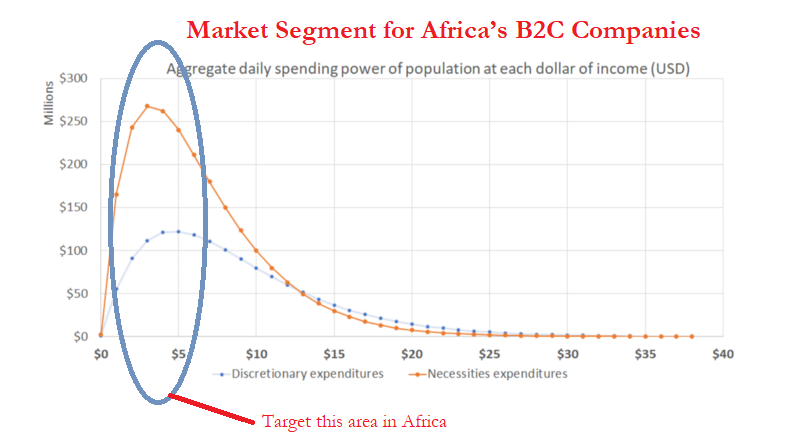
Our 2021 Q3 numbers are out and 2021 is looking SUPER-GREAT. Our leverages are compounding very well.  We continue to be laser-focused on pricing because “the most significant opportunity for African B2C startups lies with consumers who earn between $4 — $8 per day … This is largely because that income band holds the highest concentration of discretionary spending power on the continent, as the graph below shows.”

Companies like Bigi Cola and La Casera understand this redesign. You can also make a case that the sachetization in places like Nigeria where everything is now bundled in sachets has a root therein. Simply, there are not many consumers outside that $4-$8 per day segment for any big B2C business (if you focus outside this segment, your business must have a dose of B2B).

Interestingly, that is also where I see a big percentage of my popular 30 million people who earn relatively decent income in Nigeria; those 30 million are the core of the consumer market.

The Core Market Segment in Africa – Middle of the Pyramid

Facebook Introduces New Features to Revamp Its Targeted Ads Scuttled By Apple

0

Facebook announced on Thursday the launch of new products and features for businesses geared toward creating alternatives for its targeted ad business scuttled by Apple’s new privacy policy.

The social media giant said the new features will be helpful in an era where “people will want to easily discover products and services, get support and ask questions right from chat, and conduct transactions, all while having more control over their personal information.”

The privacy-driven policy that restricts Facebook from tracking people across iOS apps for targeted ads, has been widely accepted by users of iPhones, leaving the social network with no choice than to seek alternatives for its advert-based enterprise.

Facebook has been at the receiving end of heavy criticism over how it uses personal information, and many users are seeing the iOS policy update as a succor to their concern that their private information may someday be mishandled. Against this backdrop, Facebook is rolling out new features that will allow businesses to better position themselves in front of relevant audiences.

These new features are interconnected with Facebook’s sub-companies to enable businesses to have access to ads and interact with their customers.

“We want our family of apps to be the best place for businesses, especially SMBs, to run their business online. That’s why we are announcing new products to help businesses connect with their customers and simplify day-to-day management,” the company said.

Facebook has been expanding on e-commerce with features such as Marketplace and the newly introduced business directory on WhatsApp, which allows consumers to find shops and services on the chat platform.

As part of its push to create a business environment independent of third party services, Facebook has been trying many new features. TechCrunch noted that earlier this year began testing a way for customers to explore businesses from underneath News Feed posts by tapping on topics they were interested in — like beauty, fitness and clothing, and exploring content from other related businesses. The feature allows people to come across new businesses they may also like, and would allow Facebook to create its own data set of users who like certain types of content. Over time, it could possibly even turn the feature into an ad unit, where businesses could pay for higher placement.

For now, Facebook will expand this feature to more users across the U.S., and launch it in Australia, Canada, Ireland, Malaysia, New Zealand, Philippines, Singapore, South Africa and the U.K.

The company has emphasized on using chat messaging to help businesses and customers communicate across its platforms.

“We are investing across Facebook, Instagram and WhatsApp, in business messaging tools as well as omni-channel communication tools such as email. We’re using our expertise in person-to-person messaging to simplify person-to-business communications. These new tools are built to drive better business results across the customer journey – from higher-quality leads, to incremental sales, to higher customer satisfaction at lower cost,” the company said.

This means it will become easier for businesses to chat with customers, buy ads that encourage people to message them on Facebook’s various chat platforms — Messenger, Instagram Direct or WhatsApp, and also be able to choose all the messaging platforms where they’re available, and Facebook will default the chat app showcased in the ad based on where the conversation is most likely to happen.

The company will tie WhatsApp to Instagram, as well, as part of this effort. Facebook explains that many businesses market themselves or run shops across Instagram, but rely on WhatsApp to communicate with customers and answer questions. So, Facebook will now allow businesses to add a WhatsApp click-to-chat button to their Instagram profiles.

The company also announced new updates to Facebook Business Suite, where new technologies like automation, and simplifying how businesses manage their digital presence, have been featured. This will help businesses to focus on reaching their customers and growing their business.

Facebook said it is also introducing File Manager, a new feature that allows businesses to easily create, manage and post content within Facebook Business Suite, and also making post testing available in Facebook Business Suite to let businesses test and compare multiple versions of a post to see which one people are more likely to engage with.

Other new products include tests of paid and organic lead generation tools on Instagram; quote requests on Messenger, where customers answer a few questions prior to their conversations; and a way for small businesses to access a bundle of tools to get started with Facebook ads, which includes a Facebook ad coupon along with free access to QuickBooks for three months or free access to Canva Pro for three months.

Facebook said it plans to incorporate more content from creators and local businesses and new features that let users control the content they see.

The Nature and Implications of SDGs Deficit in Nigerian Universities Benchmark Minimum Academic Standards

1

Nigeria and other countries in the world have less than 10 years for the realisation of 17 Sustainable Development Goals accepted by the political and business leaders in 2015. In one of our previous article series on sustainable development, our analyst stressed the place of academics and academia in the attainment of the Goals.

In the analysis, it was specifically stated that academic publications such as peer reviewed journal articles, chapters in books and whitepapers would go in a long way of calling attention of relevant stakeholders to the need to priorities the Goals and their specific targets before 2030. Similar submissions have also been made in other analyses, especially on the place of strategic partnership and lack of data for evaluating and measuring progress.

As one of the key stakeholders, academics, development specialists and other professionals who are connected with the path of realising the Goals directly or indirectly have hinged that universities and other higher education institutions have teaching, collaborative, evidence-based knowledge, measuring and evaluating, and advocate roles to play if countries, nations, cities, towns, villages and communities would ever realise the Goals by 2030.

Teaching role requires that HEIs have appropriate academic curricula that disentangle each of the Goals for the students and members of the Institutions’ immediate community. This role also requires that the teachers of the trainees or trainers of the teachers have adequate knowledge, skills and experiences that would enable them to transfer necessary knowledge, skills and experiences associated with effective problem identification and provision to targets/beneficiaries of each Goal.

Since teaching cannot be a single approach to educating relevant stakeholders about the significance of attaining the Goals, universities cannot do without collaborating with other key stakeholders. For instance, our analyst notes that universities-industry partnerships in Nigeria needs process and people reengineering. This is premised on the recent experience which shows that both the gown and the town are collaborating less towards solving varied issues in the two climes.

From publications, universities are in a better position to ensure evidence-based solutions provision and application. With the appropriate understanding of how researches fuel development and shape societal issues and needs, universities cannot do without creating necessary and relevant metrics for monitoring and evaluating progress of each Goal before 2030.  While performing these roles, strategic advocacy and civic engagement cannot be jettisoned. This is needed whenever research outcomes show grey areas in the private and public sectors’ activities related to the Goals. It is also important that universities engage policy makers and implementers on the need to consider the outcomes for emergent policy formulation and implementation in the key industries and sectors that align with the Goals.

As debates about the roles of universities continue, in this piece, our analyst examines effectiveness of academic programmes’ number of aims and objectives in the sciences and social sciences on the reflection of the SDGs’ related courses. For the two faculties, analysis suggests possible teaching of climate change as topic more than sustainability and environment.

Applied Geophysics, Biochemistry, Biology, Biotechnology, Botany, Brewing Science and Technology, Chemistry, Computer Science, Criminology and Security Studies, Demography and Social Statistics, Development Economics/Studies, Economics, Economics and Development Studies, Environmental Management and Toxicology, Geography, Geology, Industrial Chemistry, Information Science and Media Studies, International Relations, Marine Science, Mass Communication, Mathematics, Meteorology, Microbiology, Peace Studies and Conflict Resolution, Petroleum Chemistry, Physics, Political Science, Psychology, Science Laboratory Technology, Science Laboratory Technology (Biology), Science Laboratory Technology (Microbiology), Social Justice Studies, Social Work, Sociology, Statistics, Tourism Studies and Zoology are the programmes chosen for analysis.

Analysis specifically considers some of the premises for the inclusion and teaching of SDGs in schools. For instance, Professor Sahagian Dork recently noted that “there are at least two key aspects of incorporating SDGs, and sustainability in general, into courses and curricula at the college level. The first is through sustainability and environmental degree programs, whose students plan to pursue these topics as a career and whose faculty have already made this their career. The second, and more difficult, aspect is incorporating SDGs throughout the entire college curriculum to reach those students who may not be pursuing sustainability as their life’s work.”

Our analysis shows some levels of alignment with Professor Sahagian. We found that none of the programmes in the two faculties is specifically designed for teaching of sustainability and environmental issues. We only discovered courses within programmes that suggest the possibility of teaching SDGs related issues and needs. However, Environmental and Sustainable Development is a course in the General Studies Programme and being taught in twice in 200 levels. Majority of the courses within the selected programmes that align with the SDGs partially are being taught in 200, 300 and 400 levels.

Our analysis reveals that Environmental Management and Toxicology, Development Economics/Studies, Marine Science, Geology, Meteorology are more aligned with SDGs than other programmes. We equally found a strong association of the number of aims and objectives with the courses that establish possible teaching of climate change and sustainability as topics, but not for environment as topic. For sustainability and climate change to be taught as topics significantly, analysis shows that a programme needs between 5 and 11 strategic aims and objectives.

Exhibit 1: Number of Aims and Objectives in Selected Programmes in Relation to Selected Courses Per Select Faculties

Source: National Universities Commission’s BMAS, 2015; Infoprations Analysis, 2021

Key: Number of Aims and Objectives are repeated when a programme has more than one course that aligns with SDGs [fully or partially]

Exhibit 2: Severity of SDGs Reflected Courses by Faculties


Source: National Universities Commission’s BMAS, 2015; Infoprations Analysis, 2021

Key: 201 SDGs reflected courses for sciences; 155 SDGs reflected courses for social sciences

Source: National Universities Commission’s BMAS, 2015; Infoprations Analysis, 2021