This is one mistake many Nigerian merchants make: convert US dollar-based pricing and ask customers to pay the Naira equivalent. The thinking is like this: if your product goes for N50,000 or $140 when the US dollar is exchanged at N400/$, if the exchange moves to N500/$, you have to go and increase that N50,000. That is wrong.
That confusion is why I get this type of inmails: “On your advert on Tekedia Diploma programmes, you said $100 orN36,000.00. I thought the exchange rate is now above 400 naira per dollar?”
In Tekedia Mini-MBA, we have three different pricing courses from leading experts; pricing efficiency is very important in any business. That Naira is falling must not mean that my Nigerian customers must be asked to pay more if that fall of USD does not affect my marginal cost and broad cost of production.
More so, that Naira is losing value to USD does not mean that those earning local currency (Naira) suddenly have more Naira. So, if you have a product at say $100 or N36k when the exchange rate was N360/$, and Naira has dropped to N500/$, you cannot recklessly jack up prices unless there are clear production factors which would be affected.
So, when you see our pricing, it is not a typo. Microsoft does that all the time. It costs me $99 per year on my personal Microsoft 365; some vendors can sell you for less than N7,000 ($15) in some African countries because it is easier to make $99 than make N7,000 ($15) say in Nigeria. If Microsoft translates that without considering purchasing power parity, it will miss its customer base.
Sure – that does not mean you cannot increase the price as currency erodes value. But it has to be done not just because some speculators are at work!
Similar to the parents’ behaviour expected, while children need to buy and use certain commodities and services, in terms of health products buying and services use, parents are expected to be the first buyers or users. They are the first buyers or users because they constitute the only persons who could explain the status of children’s health needs or challenges better. This, according to many scholars and professionals in the consumer behaviour field, has been hinged on the premise that parents usually have in-depth understanding of how children feel.
In the course of helping their children in times of health needs or crises, parents have online and offline platforms for seeking necessary information about their children’s health conditions and needs. In the last two decades, the proliferation of new technologies has shaped and still reinventing how parents seek information about health conditions and needs of children globally.
From search engines to social media networking sites, parents are exploring various information with the key interest in solving different health conditions and issues. Google Search Engine has remained one of the most appropriated search engines for information seeking in the last two decades.
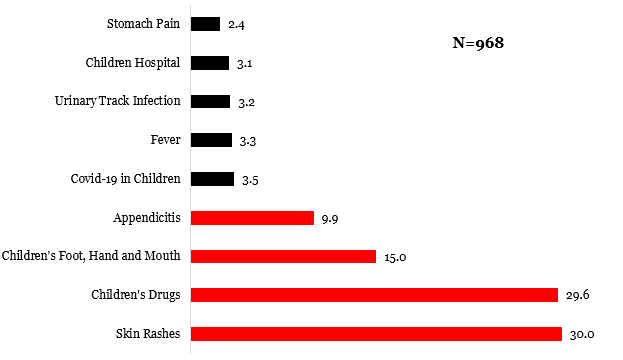
Our check indicates that among 51 countries, where parents have significantly developed interest in seeking information about their children’s health status or issues in the last 5 years, Nigeria has been occupying the 6th while Zambia, the United Kingdom, Ghana, Ireland and New Zealand are the 1st, 2nd, 3rd, 4th and 5th respectively. For the years, skin rashes, children’s medications and issues related or conditions of foot, hand and mouth remain the key concerns [see Exhibit 1].
Despite significant interest in seeking information through the Internet and social networking sites, a number of parents are always skeptical about using the information because of the low quality in most cases. When they sought information, a recent study found that they consulted a physician, consulted a traditional healer, and relied on self-medication or asked friends for suggestions.
Exhibit 1: Key Areas of Concern for Parents Globally
Source: Google Trends, 2021; Infoprations Analysis, 2021
Our analyst notes that having doubts is understandable considering the implications of using quantum of non-medically proved information that abound on the Internet and social networking sites. While there are many groups and people on digital platforms who parade themselves as professionals in child health information provision and guidance without appropriate strategies of creating posts and replying to parents’ requests, ASK THE PAEDIATRICIANS, a group on Facebook, has proved to be a game changer in the digital health information.
This position was established after analysing the Group’s page and official website. The Group, which later transformed to a Foundation, was created the 20th July 2015 by Dr. Gbemisola Boyede, Consultant Paediatrician at the Lagos University Teaching Hospital, Idi-Araba, Lagos.
“Ask The Paediatricians has since grown beyond the online platforms which now included the ATP mobile app into a non-profit registered with the corporate affairs corporation of Nigeria in July 2017. Ask The Paediatricians Foundation is fully committed to promotion of the health and welfare of all children globally and especially in Nigeria through our online health education platforms and offline community medical outreaches, Group’s Page notes.
As at the time of analysing the Group, over 600,000 parents, living in Nigeria, the United Kingdom and other countries, are members of the Group. Our analyst also found that complementary feeding, colds, cough, catarrh, child nutrition, childhood immunizations, skin rashes, stool abnormalities, ideal weight and height, miscellaneous child health issues, breastfeeding, medications and mothers’ health issues have been posted by members and reacted to by Paediatricians.
In our analysis, we found that Dr. Gbemisola Boyede and her team’s responses to the members’ questions align with the best practice of replying and educating people on digital health information seeking in the current health information pollution. For instance, Dr Boyede and her team usually inform the members who asked questions to consult relevant doctors rather than engaging in self-medication. As part of reinforcing replies to questions, links of relevant articles are shared by the doctors.
Our analysis also reveals that the Group’s official website has relevant information that parents could explore. One of the unique features of the website is bot addition, which usually encourages parents to ask questions just like what is obtainable on the Group’s Facebook page.
The VAT controversy between the Federal Inland Revenue Service (FIRS) and Rivers State, which is increasingly escalating to involve other states, keeps introducing new episodes as Governors make decisions on which side of the matter they stand.
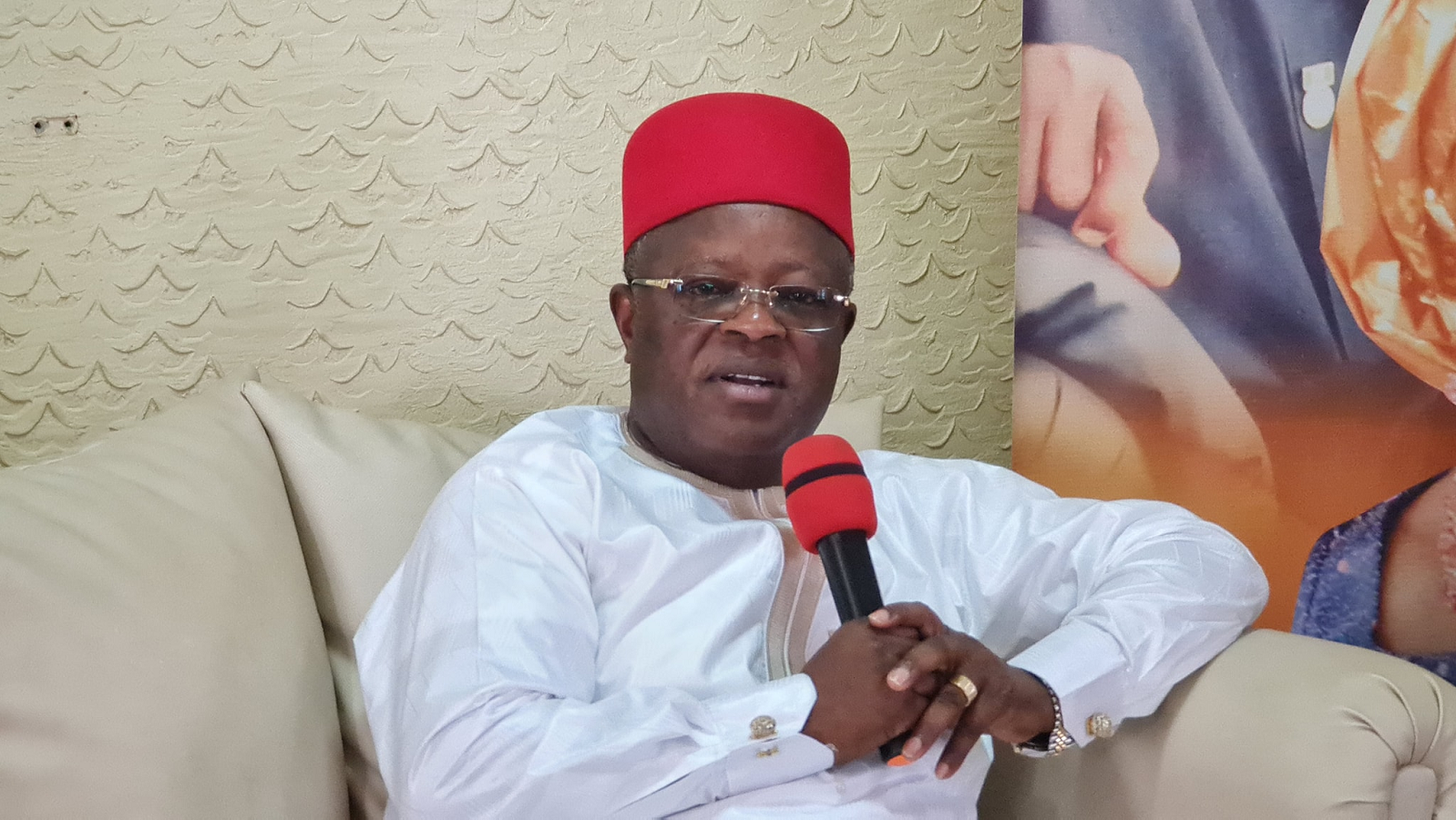
Ebonyi State Governor David Umahi has charted a path away from the perceived desire of Southern governors to support Rivers State Governor, Nyesom Wike’s struggle to stop the FIRS from collecting VAT from businesses under states’ jurisdiction. Umahi has said he is not in support of the legal tussle which has been backed by Lagos State, and Ogun State, reportedly working on a bill to give VAT collection by the state government, a legal backing.
“Ebonyi state is not in support of any state collecting VAT. We are in support that FIRS should continue to collect tax and share,” Mr Umahi was quoted as saying at a dinner in honour of a former Chief of Army Staff Tukur Buratai.
Following aFederal High Court ruling last month, which declared the collection of Value Added Tax in states by the federal government illegal, some states in southern Nigeria have been trying to use the opportunity to break away from the tax marriage with Abuja, which has been described as ‘unjust.’
The Rivers and Lagos state governments were swift to enact a law that will empower their states to take charge of VAT collection, and other states, including Akwa Ibom are following their steps.
However, breaking ranks with his southern counterparts, Umahi, who has been a vocal supporter of the federal government’s initiatives, said he doesn’t support the idea.
The outlet reported the governor strongly opposing the move in his address during an event held at the Governor’s Lodge, Centenary City, Abakaliki. He was quoted as saying that “evil will continue to thrive if good people keep quiet.”
“We must make Ebonyi state very exceptional by rising to the challenges. When we shout true federalism, I say, I agree. But it should be administrative restructuring,” he said.
“People are taking special interest in Ebonyi state and her governor, positively and negatively. But it is very important to be in the news than for you to say there are 36 states. You will name 35 and say, ‘what is the other state?’ We have aborted it. We are now a state to reckon with, and we have no apologies.”
Umahi’s decision to stick with the federal government is believed to emanate from Ebonyi State’s total dependence on federal allocation. The southeastern state’s 2020 internal generated revenue (IGR) of about N13 billion is among the poorest in Nigeria, and it’s the only southern state ranked among top-10 poorest states in the country.
While the Federal High Court’s VAT judgment has been hailed as a bold step to fiscal federalism, many states will not survive if it’s nationally implemented. Against this backdrop, many states, especially in the north, are rallying around the FIRS, while others in the south, who have enough IGR numbers to survive without federal allocation, are standing firm in their opposition to the tax agency.
For instance, Lagos and Rivers states have both ignored the ruling of the Appeal Court, which ordered all parties in the VAT case to maintain the status quo. While the Lagos State Government proceeds with all moves to collect VAT, the Rivers State Government has taken the FIRS to the Supreme Court, challenging the appellate court order.
Rivers State wants the Supreme Court to order that the substantive appeal by FIRS be heard and determined by a fresh panel of the Court of Appeal.
Rivers is also requesting the apex court to set aside the ruling made by the appellate court, which ordered the state to stop VAT collection pending the determination of an appeal filed by the FIRS.
It is a very beautifulvision and one we must commend and support: “The Federal Government has said that it is targeting an increase in e-commerce trading, from the current market value of $13bn to about $75bn by 2025. The Permanent Secretary, Ministry of Industry, Trade and Investment, Dr Evelyn Ngige, who disclosed this on Tuesday in Abuja at the second National E-commerce Roundtable organised by the ministry noted that e-commerce had grown from 14 percent in 2019 to 17 percent in 2020.”
This is how great things happen provided we can walk the talk. The future of markets in Nigeria would be digital because the transition from meatspace to the digital space will continue for decades. Yes, Nigeria has decades-long opportunities to redesign its industries and commerce is a big component.
Yet, if Nigeria wants to make this $75 billion ecommerce business come to pass, it has to do two things: fix postal service (PPP or joint venture with private sector) and stimulate ecommerce spending.
In the United States, they used the initial sales tax waiver collection to make things online cheaper. In other words, because the old Amazon was not required to collect local sales tax, things in Amazon were cheaper than your neighbourhood store.
If you spend $1000 on Amazon, you do not have to pay an extra $80 sales tax unlike in your local store which is required to collect it. And with free shipping, many would wait for the extra two days it would take Amazon to ship the items, to save that $80. So over time, ecommerce became a destination for shopping. American policy seeded that redesign.
The second part is that without a good postal service, there is nothing like a dynamic ecommerce sector at the consumer level (B2B ecommerce is flourishing). The marginal cost of an ecommerce business is captured by transaction and distribution costs. The distribution cost is physical (yes, you have to actually move the item from the warehouse to the buyer) and the internet will not solve that cost element. So, without a postal service in Nigeria, we cannot have a dynamic ecommerce since participants would be required to build huge logistical systems. Not many have that resource. So, Nigeria needs to get the postal service working for us to touch that $75 billion.
Doable? Yes if we focus on some pillars and anchors. In short, $75 billion is very small. The total consumer spending in Nigeria is close to $350 billion yearly; we have rooms to digitize.
Tekedia Institute offers many tracks in the Advanced Diploma programs which run for 8 weeks. A track has no Live Zoom session, and it is completely self-paced and online. Upon payment, you have immediate access to start learning. The program includes class notes, flash cases and videos. Here are the tracks:
Advanced Diploma in Logistics & Supply Chain Management
Advanced Diploma in Business Innovation, Growth & Sustainability
Advanced Diploma in Project Management
Advanced Diploma in Risk Management
Advanced Diploma in Business Administration
Advanced Diploma in Innovation & Design Thinking
Advanced Diploma in Accounting, Auditing, Forensics & Taxation
Cost: Each track costs $100 or N36,000 naira per participant. Register here.