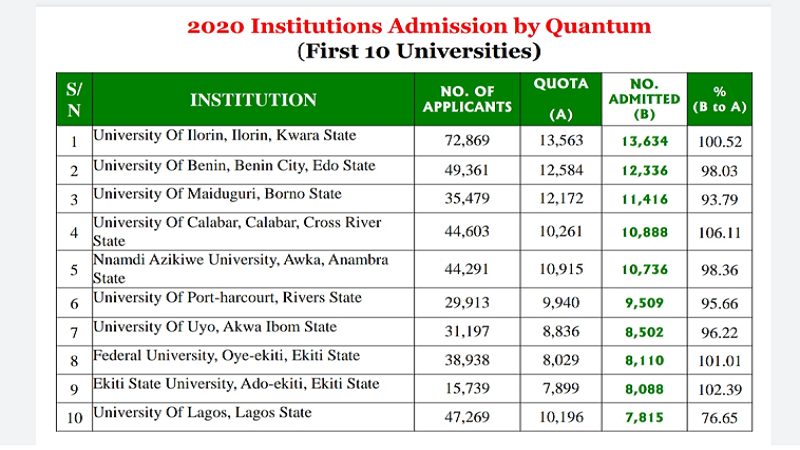
About 550,000 students have been admitted into Nigerian universities as of August, for this admission cycle. Ten universities will welcome 20% of them which means the other close to 200 universities will pick the balance 80%. UNILORIN, UNIBEN, UNIMAID, UNICAL and NAU lead the numbers. Notice that ABU Zaria, UNN, UI, and OAU are not in the top 10; interesting dynamics.
Yet, looking at these numbers which have not changed for years, you will see the challenge in the nation. A nation of 210 million sending just 550k students to universities.
The United States is just about 1.6 times the population of Nigeria; US population is about 330 million. The Arizona State University admits about 125k students, more than the combined total of Nigeria’s top ten: “ASU’s enrollment increased 7% compared to last year and will welcome approximately 125,000 students to the University community, a Thursday press release said. “
Sure, it goes beyond quantity to quality! Yet, the number needs to move.
President Muhammadu Buhari has asked the parliament for approval to borrow $4 billion and €710 million to fund the deficit in the 2021 budget. That has been expected when the government could not make progress to extract “abandoned balances in bank accounts” and “unclaimed dividends”. With no productivity to bring tax Naira, going to the capital market was expected.
I understand that PDP, the opposition party, is not happy with the development. Sure, PDP left the national debts at about N12 trillion when it left power in 2015. In six years, that figure has hit N33.1 trillion as of March 2021.
Yet, this is not the end: I expect this loan to hit N100 trillion by 2027. Even the Debt Management Office, a government bureaucracy, is worried. Nothing will change this trajectory until there is a sense of ownership and responsibility in Nigeria. Our current structure makes this possible: with no intra-state competition, everyone sleeps because Abuja will feed us.
What do I mean? Adamawa’s FDI for a whole year was$20,000, and that effort added it to the list of Nigerian states with FDI in 2020: “By destination, Lagos emerged as the top destination of capital investment in Nigeria with $8.3 billion, followed by Abuja, which received $1.3 billion. The others on the list are Abia State with relatively lower $56 million, Niger with $16.4 million, and Ogun with $13.4 million. Anambra State recorded $10.2 million, Kaduna State recorded $4.03 million, Sokoto got $2.5 million and Kano got $2.4 million. Akwa Ibom received $1.05 million ahead of Adamawa, which received just $20,000.” Yes, Simply, no incentive to leverage on comparative advantages across the nation. Twenty-six Nigerian states recorded zero foreign investment in the whole of 2020, figures released by the National Bureau of Statistics show.
My biggest concern is that the Nigerian government has not opened our borrowing business so that fintechs can participate! Yes, that is a huge market which is growing in double digits. I expect it to continue to grow irrespective of the party that takes power in 2023 until fundamental changes take place in the economy – and that is intra-state competition or what some call fiscal federalism!
This app – Jeka (!) – can raise $1billion via API to all bank accounts for x% monthly interest for Abuja! No need for JP Morgan Chase, Goldman Sachs, etc. Go Figure.
People, more loans!
Comment on LinkedIn Feed
Comment: Well articulated, however focus on debt should be in 2 parts… Debt to GDP ratio and what the burrowed funds is used for. Today America is burrowing $2trillion to finance deficit caused by Corona and jump start the economy. Last I check Nigeria’s debt to GDP was about 35% while IMF stipulates 25% as a comfort band. America’s debt to GDP is 107%, China 246% while India 21%, Ghana is 78%, UK 106%.
My Response: If a villager borrows from his village, it is market. But if he goes to another village, it opens up for enslavement. Nigeria’s borrowing cannot be compared with what happens in US because US borrows from its village (America) while Nigeria goes to another village – and this the slavery.
In Igbo novels, from Uwadiegwu to Omenuko, kinship-sourced debt is seen as a better alternative than a “foreign” one because if you lose your home, your kinsman (the lender) is obliged to host your wife and children because the child is Nwaoha (a child belongs to the village, not just to the parents) including to the lender.
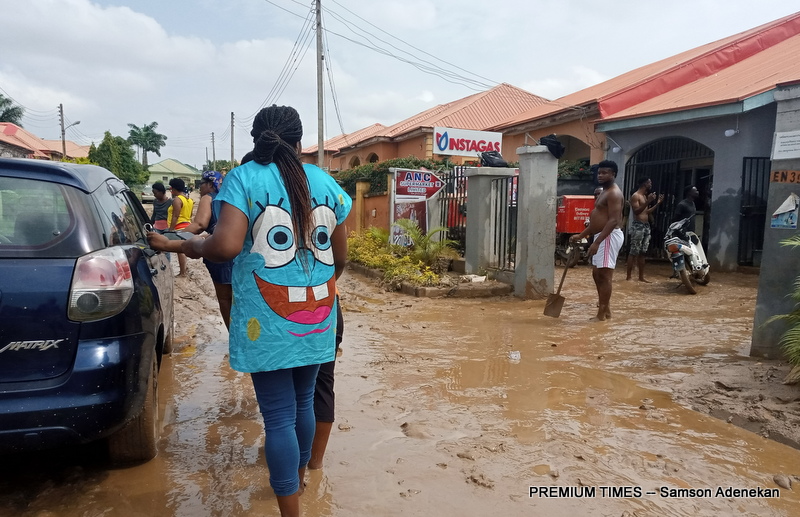
Our good wishes to our fellow citizens at Trademore Estate in Lugbe, Abuja, for the lives and properties lost as a result of the heavy downpour late Sunday. These things are happening more often these days across the nation. Walk around the Bar Beach area in Victoria Island, Lagos, and look at those abandoned buildings in the supposedly most expensive zip code in West Africa. You will pity the owners: they have washed hands and prepared the nuts for the fowls!
Nigerian civil engineers: it is time to work with the government to enforce the law. Adding an additional building to block drainage risks everyone! Government: permits must not be issued without looking at the drainage system.
People, things need to work in Nigeria. Not everything must be the fault of Aso Rock or state capitals. I saw an estate in Owerri built with largely no drainage. The hope remains that bad things will not happen. Unfortunately, the cases are ramping up.
No fewer than 74 houses were heavily affected by the flood that ravaged Trademore Estate, one of the largest privately-owned estates in Abuja.
The flood, caused by a heavy downpour which started late Sunday, was confirmed to PREMIUM TIMES by residents as the worst disaster that has ever happened in the estate in over nine years.
Already, three persons have been confirmed dead while search for more bodies is ongoing..
Aside from the destroyed buildings and cars worth millions of naira, a number of shops and businesses along the Phase 3 areas of the estate recorded huge losses that are beyond redemption..
This is one mistake many Nigerian merchants make: convert US dollar-based pricing and ask customers to pay the Naira equivalent. The thinking is like this: if your product goes for N50,000 or $140 when the US dollar is exchanged at N400/$, if the exchange moves to N500/$, you have to go and increase that N50,000. That is wrong.
That confusion is why I get this type of inmails: “On your advert on Tekedia Diploma programmes, you said $100 orN36,000.00. I thought the exchange rate is now above 400 naira per dollar?”
In Tekedia Mini-MBA, we have three different pricing courses from leading experts; pricing efficiency is very important in any business. That Naira is falling must not mean that my Nigerian customers must be asked to pay more if that fall of USD does not affect my marginal cost and broad cost of production.
More so, that Naira is losing value to USD does not mean that those earning local currency (Naira) suddenly have more Naira. So, if you have a product at say $100 or N36k when the exchange rate was N360/$, and Naira has dropped to N500/$, you cannot recklessly jack up prices unless there are clear production factors which would be affected.
So, when you see our pricing, it is not a typo. Microsoft does that all the time. It costs me $99 per year on my personal Microsoft 365; some vendors can sell you for less than N7,000 ($15) in some African countries because it is easier to make $99 than make N7,000 ($15) say in Nigeria. If Microsoft translates that without considering purchasing power parity, it will miss its customer base.
Sure – that does not mean you cannot increase the price as currency erodes value. But it has to be done not just because some speculators are at work!
Similar to the parents’ behaviour expected, while children need to buy and use certain commodities and services, in terms of health products buying and services use, parents are expected to be the first buyers or users. They are the first buyers or users because they constitute the only persons who could explain the status of children’s health needs or challenges better. This, according to many scholars and professionals in the consumer behaviour field, has been hinged on the premise that parents usually have in-depth understanding of how children feel.
In the course of helping their children in times of health needs or crises, parents have online and offline platforms for seeking necessary information about their children’s health conditions and needs. In the last two decades, the proliferation of new technologies has shaped and still reinventing how parents seek information about health conditions and needs of children globally.
From search engines to social media networking sites, parents are exploring various information with the key interest in solving different health conditions and issues. Google Search Engine has remained one of the most appropriated search engines for information seeking in the last two decades.
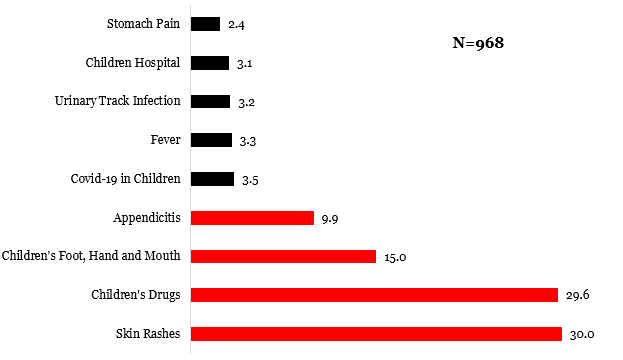
Our check indicates that among 51 countries, where parents have significantly developed interest in seeking information about their children’s health status or issues in the last 5 years, Nigeria has been occupying the 6th while Zambia, the United Kingdom, Ghana, Ireland and New Zealand are the 1st, 2nd, 3rd, 4th and 5th respectively. For the years, skin rashes, children’s medications and issues related or conditions of foot, hand and mouth remain the key concerns [see Exhibit 1].
Despite significant interest in seeking information through the Internet and social networking sites, a number of parents are always skeptical about using the information because of the low quality in most cases. When they sought information, a recent study found that they consulted a physician, consulted a traditional healer, and relied on self-medication or asked friends for suggestions.
Exhibit 1: Key Areas of Concern for Parents Globally
Source: Google Trends, 2021; Infoprations Analysis, 2021
Our analyst notes that having doubts is understandable considering the implications of using quantum of non-medically proved information that abound on the Internet and social networking sites. While there are many groups and people on digital platforms who parade themselves as professionals in child health information provision and guidance without appropriate strategies of creating posts and replying to parents’ requests, ASK THE PAEDIATRICIANS, a group on Facebook, has proved to be a game changer in the digital health information.
This position was established after analysing the Group’s page and official website. The Group, which later transformed to a Foundation, was created the 20th July 2015 by Dr. Gbemisola Boyede, Consultant Paediatrician at the Lagos University Teaching Hospital, Idi-Araba, Lagos.
“Ask The Paediatricians has since grown beyond the online platforms which now included the ATP mobile app into a non-profit registered with the corporate affairs corporation of Nigeria in July 2017. Ask The Paediatricians Foundation is fully committed to promotion of the health and welfare of all children globally and especially in Nigeria through our online health education platforms and offline community medical outreaches, Group’s Page notes.
As at the time of analysing the Group, over 600,000 parents, living in Nigeria, the United Kingdom and other countries, are members of the Group. Our analyst also found that complementary feeding, colds, cough, catarrh, child nutrition, childhood immunizations, skin rashes, stool abnormalities, ideal weight and height, miscellaneous child health issues, breastfeeding, medications and mothers’ health issues have been posted by members and reacted to by Paediatricians.
In our analysis, we found that Dr. Gbemisola Boyede and her team’s responses to the members’ questions align with the best practice of replying and educating people on digital health information seeking in the current health information pollution. For instance, Dr Boyede and her team usually inform the members who asked questions to consult relevant doctors rather than engaging in self-medication. As part of reinforcing replies to questions, links of relevant articles are shared by the doctors.
Our analysis also reveals that the Group’s official website has relevant information that parents could explore. One of the unique features of the website is bot addition, which usually encourages parents to ask questions just like what is obtainable on the Group’s Facebook page.