Two weeks afterSouth Korea’s parliament enacted a law to checkmate monopolistic practices of Apple and Google, the country’s competition watchdog has fined Google 207.4 billion won ($176.8 million) for abuse of its market dominance.
The Korea Fair Trade Commission (KFTC) said Tuesday it handed Google the fine for abusing its dominant position in the smartphone market and forcing smartphone makers to use its Android operating system on their devices.
It is the latest in a number of antitrust actions taken against the tech giant in recent weeks, amidst growing calls to keep the big players in the tech industry in check.
Google was accused of using its dominant position to block smartphone makers like Samsung from using operating systems developed by rivals.
“We expect the latest measures will help set the stage for competition to revive in the mobile OS and app markets. This is also expected to help the launch of innovative goods and services in smart device market,” the KFTC said in a statement.
Investigation into Google’s anticompetitive activities started in 2016. The KFTC said the web search giant’s action stifled competition by demanding that smartphone makers accept an “anti-fragmentation agreement” (AFA) when they sign key contracts with Google over app store licenses and early access to OS, according to South Korea’s Yonhap news agency.
The AFA prohibits device makers from installing Android forks, modified versions of Android OS, and also from developing their own Android forks.
The KFTC said the practice has helped Google to dominate the mobile market and undermine innovation in the development of new OS for smart devices, it thus ordered Google to take corrective measures.
AP reported KFTC official Kim Min-jeong saying the fine is provisional and currently based on Google’s revenue in South Korea from 2011 to April 2021. The final fine, due to be announced later this year, could be higher on account of the revenue generated between April and then.
The regulator is still investigating separately three more cases related to Google’s alleged anti-competitive activity, according to Yonhap.
The three cases being investigated is whether Google forced mobile game applications to be released only on its Play Store. The watchdog is also probing Google’s alleged unfair practice over the sale of digital rights, and whether Google’s new billing policy has harmed market competition, according Yonhap.
In addition to the fine, the KFTC ordered Google to stop implementing the anti-competitive contracts under AFA in the future and make corrections to the existing ones.
The fine is believed to be the largest in South Korea’s history. But a Google spokesperson told Forbes the company intends to appeal the decision and believes “Android’s compatibility program has spurred incredible hardware and software innovation.”
Last month, South Korea’s national assembly approved a legislation that will limit the monopolistic practices of Apple and Google in their app stores, making the Asian country the first nation in the world to take such a regulatory step.
The new law, which is an amendment to the Telecommunications Business Act, bars app market operators from abusing their market positions by forcing certain payment systems on mobile content businesses.
With the advent of the Nigerian Data Protection Regulation 2019, personal data and data privacy have become key issues in the digital economy. Though the regulation has been extant for over 2 years, there is a lack of knowledge on the part of most data subjects as to the extent of their data protection and what constitutes breach of data. While the NDPR has played a huge role in stimulating the digital economy, this has restricted the impact of the regulation.
In espousing its objective, the Nigerian Data Protection Regulation provides that it was made in recognition of the fact that many private and public bodies have migrated their respective businesses and other information systems online, and these information systems have thus become critical information infrastructure which must be safeguarded, regulated and protected against atrocious breaches.[1] The principle guiding the NDPR also stipulates that personal data shall be collected and processed in accordance with specific, legitimate and lawful purpose consented to by the Data Subject.
In recent times there has been a proliferation of digital retail lenders within the lending space in Nigeria, and this has helped to bridge the financial inclusion gap, as report from the Financial Inclusion Secretariat shows that formal sector credit penetration as a ratio of the adult population in Nigeria was below 5.3% in 2017[2]. The rise in digital lending can be linked to the widespread use of mobile phones, high demand for credit and a fragmented regulatory landscape for industry players. Traditionally banks have been averse to retail lending, because the risk appetite of banks do not extend to retail loans and also, the process of applying for a bank loan is rather complex, often involving lengthy paperwork and delays.
On the contrary, it is abstruse why banks/financial institutions that have held and processed data of customers for more than ‘10 years’ are unable to offer loan/overdraft facilities to such customers, based on the data they have alone, yet digital lending companies employ simpler processes and no paperwork to make this possible.
These companies are able to leverage payment data to determine lending risk more easily and utilize smartphones as a distribution channel. Some have gone ahead to leverage alternative credit-scoring algorithms to provide instant, unsecured, short-term loans to individuals. This sort of lending is attractive not only to existing customers, but also to first time borrowers who would otherwise be shut out due to lack of a credit history.
Consequently, the transfer of personal data and financial information through digital channels raises concerns of data privacy and there is strict responsibility on the part of digital lenders to process these data lawfully, as a result of the digital business model which they have adopted. It has become customary practice for some digital lending companies to use non financial data and mined phone data to engage in debt shaming of debtors/loanees by informing their family, friends and employers of the existing debt.
In a recent development, Sokoloan, a digital lending company was fined N10million by NITDA for alleged privacy invasion. Aside processing data of data subjects without their consent, NITDA further determined that the company embeds trackers that share data with third parties inside its mobile application without providing users information about it or using the appropriate lawful basis. The company was said to be in violation of the following: Use of non-conforming privacy notice, contrary to Article 2.5 and 3.1(7) of the NDPR; Insufficient lawful basis for processing personal data, contrary to Articles 2.2 and 2.3 of the NDPR; Illegal data sharing without appropriate lawful basis, contrary to Article 2.2 of the NDPR and Non-filing of NDPR Audit reports through a licensed Data Protection Compliance Organisation (DPCO), contrary to Article 4.1(7) of the NDPR amongst others.[3]
In processing the personal data of a data subject, and by requesting access to the contacts of the loan customer, digital lenders also have access to the personal data of the ‘contacts’ of the customer. It is worthy of note that consent to process personal data of the customer cannot include consent to process personal data of another data subject which forms part of the data that was collected from the customer.
According to the NDPR, prior to collecting personal data from a data subject, the Controller shall provide the data subject – through a privacy policy – with the following information;
Purpose of the processing for which the personal data are intended as well as the legal basis for processing
Period for which personal data will be stored
Existence of right of data subject to withdraw consent anytime
Existence of the right to request access to, rectification or erasure of the personal data
How the data will be processed
Type of data collected etc
Therefore digital lenders are not at liberty to process data from a customer’s phone, unless they have informed the customer. Also lenders ought to specify all the data that they intend to collect and how they want to use it. The use should be in line with what is reasonably expected by the data subject. For instance, it is reasonable expected that a lender would obtain the customer’s name and phone number for purposes of records, and possibly collect data relating to call records, browsing history, phone model, GPS data and communication pattern for purpose of credit scoring. However it is unreasonable for a lender to obtain contacts of ‘data subjects’ from a customer’s phone for the purpose of calling them and engaging them to recover outstanding debts.
The NDPR defines personal data as any information relating to an identified or identifiable natural person (data subject); an identifiable natural person is one who can be identified, directly or indirectly, in particular by reference to an identifier such as a name, an identification number, location data, an online identifier or tone or more factors specific to the physical, physiological, genetic, mental, economic, cultural or social identity of that natural person. It can be anything from a name, address, a photo, email address, bank details, posts on social networking sites, medical information, and other unique identifier such as but not limited to MAC address, IP address, IMEI number, IMSI number, SIM, Personal Identifiable Information (PII) and others.[4]
For data controllers/digital lenders, one way of complying with NDPR means sending an email to every single person in a customer’s contact list to either get consent for you to hold and process their data, and to explain how they exercise their rights under NDPR.
Furthermore, if a digital lender were found to be processing “personal data” belonging to a data subject on a loanee’s contact list (or any other person whose information is uploaded to their server through the action of another person) they would find it difficult to contend that the processing was lawful, because the activity doesn’t prima facie satisfy any of the criteria for lawfulness in Article 2.2 (a – e) of the NDPR.
It is interesting to note that the ‘loanee’s’ contact has not given consent for the lending app to process her personal data for any purpose. She has merely given the loanee consent to process her personal data to the extent that the loanee has stored it in his phone, but that consent presumably does not extend to the lending app uploading that data to its server and calling or texting such person when the loanee is in default.
In Kenya, the Data Protection Act is set to revolutionize digital lending privacy and put an end to debtor shaming and collection of data from undisclosed sources[5]. In essence, digital lending companies need to be aware of the far reaching implications of the provisions of the Nigerian Data Protection Regulation, while we await a substantive legislation for data protection. As data protection becomes more rooted in the fabric of the digital economy, there is bound to be a rise in reports and fines/awards against erring data controllers. Therefore digital lenders need to fully grasp compliance obligations under the NDPR including conducting regular data audits and appointing a DPCO, and come up with an appropriate compliance policy framework.
Sample such letters
References
[1] Preamble to Nigerian Data Protection Regulation 2019
A very simple logic: demand is high, why not work to provide more supply? That is business and economics 101. So, the postulation by John Mc Keown that Nigeria could go into microfabrication business to take advantage of the broad high prices of chips, while a good call at superficial level, will certainly struggle at a deeper level.
First, the condition precedent for Nigeria for a chip factory is not there. Yes, we cannot run a foundry with generators. Secondly, our universities are not there to produce the knowledge workforce to design chips and fabricate them. Thirdly, the comparative advantages are against Nigeria with silica, etc (be at least as good as TSMC to have opportunities in markets). You can add more challenges.
This is what Nigeria needs now in the semiconductor business: a clone of MOSIS. MOSIS is a service funded by the US military research unit which connects all universities and small chip design companies together, making it easier for people to create prototypes at largely zero cost. So, magically, a Stanford student can design a chip and send it to MOSIS and within 3 months will get five samples. Through MOSIS, the US government took out the burden of schools needing to build $1 billion factories, and got them to focus on designs.
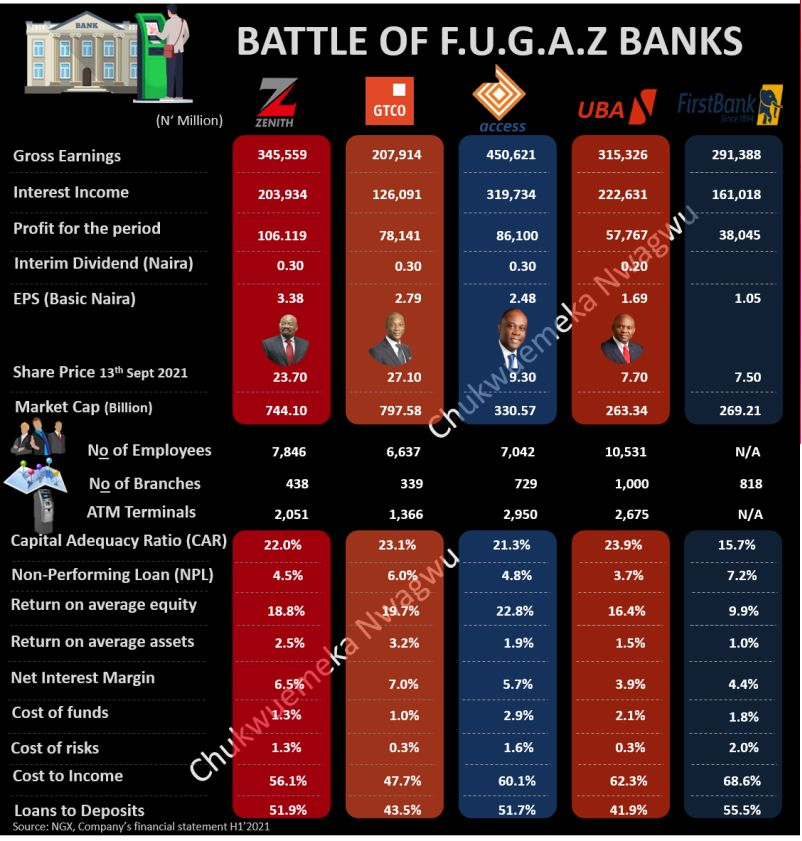
What is happening to GTBank (yes, GTCO)? It is losing steam across the board. Begin with the cost-to-income ratio which used to be industry leading at sub-40%. Now, it has jacked it up to 47% (I guess the holdco setup could have caused that). From gross earnings to profitability, Access and Zenith are there. Access is becoming a critical banking institution; look at the interest income.
There is a pattern I am seeing: improved marginal cost is a solid competitive advantage and being big will work for these relatively big and geographically positioned institutions, as the new era of African commerce begins. Nigerian banking will be totally different in 5 years.
Access and Zenith are on to something; GTBank has to watch itself well.
China goes to break Ant Group’s Alipay as the nation continues to push for new ordinance for digital firms: “The Financial Times reported Monday, citing sources, that Beijing is moving to break up Alipay, and create a separate app for the company’s highly profitable loans business.”
Africa: do not follow China. China is scoring an own-goal and over the next few years, if this trajectory is not reversed, will begin to fade. As I wrote in Harvard Business Review, China transformed its economy by becoming the manufacturing capital of the world. China, despite that success, is not yet a high-income country. Yes, despite its aggregate wealth, China remains a developing economy. China’s per capita income is around (nominal) $9,000 while the US hits $60,000. In short, Chile is better than China (Nigeria is about $2,000).
Few countries have moved into the high-income status and in all those countries, one thing has been a constant: democracy and free markets. Yes, even if you produce for the world, without a free market system for capital to organize other factors of production based on market forces, you will struggle to get there.
Fair rule, transparency, democratic systems, retrenchment of states for the flourishing of the private sector, predictable and fairly applied regulations, and cardinal rule of law, are some of the factors that enable economic redesign, towards high-income status. From Japan to South Korea to Taiwan and to potential newcomers into the high-income countries, there was and will always be constant: what worked when you were poor to mid-income, will not work for you to move from mid-income to high-income.
At a poor state level, you need the government to create order, but quickly the government must retrench for markets, to drive productivity and improve the efficiency of the utilization of factors of production. It is through productivity in an evidently complex national system that nations move to high-income level. In my study of economic systems, only markets have the ability to allocate the factors of production at this level! No politician has any chance. President Xi is not helping China unless he never wants the nation to move to high-income status.
Yes, China is blowing the playbook thinking that what worked from its poor state to mid-income will work for it to move to high-income. Simply, China is scoring own-goals and it would be lucky to stay in mid-income. It has no chance of transitioning into high-income unless the Xi nation changes course.