DD
MM
YYYY

PAGES

DD
MM
YYYY

spot_img

PAGES

Home Blog Page 5584

Biden Administration Opens The Veil On Crypto Ransomware Criminals

1
White House

One of the greatest illusions in modern commerce is the construct that Bitcoin and its cousins are outside the control of the government. My postulation has remained: provided you cannot keep the coins under your pillow or underground rock safe, you will need an exchange. And for an exchange to receive your money, it needs to be registered by a government to be connected to the regular banking system. Through that system, you will have an opportunity to transfer money and buy the coins.

And since that is the case, with the exchange under the control of the government, Bitcoin may be technically decentralized but unfortunately for the crusaders, it is centralized, legally on structure. 

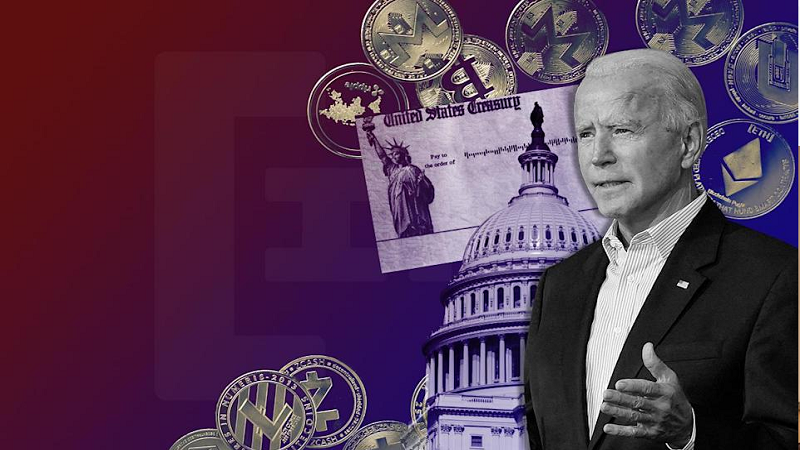
That is playing out right now: the Biden Administration is simply suing exchanges which help criminals cash out on ransomware: “The Biden administration has announced new sanctions against cryptocurrency exchange Suex for using its platform to receive revenue for ransomware groups adding to the growing trend of cyberattacks targeting companies and government agencies.”

Good luck arguing that you did not know your customers. Then, they will drop another regulation – KYC/AML. By the time you are beaten left and right, you will ask those crypto holders to show up with their correct identities.

It is simple: governments run this earth and when it matters, they have all the tools to get things done!

U.S. Sanctions Crypto Exchange, Suex, for Facilitating Ransomware Transactions

0

The Biden administration has announced new sanctions against cryptocurrency exchange Suex for using its platform to receive revenue for ransomware groups adding to the growing trend of cyberattacks targeting companies and government agencies.

It marks the first of such action against a virtual currency exchange. The Treasury said ransomware payments totaled more than $400 million in 2020 alone, four times more than it was in 2019, and it is taking new measures to see it stops.

The sanction means Suex’s access to US markets has been cut off. The department alleged that Suex “has facilitated transactions involving illicit proceeds from at least eight ransomware variants.” It also said that more than 40% of the company’s known transaction history is “associated with illicit actors.”

The Treasury Department has also updated guidance to US businesses on paying ransoms to cybercriminals, saying that it “strongly discourages” such action.

Cyberattacks targeting US companies were notably significant this year with the ransomware attack against Colonial Pipeline – the largest fuel pipeline in the United States – in May. Carried out by the Russian-linked Darkside ransomware group, the attack forced Colonial Pipeline to take systems offline and halt all pipeline operations. The height of the attack rattled the US government with the Biden administration issuing emergency waivers in response, lifting limits on the transportation of fuels by road as fears of shortages begin to put upward pressure on oil and gas prices.

Bloomberg reported that Colonial Pipeline handed over almost $5 million to the attackers for decryption of its data, some of which was subsequently recovered by the Justice Department in June. It took Colonial Pipeline several days to get operations back to normal.

CSO reported that earlier this week, New Cooperative, a grain distributor with 60 locations in Iowa, fell victim to a large ransomware attack by a Russian-speaking group known as BlackMatter. The attackers are believed to have requested almost $6 million for the release of the data, although this is unconfirmed by New Cooperative. An investigation into the incident is ongoing.

The new sanctions against Suex, a platform that offers an easy and often difficult to trace way to buy and exchange cryptocurrency, are an effort by the Biden administration to prevent ransomware payments that encourage actors to carry out further attacks against US companies.

Commenting to reporters ahead of the announcement, Treasury Deputy Secretary Wally Adeyemo said, “Exchanges like Suex are critical to attackers’ ability to extract profits from ransomware attackers,” adding that the action “is a signal of our intention to expose and disrupt the illicit infrastructure using these attacks.”

However, John Bambenek, principal threat hunter at Netenrich, questions whether the move will have any material impact on the proliferation of ransomware.

“Attempting to stop ransom payments didn’t help the kidnapping problem we saw in Sou a couple of decades ago, and it’s not likely to help much here either,” he tells CSO. “Sanctions against providers may make a degree of sense as long as the more honest providers are able, willing, and incentivized to report bad behavior on their platforms. What is more important in stopping ransomware is finding those involved and getting them brought to justice, and these kinds of actions actually could impair intelligence collection on those bad actors.”

This new line of action is expected to deter other crypto exchanges, making it difficult for them to facilitate transactions for ransomware criminals.

Fuel These Rocketships for Africa’s Future

0

We seeded one last year in Lagos and this year, it would have an office in Canada. Join us at Tekedia Capital Syndicate, to put fuel on new species of startups, and build the foundation of new species of entrepreneurial capitalism, globally.

Tekedia Capital offers a specialty investment vehicle (or investment syndicate) which makes it possible for citizens, groups and organizations to co-invest in innovative startups and young companies in Africa and around the world. Capital from these investing entities are pooled together and then invested in a specific company or companies. Click and register here.


Innovators and Project Champions, You’ve Found Your School At Tekedia Institute

0

If you are looking for a school for innovators and project champions, stop looking because you have found one! Yes, Tekedia Institute is here. We have courses in business education, renewable energy business, agribusiness, digital business, and more.

These courses come in many ways – mini-MBA, advanced diploma programs (7 tracks), certificate programs (12 tracks), live-only  session Zoom, etc.

By next month, we will launch Tekedia Startup Masterclass: from start-up to scale-up. Visit our website and see our courses and programs.

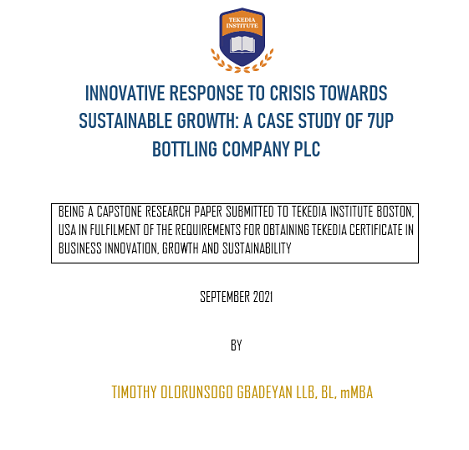
Innovative Response to Crisis Towards Sustainable Growth – A Case Study of 7UP Bottling Company Plc

1

With the permission of  Timothy Gbadeyan, I am happy to share the introduction of his Capstone for the award of Tekedia Certificate in Business Innovation, Growth and Sustainability. Our capstone is a research paper and it is one way we are co-learning with our learners to develop deeper capabilities on business communication, and writing investment briefs, proposals, etc.

We have a library of dozens of these works but unlike typical university projects and theses, our learners are examining core business matters with IPs. So, we do not make them public and have no plans to do so because some of them have become startups, and critical elements in companies.

Now, read Tim’s work:

Introduction

By an equation formula, Prof Ndubuisi Ekekwe[1] has described Innovation as a combination of invention and commercialization. He postulated that invention does not necessary translate to innovation, as invention in its raw form is limited in breadth as an idea. However, for an invention to translate to innovation, it must meet a societal need. By this, invention must be implemented and whisked away from its form as an idea with potential to fix a friction into homes, offices and hands of humans to actually fix the identified friction. In doing this, invention is essentially commercialized.

While innovation is critical to building the wealth of nations, it is actually the lifeblood of firms. For businesses, innovation is not desirable, it is mandatory. First, the mission of firms is to fix frictions in the society and/or societal units and in order to fix frictions, firms must innovate. Secondly, when sustainability is viewed from economic lens and not the lens of social impact or environment, one cannot but come to the conclusion that innovation and/or continuous innovation is the main factor of sustainability for businesses. Beneath this is the fact that “consumer loyalty” is a farce. In reality, what exist is “consumer satisfaction.”

Actually, consumer loyalty is a construct which Companies use to describe a group or “repeat customers” for the purpose of reward, feedback, product review, defining product base and such other data purposes. However, customers are neither to loyal to products or companies; they only continue to patronize either because they remain satisfied or because of the absence of better alternatives. In the wake of the emergence of better alternative, a company can lose 95% of its market share within one to three months. It’s simple- wholesalers will buy only the products which in Nigeria market parlance are “moving”.

In effect, wholesalers buy the goods which retailers want to quickly buy and retailers will buy the products which consumers will quickly buy- because no matter how profitable a business, the periodic profitability boils down to “turnover”. From the foregoing, it is obvious that the basis of consumer loyalty is continuous customer satisfaction and to keep customer satisfied, firms must meet emerging needs and perceptions and to do so, firms must innovate.

When firms innovate, one of the expected outcome is sustainable growth. By this we mean that firms continue to experience year-on-year, quarter-on-quarter and month-on-month profitability. This is because the market will always reward innovation. But the question is this- what guarantees that the trajectory of growth being experienced by a company will continue. Rapid growth will not attract Investors like Sustainable growth.

For a business to be healthy and sustainable, it must demonstrate that the rate of growth can be maintained. Innovation is a key influencer for maintenance of growth. Sometimes, consumers want the taste of a particular food product to remain the same over time as a mark of quality, but producers can innovate with access to product, ease of payment, ease of opening product carton, sachetization of product and so on. One thing is clear in the digital age, innovation and continuous innovation are keys to growth and sustainability.

[1] N. Ekekwe Ph.D, “The Innovation and Growth of Firms; P. 10 TEKEDIA INSTITUTE 2021