DD
MM
YYYY

PAGES

DD
MM
YYYY

spot_img

PAGES

Home Blog Page 5589

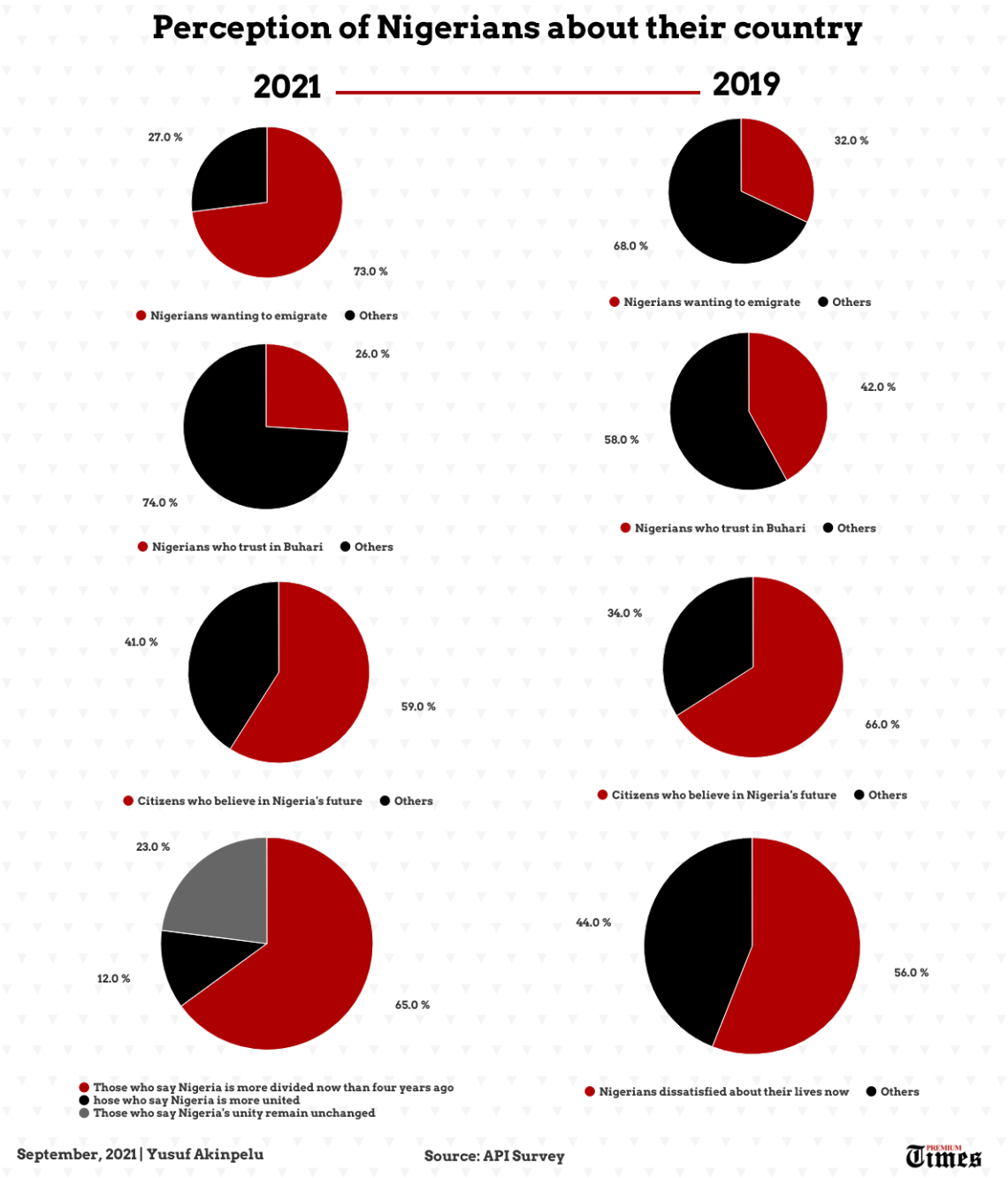
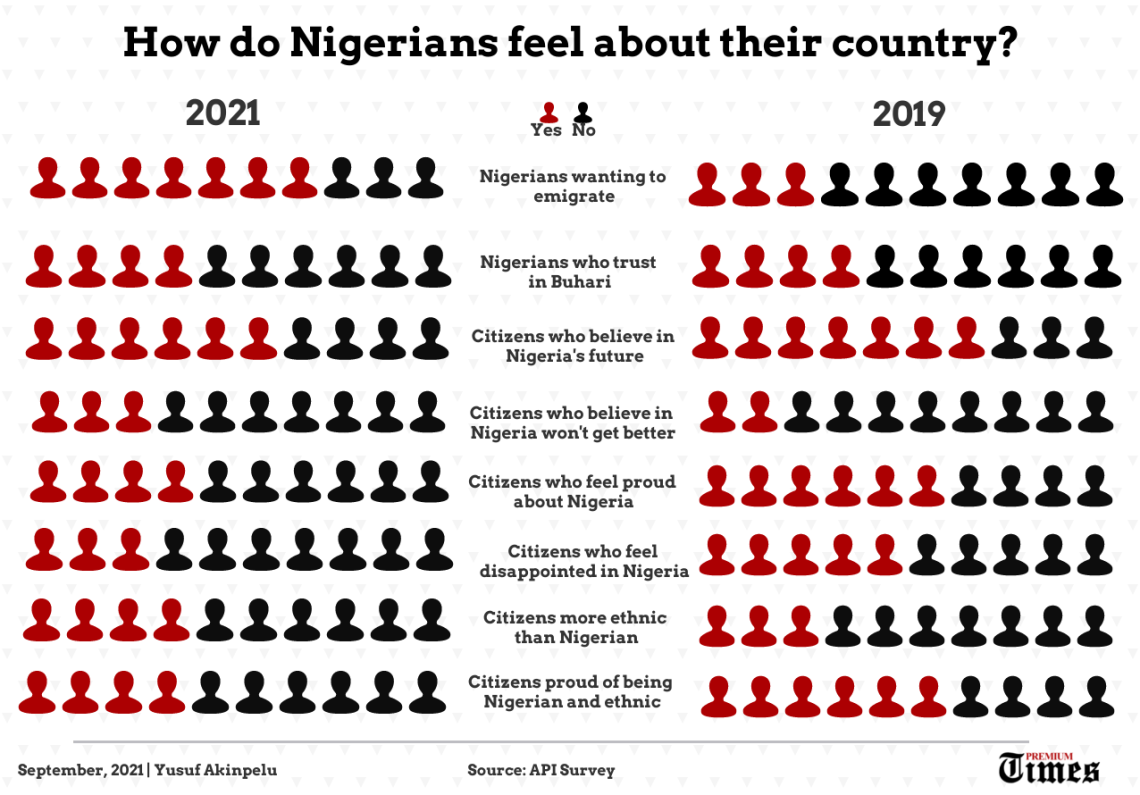
Nigeria’s Great Exodus: 73% Want To Relocate Abroad, Survey Shows

2

It took the efforts of the secret Police to stop those who came to recruit Nigerian doctors to give up a few weeks ago. Some Nigerian doctors are still on strike and the government is still speaking grammar when citizens are dying daily due to lack of healthcare services. It is very unfortunate indeed: “More than 7 in 10 Nigerians (73 per cent) have said they would relocate abroad with family members if they had an opportunity, a new survey published this week has found.”

“Most of the citizens (74 per cent) believe that all Nigerians are not equal before the law; versus 23 per cent who feel otherwise. About 6 in 10 Nigerians (58 per cent) express the view that the federal government isn’t making enough effort to promote a sense of inclusion for all ethnic groups in the country,” a summary of the report further showed.

“The survey findings showed that only 63 per cent of citizens are “extremely or somewhat willing” to cooperate with fellow citizens to make Nigeria more united.

Nigeria is the only country where everyone is a victim. It took the efforts of the Chief Justice to warn the judges to stop the mindless counterintuitive political calls they have been making recently. Yes, 1+1 = 2; one judge will rule. Another from another place will call it 3. Simply, you wonder how a nation can be run that way. From law to healthcare to sports to [add yours], it is a domino!

Alibaba Joins Other Firms, Pledges $15 Billion for China’s “Common Prosperity”

0

China’s new “common prosperity” goal is gaining the support of the country’s big men who have been caught in the web of policy shifts recently, and are working hard to appease the Chinese Communist Party.

Increasing number of business leaders in China have pledged to support President Xi Jinping’s campaign – among them is Alibaba. The e-commerce giant is throwing 100 billion yuan ($15.5 billion) into the “common prosperity,” goal, augmenting the pledge from other Chinese companies including Tencent and Pinduoduo.

These companies are acting in response to Xi’s call last month for “reasonable adjustment of excessive incomes” urging high income groups and businesses to “return more to the society.”

Alibaba said the fund will be invested in these five key areas by 2025: innovation in technology, economic development, the creation of “high-quality employment,” supporting vulnerable communities, and setting up a special development fund.

“Alibaba is a beneficiary of the strong social and economic progress in China over the past 22 years. We firmly believe that if society is doing well and the economy is doing well, then Alibaba will do well,” Chairman and CEO Daniel Zhang said in a statement Friday.

“We are eager to do our part to support the realization of common prosperity through high-quality development,” he added.

The tech giant will also set up a “Prosperity Advancement Working Committee,” that will be headed by Zhang.

Alibaba’s plan includes other 10 specific goals which involve increasing technological investment in the country’s less developed regions, improving the welfare of gig economy workers and working to speed up the growth of small businesses and agriculture.

Similarly, other major Chinese tech firms, Pinduoduo and Tencent are donating toward the goal. Pinduoduo pledged to hand over its entire profit for the last quarter to rural development projects in the country.

The e-commerce company said last Tuesday that it would donate $372 million to the development of China’s agricultural sector and rural areas, with plans to give away 10 billion yuan ($1.5 billion) toward similar causes overall.

The move was notably bold for Pinduoduo. Per Nikkei, the US-listed firm had just posted a profit for the first time as a public company in the quarter ended June.

Following the growing trend, Tencent announced last month that it would dedicate 50 billion yuan ($7.7 billion) toward achieving Beijing’s goal of “common prosperity.” The company said it would aim to help increase income for the poor, and address education inequality, among other initiatives.

The bottom line

The “common prosperity” goal is a segment of policy changes that Beijing has, without warning, unveiled recently. And it came with an avalanche of impacts that are sweeping through China’s tech ecosystem now.

Last year, when Chinese authorities abruptly halted proposed Ant Group’s IPO, which would have toppled Saudi Aramco’s world’s largest IPO record, many companies in China didn’t know it’s the beginning of an elaborate crackdown that would take them by storm and spiral into redistribution of wealth.

As Beijing opened the chapters of the crackdown, many of the companies found themselves in paragraphs written with unfavorable ink for issues ranging from anti-competition to misuse of private data.

Since this year, many companies including Alibaba which was hit with a record $2.8 billion fine for acting like a monopoly, Tencent, Didi etc. have received a stroke of disapproval from market regulators who handed the firms fines and sanctions.

However, the bottom line appears to be getting clearer, China doesn’t want a class of rich people separated from others by miles of wealth. Consequently, it dawned on the South Asian giant, when last year, Jack Ma dared to criticize its policies, that it’s time to slash the burgeoning wealth before its over-bloated beneficiaries get intoxicated by it and forget what China stands for.

For Chinese companies and business leaders, the only choice is to say yes and accept every condition given. When in April Alibaba was handed the $2.8 billion fine, the company could only say thank you, promised to make amends and to cooperate with the authorities, while in the US, its counterparts are in courts challenging regulators’ decisions.

With no freedom to question the decisions of the authorities, business leaders in China have learnt that the easiest way to survive in their clime, where the control of everything belongs to the Communist Party, is to sing along every chorus orchestrated in Beijing – and “common prosperity” is the latest.

Tekedia Business Growth Playbooks Begins: Week 1 – “The Pursuit of Business Growth”

0

Good People, this is a quick reminder that Tekedia Business Growth Playbooks w/ Ndubuisi Ekekwe begins today at 4.30pm WAT. If you have registered to co-learn with us, you ought to have received the Zoom link from my team. If not, email immediately.

This is an 8-week program and wholly live sessions (no pre-recorded videos or reading as we do in Tekedia Mini-MBA) and we will focus exclusively on business growth. I will present for about 30-45 minutes, and then open the floor for Q/As. Week 1 is titled “The Pursuit of Business Growth”.

Note: all sections will be recorded and archived in case you cannot make it due to timezones, etc. For those joining today, Admin will send you the Zoom link and later complete the Board setup. Register here N20k or $60.

Time for business growth; I am ready.

Commendable Playbook from Nigeria’s Securities and Exchange Commission (SEC)

1

I truly want to commend the Director General of Nigeria’s Securities and Exchange Commission (SEC),  Lamido Yuguda, for his nuanced, analytical and data-driven playbook in the SEC. If you have not noticed, note that the SEC has been more consultative and engaging. They continue to do regulatory work while making sure that the economy is exposed to potential opportunities of the future.

So the news that the SEC  has set up a fintech division to study crypto investments and products in order to come up with regulations is a welcome development. Notice that I have no interest in these domino called crypto investments.

Months after the Central Bank of Nigeria (CBN) ordered regulated financial institutions to cease all transactions in cryptocurrencies due to its volatility and lack of regulation, the Nigeria’s Securities and Exchange Commission (SEC) has come up with an idea that will enable it to regulate the new market.

Nigeria’s SEC Director General Lamido Yuguda said on Thursday it has set up a fintech division to study crypto investments and products in order to come up with regulations, Reuters reports.

“We are looking at this market closely to see how we can bring out regulations that will help investors protect their investment in blockchain,” he told Reuters in a virtual interview in Abuja.

According to the report, Yuguda did not provide a time frame for issuing regulations but said the SEC will step in with regulations once crypto is allowed within the Nigerian banking system.

My interest is that Nigeria must allow its young people to participate in a game their peers are playing globally while making sure such will not destroy their futures and the national economy. In other words, we need to regulate and not BAN or SUSPEND.

Yet, the SEC must elevate its status. I have noticed that the apex bank has banned startups it gave greenlights in some categories. So, if it can make rules and cannot defend the rules before other agencies, it may be better to stop issuing worthless permits!

Nigeria’s Securities and Exchange Commission (SEC) Establishes Fintech Division to Understudy Cryptocurrency

Nigeria’s Securities and Exchange Commission (SEC) Establishes Fintech Division to Understudy Cryptocurrency

1

Months after the Central Bank of Nigeria (CBN) ordered regulated financial institutions to cease all transactions in cryptocurrencies due to its volatility and lack of regulation, the Nigeria’s Securities and Exchange Commission (SEC) has come up with an idea that will enable it to regulate the new market.

Nigeria’s SEC Director General Lamido Yuguda said on Thursday it has set up a fintech division to study crypto investments and products in order to come up with regulations, Reuters reports.

“We are looking at this market closely to see how we can bring out regulations that will help investors protect their investment in blockchain,” he told Reuters in a virtual interview in Abuja.

According to the report, Yuguda did not provide a time frame for issuing regulations but said the SEC will step in with regulations once crypto is allowed within the Nigerian banking system.

The SEC has sought to regulate crypto on the grounds that they qualify as securities transactions. In February, the financial asset regulator said it’s embarking on research and consultations in collaboration with the CBN to develop a regulatory framework for Nigeria’s booming crypto market which was scuttled by CBN’s order.

“There is a lot of investment moving into the cryptocurrency market and the tendency is that it will reduce the amount of investments in the stock market.

“Part of the desire of the SEC even in the future is to provide a regulatory framework that will take care of all these challenges that we have seen internationally and the entire world is grappling with in terms of cryptocurrency and digital assets.

“For us at the SEC and capital market, it is something to look at, the world cannot be moving forward and we will be static, no. It is important for us to review, understand, appreciate and introduce regulations that will guide the movement of the market in this direction,” Timi Agama, Head of Department, Registration, Exchanges, Market Infrastructure and Innovation Department of SEC said then.

Nigeria’s cryptocurrency market has faced relentless opposition from the government after the country’s apex bank alleged the burgeoning market is plummeting the naira, Nigeria’s fiat.

The CBN’s order, which forbids financial institutions in Nigeria from carrying out crypto-related transactions, pushed many crypto traders to Peer to Peer (P2P) platforms, drastically reducing the country’s huge crypto trading volume.

Before the CBN’s order, Nigeria ranked top among the countries using cryptocurrency in the world, having only the United States ahead. The crypto market has since grown above $2 trillion in value as more countries and institutions embrace the digital asset.

Investment opportunities in Nigeria have been greatly stymied by the government’s opposition to cryptocurrency, especially for youths who had found employment in the trade.

Yuguda said SEC has been in talks with the central bank, part of which led to the launch of the country’s digital currency, e-naira.

Now, the commission is seeking to work with fintech firms to boost the marketing of domestic securities to prevent capital flight.

He said the SEC is looking to boost savings through investment schemes, which currently have over 4 trillion naira ($9.7 billion) under management split between public and private fund managers. Yuguda said the regulator has asked private managers to put in place custody arrangements to protect investors.

However, concerns remain if the government, through the CBN, will allow anything related to cryptocurrency to be legally traded in Nigeria like before. The central bank’s development of e-Naira suggests the government wants only digital assets it can control.

The CBN said it made the decision to restrict the use of cryptocurrency to protect the naira, and to stop those funding terrorism via cryptocurrency. The apex bank had last month blocked the accounts of six fintech firms for alleged illegal forex and cryptocurrency transactions that it said undermines the naira.