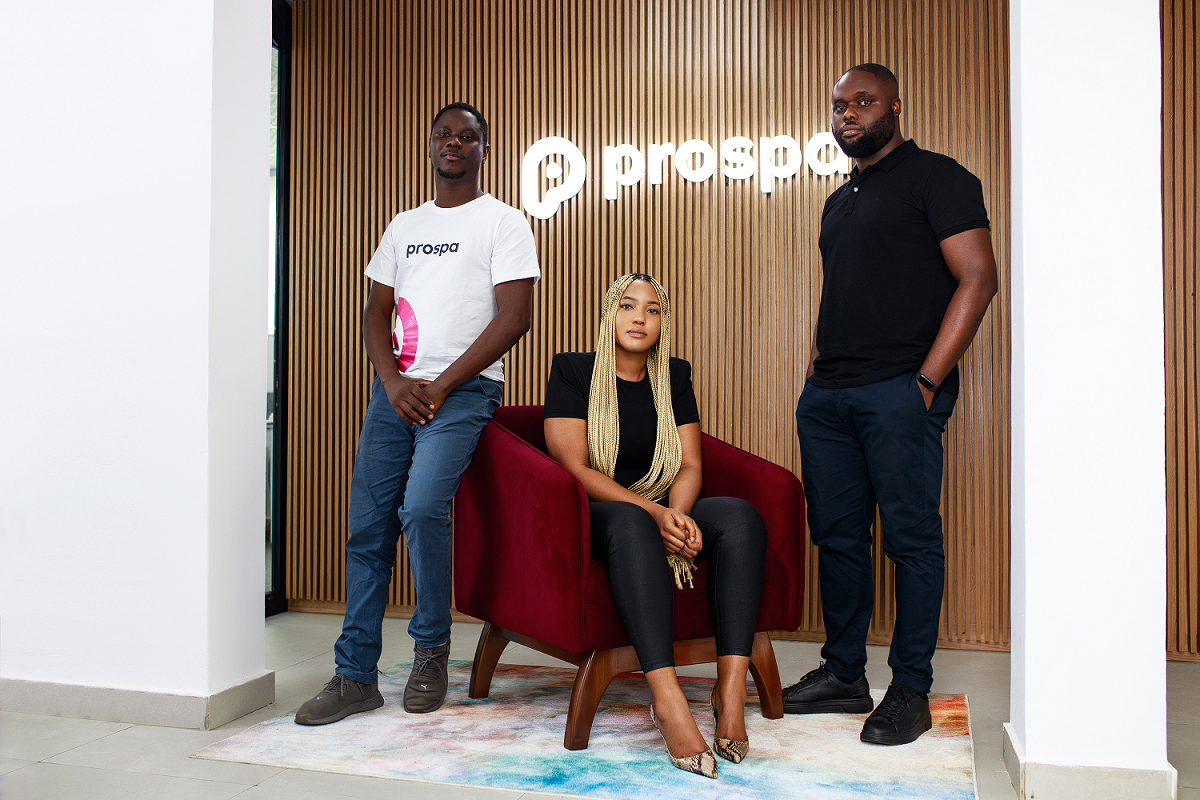
A Nigerian fintech startup, Prospa, has closed a $3.8 million pre-seed round to offer small businesses banking and software services, bridging the gap between banks and businesses in terms of using data to solve problems.
The startup uses data generated through business transactions to provide insight and solutions for businesses, creating growth opportunities for microbusinesses.
Prospa, which was founded two years ago by Frederik Obasi, Chioma Ugo and Rodney Jackson-Cole, was among the 10 African startups that participated in Y Combinator’s winter batch in March.
The idea was developed by Obasi and his cofounders through their experience running other businesses. Spotting the challenge created by Nigerian banking system, which mainly provides financial services, Obasi moved to change the status quo.
With the need for software and personnel visibly high, especially for small businesses that can’t afford to delegate or use machines for operations, the idea of providing software for microbusinesses was born.
In a conversation with TechCrunch, Obasi explained how it started and how they hope to achieve with the newly raised fund.
“When I left my last business, I wanted to do something really big and something that I knew the problem inside out. That’s why I started Prospa,” Obasi told TechCrunch over a call.
Prospa was built between June and September 2019 and went live in October. Since then, the company acquired customers in stealth even when they got into YC. Obasi explains that he wanted Prospa to have organic traction void of the growth driven by hype and media noise.
“We like to think a really long-term game. We really wanted to really test the hypotheses, build an actual business with revenue and understand what we were doing. Then the COVID period came and we started seeing enough traction,” he added.
But when the company began to get some buzz, the typical description people had about Prospa was “a neobank for small businesses.” Over the call, CEO Obasi is quick to dispel that notion. Alongside providing banking services, he says Prospa offers invoicing tools, inventory management, employee and vendor management, an e-commerce store, and payroll features.
“Banking is just a little part of what we do. We know we’re put into the neobank category, but we see our product as 10% banking and 90% software. So the experience is very much different from what you’d get from a neobank and the use case for Prospa users is quite different,” he added.
Prospa focuses on freelancers and entrepreneurs, acting as the “operating system” for their businesses.
Registered businesses on the platform get access to an account number and other features Prospa provides. For unregistered businesses, Prospa takes them through a process of formalizing their business and providing bank accounts. However, in the grand scheme of things, this segment is more of an inroad into an upsell.
Talking on traction, Obasi says the company has tens of thousands of businesses and is growing 35% month-on-month. And from a non-banking perspective, Prospa has managed over 150,000 product catalogs while small businesses have sent out 360,000 invoices on the platform.
Then pricing depends on the business’ turnover. For instance, a business with a turnover of N100,000 (~$200) is not expected to pay Prospa any subscription fee. But businesses with turnovers exceeding ?100,000 pay fees between ?3,000 (~$6) and ?5,000 (~$10) monthly.
Prospa’s pre-seed investment is the largest round of its kind in Nigeria and sub-Saharan Africa at the moment. In Africa, only Egyptian fintech Telda has raised a larger round.
Obasi believes the company’s understanding of the market and what it wants to achieve was the main reason it could command such a price which, according to him, was almost four times oversubscribed.
The investors in the round include VCs like Global Founders Capital and Liquid 2 Ventures. Founders of global fintechs like Mercury’s Immad Akhund, Karim Atiyeh of Ramp, and executives from Teachable, Square, Facebook and Nubank also participated in the round.
Seeing the likes of Akhund and Atiyeh on Prospa’s cap table might suggest to some that Prospa was backed because the company is building a replica of those businesses in Nigeria. However, Obasi says while there are similarities, Prospa is not building a product for startups.
“There’s a massive startup ecosystem in the U.S. where you can basically grow a billion-dollar company just serving YC companies. We don’t have that here. We’re really building for the backbone of the economy, which is small and micro-businesses. Speaking to and being able to build relationships with investors, one of the things we made clear is that we’re not an American copycat,” he said when asked if Prospa could be likened with Mercury and other U.S. startup-focused financial product.
Prospa plans to use its new capital to double down and expand with acquisition strategies to get more customers. In addition to that, the company plans to hire more talent, especially in product and engineering.
Like this:
Like Loading...