DD
MM
YYYY

PAGES

DD
MM
YYYY

spot_img

PAGES

Home Blog Page 5592

Congrats Tekedia Mini-MBA Edition 5; Registration Continues for Edition 6 Which Begins Sept 13

0

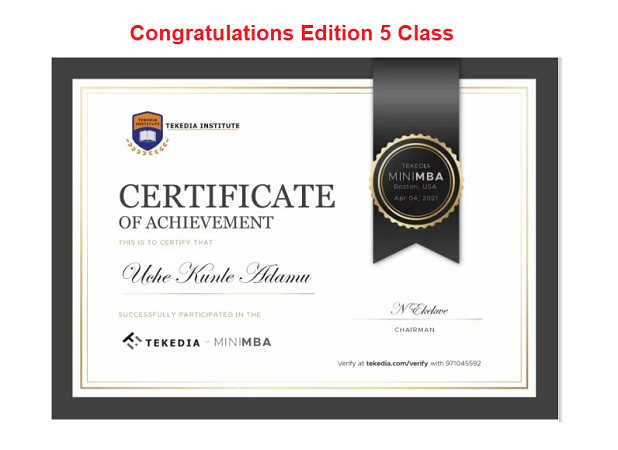
Amazing Edition 5 Class, let me congratulate you again for completing your Tekedia Mini-MBA program on Saturday. Tekedia Institute stands for excellence and quality in business education, and you have experienced what makes us unique: educating on the tenets of entrepreneurial capitalism, anchored on three pillars of innovation, growth and business execution. We overlay digital on everything. Thank you for choosing us and more wins ahead. Get your certificate from Admin and celebrate.

I also welcome our new members starting today on Tekedia Practice on Digital Business, Agribusiness, and Renewable Energy Business. We hope the next two months will be amazing before we place you in modern companies for your 4-month internship programs. Welcome to the Institute.

And next week, a new edition of Tekedia Mini-MBA begins on Sept 13. The 6th edition of Tekedia Mini-MBA promises to be better as we are introducing new courses. To join this edition, go here and register; same N50k or $140 for the 12-month online self-paced program which has thrice weekly Zoom besides pre–recorded sessions.

Nigeria’s Big Yard Sale – NIPOST, NCX, Bank of Agriculture, etc Available

3

Nigeria wants to sell some assets. They have many things available. This should not be surprising as I noted that by 2025, Nigeria will sell some university campuses to fund its bloated budgets. Yes, expect the privatization of some federal universities before the end of this decade! In Abia state, the state abandoned a college of education and weeds are now schooling therein!  Check out the list...

The Nigerian government hopes to sell or temporarily hand over control of dozens of state-owned businesses in a bid to resuscitate them in 2021 and beyond. […]

For the current year and beyond, the Bureau said it has over 36 transactions and projects, including new reform initiatives for the health, education, and oil & gas sectors.

The document listed the various 2021 definitive projects under the purview of the Bureau of Public Enterprises (BPE) to include the Nigeria Integrated Power Projects (NIPPS); Calabar, Geregu, Omotosho and Benin (IHOVBOR); Transmission Company of Nigeria (TCN); Zungeru Hydro Plant; Nigerian Postal Service (NIPOST); Abuja Environmental Protection Board (AEPB) and the Nigeria Film Corporation (NFC).

Others are the Federal Capital Territory Water Board; Abuja International Conference Centre (AICC); Save sugar company; Lagos international trade fair complex (LTFC); Tafawa Balewa Square (TBS); River Basins Developments Authorities (RBDAS); Bank of Agriculture (BOA) and the Nigeria Commodity Exchange (NCX).

People, it is a big yard sale – and everything is discounted. I like NIPOST if the price is good. You can buy it just for the prime real estates, and not necessarily for the logistics business. Of course, be aware that pension obligations associated with such assets could be challenging to handle.

Elon Musk’s Starlink Grand Disruption And Looming Value Destruction in Telcos

1

A few months ago, I wrote that SpaceX Starlink would in near future develop a “special phone” which would make it possible for users to connect directly to SpaceX satellites without an “intermediary” or downlink station. That call has come to pass. 

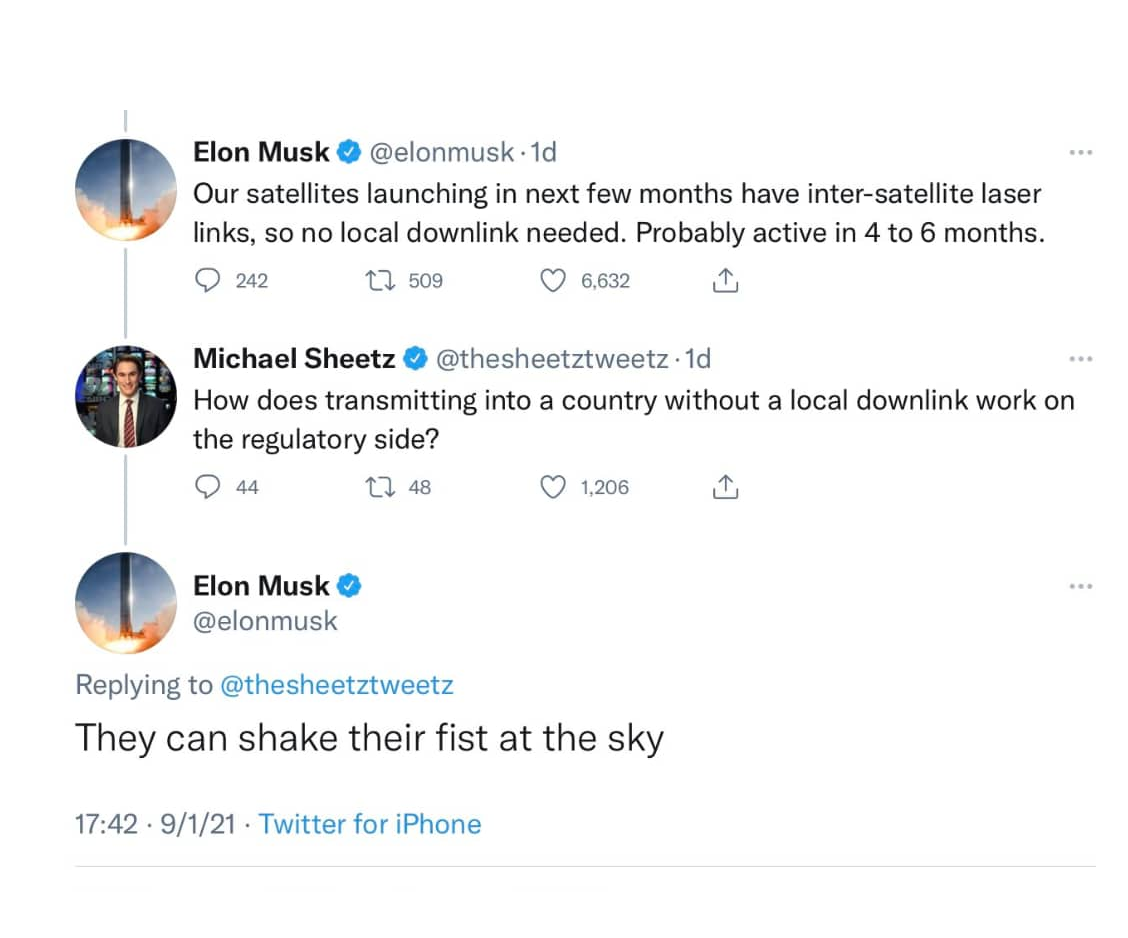
Elon Musk, the generation’s finest innovator, tweeted this: “Our satellites launching in next few months have inter-satellite laser links, so no local downlink needed. Probably active in 4 to 6 months…. Technically, data packets do not need to touch regular Internet – data can flow from user terminal to satellite/s to user terminal”.

Largely with this, SpaceX Starlink can deal directly with users, cutting even regulatory ordinance in nations. Unless a country bans the distribution of the phones, there is no way it can stop this redesign.

With Moore’s law on its side, the cost of the electronics will keep dropping – and over time, the phones will become cheap enough. If that trajectory is followed, be concerned if you are running a telco business, especially in rural Africa, because satellite broadband in this format Starlink is bringing it will provide a new basis of competition.

Comment LinkedIn Feed

Comment: Ndubuisi Ekekwe Its not just banning the distribution of phones, per ITU standards the regulators control the spectrum, so without banning phones the user or SpaceX/Starlink still need the regulators to manage the freq. spectrum used or the solution wont scale.

My Response: My thinking is this: Elon Musk might have tried to engage many regulators and many are not open for business since they want to sell spectrum and command the airwaves. So, this playbook is to use tech to overcome that conversation. Personally, I hope Musk does not follow this path because if he does, he could consolidate all digital wealth in America since over time, no one will care for Glo, MTN, etc. But whether it is possible, yes indeed. People who use satellite phones do not ask bureaucrats for permission to get receptions already! The issue is when the whole village does that!

The Playbook At Afghanistan’s Panjshir Valley

1
????????????????????????????????????????????????????????

I read this report from CNN on the current battle between the Taliban and a province (Panjshir Valley) which remains out of Taliban’s control in Afghanistan. The Panjshir Valley has the  National Resistance Front (NRF) fighting therein. An interest is this statement from NRF after Taliban reported a few days ago that it had entered the valley, claiming that it would be concluding the battle soon.

An NRF spokesman said: “We have allowed them (Taliban) to enter the valley intentionally and now they are trapped. ..This is a tactic we have used from our playbook from the 1980s when the Soviets entered the Valley. The NRF is all over Panjshir and the Taliban have suffered heavy casualties tonight”.

No one is sure who is telling the truth, but you will not miss the use of the word “Playbook”. Politicians and business leaders do this all the time. An opponent produces bogus surveys telling you that your numbers are looking good, and that a state is winnable, even when it knows you have no chance; Trump campaign did it for Biden in Texas but Biden campaign despite many asking it to go for it (win Texas) did not fall for that trap. 

The US during the Gulf War did a similar thing: it “leaked” many documents that it was coming through the Euphrates River, conditioning the Iraq military to station there for resistance there. Magically, they came from another area, flanking Saddam Hussein soldiers and Baghdad fell in about 3 weeks.

I called this Fish Bait Acquisition Construct in business. Yes, what looks like easy wins may be designed to emasculate a business, trapping the brand into annihilation. Have awareness!

China’s SMIC to Build $9 Billion Plant in Shanghai

0
????????????????????????????????????????????????????????

China’s top chipmaker, Semiconductor Manufacturing International Corp. (SMIC), has joined the growing number of chipmakers aiming to expand production as global chip shortage buoyed by covid-19 pandemic skyrockets demand. The company said on Friday that it will build a nearly $9 billion chip plant in Shanghai, giving hope to Chinese manufacturers, including Huawei, who have been caught in the heat of chip shortage.

According to a report, the plant will be Semiconductor Manufacturing International Corp.’s biggest investment in years and will churn out older-generation chips that are currently in short supply for everything from consumer electronics to self-driving cars.

SMIC said in a stock exchange filing that it has agreed with the Lin-gang Special Area of China (Shanghai) Pilot Free Trade Zone to form a joint venture to build and operate the plant. Capacity is planned to reach 100,000 wafers a month, with a total investment of $8.87 billion.

The plant will make chips using 28-nanometer production tech or older, which is suitable for such chips as image sensors, Wi-Fi chips, driver ICs and microcontrollers, many of which are in extremely short supply. The most advanced chips on the market are made using 5-nm technology for iPhone processors and Mac CPUs.

The move challenges Taiwan Semiconductor Manufacturing Company (TSMC), the world’s biggest contract chipmaker, which announced a similar move this year. TSMC said it will spend $2.8 billion to expand its production capacity in the Chinese city of Nanjing for 28-nm tech to tap growing local demand. Other global peers, including Globalfoundries and United Microelectronics, are also aggressively expanding capacity.

The registered capital of SMIC’s joint venture will be $5.5 billion, according to the filing, with the chipmaker taking at least a 51% stake and shouldering responsibility for its operations and manufacturing. The Shanghai government will take a 25% stake and third-party investors will be sought for the remainder, the filing said. It was not immediately clear when the new facility is slated to begin production

SMIC announced this year that it will jointly invest in a $2.35 billion chip project with the Shenzhen government to churn out 40,000 wafers a month in the southern Chinese city, starting in 2022.

Last September, SMIC was added to the U.S. Commerce Department’s Entity List, which bans the unlicensed exports of American technology to the company.

SMIC co-CEO Zhao Haijun has confirmed several times that the U.S. blacklisting has hindered the company’s development of more advanced technologies, which rely more heavily on American equipment suppliers such as Applied Materials and Lam Research. Zhao said his company is looking for alternative solutions while continuing to communicate with the U.S. government.

SMIC is China’s most promising contract chipmaker and thus shoulders many of Beijing’s hopes for building a self-reliant chip industry.

Recently the company has benefited from a surge in prices for chipmaking services as global electronics manufacturers and automakers battle an unprecedented shortage of semiconductors. SMIC is a key production partner for many Chinese chip developers, as well as U.S. chip developer Qualcomm. The company reported record earnings for the first half of 2021, thanks to higher prices and robust demand.

The plant will also help China to bridge its wide semiconductor gap with the US, and ease the strains of US sanctions on Chinese industries.