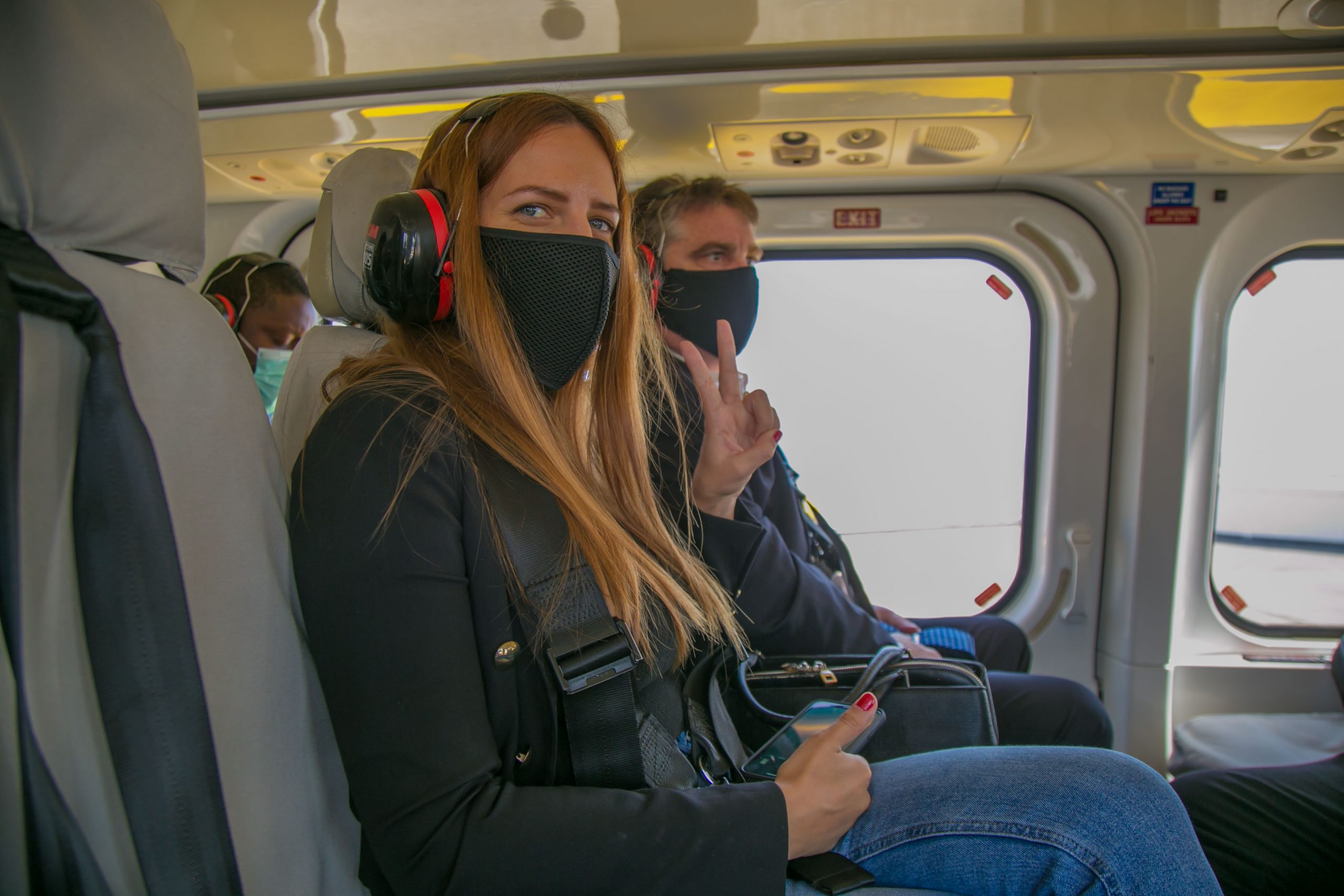
I promised to share helicopter tickets here and that is coming. Also happy to share the taste of what you would experience as you fly Vetifly and experience the luxury, class and fun. Yes, fly over traffic across Nigeria. Victoria Island to Ikeja Airport in 7 minutes!
Full operations begin in two weeks in Lagos, and quickly we will ramp up to many Nigerian cities and African countries. But first, help me and download the appvetifly.com (Android and Apple iOS).
As we hit this milestone of public launch. I want to thank all Vetifly investors, especially Tekedia Capital investors who came in big. Thank you so much.
Vetifly >> arrive in style, move different!
Video credit: Vetifly customer and flyer, mycraw on Instagram
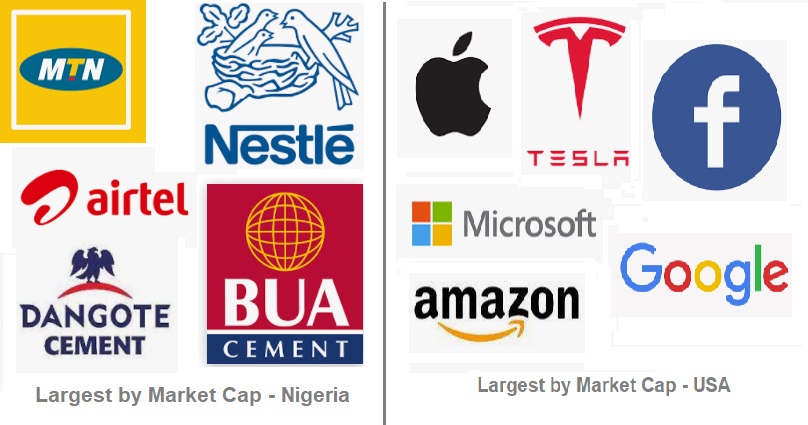
Nigeria’s stocks worth over one trillion (SWOOT) naira, and certainly the largest companies, have two cement companies, two telecommunication firms, and a food & drink processing conglomerate. In the United states, the six largest publicly traded companies (and certainly the largest overall), are largely all technology companies.
From these companies, one can also pick the states of the economic developments: Nigeria’s is still emerging with cement and food catalytic while in the US, those have since passed their growth phases. While Nigeria bets big on the infrastructures of the digital economy with MTN and Airtel, the US is focusing on the utilities built on those infrastructures with the core infrastructure players largely not dominant.
But there are many more things one can point out by looking at these logos. What do you see?
Comment 1:Ndubuisi Ekekwe, the first logo shows that Nigeria is still on the lower rung of the Maslow’s Hierarchy of Needs (Physiological Needs), and The US, has met these needs, therefore innovation is easier. You cannot innovate until you meet the first need. “It is hard for a hungry man to think”
Comment 2: We went to the Olympics, and returned with two medals: silver and bronze. So for all those sixteen days, Nigeria’s national anthem never roared, with green white green ascending, while the world salute us. Nothing can compare to that feeling, but we never had one of those precious moments.
We have done all kinds of economic analyses and political governance systems here, but what exactly can we say Nigeria is good at? Just bunch of creatures who talk too much but do very little.
Let’s deal with small things first, if we cannot make good impressions in global games like the Olympics, then it makes no sense debating more sophisticated and costly adventures, because there are many nations who are well ahead.
I don’t want to blame anyone, just that we are never great at anything, and the earlier we accept this, the better for us. This mindset of settling for average or mediocre outcomes is what I find absurd, our will to succeed is nowhere near what you see from other nationals. When people expect a lot from us, and we disappoint, our attitude doesn’t even show remorse or great sense of responsibility, because we have all remained largely irresponsible in this part of the world.
I want to hear our national anthem at the grandest of stages, nothing can make me prouder as a Nigerian, for now we don’t have any bragging rights.
We are trading cement and food, yet homes aren’t affordable, neither do we have enough food for the hungry…
Comment 3: Prof Ndubuisi Ekekwe, please note that the dichotomy you are referencing is a result of differing stakes in the equity markets in these two economies. The driving forces in the US stock market are completely different from what obtain in Nigeria. In addition to reported corporate profits, low to zero interest rates in the US has virtually guaranteed a bullish stock market here, resulting in what some believe are equity pricing “bubbles.”
Remember also that the US is largely service and consumer economy, although the Biden administration is seeking to bring manufacturing back into the economy. Nigeria’s economy on the other hand, is purely a consumer economy. So, the market caps of the companies referenced are more indicative of the economic activities in the country.
Comment 4: First, I see that the US economy is already positioned for the future ; a time when almost all sectors of the economy would depend on tech to function optimally. On the other hand, I see that the Nigerian economy is still dwelling in the present, characterised by shortage in housing, food and Internet connections. I see a largely untapped tech market for Nigerians however, depending again on the institutional support for such tech exploration. Prof., these, I have seen.
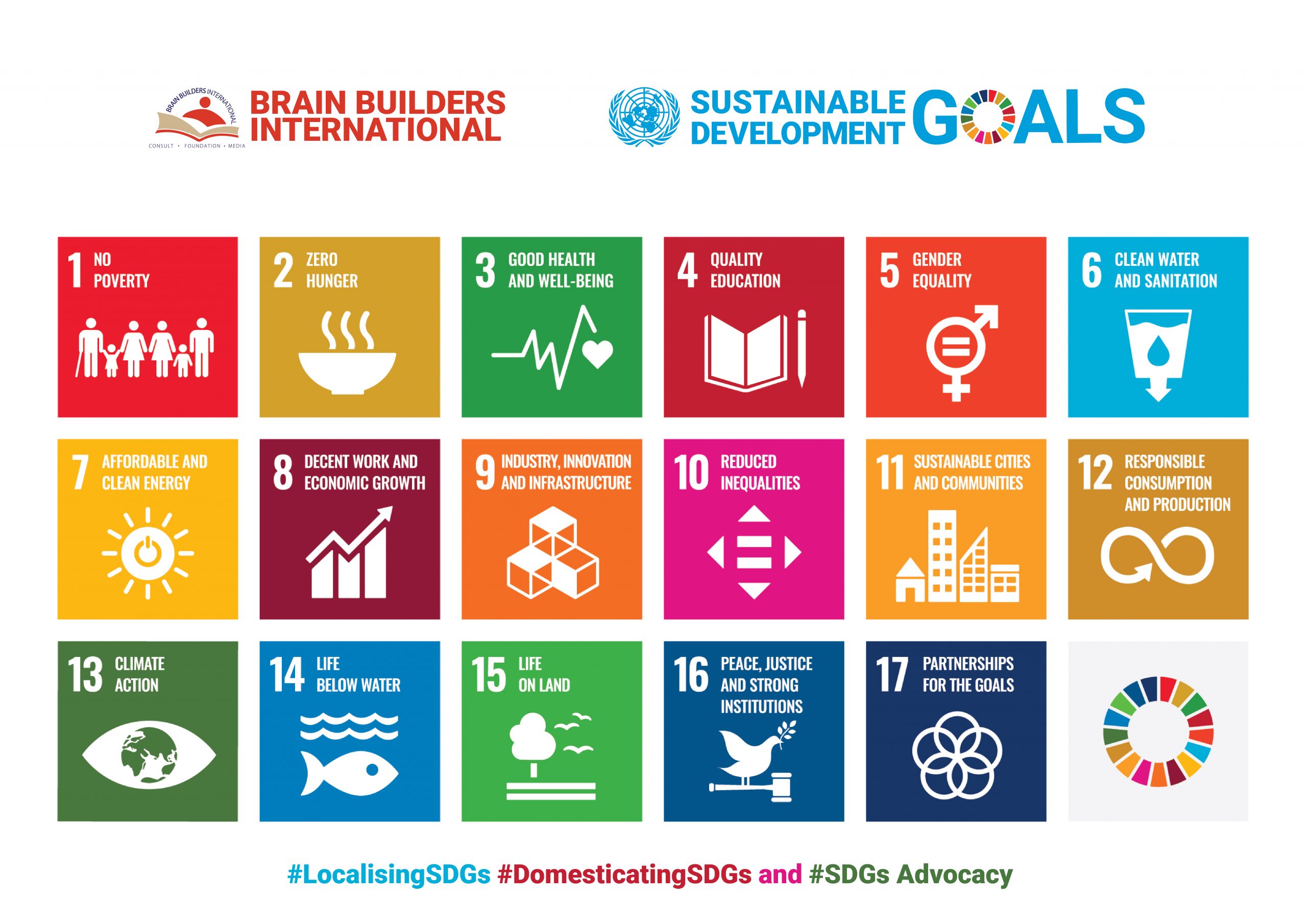
By 2030, Nigeria is expected to be among the countries that have absolutely or partially achieved all the 17 Goals of the Sustainable Development Goals, agreed on by business and political leaders some years after the inability of realising all the Millennium Development Goals. Nigeria is one of the countries that achieve less of the MDGs. This has been a great concern to academia and industry, including Ministries, Departments and Agencies that have the mandate of ensuring sustainable living for everyone.
Our analyst had earlier reported that businesses and scholars need to come together and work with the mindset of removing perenial frictions associated with organisation to organisation partnership in the past, especially industry and academia relationship. In furtherance of this proposition and our analyst’s quest of understanding happenings around SDGs, he was privileged to attend an online discussion, where Nigerian professionals from the industry, academia and civil society space discussed all the 17 SDGs.
Available information suggests that the discussion of the first 16 Goals resulted in spending almost 50 hours, allowing the professionals to raise issues and needs, and discussing them thoroughly. Week 17, which is just ended a few hours ago, allows the professionals to discuss SDG 17: Partnership for the Goals. This Goal sums all the mechanics and physics of Goal 1 to Goal 16. It challenges stakeholders on the primary place of strategic collaborations and partnerships in attaining the rest Goals.
As the guest speaker of the week 17, Professor Nnamdi Madichie of the Nnamdi Azikiwe University, Akwa, dwelled on the key things stakeholders in industry and academia, including government must do before Nigeria realises all the Goals. He stressed the place of mutual understanding before and during partnership or collaboration formation.
Other professionals who spoke identified information asymmetry among the stakeholders. According to them, lack of data and effective information exchange are impacting forming strategic alliance and executing projects. It also emerged that stakeholders are having collective benefit conflicts. Some organisations want their stories to be told along with the projects being executed. Identifying and connecting different value propositions of the stakeholders also remain significant problems.
At the end of the discussion, participants agreed to forge ahead with the internal collaboration. For instance, participants who have existing projects on the realisation of the Goals or know individuals or organisations working towards attainment of the Goals were informed to connect with others or link such individuals or organisations with the participants.
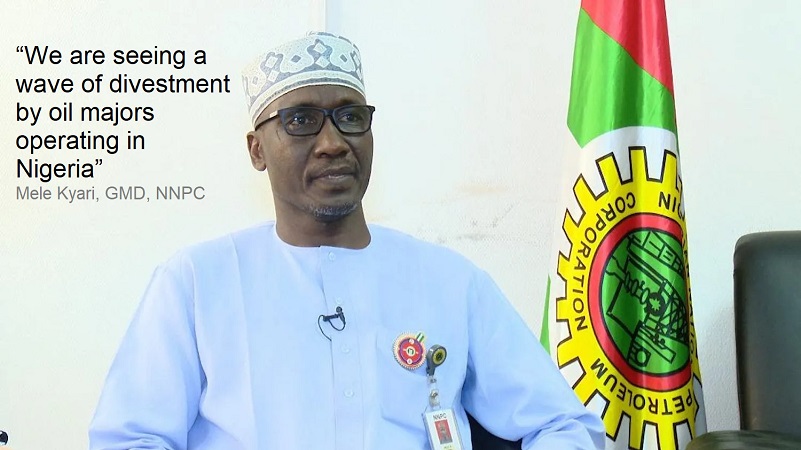
“We are seeing a wave of divestment by oil majors operating in Nigeria”, Mallam Mele Kyari, GMD of NNPC at 2021 NAICE.
As the world makes big oil the new tobacco which must be avoided by all means, Nigeria’s moment of truth is here. Cholera has returned at scale, insecurity has scaled, even IBB baptized himself a saint by looking at the level of corruption these days, doctors are still striking, teachers are not left out, etc you will ask: what will happen when even the oil money is not in the purse?
If I have to speak with President Buhari this morning, I will tell him one thing: you are the petroleum minister, move your junior minister and make him the Minister of Energy Transition & New Economy, with a clear mandate to develop protocols on new systems to substitute whatever Nigeria will lose from petroleum. The goal is to have structures which will help Nigeria enter the new energy world confidently, and I do think despite whatever the ministries of ICT, Science, tech and innovation, etc may be doing, it is only the petroleum ministry that will send the loudest alarms.
The oil majors are not in control of this redesign: the investors are. As major funds dump them over exposure to the “new tobacco”, they want to wean themselves off hydrocarbons to remain viable in the markets.
The World Bank has joined the march to greenhood, phasing out key upstream investments. The sovereign wealth fund of Norway, the largest equity investing fund in the world, controlling nearly 1.5% of the total global equity war chest, is cutting exposures to (fossil-based) energy companies. Shell is leaving Nigeria. Today, Toyota has learnt that selling more cars is not what matters, it is the type of car (EV or gasoline) that investors care about.
People, they are tobacco-lizing big oil, and in the near future the pension funds will join the party, and some university endowments will fire fatal bullets. Big oil is the new tobacco and the world is running away from it. Nigeria must open its playbooks.
Comment #1: Prof Ndubuisi Ekekwe, honesty and accountability need to be built into Nigeria’s business culture. The NNPC GMD is only partially right in the attributed quote. He used a present continuous verb tense (we are seeing), in place of a compound continuous past perfect tense (we had been seeing).
The divestment trend among oil majors had been in progress for almost 8-10 years. Oil giants are being compelled by lawsuits, shareholders, and boardrooms to pursue new pathways in energy production, especially ones with a lower carbon future. Even national oil companies have begun diversifying. Saudi Arabia, one of the biggest oil-producing countries in the world has engaged in large commercial solar energy projects since 2011.
As you concluded, the change is imminent, and “Nigeria must open its playbook.” Unlike crude oil, gas production must ascend into the high priority realm, meaning gas flaring must come to an immediate ending.
When will the country begin to lay the foundations for the adoption of electric vehicles? Are the ministers of energy and transport even considering this?
Comment #2: “The goal is to have structures which will help Nigeria enter the new energy world confidently …….Its is only the petroleum ministry that will send the loudest alarms”. Exactly what Dubai did,and Venezuela refused to do.As of 2016, Venezuela has the largest oil reserves in the world.(Lol)
Good people,Nigeria has the best ideas-best brains. We have the best committees set up to look at the root causes and submit a term-paper. Then a second committee to serve as oversights to the first one.(Chuckling)
What we lack is sustained execution. Strong executions come from strong leaders,not drama or politics. It comes with dedication to the mission above all others. We have to start teaching our kids execution,not sentiments,ethnicity or politics. Just the results.Everything is simple thereafter.The common wealth should be our national destination.
Lagos is setting the pace. I predict in the next 20years,you will need some kind of intra visa,or economic visa status to live in Lagos, if the other states remain asleep .Just wait till Lagos gets its ultra modern state police.
In our program, I introduced our members to one critical business framework: product minimum viable quality. I postulated that quality without the construct of cost is meaningless. Yes, you pay $402 per year for tuition and board in a federal university in Nigeria, and yet you are expecting to have Harvard University quality which costs north of $67, 000.
You spent $300 in Transcorp Hilton Abuja and yet you expect the same quality in the Oshodi “hotel” where $12 can cover your head for a night. Those make no sense – and that is the reason why China is winning the world. Even though it could make a high quality product, sometimes, it thinks it could price the customers out. So, you buy that Christmas toy for $2 which breaks down within two hours the kid is playing with it when the German version which costs $100 will last for months. But the problem is this: few have $100 to spend on a toy. Magically, the crappy China’s version wins the global market.
That takes me to European football. If France’s PSG picks Messi when we already have Neymar and Mbappe, can we still write that Ligue 1 has a competition for #1 or just looking for #2? Yes, who will finish behind PSG? Those three players could buy some 11 players in some Ligue 1 teams. You do not call that competition.
I like how they do it in America: there is a team salary cap and once you hit that, nothing else can open. You can decide to use 70% of that cap and pay one person but you cannot exceed that cap. In Europe, it is lousy. You can rake a bank and assemble the best in one team, making it a game of money and no more football!
Arsenal legendary coach, Arsene Wenger, mastered that business, returning tons of profits for the club, by constantly developing and selling good players, even when winning silverware was dimming. The fans wept that Arsenal was not winning trophies when the team owners were smiling to the bank. The question is this: if it is competition on the field, there needs to be a balance in the accounting books.
A Messi-Neymar-Mbappe trifootballogy will be a super-threat and the global united nations football security should pay attention – and act! Sure, get better goalkeepers to lead the commissions!