DD
MM
YYYY

PAGES

DD
MM
YYYY

spot_img

PAGES

Home Blog Page 5634

How Ibadan Radio Stations Could Win Facebook-Radio Convergence Game

0

The world has had different narratives about who really invented radio. Some have argued that Guglielmo Marconi was the real inventor. Another group of historians and scholars has equally noted that Reginald Fessenden was the actual inventor.

Either Marconi or Fessenden, what really matters is that the invention enables people to listen to a voice or more through a box. The invention also affords the man or people behind the voice to communicate with a large audience without seeing them and audience, not seeing who is communicating with them too except his or their voice.

Several years later, television was invented, which allows the large audience to see the speakers and also interact with them via telephone like what is obtainable for the radio transmission of voice.  In 1997, Six Degrees, the first social media birthed after many years of emergence of the Internet. Six Degrees “enabled users to upload a profile and make friends with other users”. Some of the lapses seen led to the creation of Facebook in 2004 and Twitter in 2006, including several social networking sites after these years.

As these tools or channels of communicating censored and uncensored continue evolving, the need arises for combining one or two of them for synergistic content distribution or communicating the heterogenous audience. This gives birth to media convergence among scholars and professionals in the global news media industry. In the context of radio, according to our checks, convergence “refers to the network architecture that broadcasters have adopted to merge previously distinct media (so-called traditional broadcasting or terrestrial broadcasting) into common interfaces on digital devices.”

Though, there are technological convergence, economic convergence and cultural convergence as the main categories of media convergence, globally, broadcast media establishments have mainly appropriate technological convergence more than other categories. They are using various Internet-enabled devices and leveraging social networking sites for the distribution of their news, programmes and commercials to the targeted audience during different time belts.

Beyond explication of the various inventions and media convergence, this piece examines how select popular radio stations in the city of Ibadan are using the Facebook-radio convergence strategy. Are Ibadan radio stations getting radio-social media convergence strategy, right? As a at the time of writing this piece Ibadan, the capital of Oyo State, has 23 Frequency Modulated radio stations. Majority of these stations were established in the last 10 years, except the Federal Radio Corporation of Nigeria (FRCN) and the Broadcasting Corporation of Oyo State (BCOS), which were founded in 60s and 70s respectively.

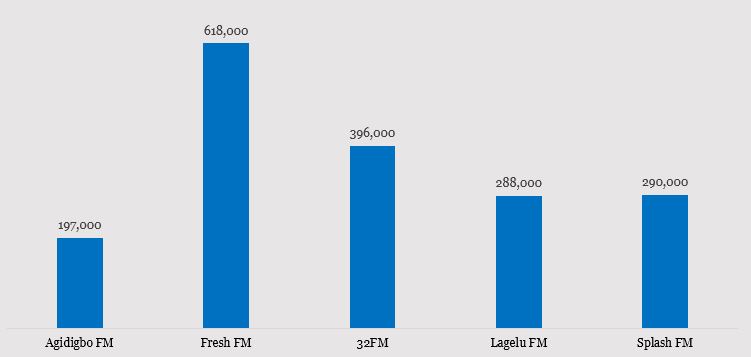
Our analyst considered Agidigbo FM, Fresh FM, 32 FM, Lagelu FM and Splash FM with a total of 1,789,000 followers [August 5, 2021] and chose 5 content categories each; newspaper review, sports, entertainment and issues-focused. Analysis of the number of likes, shares, comments and views each station had for each content category along with the number of followers indicates that Agidigbo FM, despite its lowest number of followers, performs better in all categories than Fresh FM, 32 FM and Splash FM. Our analysis reveals that Lagelu FM largely followed Agidigbo FM.

In our analysis, we equally found that issues-focused content, especially Kokoro Alate, had the highest share of followers, liking, commenting, sharing and viewing the content than others content of the station [Agidigbo FM] and other contents from the remaining stations examined by our analyst.

The followers of the radio stations also engaged with entertainment and sports content more than newspaper review and news commentary content. From these insights, our analyst notes that Facebook-radio convergence has not really worked for the Ibadan stations. It is glaring that the large number of followers of the stations’ Fan pages does not translate into large viewers as expected.

Exhibit 1: Stations’ Followers on August 5, 2021
Source: Stations’ Facebook Accounts, 2021; Infoprations Analysis

Exhibit 2: Share of Likes, Comments, Shares and Views in Followership
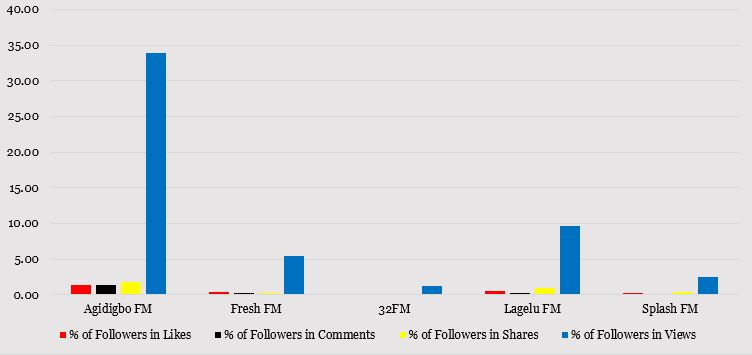
Source: Stations’ Facebook Accounts, 2021; Infoprations Analysis

Exhibit 3: Agidigbo FM’s Performance in Select Programmes
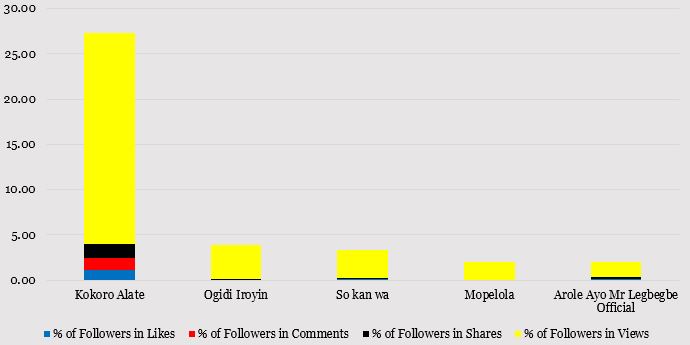
Source: Stations’ Facebook Accounts, 2021; Infoprations Analysis

Exhibit 4: Lagelu FM’s Performance in Select Programmes
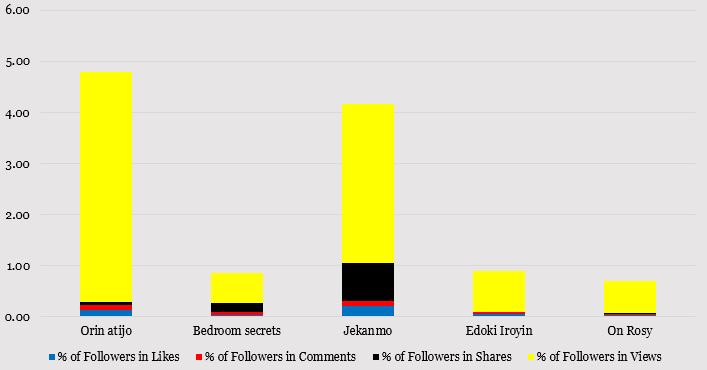
Source: Stations’ Facebook Accounts, 2021; Infoprations Analysis

Turning Facebook Followers to Active Listeners

Therefore, these stations and others in the city need to restrategise towards sustainable capturing inherent benefits in Facebook-Radio convergence.  The need has emerged for creation of apps that will be notifying those who liked and followed the stations about a particular programme/comment that is being streamed. This will augment Facebook’s feature, which informs followers about live streaming of video and audio content.

Programme producers and presenters also need to work on demographics and psychographics of the followers. For instance, using Facebook Analytics section of the Fan page will help in understanding gender, interest and concerns of the followers. This will be useful in redefining the content being distributed, for example, personalizing entertainment content. This is imperative as radio audience is quite different from social media audience.

Additional reports by Umar Ajetunmobi

TradeGrid Partners IPMAN (Independent Petroleum Marketers Association of Nigeria)

0

Let me congratulate Tekedia Capital portfolio company, TradeGrid, for closing a major partnership with Independent Petroleum Marketers Association of Nigeria (IPMAN). With TradeGrid, 30,000 filing stations nationwide can now skip the long queues at depots, to order products remotely. TradeGrid offers marketplace, financing, logistics, asset verification, forex services, etc.

We are building the digital technology architecture of the downstream sector of the energy sector including the New Energy. We also supply oil & gas parts. This is the new home of downstream energy and new energy .

Download the app here thetradegrid.com

Tencent Boss Loses $14bn As China’s Crackdown Plummets Tech Sector

0

As China continues its regulatory onslaught that is quaking its tech industry and shedding billions of dollars off its economy, the sweeping effect is now catching up with Chinese billionaires.

Alibaba and Ant Group cofounder, Jack Ma, was the first to feel the impact of the crackdown, losing billions of dollars in personal wealth. Now, Tencent’s boss, Pony Ma, has been caught in the financial crossfire. Bloomberg reported that the mild-mannered boss has lost more paper wealth over the past nine months than Jack Ma.

Beijing’s regulatory onslaught has spread across many sectors of China’s tech economy since last year when it halted Ant’s proposed IPO that would have seen the company topple Saudi Aramco record as the company with the largest IPO in the world.

Of many Chinese companies caught in the regulatory web, Alibaba and the Ant Group were the most affected. Alibaba had to pay up to $2.8 billion in fines and penalties, while Tencent received a token fine for not seeking approval during past acquisitions and investments. Though Tencent got into trouble again, and was ordered to give up exclusive streaming rights, it still has a better treatment compared to others.

However, as other companies get hit by China’s crackdown, Tencent’s share of the misfortune increases. On Tuesday, a Xinhua-affiliated newspaper took a dig at Tencent with the claim that its gaming business could be the next on Beijing’s crackdown list. The news sent the company’s shares crashing as Tencent posted its biggest intraday decline in a decade. Tencent’s value dropped to $550.5 billion from nearly $1 trillion it has reached this year.

Following the decline, Pony’s net worth recorded further plunge. Bloomberg Billionaire Index noted that his fortune has dropped by almost $14 billion since the Ant IPO was suspended in November, falling to $45.8 billion on Tuesday. He is now the third richest person in China, behind Jack Ma.

Bloomberg noted that while state media toned down their language on gaming Wednesday, helping fuel a more than 5% rebound in Tencent, the stock is still 17% lower for the year. With Beijing not ready to stand down yet, the outlook of the stocks will be determined by what regulators do next.

Tencent has been compliant with regulators and promised to make amends where necessary, including limiting play time for minors and forbidding in-game purchases for the youngest players. Bloomberg’s report said that the company also broached the possibility of the industry banning games altogether for those under the age of 12.

However, uncertainties still cloud the future of Chinese tech companies and their billionaires as the government prioritizes national security, control, financial stability and equality.

China invaded the edtech sector last week, collapsing the $100 billion industry by ordering edtech companies to go non-profit. This was days after it ordered ride-hailing company Didi to stop registering new customers and removed it from China’s app store. More Chinese billionaires are expected to witness misfortune if the crackdown continues.

Why South Africa’s Shoprite, Mr Price Faded When MTN, MultiChoice DStv Thrive in Nigeria

5

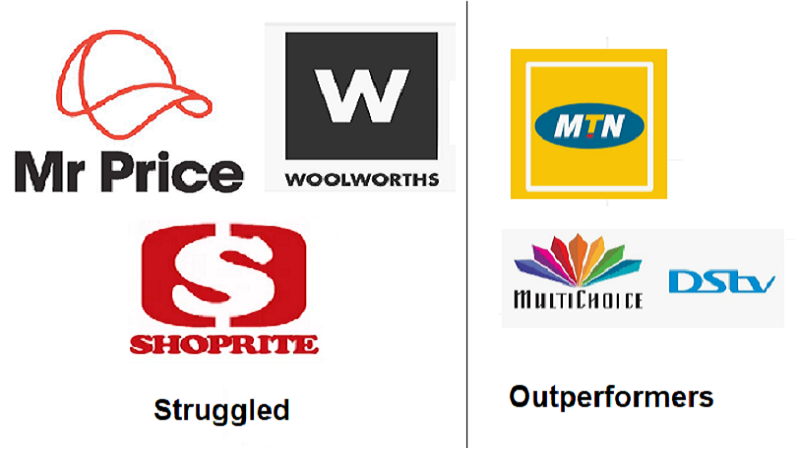
The companies on the left struggled and they were largely retailers which left southern Africa for a voyage in Nigeria. They have since returned or about returning home. Mr. Price left last year. Woolworths had departed in 2013, and Shoprite is gone, structurally. But the two on the right – MTN and MultiChoice – are from the same southern Africa, and magically have outperformed in Nigeria. The question is why?

I see three core things:

Product-Market Fit: To a large extent, formal retail in Nigeria remains highly underdeveloped due to infrastructures. While it makes sense to go to a farmer’s market in Cape Town and buy a cow, process it and dump in your deep freezer for months, large-scale shopping when there is no electricity makes no sense in Nigeria.

Economy: South Africa at close to 60 million people budgets an excess of $65 billion than Nigeria which is more than 3.5x its population. At a population of 210 million, Nigeria spends a paltry $35 billion when South Africa hits close to $100 billion. So, to a large extent, the middle class in Nigeria is very small and the purchasing power for organized retail may be limited.

Unlike South Africa, Nigeria falls within this segment which reshapes available opportunities for organized retail: “the most significant opportunity for African B2C startups lies with consumers who earn between $4 — $8 per day”. That spectrum is not a very sweet domain for organized retail. You need at least $15 per day to make it fascinating for the likes of Shoprite. So, there is a clear product-market fit dislocation and that has made organized retail challenging in Nigeria.

The Core Market Segment in Africa – Middle of the Pyramid

Also, checking the economy, South Africa collects excess of $85 billion from taxes. Nigeria’s revenue comes down to about $10 billion. This shows the scale of the disparity of the economies.

Competition: From daily to weekly open markets to shop on the street, to traffic sellers, Nigeria is a market. To win as an organized retailer, you have to beat those alternatives.But beating them when they do not tax becomes challenging. If margins remain low, issues crop up. Nonetheless, a new South African firm is in town: Pick n Pay.

But when you examine MTN and DStv, two things are evident: both enjoyed the first-scaler advantages. Yes, they did not just get to the market first, they were also the ones that scaled first. Nigeria was a blue ocean for both while in organized retail, the brands came into a red ocean.

More so, MTN and DStv pioneered pricing models which are relatively novel in Nigeria, enabling them to capture value. Despite whatever the state of the economy is, as the industry-kings, not just category-kings, they continue to capture value because the market does want the services they offer. So, there is a great alignment of product-market fit and competitive positioning. When that happens, provided there are humans, money would be made, irrespective of the state of the economy. Why? The little value available would be warehoused by the first-scalers.

What Is Pick n Pay Playbook in Nigeria?

Comment on LinkedIn Feed

Comment: I think on the right, owning content distribution rights (exclusivity over sport events alone makes it golden) sets Multichoice apart, whilst MTN rode in on a near monopolised licensed model, backed by its Pan African group presence. Most on the left expanded to Nigeria in the same phase as they did expanding beyond SADC, meaning they had to learn fast or fail across multiple countries & cultures. Some of your observations though are spot-on. Enjoyable as always!

My ResponseSure – we must not forget that MTN executed better than competitors. Its playbook to aggressively reach more cities in Nigeria was not built on monopoly but a sound business strategy that in-network network effects would compound over time. Econet (Zain, Celtel, Airtel) could have done the same since all began at the same time.  I do not think MTN triumphed on monopolistic advantages. I do think it was a better operator with experiences working across Africa. When Glo introduced per second billing, MTN could have ignored Glo, but it responded to protect its castle, reversing itself that per sec was not technically possible. If it did not do that, by now MTN would have been history – in Nigeria.

Like Dangote Cement, when Michel Puchercos grew profit 1284% while cutting salary by 50% (his was down 10%) in Lafarge, Aliko Dangote paid all to bring him to Dangote Cement. Magically, the same man returned more than N40 billion in a quarterly tax, close to all the major banks combined (N42 billion).

There is a huge lesson here: the construct of monopoly in Nigeria is unsupported by data because most sectors are at infancy. The alleged Dangote Cement dominance would have flipped over 5 years, looking at data Lafarge was running under Michel. Sure, Aliko being a legend, brought him home, making sure the party stopped at Dangote Cement.

Going for Alpha in Nigeria: Unlocking Carlos Slim And Franklin Templeton Investment Theses

2

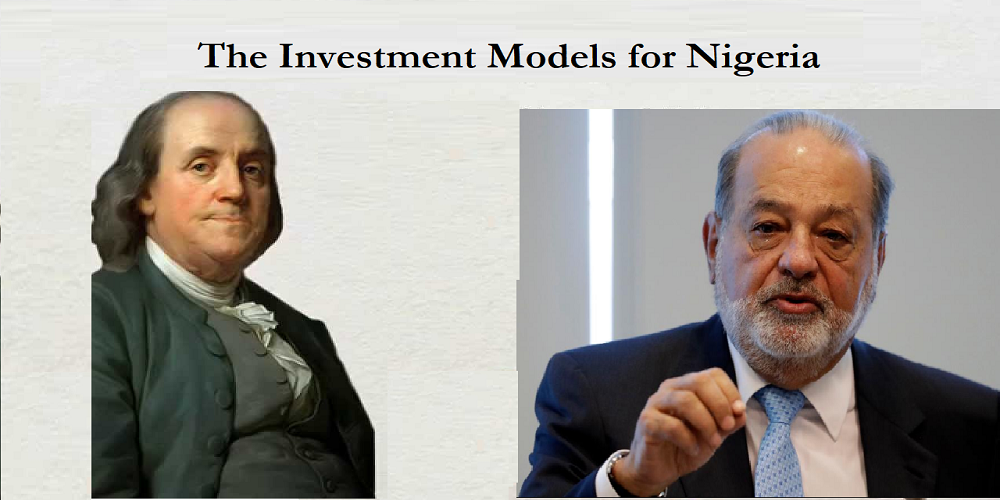
As Nigeria goes through a challenging season of economic paralysis, I want you to remember that nations rarely kaput. Yes, Nigeria and Nigerians would always be around. And despite whatever, Nigeria will remain an opportunity. I share this video about two men I study – Carlos Slim (Mexican billionaire) and Franklin Templeton (stock picker of the 20th century). As things seem to be falling apart with insecurity, remember that the sun will always rise. Do not kill that idea, because Nigeria will always be.

Carlos Slim saw hope at the lowest point of Mexico; his father had told him that Mexico will always be around. Templeton was buying stocks when the world was frozen at the heat of a world war. When others were frightened, these men sojourned and became legends.

If you cannot believe in the human race, you cannot build. If you cannot believe in the promise of the future, forget the idea of starting. Think about the dragonfly: it goes ahead on the current and defines its course, unlike the lifeless feather which is tossed around.

I study two men – Franklin Templeton and Carlos Slim – for my family investment strategies. Templeton began a firm in 1947, against all odds, at the runs of the World War II. Mr Slim bought anything in his sight at one of the lowest points in Mexican history – the peso was down and markets in ruins. Templeton trusted the human race and bought “useless” stocks. Slim’s father told him that countries do not fail; they always come back. I read about these two

As the weekend arrives, cut off the noise of hopelessness from the newsmakers, and map a playbook that even if there may be paralysis, there will always be a good pasture  for those who can think differently and take action. #believe and #action.

Believe that we can rise as a people – a nation that is open, with abundance and shared prosperity for ALL. Yes, one where ALL will rise, not just a few. That was how I closed my speech at the Platform. Translating into that future is a Call to Duty.