DD
MM
YYYY

PAGES

DD
MM
YYYY

spot_img

PAGES

Home Blog Page 5635

The European football’s Big Threat

0

In our program, I introduced our members to one critical business framework: product minimum viable quality. I postulated that quality without the construct of cost is meaningless. Yes, you pay $402 per year for tuition and board in a federal university in Nigeria, and yet you are expecting to have Harvard University quality which costs north of $67, 000. 

You spent $300 in Transcorp Hilton Abuja and yet you expect the same quality in the Oshodi “hotel” where $12 can cover your head for a night. Those make no sense – and that is the reason why China is winning the world. Even though it could make a high quality product, sometimes, it thinks it could price the customers out. So, you buy that Christmas toy for $2 which breaks down within two hours the kid is playing with it when the German version which costs $100 will last for months. But the problem is this: few have $100 to spend on a toy. Magically, the crappy China’s version wins the global market.

That takes me to European football. If France’s PSG picks Messi when we already have Neymar and Mbappe, can we still write that Ligue 1 has a competition for #1 or just looking for #2? Yes, who will finish behind PSG? Those three players could buy some 11 players in some Ligue 1 teams. You do not call that competition.

I like how they do it in America: there is a team salary cap and once you hit that, nothing else can open. You can decide to use 70% of that cap and pay one person but you cannot exceed that cap. In Europe, it is lousy. You can rake a bank and assemble the best in one team, making it a game of money and no more football!

Arsenal legendary coach, Arsene Wenger, mastered that business, returning tons of profits for the club, by constantly developing and selling good players, even when winning silverware was dimming. The fans wept that Arsenal was not winning trophies when the team owners were smiling to the bank. The question is this: if it is competition on the field, there needs to be a balance in the accounting  books. 

A Messi-Neymar-Mbappe trifootballogy will be a super-threat and the global united nations football security  should pay attention – and act! Sure, get better goalkeepers to lead the commissions!

Mastering China’s Minimum Viable Quality (MVQ) Strategy


Nigeria’s Startup, Decagon, Raises Millions to Train Software Engineers

0

In 2018, when Chika Nwobi started Decagon, his goal was to help software engineers to acquire adequate training and secure suitable jobs. Spurred by increasing tech startups and youth unemployment in Nigeria, Decagon has pushed through the hurdles to become a household name in Nigeria’s tech space, and it’s looking to extend its services beyond Nigeria with newly raised funds.

On Friday, Decagon announced a $1.5 million seed round and a student loan financing facility of $25 million from Sterling Bank, a Nigerian bank with interest in tech investments.

Decagon raised money from Kepple Africa and Timon Capital for its equity financing. Also involved are some angel investors such as Paul Kokoricha, managing partner of the private equity business of ACA, and Tokyo-based United Inc.

The company’s CEO, Nwobi, who has been in tech entrepreneurship since the early 2000s, with a couple of other companies like the seed-stage L5Lab to his name, is charting a new path with Decagon in hope to help software engineers to develop themselves.

According to him, Decagon’s aim is to address the underrepresentation of black people in tech globally, starting with Nigeria. It was a course Andela started before its pivot, though with a different approach.

Nigeria, as the most populous Black nation in the world, is riddled with market and industrial frictions that require software engineering to fix. The huge gap also creates opportunities of employment for Nigeria’s teeming unemployed youths. With over 50% youth unemployment and Nigeria’s meagre participation in the booming tech economy, Decagon hopes to change the status quo with a supply mechanism that will also stop the export of Nigeria’s limited talent abroad.

The fintech boom in Nigerian has widened the need for talents in software engineering. With more startups rising in the financial sector, its sustainability will depend on having capable software developers and connecting them with suitable companies. Decagon hopes that by training and connecting engineers to work remotely with both local and international companies, Nigeria’s young tech ecosystem will be sustained and the youth unemployment gap will thereby be filled.

“Microsoft, Facebook and Google have all invested in building engineering offices in Nigeria, but most other companies can’t afford to do that. So we help them access top talent to work as remote engineers,” Nwobi said.

Decagon’s software program is a six-month course that recruits engineering candidates based on merit. Being a paid program, the engineers are required to pay about N2 million ($4,000) in tuition fee. The company applies an income-sharing model after the engineers graduate, get a job and start earning.

The program uses the loan financing system to take care of students who cannot afford to pay the fee. Students who enrolled under the loan financing system are expected to repay the cost of N3,000,000 ($6,000) in three years.

According to Decagon, it is the first company in Nigeria to employ merit-based loan financing for students. The financing is also supported by the Central Bank of Nigeria (CBN). Its method allows Decagon to offer a Pay-After Learning plan for trainees, with facilities such as laptops, accommodation, internet, meal allowance and pocket money.

However, since the program is merit-based, students’ recruitment takes a rigorous process and only a few are selected among many applicants. Decagon says only 440 candidates were selected out of 80,000 that applied for the program. That’s 0.55% acceptance rate. However, Nwobi said other indices indicate the company is on the right track: Decagon has a 100% placement record for its trainees, a 100% loan repayment rate, and a 410% salary increment made by its software engineers after getting placement.

Obinna Ukachukwu, the divisional head of Sterling Bank said regarding the deal: “We got involved to support alternative education by providing loans for Nigerian students complemented with financial literacy training. Based on the excellent performance of the current portfolio, it made sense to scale our support to Decagon,”

Nwobi explained that Decagon combines edtech, fintech and the future of work in its operation, and the seed fund will be used to push all three projects simultaneously. Female participation in the program currently stands at 25%, the company says it looks to increase it to 50% in the next three years as a way to deepen gender inclusion.

He added that Decagon’s “tech talent catalyst” is growing at 500% per annum, and the fund will spur further acceleration.

“We see this capital as fuel to accelerate our mission to transform exceptional people, often from under-represented backgrounds, into world-class engineers by connecting them with financing, in-demand skills and their dream jobs,” he said.

How Ibadan Radio Stations Could Win Facebook-Radio Convergence Game

0

The world has had different narratives about who really invented radio. Some have argued that Guglielmo Marconi was the real inventor. Another group of historians and scholars has equally noted that Reginald Fessenden was the actual inventor.

Either Marconi or Fessenden, what really matters is that the invention enables people to listen to a voice or more through a box. The invention also affords the man or people behind the voice to communicate with a large audience without seeing them and audience, not seeing who is communicating with them too except his or their voice.

Several years later, television was invented, which allows the large audience to see the speakers and also interact with them via telephone like what is obtainable for the radio transmission of voice.  In 1997, Six Degrees, the first social media birthed after many years of emergence of the Internet. Six Degrees “enabled users to upload a profile and make friends with other users”. Some of the lapses seen led to the creation of Facebook in 2004 and Twitter in 2006, including several social networking sites after these years.

As these tools or channels of communicating censored and uncensored continue evolving, the need arises for combining one or two of them for synergistic content distribution or communicating the heterogenous audience. This gives birth to media convergence among scholars and professionals in the global news media industry. In the context of radio, according to our checks, convergence “refers to the network architecture that broadcasters have adopted to merge previously distinct media (so-called traditional broadcasting or terrestrial broadcasting) into common interfaces on digital devices.”

Though, there are technological convergence, economic convergence and cultural convergence as the main categories of media convergence, globally, broadcast media establishments have mainly appropriate technological convergence more than other categories. They are using various Internet-enabled devices and leveraging social networking sites for the distribution of their news, programmes and commercials to the targeted audience during different time belts.

Beyond explication of the various inventions and media convergence, this piece examines how select popular radio stations in the city of Ibadan are using the Facebook-radio convergence strategy. Are Ibadan radio stations getting radio-social media convergence strategy, right? As a at the time of writing this piece Ibadan, the capital of Oyo State, has 23 Frequency Modulated radio stations. Majority of these stations were established in the last 10 years, except the Federal Radio Corporation of Nigeria (FRCN) and the Broadcasting Corporation of Oyo State (BCOS), which were founded in 60s and 70s respectively.

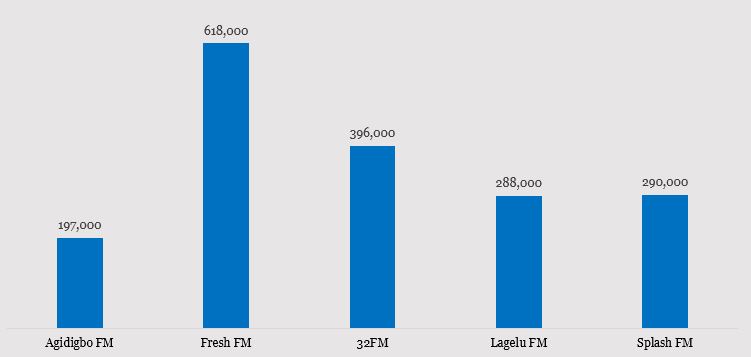
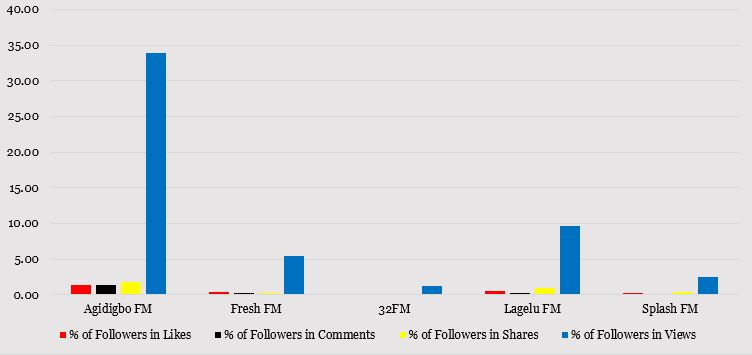
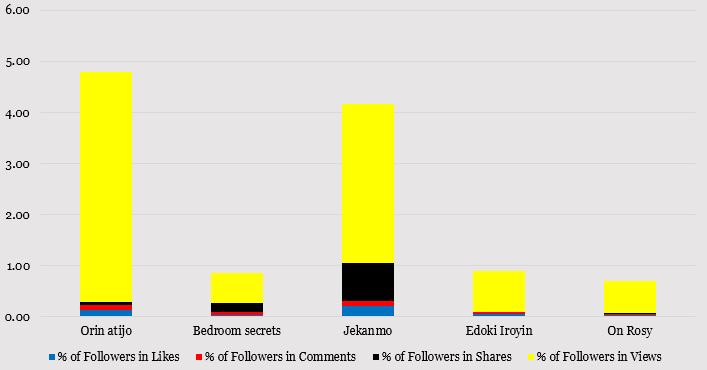
Our analyst considered Agidigbo FM, Fresh FM, 32 FM, Lagelu FM and Splash FM with a total of 1,789,000 followers [August 5, 2021] and chose 5 content categories each; newspaper review, sports, entertainment and issues-focused. Analysis of the number of likes, shares, comments and views each station had for each content category along with the number of followers indicates that Agidigbo FM, despite its lowest number of followers, performs better in all categories than Fresh FM, 32 FM and Splash FM. Our analysis reveals that Lagelu FM largely followed Agidigbo FM.

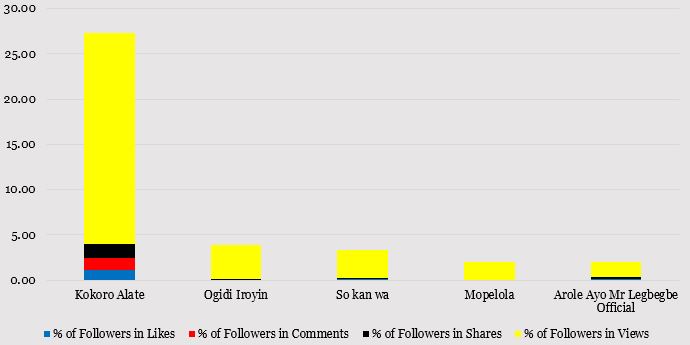
In our analysis, we equally found that issues-focused content, especially Kokoro Alate, had the highest share of followers, liking, commenting, sharing and viewing the content than others content of the station [Agidigbo FM] and other contents from the remaining stations examined by our analyst.

The followers of the radio stations also engaged with entertainment and sports content more than newspaper review and news commentary content. From these insights, our analyst notes that Facebook-radio convergence has not really worked for the Ibadan stations. It is glaring that the large number of followers of the stations’ Fan pages does not translate into large viewers as expected.

Exhibit 1: Stations’ Followers on August 5, 2021

Source: Stations’ Facebook Accounts, 2021; Infoprations Analysis

Exhibit 2: Share of Likes, Comments, Shares and Views in Followership

Source: Stations’ Facebook Accounts, 2021; Infoprations Analysis

Exhibit 3: Agidigbo FM’s Performance in Select Programmes

Source: Stations’ Facebook Accounts, 2021; Infoprations Analysis

Exhibit 4: Lagelu FM’s Performance in Select Programmes

Source: Stations’ Facebook Accounts, 2021; Infoprations Analysis

Turning Facebook Followers to Active Listeners

Therefore, these stations and others in the city need to restrategise towards sustainable capturing inherent benefits in Facebook-Radio convergence.  The need has emerged for creation of apps that will be notifying those who liked and followed the stations about a particular programme/comment that is being streamed. This will augment Facebook’s feature, which informs followers about live streaming of video and audio content.

Programme producers and presenters also need to work on demographics and psychographics of the followers. For instance, using Facebook Analytics section of the Fan page will help in understanding gender, interest and concerns of the followers. This will be useful in redefining the content being distributed, for example, personalizing entertainment content. This is imperative as radio audience is quite different from social media audience.

Additional reports by Umar Ajetunmobi

TradeGrid Partners IPMAN (Independent Petroleum Marketers Association of Nigeria)

0

Let me congratulate Tekedia Capital portfolio company, TradeGrid, for closing a major partnership with Independent Petroleum Marketers Association of Nigeria (IPMAN). With TradeGrid, 30,000 filing stations nationwide can now skip the long queues at depots, to order products remotely. TradeGrid offers marketplace, financing, logistics, asset verification, forex services, etc.

We are building the digital technology architecture of the downstream sector of the energy sector including the New Energy. We also supply oil & gas parts. This is the new home of downstream energy and new energy .

Download the app here thetradegrid.com

Tencent Boss Loses $14bn As China’s Crackdown Plummets Tech Sector

0

As China continues its regulatory onslaught that is quaking its tech industry and shedding billions of dollars off its economy, the sweeping effect is now catching up with Chinese billionaires.

Alibaba and Ant Group cofounder, Jack Ma, was the first to feel the impact of the crackdown, losing billions of dollars in personal wealth. Now, Tencent’s boss, Pony Ma, has been caught in the financial crossfire. Bloomberg reported that the mild-mannered boss has lost more paper wealth over the past nine months than Jack Ma.

Beijing’s regulatory onslaught has spread across many sectors of China’s tech economy since last year when it halted Ant’s proposed IPO that would have seen the company topple Saudi Aramco record as the company with the largest IPO in the world.

Of many Chinese companies caught in the regulatory web, Alibaba and the Ant Group were the most affected. Alibaba had to pay up to $2.8 billion in fines and penalties, while Tencent received a token fine for not seeking approval during past acquisitions and investments. Though Tencent got into trouble again, and was ordered to give up exclusive streaming rights, it still has a better treatment compared to others.

However, as other companies get hit by China’s crackdown, Tencent’s share of the misfortune increases. On Tuesday, a Xinhua-affiliated newspaper took a dig at Tencent with the claim that its gaming business could be the next on Beijing’s crackdown list. The news sent the company’s shares crashing as Tencent posted its biggest intraday decline in a decade. Tencent’s value dropped to $550.5 billion from nearly $1 trillion it has reached this year.

Following the decline, Pony’s net worth recorded further plunge. Bloomberg Billionaire Index noted that his fortune has dropped by almost $14 billion since the Ant IPO was suspended in November, falling to $45.8 billion on Tuesday. He is now the third richest person in China, behind Jack Ma.

Bloomberg noted that while state media toned down their language on gaming Wednesday, helping fuel a more than 5% rebound in Tencent, the stock is still 17% lower for the year. With Beijing not ready to stand down yet, the outlook of the stocks will be determined by what regulators do next.

Tencent has been compliant with regulators and promised to make amends where necessary, including limiting play time for minors and forbidding in-game purchases for the youngest players. Bloomberg’s report said that the company also broached the possibility of the industry banning games altogether for those under the age of 12.

However, uncertainties still cloud the future of Chinese tech companies and their billionaires as the government prioritizes national security, control, financial stability and equality.

China invaded the edtech sector last week, collapsing the $100 billion industry by ordering edtech companies to go non-profit. This was days after it ordered ride-hailing company Didi to stop registering new customers and removed it from China’s app store. More Chinese billionaires are expected to witness misfortune if the crackdown continues.