DD
MM
YYYY

PAGES

DD
MM
YYYY

spot_img

PAGES

Home Blog Page 5647

The N423/$ Message from Nigeria’s Bankers Committee

0

The Naira will not come down to N423/$ since what makes the Naira go up is not fully under the control of banks and the CBN HQ. The warehouses and factories (modern and old types) need to wake you, boosting exports to help Naira. Without them running, Naira will continue to underperform despite any financial engineering in CBN.  Yet, recent policy by CBN will help the Naira to stabilize despite any short-term spike.

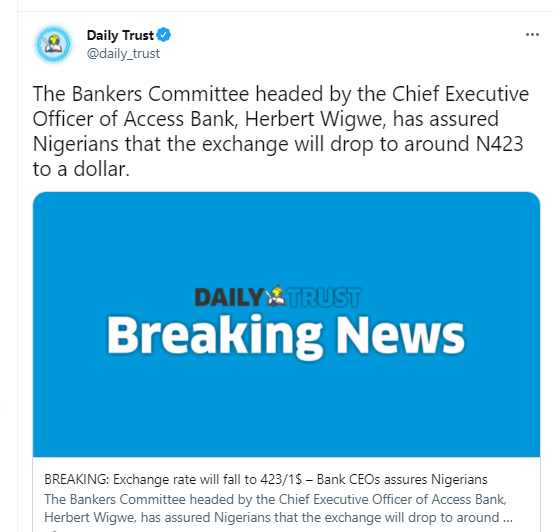
The Bankers Committee of Bank Chief Executive Officers, headed by the Chief Executive Officer of Access Bank, Herbert Wigwe, has assured Nigerians that the exchange rate will drop to around N423 to a dollar. The Committee of Bank CEOs addressed the media on Thursday following the halt in the sales of forex to Bureau De Change operators by the directive of the Central Bank of Nigeria (CBN).

Addressing the question on the sharp spike which saw the dollar hit N523, the Chief Executive Officer of Guarantee Holding (GTCo), Segun Agbaje said: “What we saw in the market yesterday and today is an aberration. “The rate will come down. Very soon, you will buy at N423 or N425 at most.”

LinkedIn Comment on Feed

Comment #1: The stability of the Naira is neither determined by the beauty of banking hall nor the opulence of the office of the CEO nor by their speeches, but by the wheels of manufactured products engineered for exports to earn $$$.

In fact prior to July 2004, Bank Executives were among the least trusted because Banks ‘dey fold like paper’. It took the radical 13-Point agenda of Prof. Charles Soludo as CBN Governor that forced Bank’s to raise their capitalization from $15 Million to $200 Million in 2004, it is this decision that changed the image of Nigerian Banks and their growth path.

Having watched a video recently about the Nigerian FOREX business and the Registration process with CBN, it is very clear that what is happening in that space is synonymous to the Nigerian Fuel Subsidy Scam where Companies are just registered with CAC and the Owners of the Company only owns briefcase ? and that’s it, you start trading. Yes, 5000 people are applying monthly to become BDC Operators, and you can operate it virtually from any corner of the world.

CBN just cut ?? off the pipeline and now handed it over to a “very few”. For as long as companies and individuals are not exporting goods and services to earn in $$$, nothing much will happen.

Comment #2 : No, naira can come down to N423 if we want, the same way it accelerated above N500 with no economic fundamentals, it was all staged.

That argument of demand and supply is very weak in naira management, because no evidence has shown that inflating the exchange rate improves supply, so all we do is to increase poverty without actually taming the quest for more dollars, it doesn’t make sense.

If our dollar inflow is $500 million per week, it cannot magically become $800 just because we exchanged naira for N500, we simply overvalued dollar, not minding that dollar has been losing value as well.

Yes, we have limited dollar supply, so let’s deploy it on things that are critical to our continuous existence, many of the things we waste dollars on will find their level locally, once the dollars dry up. People have been profiting from selling panic and fear, let’s face the demons this time and swim and sink, Nigerian spirit is stronger than this artificial dollar scarcity shenanigan.

The factories and warehouses will rise, nobody thought majority of Nigerians would embrace consumption of local rice, same happened with local juices; if people see opportunities opening up in these sectors, we will put this dollar mystery behind us.

I still have clarity on how we can make local shoe brands talk of the town in Nigeria, it’s not rocket science, and our people will love it.

I am with bankers committee on this one.
By Q4 2022, Central Bank of Nigeria will Exchange Dollars Directly with Nigerians and Companies via e-Naira Digital Currency


Taiwan Approves TSMC’s Plan for Mega Chip Plant As Competition Intensifies

0

Riled up by global chip shortage, semiconductor manufacturers have been pushing to fill the gap that has seen industries slow down productions, from smartphones to cars. But apart from the production impediment, the chip shortage is creating a big rivalry between foremost semiconductor manufacturers as they push to increase their manufacturing capacity, aiming to dominate the market.

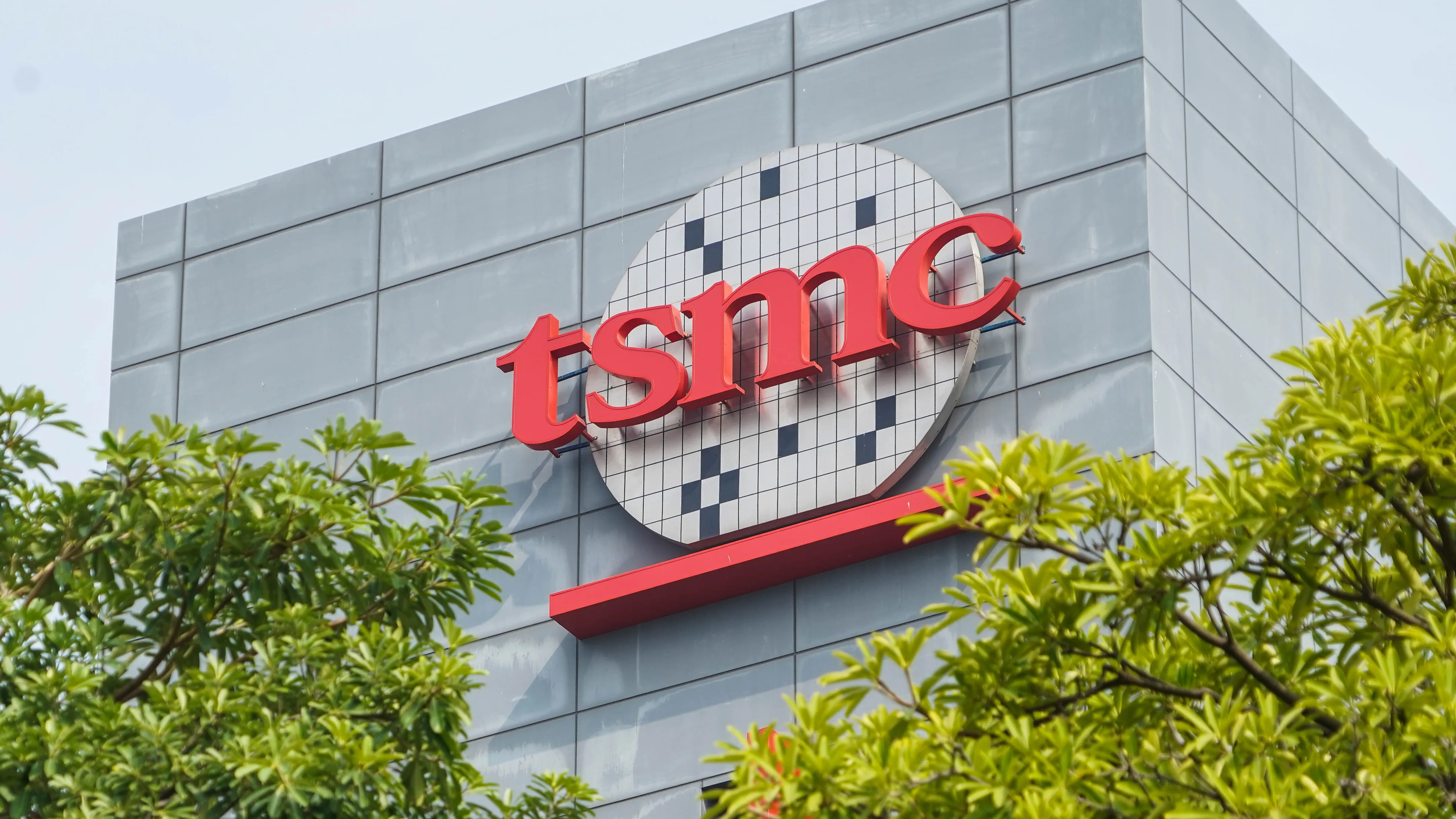
Against this backdrop, Taiwan Semiconductor Manufacturing Co. (TSMC) has received final approval to build its most advanced chip plant yet, a day after U.S. rival Intel said it planned to seize chip industry leadership, Nikkei Asia reports.

TSMC plans to build a 2-nanometer chip facility in Hsinchu, one of Taiwan’s most important chipmaking centers.

The Environmental Review Committee, a cross government and academic environmental regulatory body, approved the plan on Wednesday. This clears the way for TSMC to start construction of the facility in early 2022, and begin installing production equipment by 2023, sources familiar with the plan told Nikkei Asia.

“Semiconductor is one of the most crucial industries to Taiwan’s economic growth,” Economics Vice Minister Lin Chuan-neng said at the environmental review committee meeting. “The government will help TSMC to achieve its environmental targets while continuing to build the advanced technologies.”

The approval comes after top U.S. chipmaker Intel — a TSMC client and competitor — said on Tuesday that it aims to produce the world’s most advanced chips by 2024 and recover the global chip crown from Asian rivals like TSMC and Samsung Electronics the following year.

Taiwan’s importance as a source of advanced semiconductors was highlighted earlier this year when car making economies including Germany, Japan and the U.S. all pressured Taiwan to increase production of automotive chips amid a global shortage.

The Taiwanese government views its chip production expertise as a strategic advantage to keeping the island that China views as a part of its territory safe from any geopolitical conflicts.

TSMC’s move to diversify some production away from Taiwan will weaken the strategic importance of the island in the long term, which makes it more crucial for Taiwan to keep the company’s most cutting-edge production technology onshore, government officials told Nikkei Asia.

“It is OK for TSMC to expand its overseas footprint, but from a geopolitical perspective it is very important for Taiwan to have TSMC building its most advanced technology [domestically],” a government source familiar with the Tsai Ing-wen administration’s thinking told Nikkei Asia. “We can’t hinder TSMC’s plans to stay ahead of the competition.”

The planned 2-nm chip plant will be located in Hsinchu’s Baoshan township and cover nearly 50 acres. It is expected to use 98,000 tons of water a day — roughly 50% of TSMC’s total daily water consumption in 2020. The chipmaker has promised to use 10% recycled water by 2025 and reach 100% reused water by 2030 at the new Baoshan facility.

TSMC missed its internal sustainability goals on water usage and waste generation last year as the world’s biggest semiconductor company ramped up output of the industry’s most advanced chips.

TSMC is constructing a 5-nm chip facility in Arizona, expanding its 28-nm capacity in Nanjing, China, and is eyeing new facilities in Japan and Germany.

The chipmaker told Nikkei Asia it was glad that the project has gained regulatory approval, and that it will maintain its commitment to green manufacturing.

The approval, which conflicts with Taiwan’s geopolitical interest, reveals how much TSMC’s chip dominance means to the government and how far it could go to help the company keep its leadership in the semiconductor industry. Recently, Intel has increased its push to wrestle semiconductor leadership off TSMC, with multibillion dollar plans to establish more factories in the US and Europe. Rattled by the moves, the Taiwanese government appears to be making the needed sacrifice to its company ahead.

Dupe  Akinsiun Will Speak At Tekedia Career Week, Oct 25-30 2021

0

She is a Certified Leadership & Behavioural Consultant, and heads the Leadership & Culture Center of Expertise (CoE) in one of the finest companies in the world. As a strategic HR Business Partner, she covers nine countries. Her experiences cut across  management consulting, financial Services, pharmaceutical, and FMCG. 

She seeks to “equip emerging leaders with the knowledge, skills and abilities required to excel in life and in their respective careers”. Dupe  Akinsiun, a Tekedia Institute Faculty, will lead a session during the  2021 Tekedia Mini-MBA Career Week (Oct 25-30).

This career week is not designed for finding jobs. Rather, it is structured to TRANSFORM workers, founders & entrepreneurs into business leaders and champions of innovation in their companies. Yet, if you have no job, by the time you are done with the series, you will have a path to one! 

The sub-theme is Nurturing Innovators, and it is packaged within the Tekedia Mini-MBA theme of Innovation, Growth and Business Execution. All participants of Tekedia programs (mini-MBA, CollegeBoost, advanced diploma, etc) in 2021 qualify to attend free.

Tekedia Mini-MBA >> learn from the best. Register for the next edition of Tekedia Mini-MBA here.

Doulingo Posts $6.5bln Value in Nasdaq Debut As China Clamps Down on Edtech

0
In this photo illustration the Duolingo logo seen displayed on a smartphone. (Photo by Rafael Henrique / SOPA Images/Sipa USA)(Sipa via AP Images)

While China clamps down on its edtech sector, other players outside China are hitting record numbers in the burgeoning online education industry.

Language-learning app Duolingo Inc posted a valuation of $6.5 billion after its shares rose nearly 40% in the company’s Nasdaq debut on Wednesday, a move that impressed Wall Street. Became the latest education technology startup.

Duolingo’s stock opened at $141.4 per share, surpassing its initial public offering price (IPO) of $102 per share, which crossed the top end of its target range. The stock traded some gains later in the afternoon at $130.92.

Currently, Duolingo’s largest market is the United States, which is home to 20% of its users and brings in 45% of the company’s revenue, Von Ah said.

Duolingo raised approximately $521 million in the IPO by selling approximately 5.1 million shares. About 1.4 million of those shares were sold by existing shareholders and the proceeds will not go to the company.

Earlier this week, the company raised its price target range from estimates of between $85 and $95 per share to between $95 and $100 per share.

The company was founded in 2011 by Von Ah and Severin Hacker, who met at Carnegie Mellon University. Goldman Sachs & Company and Allen & Company are the principal underwriters for the IPO.

The company’s flotation comes at a time of growing investor interest in the edtech space, after pandemic restrictions sent students and teachers from the classroom to the web.

“Being a public company will allow us to operate at a higher level and move from minor league to major league,” said Duolingo co-founder and CEO Louis von Ahn.

Von Ah said that after the IPO, the company will focus on improving its flagship app and switching more active users to paying customers. Duolingo offers courses in 40 languages ??to approximately 40 million monthly active users.

The company plans to expand further in Asia, which is its fastest growing region.

Last week, Chinese authorities ordered edtech companies operating in China to become non-profit, killing without warning, the $100 billion valued edtech industry, and inadvertently opened the way for western-based online schools to dominate Asia. Though Duolingo and other edtech companies will find it hard finding their way into China, unless they play by the non-profit rules, they will likely grab a large share of the Asian market in the stead of Chinese edtech companies.

With the pandemic yet to be contained and more people embracing online education, more edtech companies are expected to post more numbers in valuation.

US Congress Halts Arms Sales to Nigeria Over Rising Reports of Human Rights Abuse

0

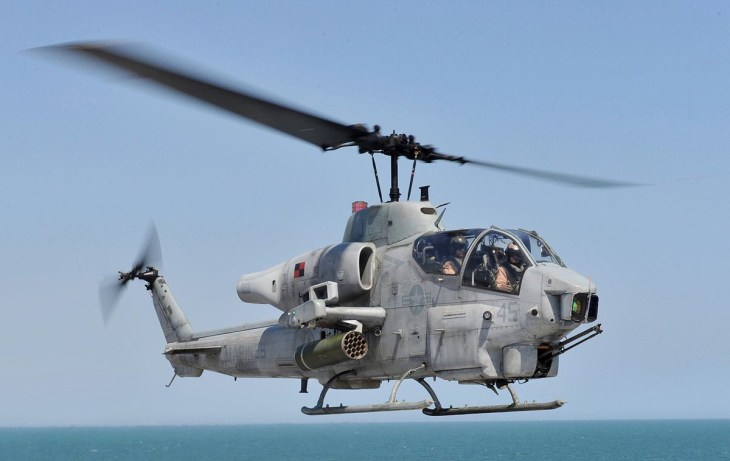
United States lawmakers are stalling a proposed sale of attack helicopters to Nigeria amid mounting concerns about the Nigerian government’s human rights record as its military grapples with multiple security crises at once, Foreign Policy magazine reports.

The top Democrat and Republican on the Senate Foreign Relations Committee have delayed clearing a proposed sale of 12 AH-1 Cobra attack helicopters and accompanying defense systems to the Nigerian military, pausing a deal worth some $875 million, according to U.S. officials and congressional aides familiar with the matter.

The behind-the-scenes controversy over the proposed arms sale illustrates a broader debate among Washington policymakers over how to balance national security with human rights objectives.

The hold on the sale also showcases how powerful U.S. lawmakers want to push the Biden administration to rethink U.S. relations with Africa’s most populous country amid overarching concerns that Nigerian President, Muhammadu Buhari, is drifting toward authoritarianism as his government is besieged by multiple security challenges, including jihadist insurgency.

Nigeria is on the front lines in the battle against Boko Haram, one of the world’s deadliest terrorist groups, and plays a role in U.S. and international efforts to roll back extremist groups in the Sahel region of West Africa.

But Western governments and international human rights organizations have ramped up their criticisms of the Nigerian government, particularly in the wake of its ban on Twitter, systemic corruption issues, and the Nigerian military’s role in deadly crackdowns on protesters after widespread demonstrations against police brutality last year.

Sen. Bob Menendez, the chairperson of the Senate Foreign Relations Committee, called for a “fundamental rethink of the framework of our overall engagement” with Nigeria during a Senate hearing with U.S. Secretary of State Antony Blinken in June.

Both Menendez and Sen. Jim Risch, the top Republican on the Senate Foreign Relations Committee, have placed a hold on the proposed arms sale, according to multiple U.S. officials and congressional aides familiar with the matter, who spoke to Foreign Policy on condition of anonymity.

The details on the proposed sale were first sent by the U.S. State Department to Congress in January before then-former U.S. Vice President Joe Biden was inaugurated as president, according to officials familiar with the matter.

In addition to the helicopters, the proposed sale included 28 helicopter engines produced by GE Aviation, 14 military-grade aircraft navigation systems made by Honeywell, and 2,000 advanced precision kill weapon systems—laser-guided rocket munitions, according to information sent by the State Department to Congress and reviewed by Foreign Policy.

Nigeria has relied on U.S. arms sales in the past to help address multiple security challenges: the 12-year insurgency by Boko Haram militants in the country’s northeast, a spate of high-profile kidnapping-for-ransom campaigns targeting schoolchildren in the country’s northwest, and deadly clashes between the country’s semi-nomadic herders and farmers fueled by climate change and environmental degradation of the country’s arable land.

The State Department describes the U.S.-Nigeria relationship as “among the most important in sub-Saharan Africa” and has provided limited funding for various military training and education programs.

Some experts said the United States should hit the pause button on major defense sales until it makes a broader assessment of the extent to which corruption and mismanagement hobble the Nigerian military and whether the military is doing enough to minimize civilian casualties in its campaign against Boko Haram and other violent insurrectionists.

“There doesn’t have to be a reason why we don’t provide weapons or equipment to the Nigerian military,” said Judd Devermont, director of the Africa program at the Center for Strategic and International Studies, a think tank. “But it has to be done with an assessment of how it will, one, change the direction of conflict in Nigeria, and, two, that they will use it consistent with our laws. In both cases, it’s either a question mark or a fail.”

“There is a culture of impunity that exists around abuses by the military,” said Anietie Ewang, the Nigeria researcher at Human Rights Watch.

Ewang cited the Nigerian military’s killing of unarmed protesters at Lekki toll gate in Lagos during the country’s massive #EndSARS demonstrations against police corruption and brutality last year as well as cases documented by human rights organizations of abuses in the military’s campaign against Boko Haram.

“I’m sure it’s a difficult situation. There are so many conflicts springing up across the country now,” Ewang said. “The authorities, I presume, are trying to do the best they can to save lives and property. But this must be done in accordance with human rights standards. You can’t throw one out just to be able to achieve the other.”

In the past, under former President, Barrack Obama’s administration, the US had halted arms sales to Nigeria over concern about the prevalence of human rights abuse resulting in many civilian casualties. But the strained relationship seems to have been mended with former President Trump.

Recall that the former U.S. President, Donald Trump’s administration agreed to sell 12 A-29 Super Tucano warplanes to Nigeria, resuscitating a proposed sale the Obama administration froze after the Nigerian Air Force bombed a refugee camp in January 2017. The first batch of those planes arrived in Nigeria earlier this month.

There has been increase in complaints of human right abuse involving the Nigerian Army since 2015, when more than 400 members of the Shiite group, and over 200 members of the Indigenous People of Biafra (IPOB) were massacred by soldiers. US Congress’ decision to halt the proposed arms sales to Nigeria means that the Nigerian Army professional conduct has become internationally worrisome.