DD
MM
YYYY

PAGES

DD
MM
YYYY

spot_img

PAGES

Home Blog Page 5650

What Is Pick n Pay Playbook in Nigeria?

4

Shoprite came to Nigeria in Dec 2005 when Naira was about N127 to a dollar; the South African Rand was about 7 rand to a dollar then. Last year when it began the exit process from Nigeria,  one dollar exchanged for N380 or 15 rand. So, over the period noted, Naira lost 200% of its value to the dollar, keeping dollar value constant.  The rand has lost 114% of its own value. But the lost value on Rand is not a big problem since Shoprite reports its financials in Rand, being a South African firm. 

Nonetheless, the biggest problem was not the currency deterioration in Nigeria but the fact that the middle class was shrinking, affecting the capacity of Shoprite to capture value with the presence of supermarkets, open markets and even street-sellers as competitors. 

When that exit was announced, I wrote, “Shoprite may not be doing terribly bad in Naira but struggles in Rand when it reports in South Africa. It is exiting Nigeria even though it makes tons of naira. So, if a local investor acquires Shoprite Nigeria with no burden to report in USD or Rand, the currency issues could be eliminated. It is like Dangote generating more naira and still losing $17 billion in net-worth in 7 years.”

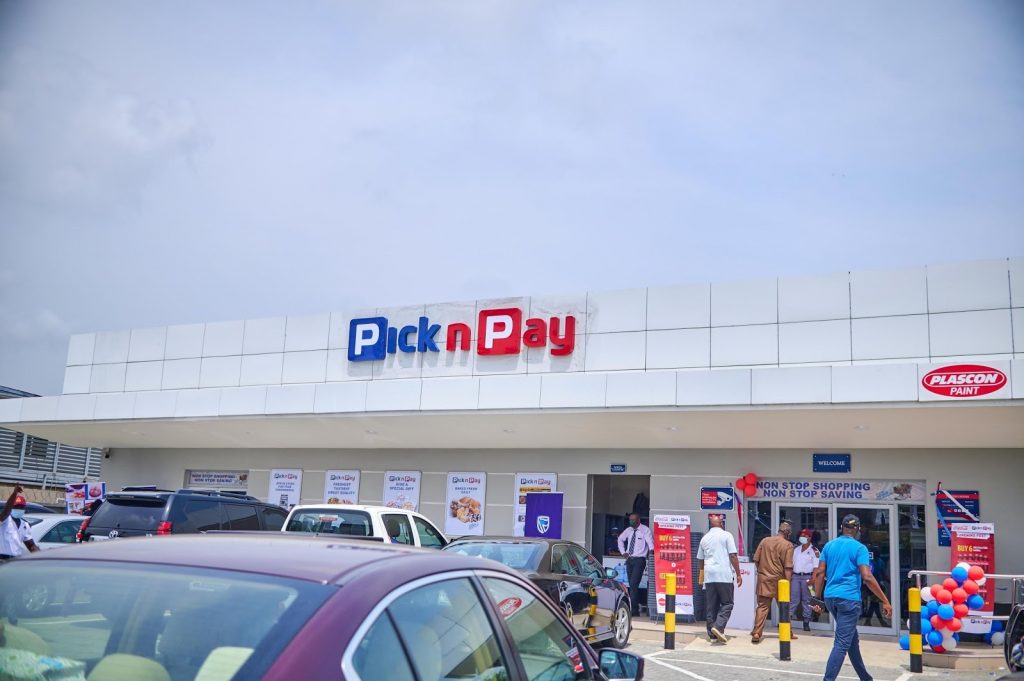
But in the midst of this paralysis, another South African retailer is here: Pick ‘n Pay. My question is this: what is the playbook for success in Nigeria considering that Shoprite, Mr Price and Woolworths could not overcome the paltry effective 30 million addressable market in Nigeria? Yes, I model that Nigeria has only 30 million who earn “decent” income and those 30 million support the remaining 180 million citizens.

So, as we see the exodus and death of companies, I remind everyone that Nigeria has about 30 million people who earn income and can pay for anything. Any model built outside that 30 million will disappoint. I have explained how I arrived at this 30 million number here. With the pandemic affecting that 30 million number, which carries the other 170 million citizens, you will then understand the challenge we have in the near future.

Comment on LinkedIn Feed

Comment #1: Prof Ndubuisi Ekekwe Modern Trade has never enjoyed mass patronage as markets have in Nigeria. Ask any FMCG manufacturer in Nigeria how much product pushes through Modern Trade and the will tell you it has never accounted for more than a few percent of revenue. Several retail outlets similar to Shoprite such s GAME, Park & Shop/SPAR, all South African.

Firstly there are far too many fresh local options cheaper and healthier/fresher like you can go to Ijora Market and Mile 12 in Lagos.

Secondly I speculate that these South African outlets must have some form of involvement of SA suppliers at investor level because a lot of their SA finished goods like Beef Boerewors or Richelieu Brandy neither grab the local consciousness of the Nigerian consumer, nor do they align with diaspora influence of known ‘abroad’ brands. There is a lot of tinned and packaged consumables also imported from SA. Forced repatriation of revenue to SA and on many goods with often weak market traction is a vulnerability. Successful large global operators maximise assimilation with local commercial ecosystems minimizing import necessity and recycling liquidity locally. They become comfortable with distributed rather than centralized profit retention.

Comment #2: Maybe we start by analysing list of investors in Shoprite and Pick n Pay, to see if they are related…

If we have 30 million people with decent purchasing power, who has been able to capture 10 million of them? Because that’s more than population of many countries in Europe and elsewhere, so it’s still a large number to service.

Again, where a retail brand sources its goods matters a lot, especially in our business climate. Can Pick n Pay position as retail of choice for locally produced items? Sometimes how we architect these things brings their downfall.

We import apple and grapes in Nigeria, are there local substitutes with similar nutritional value, which can be pushed to the public, instead of using dollars to import fruits? We don’t really have depths in the way we design economy and frame businesses here, we keep going with whatever the world brings to us.

We eat bread a lot here, wheat is largely imported, yet we haven’t been able to scale local substitutes for wheat, because we don’t see it as national emergency anyway.

I do think that the trio of our intellectuals, businesspeople and policymakers are all lazy, we talk a lot here, but no speed of thought and peerless pragmatism that can quickly bring solutions to our ‘moving target’ styled kind of problems.

Let’s see how many that will be paying after picking…

Why Brands Struggle and Depart Nigeria

New CBN Directive Could Boost Exits In Forex-Focused Fintechs In Nigeria

3

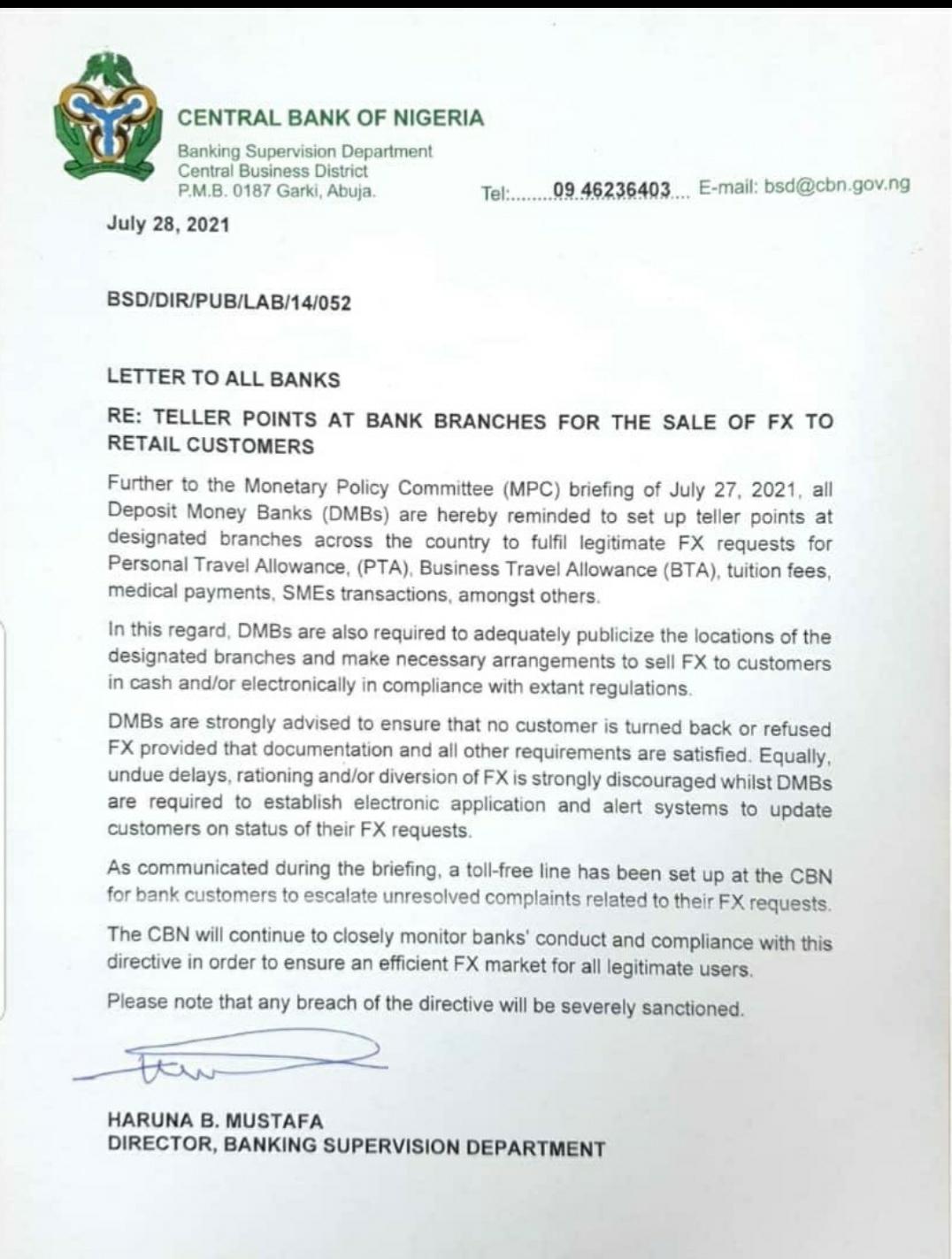
The Central Bank of Nigeria has directed commercial banks to develop apps and alert systems to update customers of their forex transactions: “Undue delays rationing and/or diversion of FX is strongly discouraged whilst DMBS [banks] are required to establish electronic applications and alert systems to update customers on status of their FX requests”. The apex bank just largely banned bureau de change operators in the nation [it will not sell foreign currencies to them] and mandated banks to ensure that they meet legitimate foreign exchange requests from customers. 

The new directive is contained in a circular issued on Wednesday by the apex bank:

“Further to the Monetary Policy Committees (MPC briefing of July 27 2021 of Deposit Money Banks (DMBs are hereby reminded to set up teller points at designated branches across the country to fulfil legitimate FX requests for Personal Travel Allowance (PTA Business Travel Allowance (BTA), tuition fees, Medical payments, SMEs transactions, amongst others. In this regard DMBs are also required to adequately publicise the locations of the designated branches and make necessary arrangements to sell FX to customers in cash and or electronically in compliance with extant regulations…As communicated during the briefing, toll-free lines have been set up at the CBN for bank customers to escalate unresolved complaints related to their FX requests,” the statement read.

So as it stands now, banks must “ensure that no customer is turned back or refused forex provided that documentation and all other requirements are satisfied equally”.

This directive opens a collision for some forex-focused fintech companies. Largely, banks are now mandated to join the fray and must build solutions to comply with what the CBN wants. My question is this: are we going to see a minor acquisition bump where some banks just decide to buy one of these fintechs instead of going to build one from scratch?

Not likely since the most important thing here is not technology, but the bank license which is the only thing CBN cares about. Yet, if you have apps in this domain, it may not hurt to shop around bank headquarters; they could pay good money.

What about it? Every bank in Nigeria now must have a forex app (web or mobile) to be in compliance. My prediction is that when e-Naira launches, a CBN API will interface with them to make every run seamlessly. The apex bank is going somewhere….just loading.

You and Implications of Your Digital Footprints in a Back-Forward Thinking World

0

Over the years, there are have been a number of individuals and groups who believe that physical rights equal digital rights. From the developed to the developing continents, these stakeholders want to be free. They want to pursue happiness in an atmosphere devoid of strict political control. They believe acting socially and politically enhance their pursuit of economic and social happiness in all ramifications. While behaving socially, economically and politically on various social networking sites, Internet-enabled gadgets they drop a significant number of traces, known as digital footprints, which is a trail of data created while using the sites and gadgets.

Our analyst had the opportunity to be among the people who participated a workshop on big data application in academic research organised by a Faculty at the Fountain University, Osogbo, Osun State. The event primarily expected to walk the students and Faculty Members in the University through the nitty-gritty of using big data in academic research towards collective value for the academia and industry turned into a forum where participants were informed of the implications of their digital footprints.

Professor Ayobami Ojebode of Department of Communication and Language Arts, University of Ibadan, shared his experience of the traces he left some years back, which were later used by a foreign based organisation that perused his application for a grant. According to him, people need to understand that as they use social networking sites, joining online pressure communities and using Internet-enabled devices, they should realise that someone in a particular location is gathering their traces [digital footprints].

While it is obvious that in the developed world, people are becoming more aware of their digital footprints, it could be said that in the developing countries such as Nigeria, people are yet to be fully aware of the implications of their digital traces. In the United States, for instance, a study shows that 60% of the people who search for their names actually find information about themselves online.

How would you know that someone has collected your digital footprints and acted on them? Our analyst suggests the use of Google Alert and Google Search, which are primarily free. Google Alert has the capacity of helping you in getting first hand information in real time when someone posted about. It also helps in documenting the traces in a cloud storage such as Google Drive and Dropbox. It is also important that you carry out ‘vanity search’ occasionally. The search is a means to understand what people and organisations are discussing and publishing about you. You only need to put the keywords that associated with your names and personality on Google Search Engine. For you to have sufficient understanding of what is happening, you must click beyond the first result page turned out by the search engine. At least, getting to the 10-page of the result pages, would give you deeper insights about your digital footprints.

However, as shared by Professor Ojebode, erasing one’s digital footprints immediately they are dropped might not be possible because the person who collected had used big data collection tools, which could not be received or deleted by the owner. In this regard, our analyst notes that people only need to be cautious of what they do in relation to their pursuit of social, economic and political happiness while on the SNSs and using internet-enabled devices.


The N423/$ Message from Nigeria’s Bankers Committee

0

The Naira will not come down to N423/$ since what makes the Naira go up is not fully under the control of banks and the CBN HQ. The warehouses and factories (modern and old types) need to wake you, boosting exports to help Naira. Without them running, Naira will continue to underperform despite any financial engineering in CBN.  Yet, recent policy by CBN will help the Naira to stabilize despite any short-term spike.

The Bankers Committee of Bank Chief Executive Officers, headed by the Chief Executive Officer of Access Bank, Herbert Wigwe, has assured Nigerians that the exchange rate will drop to around N423 to a dollar. The Committee of Bank CEOs addressed the media on Thursday following the halt in the sales of forex to Bureau De Change operators by the directive of the Central Bank of Nigeria (CBN).

Addressing the question on the sharp spike which saw the dollar hit N523, the Chief Executive Officer of Guarantee Holding (GTCo), Segun Agbaje said: “What we saw in the market yesterday and today is an aberration. “The rate will come down. Very soon, you will buy at N423 or N425 at most.”

LinkedIn Comment on Feed

Comment #1: The stability of the Naira is neither determined by the beauty of banking hall nor the opulence of the office of the CEO nor by their speeches, but by the wheels of manufactured products engineered for exports to earn $$$.

In fact prior to July 2004, Bank Executives were among the least trusted because Banks ‘dey fold like paper’. It took the radical 13-Point agenda of Prof. Charles Soludo as CBN Governor that forced Bank’s to raise their capitalization from $15 Million to $200 Million in 2004, it is this decision that changed the image of Nigerian Banks and their growth path.

Having watched a video recently about the Nigerian FOREX business and the Registration process with CBN, it is very clear that what is happening in that space is synonymous to the Nigerian Fuel Subsidy Scam where Companies are just registered with CAC and the Owners of the Company only owns briefcase ? and that’s it, you start trading. Yes, 5000 people are applying monthly to become BDC Operators, and you can operate it virtually from any corner of the world.

CBN just cut ?? off the pipeline and now handed it over to a “very few”. For as long as companies and individuals are not exporting goods and services to earn in $$$, nothing much will happen.

Comment #2 : No, naira can come down to N423 if we want, the same way it accelerated above N500 with no economic fundamentals, it was all staged.

That argument of demand and supply is very weak in naira management, because no evidence has shown that inflating the exchange rate improves supply, so all we do is to increase poverty without actually taming the quest for more dollars, it doesn’t make sense.

If our dollar inflow is $500 million per week, it cannot magically become $800 just because we exchanged naira for N500, we simply overvalued dollar, not minding that dollar has been losing value as well.

Yes, we have limited dollar supply, so let’s deploy it on things that are critical to our continuous existence, many of the things we waste dollars on will find their level locally, once the dollars dry up. People have been profiting from selling panic and fear, let’s face the demons this time and swim and sink, Nigerian spirit is stronger than this artificial dollar scarcity shenanigan.

The factories and warehouses will rise, nobody thought majority of Nigerians would embrace consumption of local rice, same happened with local juices; if people see opportunities opening up in these sectors, we will put this dollar mystery behind us.

I still have clarity on how we can make local shoe brands talk of the town in Nigeria, it’s not rocket science, and our people will love it.

I am with bankers committee on this one.

By Q4 2022, Central Bank of Nigeria will Exchange Dollars Directly with Nigerians and Companies via e-Naira Digital Currency


Taiwan Approves TSMC’s Plan for Mega Chip Plant As Competition Intensifies

0

Riled up by global chip shortage, semiconductor manufacturers have been pushing to fill the gap that has seen industries slow down productions, from smartphones to cars. But apart from the production impediment, the chip shortage is creating a big rivalry between foremost semiconductor manufacturers as they push to increase their manufacturing capacity, aiming to dominate the market.

Against this backdrop, Taiwan Semiconductor Manufacturing Co. (TSMC) has received final approval to build its most advanced chip plant yet, a day after U.S. rival Intel said it planned to seize chip industry leadership, Nikkei Asia reports.

TSMC plans to build a 2-nanometer chip facility in Hsinchu, one of Taiwan’s most important chipmaking centers.

The Environmental Review Committee, a cross government and academic environmental regulatory body, approved the plan on Wednesday. This clears the way for TSMC to start construction of the facility in early 2022, and begin installing production equipment by 2023, sources familiar with the plan told Nikkei Asia.

“Semiconductor is one of the most crucial industries to Taiwan’s economic growth,” Economics Vice Minister Lin Chuan-neng said at the environmental review committee meeting. “The government will help TSMC to achieve its environmental targets while continuing to build the advanced technologies.”

The approval comes after top U.S. chipmaker Intel — a TSMC client and competitor — said on Tuesday that it aims to produce the world’s most advanced chips by 2024 and recover the global chip crown from Asian rivals like TSMC and Samsung Electronics the following year.

Taiwan’s importance as a source of advanced semiconductors was highlighted earlier this year when car making economies including Germany, Japan and the U.S. all pressured Taiwan to increase production of automotive chips amid a global shortage.

The Taiwanese government views its chip production expertise as a strategic advantage to keeping the island that China views as a part of its territory safe from any geopolitical conflicts.

TSMC’s move to diversify some production away from Taiwan will weaken the strategic importance of the island in the long term, which makes it more crucial for Taiwan to keep the company’s most cutting-edge production technology onshore, government officials told Nikkei Asia.

“It is OK for TSMC to expand its overseas footprint, but from a geopolitical perspective it is very important for Taiwan to have TSMC building its most advanced technology [domestically],” a government source familiar with the Tsai Ing-wen administration’s thinking told Nikkei Asia. “We can’t hinder TSMC’s plans to stay ahead of the competition.”

The planned 2-nm chip plant will be located in Hsinchu’s Baoshan township and cover nearly 50 acres. It is expected to use 98,000 tons of water a day — roughly 50% of TSMC’s total daily water consumption in 2020. The chipmaker has promised to use 10% recycled water by 2025 and reach 100% reused water by 2030 at the new Baoshan facility.

TSMC missed its internal sustainability goals on water usage and waste generation last year as the world’s biggest semiconductor company ramped up output of the industry’s most advanced chips.

TSMC is constructing a 5-nm chip facility in Arizona, expanding its 28-nm capacity in Nanjing, China, and is eyeing new facilities in Japan and Germany.

The chipmaker told Nikkei Asia it was glad that the project has gained regulatory approval, and that it will maintain its commitment to green manufacturing.

The approval, which conflicts with Taiwan’s geopolitical interest, reveals how much TSMC’s chip dominance means to the government and how far it could go to help the company keep its leadership in the semiconductor industry. Recently, Intel has increased its push to wrestle semiconductor leadership off TSMC, with multibillion dollar plans to establish more factories in the US and Europe. Rattled by the moves, the Taiwanese government appears to be making the needed sacrifice to its company ahead.