DD
MM
YYYY

PAGES

DD
MM
YYYY

spot_img

PAGES

Home Blog Page 5656

China Extends Crackdown to its $100 Billion Edtech Sector, Halts For-profit Tutoring

3

China’s quest to bring its internet industries under total governmental control is seeing a shift to edtech. The crackdown, which started with the financial sector, targeting Alibaba, the Ant Group and the cryptocurrency market, is gradually escalating to every part of China’s tech industry.

Didi, a burgeoning ride-hailing company that gave Uber a run for its money in China, and recently got listed in New York Stock Exchange, became the latest victim. Now, companies offering online education in the south Asian country are facing new rules that will force their businesses into non-profit.

The decision was contained in a document circulated on Friday, and has been confirmed by Chinese news outlet, Xinhua. Foreign investment in the sector will be prohibited under the rules set out by the State Council, Xinhua said.

In details, Bloomberg reported Friday how China was considering asking companies that offer tutoring on the school curriculum to go non-profit, citing people familiar with the matter, as part of a sweeping set of constraints that could decimate the country’s $100 billion education tech industry. The news sank shares.

The new rules means the ed-platforms will no longer be allowed to raise capital or go public. Listed firms will also no longer be allowed to invest in or acquire education firms teaching school subjects while foreign capital will also be barred from the sector.

Local regulators will stop approving new after-school education firms seeking to offer tutoring on China’s compulsory syllabus and require extra scrutiny of existing online platforms, the people have revealed. Vacation and weekend tutoring on school subjects will also be banned, they said. Changes may still occur as the rules haven’t been published.

New Oriental Education & Technology Group sank a record 41% in Hong Kong Friday, while Koolearn Technology Holding Ltd. tumbled 28%, also its biggest-ever single day loss. TAL Education slumped 47% in U.S. pre-market trading and Gaotu Techedu dropped 53%.

The new set of regulations, devised and overseen by a dedicated branch set up just last month to regulate the industry, could wipe out the enormous growth that made stock market darlings of TAL Education Group and Gaotu Techedu Inc.

“Making the sector non-profit is just as good as eradicating the industry all together,” said Wu Yuefeng, a fund manager at Funding Capital Management (Beijing) Co. “The regulations on financing are a major surprise and show that to the authorities, this is a matter of no small importance. In the short term for the sector, any news will be bad news.”

Beijing is coming down hard on the sector as excessive tutoring anguishes young pupils and burdens parents with expensive tutoring fees. It’s also regarded as an impediment to one of the country’s top priorities, boosting a declining birth rate. Last month, China said it will allow a couple to have three children and released a slew of support measures to encourage births and lower child expenses.

Making the whole sector go non-profit “would make being a listed entity meaningless,” said Justin Tang, head of Asian research at United First Partners. “Investors are selling out first and asking questions later. It’s all being done to reduce the cost of education and motivate citizens to raise kids.”

Education technology has emerged as one of the hottest investment plays in China in recent years, with $10 billion of venture capital money pouring into the sector last year alone. Alibaba, Tencent Holdings Ltd. and ByteDance Ltd. all entered the arena, seeking to capitalize on Chinese parents’ desires to give their children every academic advantage. A spokesman from the education ministry said relevant policies are still being formulated and declined to provide more details.

Beijing is taking issue with for-profit companies for stressing out kids while enriching investors and startup founders. In May, President Xi Jinping chaired a meeting with top officials where they approved a new set of rules to ease the burden of homework and after-school training for primary and secondary school students.

Last month, China’s education ministry created a dedicated division to oversee all private education platforms for the first time. That followed a plethora of restrictions, including caps on fees firms can charge and time limits on after-school programs. Regulators have fined two of the biggest startups for false advertising: Alibaba-backed Zuoyebang and Tencent-investee Yuanfudao. A new law on minor protection, which went into effect June 1, also bans kindergarten and private institutions from teaching the primary-school curriculum to preschoolers — not uncommon previously.

Several high-profile startups in the sector — including Yuanfudao, which at $15.5 billion is the most valuable of the lot — are likely to have to put initial public offering plans on hold because of the crackdown.

Shares of China’s largest private education companies are among the world’s worst performers in recent months, with New Oriental Education, TAL Education and Gaotu Techedu together shedding nearly $100 billion of value from their highs reached earlier this year.

Wishing the Olympians A Great Event In Tokyo

0

They called him the “Athlete of the Century”. He was a  dominant sprinter and long jumper, “one of only three Olympic athletes who won a gold medal in the same individual event in four consecutive Olympic Games”. I join Carl Lewis to wish all the Olympians a great event in Tokyo. Nigeria, go for gold in basketball – and more.

Photo date: 2012

Accumulate And Compound Your Capabilities – Go Upstream And Capture More Market Value

1

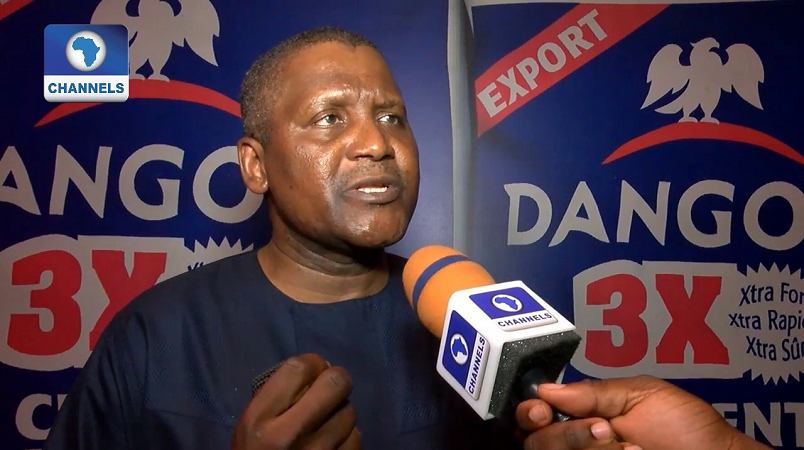
Firms win by accumulating capabilities. From Google to Dangote Group, when companies accumulate capabilities, they operate in domains that generate higher value (usually upstream) compared with where most typical firms operate (usually downstream). Dangote Group can deploy massive assets and technical know-how in cement production, making it harder for new entrants and rivals.

Google uses its datasets to win on search. By holding the first-scaler advantage on search, it enjoys the virtuoso circle of network effects which keep compounding, generating new leverageable factors which keep making Google better.

Make a business resolution: I will accumulate and compound my capabilities. You need capabilities to create products and services which are forces required to overcome frictions in markets. Markets reward through revenue when companies fix frictions.

Go upstream and capture value in markets. Watch this video.

The Rainmakers of United Arab Emirates

0

You may or may not have heard that some days ago, the United Arab Emirates successfully caused an artificial rainfall by releasing drones to shock the cloud.

How possible is this?

The UAE’s National Center of Meteorology had announced that the rain was caused through cloud seeding operations, as reported by MSN.

In recent years, millions of dollars had been invested to experiment on innovative methods that would help to create an artificial rainfall, as part of efforts geared towards reducing the excess heat of the Arid climate of Dubai and it’s environs.

Dubai has witnessed upto a temperature of 50°c in recent times.

The UAE has a rapidly growing population and very little water to support it.

According to the NCMS, with an average of 550 litres of water consumed every day by each man, woman and child, the country has the fourth highest demand for fresh water in the world. As a result, the government is aggressively pursuing alternative solutions like cloud seeding, which is said to be up to 30 times cheaper than desalination.

What is Cloud seeding?

As explained by Kondala Murali Mohan, a scientist with Krishi Vigyan Kendra (Medak), Cloud seeding is a process for creating artificial rain.

In cloud seeding, chemicals like silver iodide, potassium iodide and dry ice are sent to the atmosphere through helicopters or planes. These particles thereafter attract the water vapour in the air, leading to the formation of cumulonimbus clouds and finally rain.

It generally takes half-an-hour to produce rainfall by this method. The time taken to generate rain depends on which portion of the cloud the chemicals are being injected into. Zapping the top layers gives the fastest results.

Environmental Concerns

Although, there are justifiable reasons for conducting these kind of experiments, there are still some underlying sustainability issues. Apart from cost, some of these environmental concerns and dangers which Cloud seeding poses include:

  • Acidification of the oceans
  • Ozone layer depletion
  • Increase in the levels of Atmospheric Carbon dioxide
  • Possible danger to the health of plants, humans and animals.

In his words, the scientist continued

“The method can lead to acidification of the oceans, ozone layer depletion and an increase in the levels of atmospheric carbon dioxide. Silver is a heavy, toxic metal and it harms the health of plants, humans and animals. Cloud seeding is also a costly method. A foot of rainfall costs around USD 200.”

Magic, Miracle or Science?

In some traditional African societies such as Nigeria, we have some people known as the Rainmakers. These people are seen to possess the ability to conjure rainfall.

To many non- traditional believers, this is magic or even superstition. Some of these non-traditional believers believe that the ability to cause rainfall is vested in God alone. They believe in miracle, not magic.

For scientists, they neither support any of these schools of thought. Scientists only talk about what they can prove by science. To scientists, they don’t call it rainmaking, but artificial precipitation, artificial rainfall, or pluviculture. They invest in various research geared towards providing lasting solution to their current predicaments. To them, they don’t have to invoke the gods or the god of rain, by making incantations. With science, they can shock the clouds, and cause the cloud to shed tears.

The difference between these scientists and the traditionalists is the approach they have chosen to address the same issue ~ ©Godswill Ekwughaonu

The eventual outcome everyone wants to see is the rain.

Beat The Early Bird and Register for Tekedia Mini-MBA Immediately

0
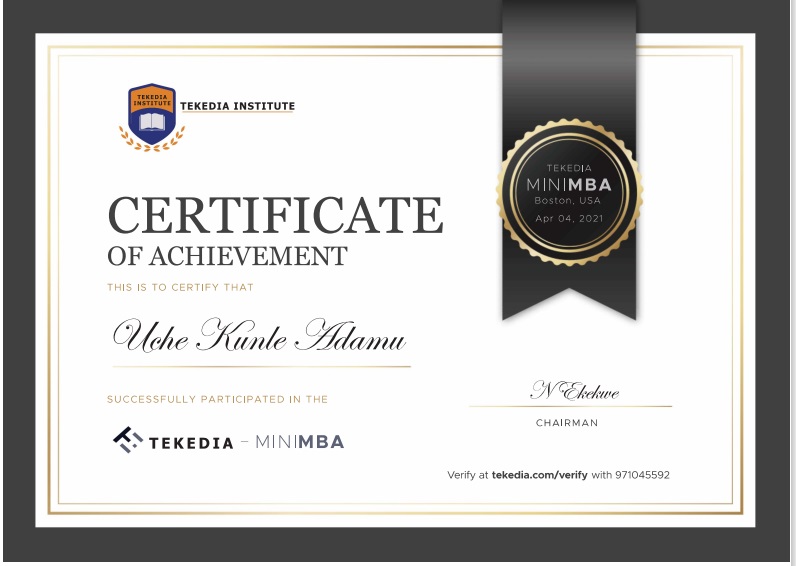
Tekedia Mini-MBA certificate sample

Join us for a great excursion on the mechanics of business systems. Tekedia Mini-MBA is excellence in value. We have brought extremely brilliant 140 business executives from the companies you admire, to teach what they do. Cost remains N50,000 or $140. It is online, self-faced and runs for 12 weeks, beginning Sept 13. You know what? We have thrice weekly Zoom sessions which I personally coordinate as we rotate our faculty members.

Beat the early bird  and register today.

Be part of the best school.  Everyone gets a certificate at the end, and that certificate is auto-verifiable on our site.

Tekedia Mini-MBA >> learn from the best.