DD
MM
YYYY

PAGES

DD
MM
YYYY

spot_img

PAGES

Home Blog Page 5659

Tekedia Capital Invests in Texas-Based Digital Bank for Immigrants

0

Tekedia Capital offers a specialty investment vehicle (or investment syndicate) which makes it possible for citizens, groups and organizations to co-invest in innovative startups and young companies in Africa and around the world. Capital from these investing entities are pooled together and then invested in a specific company or companies. 

I report that our Syndicate members have taken a position in an upcoming digital challenger bank which is based in Texas, USA. The startup focuses on immigrants and will launch with about 16,000 users, supporting about three dozen countries, next month.

We are building one of the most diversified holding companies. Today, we hold pieces of some of the most amazing technology companies operating in Africa. Join us.

To learn more about Tekedia Capital, join our Syndicate or just join our mailing list, click here.

Nigeria May Not Capture Value From Its Future Empires

1

The Nigerian stock market and the players are not ready for the future. The implication is huge: the domicile of Nigeria’s next level of wealth will be outside the nation. Yes, Delaware will remain the legal jurisdiction but Lagos has not demonstrated that it cares. How can eTranzact International Plc be valued at $21 million? CWG is even sub-$10 million.

By 2030, I expect 80% of the richest Nigerians to have made money from technology. Nigeria is having its finest cambrian moment on the formation of enduring companies. The last time we were this bold, on entrepreneurial capitalism, was in the early 1990s when some of Nigeria’s current  leading banks were established. 

But unlike those banks which today boost the local stock exchange, Nigeria’s future empires may not be found in the local bourse. And that is a challenging economic war ahead. Nigeria has been fixated with 5G, 4G, data, etc without paying attention to what matters: future economic capture.

Comment on LinkedIn Feed

Comment: Well I don’t quite agree with you on Nigerian stock market not being ready. What I believe is happening is that most of the companies that you are talking about have not yet gotten to where they would list their shares on the exchange. Nigerian exchange have demutualised, the exchange have capacity to raise funds but the new kids on the block do not only need funds. They need partners that would enable them to gain access to the global market. I believe that at a time in their growth they will need the exchange. Nigeria as a country has issues that if unresolved will make listing unattractive to investors. These include foreign exchange policy, insecurity, politicized regulators. These are factors that the exchange have no control over.

My Response: Certainly, I expected this comment since I did not link to the full piece. CWG Plc is worth about $8 million. eTransact about $20 million. Even though they are listed, I will not approve for any of our firms to be listed in Lagos if that is how the market will price them. The issue is not being listed, the issue is the exchange educating the investors and the nation doing what is critical for people to understand technology investments.

ETransact in America would be worth at least $150 million but Lagos cannot even price it up to $25m. The best investors are customers: the customers here are Nigerian people. And we need to get them into this new world.

Paystack was priced by Americans more than Wema, FCMB and Unity Bank combined. Would you have expected Paystack to pick $20million in Lagos compared with the $200 million Americans paid?

Why Trump’s Lawsuit Against Social Media Platforms is Futile

0

Just days after a federal judge halted Florida’s social media law, former President Donald Trump has sued Facebook Inc., Twitter Inc., Alphabet Inc.’s Google and their chief executives, in a new attempt to restore his megaphone that was collectively placed under wrap by social media platforms.

It has added to GOP’s vigorous efforts to stop social media platforms from “conservative censorship,” but the move has been seen as another waste of time.

The cases are: Trump et al v Twitter Inc et al, 21-cv-22441, Trump et al v Facebook Inc et al, 21-cv-22440, U.S. District Court, Southern District of Florida (Miami) and Trump et al v YouTube LLC et al, 21-cv-61384, U.S. District Court, Southern District of Florida (Ft. Lauderdale).

Trump has been left with little means of reaching his supporters after his social media ban, following the chaos instigated by his utterances after the US presidential election. With his previous attempts to curtail big tech and social media platforms quashed, and his political future hanging on his ability to reach a wider audience, he is making one more move to restore his social media presence.

In a report on Wednesday, Bloomberg details how Trump’s lawsuit stands in the eyes of experts.

Billing the effort during a Wednesday press conference as a move to defend First Amendment rights, Trump filed three separate class-action lawsuits in federal court in Florida against the tech giants and Facebook’s Mark Zuckerberg, Twitter’s Jack Dorsey and Google’s Sundar Pichai.

The lawsuits seek court orders to restore his social-media accounts, along with punitive damages, to ensure other users can’t be banned or flagged by the tech giants. The legal team is being led by John P. Coale, a trial attorney involved in lawsuits against big tobacco companies.

“We’re going to hold big tech very accountable,” Trump said during the press conference at his Trump National Golf Club Bedminster in New Jersey. “If they can do it to me, they can do it to anyone.”

Twitter permanently banned Trump in January for his role in stoking the mob that attacked the U.S. Capitol Jan. 6 in a deadly riot to stop the counting of Electoral College votes for President Joe Biden. Facebook last month said Trump would remain suspended from its networks for at least two years, with the possibility of being reinstated in 2023 if risk to public safety has subsided.

YouTube, Google’s giant video service, also froze Trump’s account following the Jan. 6 riot. The former president’s videos are still accessible, but he isn’t permitted to post new videos. Susan Wojcicki, YouTube’s chief executive, has said that the company will reverse its policy when it decides that the “risk of violence has decreased,” without providing details.

Facebook, Google and Twitter declined to comment on the suits, which were criticized by tech-funded advocacy groups. NetChoice, whose members include Amazon and other tech companies, said the action shows a “deliberate misunderstanding of the First Amendment” and is without merit.

“President Trump has no case,” NetChoice CEO Steve DelBianco said in a release. “The First Amendment is designed to protect the media from the President, not the other way around.”

The Computer & Communications Industry Association, whose members include Facebook, Twitter and Google, said in a statement that digital services have the right to enforce their terms of service and “frivolous class action litigation will not change the fact that users — even U.S. presidents — have to abide by the rules they agreed to.”

Joshua Davis, a professor at University of San Francisco’s law school, agreed Trump’s legal argument was “weak” but said politics may inspire some judges to rule differently.

Trump is very likely to lose the cases “on the legal merits,” he said. “Having said that, there are political movements afoot that probably make it attractive to conservative judges who I think are concerned about the effects of social media on conservative causes and also more liberal judges who are concerned about the power that social media commands.”

Trump and the Republican National Committee began blasting fundraising solicitations almost immediately, including one appeal seeking donations “to show your support for President Trump’s lawsuit against Big Tech.”

Trump is seeking to overturn a federal law that shields internet companies from liability for content posted by users. Section 230 of the 1996 Communications Decency Act protects social media platforms from lawsuits accusing them of unfairly removing posts or accounts, among other legal challenges. The First Amendment prohibits the government from forcing tech companies to leave up or take down certain categories of posts.

The companies are private and therefore not subject to First Amendment claims from users and have liability protections under Section 230. But in his lawsuits, Trump is arguing that the tech giants worked with the government to censor Americans and thus are “state actors” who can be sued.

The banishment of Trump by major tech platforms reignited Republican calls to revoke the legal shield, arguing that it has enabled social media platforms such as Facebook and Twitter to censor conservative viewpoints.

The lawsuits aren’t the first time Trump has taken aim at Section 230. While in office, he tried to get Congress to repeal it by threatening to veto a Defense Department spending bill. Democrats have also proposed bills to curtail the legal shield to encourage tech companies to more aggressively rid their platforms of bigotry, abuse, and harassment.

Tech companies have largely resisted changes to the law, fearing that the proliferation of lawsuits will force them to clamp down on the free-flowing user-generated content. However, both Zuckerberg and Dorsey have expressed openness in recent months to Section 230 reforms.

Without access to the broad reach afforded by social media giants, Trump has struggled to maintain an online presence. He shut down his blog-like “From the Desk of Donald J. Trump,” though he frequently sends out several press statements a day — often targeting fellow Republicans he believes are insufficiently loyal.

Trump recently stepped up his public activity by restarting rallies and making a trip to the southern U.S. border last week to criticize Biden’s immigration policies. He’s backing candidates in the 2022 midterm elections and actively opposing others. He has also held out the prospect of running again for president in 2024.

The former president has been teasing that he’ll launch a new platform that can’t remove him. He said on Dave Rubin’s “Rubin Report” podcast on June 25 that “there’s a lot of platforms out there, that’s what we’re looking at, getting the right platform, a perfect platform, and I think you’ll see something fairly soon.”

During his presidency, Trump used Twitter for everything from insulting rivals to major policy announcements, and he relied on Facebook especially to raise money from small-dollar donors.

A Florida law that was supposed to go into effect July 1 prohibiting social media platforms from suspending the accounts of political candidates was blocked by a federal judge. Likening the state’s law to “burning the house to roast a pig,” U.S. District Judge Robert Hinkle in Tallahassee said the legislation passed by a Republican legislature and a priority of Governor Ron DeSantis, violates the companies’ free speech rights.

To many others, Trump’s lawsuit is just another means of fundraising for his political engagements, as many of his supporters are already making donations in support of the lawsuit.

England’s Historic Euro 2020 Final, Dented by Controversy

0

England is having the best of its football in a long while in Euro 2020, defying the poor performances that has kept it at par with mediocre national teams for years.

From coming out tops in Group D to beating Germany 2 0 in the round of 16, the Three Lions have given English fans a temporary relief from covid pains. A 4 0 win over Ukraine on Saturday set England up for reaching a semi-final milestone. Denmark, England’s semi-final opponent, has also shown in Euro 2020, thus seting up a dreaded duel that has cast a dent on England’s performance.

While England exulted at reaching a first major final since 1966, there was increasing outcry abroad over the penalty awarded for a foul on Raheem Sterling in extra time to give them a 2-1 win over Denmark in their Euro 2020 semi-final.

Reuters match report highlights the scope of disappointment expressed by both fans and football professionals after the match.

An array of media and football figures joined Danish fans in condemning the penalty as too cheap for such a big game, some saying England’s haughty views on diving looked hypocritical in view of Sterling’s tumble at the lightest of touches.

“They always say how bad it is when a foreign player tries to deceive the referee with a dive. In pure English football, this does not happen. Apart from, of course, in a European Championship semi-final,” said Spanish newspaper Marca.

“It would be nice for English football to stop giving lectures to the rest of the continent about diving.”

The speedy and swerving Sterling, who has been accused of diving before in England’s Premier League, went over in the box after minimal contact from Denmark’s Joakim Maehle.

Dutch referee Danny Makkelie pointed to the spot and upheld that after briefly consulting the Video Assistant Refereee, though without reviewing the move on the pitchside monitor.

Harry Kane’s penalty was saved by Kasper Schmeichel but the captain followed up to score and give England the win.

‘FAR TOO CHEAP’

“This was a soft penalty for me … far too cheap a penalty for a Euro semi-final,” ex-referee Jonas Eriksson, who officiated at Euro 2012 and 2016, said on Swedish network SVT.

“I am mostly surprised and annoyed that the VAR doesn’t tell the referee. This decides which team goes through.”

Sterling himself said after the game it was a clear penalty with his leg clipped. But former Arsenal manager Arsene Wenger, who is now international governing body FIFA’s head of global football development, was among those doubting.

“In a moment like that it’s important the referee is absolutely convinced it was a penalty. It was not clear enough to say ‘yes it is’. He should have at least had a look at the screen,” he said on Qatari network beIN Sports.

Roma manager Jose Mourinho went further, telling radio station Talksport “For me, it’s never a penalty” even though he said the best team won and he was happy for England.

Denmark might also have felt aggrieved by the fact a second ball was on the pitch when Sterling entered the area, which according to regulations could have led to play being halted.

“They won with a penalty which was a blatant dive,” fumed former Germany player and pundit Dietmar Hamann. “England always prides itself on being the home of fair play and no diving.”

Elsewhere, France’s L’Equipe newspaper said England had only breached the Danish defence with “a questionable, not least generous, penalty”, while in Italy – England’s opponents in Sunday’s final – Gazzetta dello Sport said “it’s a shame they get these little bits of help, because they don’t need it”.

“It’s diving home,” tweeted Italian journalist Tancredi Palmeri in a sarcastic reference to England’s football anthem “It’s coming home.”

But there is more to the question of whether it was a penalty or not. Someone in the crowd at Wembly pointed a laser at Danish goal keeper Kasper Schmeichel as he was gearing up for the penalty taken by Harry Kane, igniting calls for a life ban for the fan.

Schmeichel’s saving of the penalty and Kane’s scoring in the rebound to give England the 2-1 win, fueled the backlash. Many believe that it’s unffair football practice, and it has robbed Denmark the chance of reaching Euro 2020 final.

The European football governing body, UEFA, had on Thursday, opened investigation into the laser incident. But it won’t change anything, the damage has already been done.

Four Factors To Embrace As Nigeria, Africa Restarts Post Covid-19

0
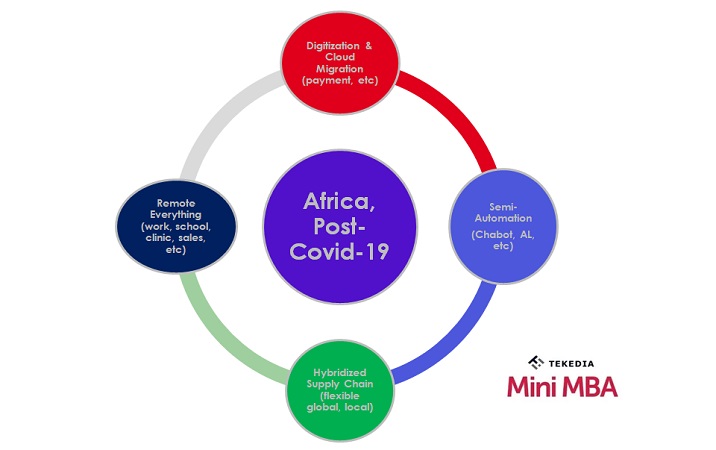
The 4 key tech redesigns in Africa, post-covid-19

As the world restarts from the paralysis of Covid-19, I see these factors shaping industrial sectors and domains in Africa. 

  • Digitization and Cloud Migration: The pace is accelerating and most industries would be eaten and also saved by software, running on computational systems in the cloud.
  • Semi-automation: Disintermediation of humans will accelerate as machines become starter. The chatbots deployed by banks will simply get better.
  • Hybridized Supply Chain: Flexible, adaptive, global and local, at the same time. Great companies are revamping their supply chain strategies. Coca Cola Nigeria just noted that Nigeria’s currency fluctuation has minimal impacts as most of its raw materials are now sourced locally. 
  • Remote Everything: The web will run the world across sectors.  From education to entertainment and beyond, the unbounded and unconstrained nature of the internet will continue to bring new ordinances in markets, homes and offices.

In my State of the Tech Nation address, I explained them comprehensively. Let me say this: the most important thing in business is your business model. There is a reason we have a $2 trillion Microsoft and $140 billion IBM today. Check the chart, just a few years ago, both were close. But Microsoft changed its business model under  a new CEO while IBM continued on the quest of filing more patents! Nothing bad about it, but technology must be put in its own position – help you execute the right business model.