DD
MM
YYYY

PAGES

DD
MM
YYYY

spot_img

PAGES

Home Blog Page 5695

Comparing Oil Revenues, Budgets, etc in Nigeria (1990 – 2017) Across Administrations

0

Responding to this post by Nurudeen Adeyemi, you always tag me (thanks), but here you did not state my position to help your audience. The average oil revenue during Jonathan was $76 billion per year , Buhari’s was $47 billion per year, using your data (I assume they did not include 2017 data). But if you look at borrowing, Buhari has made up his oil shortfalls via borrowing. My comment on that feed was this: money is money, borrowed or via oil revenue as when you spend Naira, it does not have a marker with “they got me from oil” or “I am borrowed”.

What Buhari did not get in oil, he had borrowed from pension, IMF, etc and at the end, he HAS more money (per year) than any of the administrations you mentioned. More so, the oil revenue that came during OBJ, Yar’Adua (the best among them), GEJ etc went into paying military era debts and because of that their budgets were LOWER.

Last Jonathan’s budget was N4.962 trillion in 2014 but Buhari’s last budget was 10.59 trillion naira in 2020. Even using absolute official rates in both 2014 and 2020, Buhari has more USD; Jonathan was around $24 billion using N200/$ in 2014 and Buhari $28 billion using N380/$ in 2020.

So, what you are sharing is irrelevant because even though oil revenue has dropped, President Buhari has used loans to jack up spending, more than any president in both Naira and USD. However, as I noted in the piece you cited, the thinking into the spending has not been strategic, and that is why it seems he does not have money even though he is spending more!

Comment on LinkedIn Feed

Comment: Even though President Buhari has used loans to jack up spending, more than any president in both Naira and USD, as you’ve said, he has projects to show for those spending but the previous administrations have no project to show for their spending that’s the issue.

Response: That is another debate which I do not want to follow up. I simply responded to debunk the “scarcity” you created on your feed. I am happy we are in affirmative now. You tagged me; so, I simply wanted to explain my side of the point. Mr. Buhari has a reason to be borrowing – he is fighting a war.  Yes, that he is spending more is understandable. I only responded to debunk that he had no money because oil revenue went down.
The Mastery of Marginal Cost is the Mastery of Digital Business Growth

0

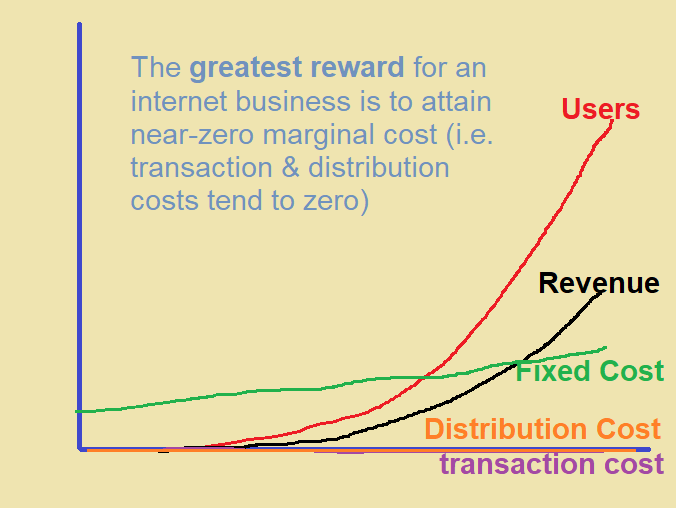
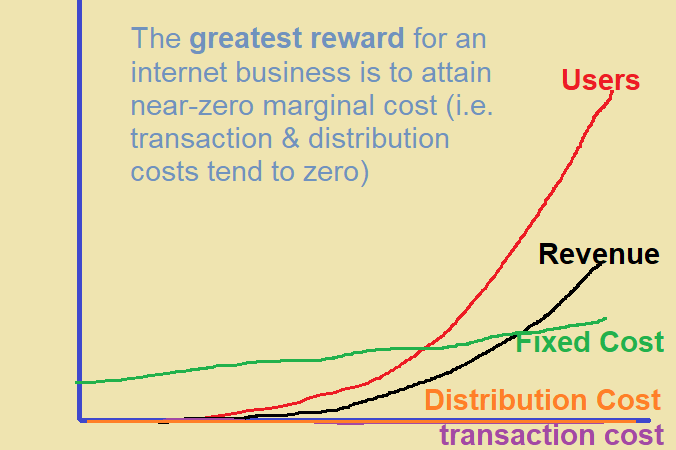
In a perfect internet market, the marginal cost of a digital product is zero. But no market is perfect, so, what we have in reality is that the marginal cost tends towards near-zero. What that means is that the transaction and distribution costs stay low even as output increases. Whenever you attain that positioning, your unit economics improves since you are essentially having accelerating returns which keep compounding.

Before you launch that digital product, understand this plot. If you do not, you will struggle to scale that product. The mastery of marginal cost is the mastery of digital business growth. Your scalable advantage is built on the “physics” bounded by distribution cost and transaction cost.

Unit Economics. Marginal Cost. Understand both, and the path to the mountaintop becomes clearer. How do you keep growing without increasing marginal cost?

The Mastery of Marginal Cost is the Mastery of Digital Business Growth


https://youtu.be/P75hzh3e190

Bitcoin Rebounds Above $40,000 As Elon Musk Continues to Wield His Power Over Cryptocurrency Market

0

Tesla founder and CEO Elon Musk continues to exert enormous influence on the cryptocurrency market. Musk, who has been an ardent fan of the leading cryptocurrency, bitcoin, announced his abrupt parting with the much touted digital coin in April, citing the use of carbon-energy in mining. Bitcoin plunged more than half from $64,000, its highest price so far.

Bitcoin has been reeling from the effects of Musk’s tweets, swinging below $40,000 since then. Now with another tweet, Musk has sent the coin up, setting it up for maybe, a total rebound.

On Sunday, Musk fended off criticism over his market influence and said Tesla sold bitcoin but may resume transactions using it.

Bitcoin has gyrated to Musk’s views for months since Tesla announced a $1.5 billion bitcoin purchase in February and said it would take the cryptocurrency in payment.

“When there’s confirmation of reasonable (~50%) clean energy usage by miners with positive future trend, Tesla will resume allowing Bitcoin transactions,” Musk said on Twitter on Sunday.

Bitcoin, which jumped nearly 10% on Sunday, breaking above its 20-day moving average, was up 4.3% on Monday at 40,692.27, its first foray above $40,000 in more than two weeks.

“Musk’s words caused bitcoin to surge,” said Simon Peters, market analyst at eToro.

Bitcoin was also supported Monday after billionaire hedge fund manager Paul Tudor Jones told CNBC on Monday that bitcoin is a great way to protect his wealth over the long run and is part of his portfolio just like gold.

Bitcoin prices were also helped by software company and major bitcoin-backer MicroStrategy raising half a billion dollars to buy bitcoin, said Bobby Ong, co-founder of crypto analytics website CoinGecko.

Musk’s tweet was made in response to an article based on remarks from Magda Wierzycka, head of cybersecurity firm Syngia, who in a radio interview last week accused him of “price manipulation” and selling a “big part” of his exposure.

“This is inaccurate,” Musk said. “Tesla only sold ~10% of holdings to confirm BTC could be liquidated easily without moving market.”

Musk had tweeted in May that Tesla “will not be selling any bitcoin” and “has not sold any bitcoin” but investors are keenly awaiting Tesla’s next earnings update – due next month – for any disclosure of changes to its position.

Musk has taken issue with the vast computing power required to process bitcoin transactions and in early June posted messages appearing to lament a breakup with bitcoin.

However, his influence in the cryptocurrency is yet to be contained, and investors are finding it hard to reckon with. In early June, the hacker group, Anonymous had threatened the billionaire in a video they shared on Twitter, for manipulating the cryptocurrency market.

Billionaire entrepreneur Elon Musk has “destroyed lives” through his tweets about cryptocurrency, hacker collective Anonymous has said in a video threatening the Tesla founder.

In the video posted on Saturday, the group said Musk was “another narcissistic rich dude who is desperate for attention”, but that his tweets on cryptocurrency were damaging to investors.

“Millions of retail investors were really counting on their crypto gains to improve their lives,” a figure in a Guy Fawkes style mask says in the video.

“Of course, they took the risk upon themselves when they invested, and everyone knows to be prepared for volatility in crypto, but your tweets this week show a clear disregard for the average working person.”

The group said retail investors had been hoping their cryptocurrency gains would improve their gains, and that Musk needed to stop his “temper tantrums”.

“You may think you are the smartest person in the room, but now you have met your match,” the nearly four-minute long video concluded.

“We are Anonymous! We are Legion! Expect us.”

Musk’s tweet on Sunday, which helped buoy bitcoin to more than $40,000 is an indication that he still wields a strong grip on the cryptocurrency market. Investors are hoping that he doesn’t tweet something negative soon that will ruin the little gain of the week.

Indian Court Insists on Probing Amazon, Walmart’s Flipkart As Big Tech Antitrust Cases Heighten

0

An Indian court dismissed pleas on Friday by Amazon.com Inc and Walmart’s Flipkart to quash an antitrust investigation into the business practices of the U.S. firms, dealing them a blow in their key growth market. Reuters has the report.

The Competition Commission of India (CCI) announced its investigation in January 2020 after a trader group’s complaint accused the firms of promoting some “preferred sellers” and hurting business for smaller sellers.

A court had put the investigation on hold last year after Amazon and Flipkart challenged it saying the CCI had no evidence the e-commerce giants were harming competition.

On Friday, Justice P.S. Dinesh Kumar of the high court in the southern state of Karnataka said he was dismissing the petitions by Amazon and Flipkart, and refused them any further relief.

“It would be unwise to prejudge the issues … at this stage and scuttle the investigation,” Kumar wrote in his 51-page order.

Amazon said it would review the order “carefully and then decide on the next steps”. Flipkart did not immediately respond.

Abir Roy, a lawyer for the Indian trader group Delhi Vyapar Mahasangh, told Reuters the judge’s decision effectively paves the way to restart the investigation, which has been on hold since February 2020.

However, the companies are likely to appeal against the verdict.

When the competition watchdog ordered its investigation, it listed four alleged anti-competitive practices. These were exclusive launches of mobile phones by the e-commerce firms, promoting preferred sellers on their websites, deep discounting practices and prioritising some seller listings over others.

The CCI investigation will be the latest setback for the firms, which have also battled tougher foreign investment rules, and faced accusations for years from brick-and-mortar retailers about circumventing Indian law by creating complex business structures.

In February, a Reuters investigation based on internal Amazon documents showed the U.S. firm for years had helped a small number of sellers prosper on its platform in India, giving them discounted fees and helping one cut special deals with big tech firms.

As the competition watchdog sought to restart the probe, it told the Karnataka court in March the Reuters report corroborated evidence it had received against Amazon.

In response, the company, which has said it “does not give preferential treatment to any seller”, told the court it disagreed with the Reuters report, which should not be considered evidence.

India’s Amazon antitrust probe highlights the growing global spotlight on American big tech. Google, Facebook, Apple and Microsoft are all having their full share, as the country seems to be heeding the wake up call to hold them to account.

The US is following the steps of European watchdogs, who recently have had many of the tech companies in their bad books. Democrat US Senators are currently working on an antitrust bill that would force the biggest tech companies to change parts of their business models and curtail large acquisitions.

The drafts, if it becomes law, could require business model overhauls for Apple and Amazon by limiting their ability to operate marketplaces for products and apps while selling their own goods and apps on those same stores.

They would also make it harder for those companies plus Facebook and Alphabet (Google’s parent company) to complete large mergers, and would force them to make it easier for users to leave their platforms with their data intact.

Ndubuisi Ekekwe To Keynote ‘Digital Africa Conference & Exhibition’

0

Good People, join me on June 22 as I keynote ‘Digital Africa Conference & Exhibition’ which will be held from the 22nd to 24th of June, 2021. I will open the event with a Keynote on the 22nd at 9:35AM WAT.

Digital Africa Conference and Exhibition is Africa’s premier consumer technology show which holds annually. It provides the perfect platform to showcase your brand and enhance your reputation. It presents to its participants a major opportunity for unrivalled networking and privileged access to strategic partners, investors and potential buyers.

Connect here