DD
MM
YYYY

PAGES

DD
MM
YYYY

spot_img

PAGES

Home Blog Page 5718

Blue Origin Space Trip Boosted with $28m Seat Auction

0

All is getting set for Blue Origin’s space trip that will have the world richest man, Jeff Bezos as passenger. An auction for the ride next month alongside Bezos and his brother ended with a winning $28 million bid Saturday. ABC has the report.

The Amazon founder’s rocket company, Blue Origin, did not disclose the winner’s name following the live online auction. The identity will be revealed in a couple weeks — closer to the brief up-and-down flight from West Texas on July 20, the 52nd anniversary of Neil Armstrong and Buzz Aldrin’s moon landing.

It will be the first launch of Blue Origin’s New Shepard rocket with people on board, kicking off the company’s space tourism business. Fifteen previous test flights of the reusable rocket and capsule since 2015 — short hops lasting about 10 minutes — were all successful.

Saturday’s auction followed more than a month of online bidding that reached $4.8 million by Friday. More than 7,500 people from 159 countries registered to bid, according to Blue Origin. More than 20 bidders — the high rollers — took part in Saturday’s auction.

Bezos announced Monday that he and his younger brother, Mark, would be on board New Shepard’s first crew flight; the news quickly boosted bidding. The winning amount is being donated to Blue Origin’s Club for the Future, an educational effort to promote science and tech among young people.

The completely automated capsule can carry up to six passengers, each with their own big window. Blue Origin’s top sales director, Ariane Cornell, said following the auction that the fourth and final seat on the debut crew flight will be announced soon.

While Blue Origin has yet to open ticket sales to the public or divulge prices, the success of this trip will mean wider opportunity for the public, wishing to have a taste of space travel.

Since the past 10 years, the goal of developing commercial space aircrafts has gained momentum, with many billionaires putting in resources to make it happen. Richard Branson, the founder of Virgin Atlantic is also planning on conducting flights to suborbital space for ultra-wealthy thrill seekers, putting up competition with Blue Origin and SpaceX. Like Bezos, the British billionaire said he would be among the first to ride on Virgin Galactic’s rocket-powered plane which is expected to fly later this year.

Blue Origin is a six-seater capsule and 59-foot rocket, it’s crew will tear the rocket toward the edge of space on a 11-minute flight that’ll reach more than 60 miles above Earth.

Understand Marginal Cost for Your Online Business

3
Marginal cost

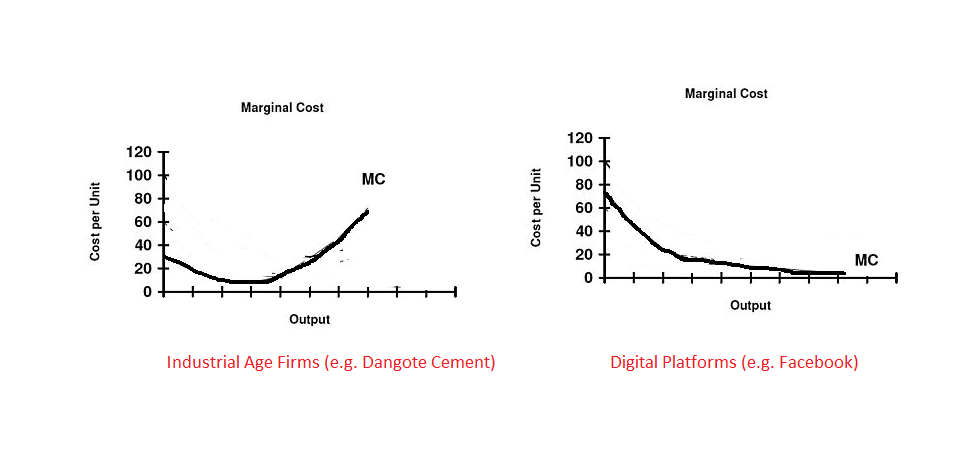
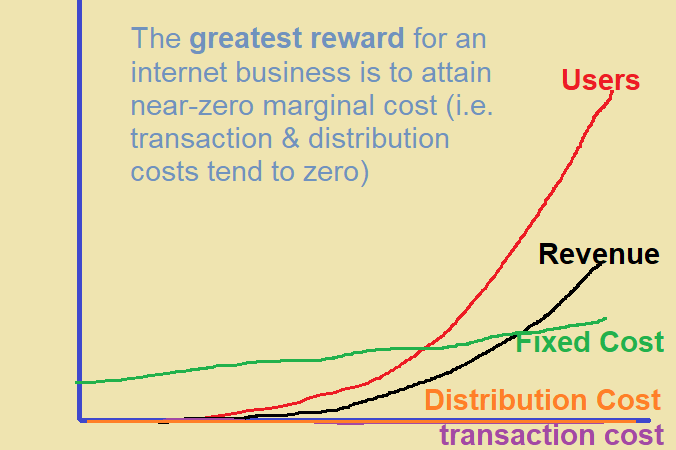
In a perfect internet market, the marginal cost of a digital product is zero. But no market is perfect, so, what we have in reality is that the marginal cost tends towards near-zero. What that means is that the transaction and distribution costs stay low even as output increases. Whenever you attain that positioning, your unit economics improves since you are essentially having accelerating returns which keep compounding.

In theory, you can just keep growing, unlimited by the typical industrial age marginal cost which begins to go low, but quickly ramps up with output (recall your average fixed cost shape in secondary school economics) thereby restricting growth.

If you do not understand how marginal cost affects your business, you cannot drive growth in that business. Make time and study marginal costs. It is the most important cost you must understand if you want to develop a growth playbook.

Yes, before you launch that online business, I want you to understand Marginal Cost. Watch the videos.


https://youtu.be/P75hzh3e190

The Mastery of Marginal Cost is the Mastery of Digital Business Growth


Why I Support The Twitter Ban – Hilary Unachukwu

1

On the Friday 4th, 2021, the Federal government with the auspices of the Federal Ministry of Information and Culture put out a memo that directed telecom companies and ISPs to block access to the website and mobile app, Twitter. This caused a huge furor not just nationally but also internationally. The ambassadors of US, UK, and Canada were called up and the whole nation was stirred up by the move. The move was in response to the tweet of the President Buhari being taken down because of its incitive tone and message. While, I think the tweet was repugnant and abhorrent. I fully support the ban of Twitter’s operation in Nigeria.

This is an example of where corporate entities especially big tech companies insert themselves in the affairs and the governance of a sovereign nation. It is a very serious situation when a private company interferes with the communication of a nation state. This is something that would not be a very good decision and would probably affect the operations of social media giants in future.

Nigeria is not the first country to ban or limit Twitter. Several countries such as Tanzania in Africa have done the same thing. My main problem is that Twitter should not be interfering with the communication of the Head of State in Nigeria. The President is the head of security of Nigeria and is the Commander-in-Chief of the Armed Forces. So, Twitter controlling and censoring his speech is not something that should be accepted by any government. I can fully condemn and repudiate the tweet made by President Buhari. But a foreign company meddling directly in the affairs of our country should give one pause. This brazen move by the corporation that does not pay taxes to Nigeria is something I think is an overreach. The actions of this American company should not be taken lightly at all.

The main pretext is that Twitter has its T&Cs so anyone that violates it would see judgement as Twitter deems fit is laughable. There are innumerable instances of how Twitter uses double standards when it comes to communications and messages sent out by people. It’s safe to say that Twitter leans heavily left and aligns with the politically liberal. So, when there are riots, Twitter would support and promote them as “peaceful protests.” However, there is some about-face on Twitter’s part as when there are some demonstrations in Nigeria, Twitter tends to suppress the chatter and make sure the trends are not dominating the website. To be clear, Twitter tries to be politically expedient to certain factions in society at large. However, to state that they are standing by their T & Cs is a very lame defense of their actions towards the Nigerian Government.

I really think businesses should not be in control of public discourse. The business model of Twitter and other social media platforms involves aggregation. Aggregation is where they can get many users on a platform. The number gives the platform standing and the network effect increases the value of the platform exponentially. To protect such platforms and their aggregation of comments and interactions, there is legislation called Section 230 that identifies and protects these platforms from litigation since they are not publishers. They do not take responsibility on what is published on their platform. However, big tech platforms for years have expanded their hold on public discourse by suppressing and censoring people and information. This goes beyond even the business practices allowed in America.

Many people bring up that the President of America, Donald J. Trump was banned not only from Twitter but also other social media platforms. This brings me back to the other points of Twitter’s political bias and its adherence to its own T & Cs. Even during the Senate trial, the exact reading of Trump’s statement shown proved no incitement of violence or any ominous threat. But since there is a concerted effort to censor not only Trump but millions of his supporters, this was made to go through. Trump probably handled the social media giants very badly from the start. Refusing to assess the expanding power and desire to censor Americans and control the messaging of American discourse but that was a grave mistake that hurts not only him for the entire America “Overton window.” Now not only is information suppressed, but also people really are believing in propaganda since the sources of media are controlled are biased towards a certain ideology.

A very curious example of Twitter’s bias. Is Nick Sandmann of Covington Catholic High School. His class went on a field trip and they wore “MAGA” caps. There was a situation where a man walked up to them and started drumming in their faces. It was interpreted all over Twitter as the 15-year-old, at the time, being racist and disrespectful to an elderly Native American veteran. All over Twitter was hateful comments and threat towards the Nick Sandmann, the students, the school, and his family. Nick Sandmann and his family sued the offenders and the media that published the false stories in court. The courts easily found evidence, just like any resourceful person could, about the incident. The media houses such as CNN has to settle in court. But, many of the people that made threatening comments including then death threats still had their tweets on the site and no sanctions were made against them. Twitter did nothing despite its own T & Cs.

I think that there is an opportunity for the government to not only bring the social media giant in line but it can also start reviewing how it contributed to the country in the way of taxes and other means. Since, they may not be interested in building facilities in Nigeria, maybe them paying taxes would be something that would add to our economy. Many businesses used Twitter for their advertisements and Nigeria is still has a large population what would make a huge difference in any business environment. I think the Federal Government should have stiff sanctions with the social media giant but still leave roam for indulgences.

10 Most Corrupt Countries in the World and the Global Impact of Corruption

0

In early May 2021, an investigation conducted by BBC Africa Eye on pension corruption in South south state of Nigeria, Cross Rivers State, exposed one of the many ills that corruption brings upon a nation and its people.

According to the investigation, many retired civil servants of the state have been labeled “Ghost Pensioners” by state actors and thus denied their pension. The affected pensioners are forced to depend on friends and relatives to feed, most of them are old and in serious need of Medicare.

They have been declared dead by the government, who thus divert their pension fund jumbo pay of officials who live flamboyantly. Those fortunate enough among the pensioners to receive their pension are forced to pay bribe. This sad situation goes beyond Cross River State, in fact, it has become an aberration accepted as a way of life in Nigeria.

Nigeria has for years been named among most corrupt countries in the world. This means, the appalling situation in the country’s pension cuts across all other sectors, promoting illicit wealth and stymieing economic growth.

A survey conducted by the United Nations Office of Drugs and Crime (UNODC), estimated that some 117 million bribes are paid in Nigeria on a yearly basis, the equivalent of 1.1 bribes per adult. In 2019, the Human Environmental Development Agenda (HEDA), an anticorruption non-governmental organization, said Nigeria has lost at least $600 billion dollars to corrupt officials since 1960, according to the findings it made following an intensive global research it conducted in collaboration with international partners.

This means that funds meant to provide basic amenities like hospitals, schools, roads etc. for the citizenry have been embezzled, leaving the country in a significant infrastructural deficit that breeds unemployment, insecurity and preventable deaths among other ills.

Nigeria has a median age of 18.1 years with a vibrancy that commands a formidable workforce. Unfortunately, as a result of corruption, which has become a way of life, jeopardizing the country’s economic future, the goal of most of these young people is to leave the country in search of a better life.

In 2019, the Nigerian Medical Association (NMA) said that 2,000 doctors leave Nigeria for developed countries yearly. It is said that out of 75,000 registered doctors in Nigeria, only 35,000 work in Nigeria. That leaves a hallowing gap in the health sector for a country of about 200 million people.

The debilitating effects of corruption cut across many facets but have the same impact on lives and economic growth of most corrupt countries. Poor infrastructure, unemployment that usually results in high crime rate, and illicit wealth in the hands of a few.

What Makes A Country Corrupt?

According to a 2017 survey study, the following factors have been attributed as causes of corruption:

  • Greed of money, desires.
    Higher levels of market and political monopolization
    Low levels of democracy, weak civil participation and low political transparency
    Higher levels of bureaucracy and inefficient administrative structures
    Low press freedom
    Low economic freedom
    Large ethnic divisions and high levels of in-group favoritism
    Gender inequality
    Poverty
    Political instability
    Weak property rights
    Contagion from corrupt neighboring countries
    Low levels of education
    Lack of commitment to society
    Extravagant family

In most corrupt countries, where corruption is a way of life, lack of political will by the government to fight corruption opens a wide room for politicians and public office holders to loot public funds with impunity. Moving from public to private sectors, it contagiously influences individuals, promoting the “if you can’t beat them you join them” lifestyle.

Which country has the highest level of corruption?

According to the Corruption Perception Index (CPI), Somalia has the highest level of corruption in the world. Since 2006, the East African country has been ranked at the bottom of CPI, due to increasing corrupt practices that have been fueled by civil conflict and lack of political will by the government to establish an effective anti-graft agency.

Which country is the least corrupt in the world?

The 2020 Corruption Perception Index places Denmark as the least country in the world. The European country scored 88 points to stay top of 180 countries surveyed. It has consistently been in the top-4 since the publication of the first report in 1995.

In Denmark, People don’t consider corruption a problem as there are rarely cases of bribery in the public and private sectors. The business environment regarding the ethical behavior of companies’ interaction with public officials, politicians and other enterprises, as well as the financial auditing and reporting standards among companies, are very strong, according to the Global Competitive Report.

How much does corruption cost the world?

Yearly, the world counts huge losses emanating from corrupt practices. It touches life as well as the economic wellbeing of affected countries. In 2018, United Nations Secretary-General António Guterres said the annual costs of international corruption amount to a staggering $3.6 trillion in the form of bribes and stolen money. This means a significant decline in governments’ revenue as taxes are either not paid or they go into private pockets. In many corrupt countries, unqualified persons bribe their way into critical public and private sectors positions, endangering lives and jeopardizing their nations economic growth.

In Nigeria for instance, state actors collude with contractors to inflate the cost of projects, and contractors are made to pay huge sums in bribes to secure contracts. All these drain the scarce funds in the government’s purse, enriching the corrupt who rake in millions of dollars in kickbacks.

In most corrupt countries where there are relative anti-graft agencies, politically exposed persons rely on money laundering to save their ill-gotten wealth. This they do by usually moving stolen public funds to other countries.

A notorious example is James Ibori, the governor of Delta State, Nigeria from 1999 to 2007. Ibori was arrested in 2012 and imprisoned in London for stealing and laundering $250 million belonging to the Delta State Government.

A 2015 survey published in ResearchGate rated Delta State among the most infrastructure disadvantaged states in Nigeria. According to the report, there were varying degrees of infrastructural deficiencies. 34.22 per cent of the Primary Health Care system (PHCs) had no access to safe water; 51.33 per cent were not connected to the national electricity grid; and 34.22 per cent of the available beds and 40.89 percent had no means of communication whatsoever.

The major cause of the infrastructural deficiencies was insufficient funding, lopsided allocation of resources and official corruption.

By stealing the funds meant for public services and infrastructural development, corrupt public office holders leave needed infrastructural projects dilapidated, exposing citizens to preventable harm. Cletus, one of the victims in the BBC Africa Eye Pension investigation died sadly not long after, because he couldn’t afford adequate healthcare due to his stolen pension.

Here is the list of 10 most corrupt countries in the world according to CPI.

  1. Somalia

The Sub-Saharan African country is bedridden with corruption that is ravaging every aspect of its existence. Compounded by conflict and civil war, which resulted in destabilization of government for long, Somalia has been reeling at the mercy of corruption. Currently, it is weakening its state-building efforts, undermining democracy, human rights, and rule of law. In addition, it is raising rates of crimes and terrorism. To make things worse, state actors do not show enough commitment to quell corruption.

  1. South Sudan

In 2012, President Salva Kirr made an appeal to government officials, whom he said had stolen $4 billion from government coffers to return the money. He said most of the fund had been hidden in foreign accounts when the new born country is in dire need of money to fund development.

Kirr’s lamentation highlighted the level of corruption that’s followed the North African country since its creation from Sudan in 2011, has witnessed havoc-wreaking corruption that has limited its economic development to the barest minimum.

“Corruption permeates all sectors of the economy and all levels of the state apparatus and manifests itself through various forms, including grand corruption and clientelistic networks along tribal lines,” Amnesty Intl. said of corruption in South Sudan.

  1. Syria

The war-torn Middle Eastern country has three major aspects of corruption. 1. Bribery, which is widespread in all sectors of Syria. 2. Abuse of power is considered to be another type of corruption, according to the Penal Law in Syria. Abusers of power exploit their connections with decision makers (real or virtual connections) to trap their victims into financial or moral payoffs. 3. Embezzlement of public fund.

The major cause of widespread corruption in Syria is dictatorship. A system of government that does not allow adequate freedom for checks and balances as it stifles press freedom, thereby creating protection for those in power to loot public fund.

  1. Yemen

Yemen is another country whose case of corruption is characterized by conflict. The Middle Eastern country has been in a war that has claimed over 233,000 lives for more than six years now. The situation exposed the poorest Arab country to severe corruption. The UN said the warring factions, the Iran-aligned Houthi militias and the “legitimate” government of President Abd Rabbo Mansour Hadi are both accused of money laundering and diverting funds meant for humanitarian purposes. This has exposed the country to widespread extortion, racketeering and bribery.

  1. Venezuela

Most sectors of the Venezuelan economy suffer from endemic corruption, due to the highly politicized and ineffective judiciary that is inefficient in cracking down on corruption and impunity. The Venezuelan legal framework criminalizes several corruption offenses, including extortion, passive and active bribery and abuse of office. However, the legal framework does not include the bribery of foreign officials.

Enforcement of anti-corruption legislation in the country is very weak, and government officials do engage in corrupt practices with impunity. Bribery and facilitation payments are widespread. Gifts given in return for an undue advantage are illegal under Venezuelan law; however, the practice is recurrent in most sectors.

  1. Sudan

Corruption is present in all sectors and across all branches and levels of government in Sudan. The Sub-Saharan African country scored 16/100 and ranked 174/180 in CPI. In Sudan, public servants are known to demand bribes for services that individuals or companies are legally entitled to; government officials hold direct and indirect stakes in many enterprises, which distorts the market through patronage and cronyism; and the head of state and government is believed to have embezzled up to $9 billion from oil revenues.

  1. Equatorial Guinea

Political corruption in Equatorial Guinea is high by world standards and considered among the worst of any country on earth. It has been described as “an almost perfect kleptocracy” in which the scale of systemic corruption and the rulers’ indifference towards the people’s welfare place it at the bottom of every major governance indicator or ranking, below nations with similar per capita GDPs. The CPI ranked the West African country 174/180 countries. The government is controlled by a limited group of powerful individuals who divert most of the country’s revenues into their own clandestine bank accounts in other nations. The high level of corruption in Equatorial Guinea has left the majority of its citizens poor even though it is a rich country.

  1. Libya

According to Gan Integrity, all sectors in the Libyan economy suffer from widespread corruption; however, the public procurement sector and the oil industry are among the most affected. Bribery and favoritism are common practice in all sectors, and companies may struggle with unfair competition from state-owned businesses, which also dominate the local market. Corruption was rampant under Gaddafi’s rule, and the situation has only worsened in the post-revolution period.

The institutional framework to combat corruption is weak, and the rule of law is undermined by political instability and violence. The Libyan Constitution Drafting Assembly is still in the process of writing the constitution, resulting in all laws being derived from the Constitutional Declaration that came into force after the ousting of Gaddafi. Nonetheless, the judiciary and the security apparatus are ineffective, rendering the enforcement of the law as very weak. Libya scored 17/100 to rank 173/180 in the 2020 Corruption Perception Index, and has been in the rank of most corrupt countries in the world since 2012.

  1. North Korea

There is an endemic system of corruption which pervades all aspects of life in North Korea. The brutal dictatorship keeps announcing rigid rules that prohibit freedom and the right to expression. A 2019 UN report asserts that the State-run public distribution system collapsed in the mid-1990s, forcing people to work in informal markets, where they have no choice but to bribe officials to avoid arrest. The result is a high level of hunger that affects around 10.9 million people – more than 43 per cent of the population. North Korea ranked 170/180 after scoring 18/100 in the CPI 2020.

  1. Democratic Republic of Congo

Corruption permeates all levels of society from petty bribery and grand corruption to illicit financial flows. Characterized by clientelism, rent-seeking, and patronage. The situation has been aggravated by prolonged civil conflict and lax anticorruption fight. State actors practice corruption with impunity. DRC thus becomes one of the most corrupt countries in the world. The ruling elite has a direct stake in the country’s economy, and often steer economic activities in accordance with their own personal opportunities. The country’s economic future is thus marred, becoming the least competitive in the world. DRC scored 18/100 rank 170/180 in the 2020 CPI, and has been ranked among the most corrupt countries since 2012.

Although every country in the world faces the challenge to protect itself from corruption, African countries are the most affected. The resulting consequence have been poor economic growth which opens opportunities for crime, civil unrest and mass migration and abject poverty. However, while Africa leads in the 10 corrupt countries index, other continents have also been proportionately plagued, making corruption a global pandemic that needs to be contained for economic sustainability.

The UN said taming corruption requires the involvement of strong anti-corruption bodies, better oversight, more open and transparent public procurement and enhanced anti-corruption compliance by the private sector. In addition, countries also need to ensure support to and protection for whistleblowers and journalists uncovering corruption.

Nigeria’s Twitter Ban: Before the US Talks to Nigeria in the Language It Understands

0

It’s been 10 days since the Nigerian government suspended the operation of microblogging app, Twitter indefinitely but later updated temporarily. The decision, which has been widely criticized as suppression of freedom of expression, was made after Twitter removed a tweet from President Muhammadu Buhari which violated its policy.

The tweet reads: “Many of those misbehaving today are too young to be aware of the destruction and loss of lives that occurred during the Nigerian Civil War. Those of us in the fields for 30 months, who went through the war, will treat them in the language they understand.” His reference to Nigerian civil war, which claimed more than 2 million lives, mostly Igbos, and the threat to “treat them in the language they understand” provoked a global backlash. It was widely perceived as a threat to repeat the war actions against the Igbos.

Twitter deleted the tweet for violating its “abusive behavior” policy, and in retaliation, the Buhari administration announced the suspension of the social media app in Nigeria.

While the development appears to be centered on recent events, there is much more to it. The Nigeria government has been in loggerhead with social media since 2015. In November 2019, a bill known as the Protection from Internet Falsehood and Manipulation Bill 2019, sponsored by Senator Sani Musa, was being debated in the National Assembly. There was also the Prohibition of Hate Speech Bill sponsored by Senator Sabi Abdullai. Each of these bills was seeking to control free speech and how Nigerians react to issues.

Though the Bills didn’t survive the local and international opposition that greeted them, they didn’t go beyond second reading, the bad blood between social media and Buhari’s administration has remained. The Bill was seen as part of the government’s efforts to suppress free speech, given its attitude towards journalists and the Nigerian media space in general, especially the broadcasting part of the press.

The regulator, National Broadcasting Commission (NBC) had doled out a set of new broadcasting codes prohibiting TV and Radio stations from airing whatever the government considers “hate speech” or unwholesome for Nigeria’s public consumption. Media houses have been raided and some journalists had to flee the country as the attack on press, based on the new broadcasting codes, rose. The body language of the Nigerian press gradually started changing from “expressive” to “careful,” and the people were taking note of it all.

So with the perception that the Nigerian press has been compromised, and many media outlets intimidated to practice “careful” journalism, many Nigerians turned to citizen journalism, and Twitter became their platform.

In the past five years, Twitter has given voice to Nigerians, who fearlessly question the dos and don’ts of the people in power. It has also become the platform for citizen-based checks and balances that do not only challenge the status quo, but also expose the ills many state actors don’t want in the limelight.

The most significant example of Nigerian Twitter power was the End SARS protest, a campaign against police brutality that happened in October 2020. It has been described as the most successful protest in Nigeria. It kicked off on Twitter, sustained by charisma and extraordinary organization that beat every government’s attempt to quell it. Jack Dorsey, the founder and CEO of Twitter didn’t hide his support for the protest. He approved an icon for the campaign on Twitter, and the platform was used to coordinate the worldwide donations that supported the protest.

The government was outsmarted, overpowered, that it felt threatened and sought to end the protest in a very brutal way – the Lekki Massacre. Scores of protesters who had gathered at Lekki Toll Plaza were shot and killed. In his chat with journalists on AriseTV during his visit to Lagos on Thursday, Buhari said that the End SARS protest was designed by “young people that wanted to march here and remove me.” His statement confirmed how threatened he felt over a protest that began on Twitter.

Ever since the end of the End SARS protest, the Nigerian government appears not only wary, but paranoid of the activities on Twitter, and seems ready not to allow Twitter to power anything close to the protest again. So when the microblogging platform took the step to remove Buhari’s tweet, it seems to have triggered Government’s paranoia and spurred the decision to end it once and for all time. But there may be a price to pay for the Twitter suspension that the Nigerian government cannot afford for now.

Twitter is a US tech company operating in Nigeria under International Investment Law, which protects foreign investors and their investments from unfair interference by a host government through regulation or other governmental measures that are arbitrary and unfair. The decision of the Nigerian government to suspend Twitter does not only contravene the International Investment Law, it also breaches the right or freedom of expression of the Nigerian people as enshrined in the constitution.

The US government has joined other nationalities urging Nigeria to rescind the decision, which now, does not only amount to authoritarianism but also to an attack on a company of US origin.

“Unduly restricting the ability of Nigerians to report, gather, and disseminate opinions and information has no place in a democracy. Freedom of expression and access to information both online and offline are foundational to prosperous and secure democratic societies,” U.S. State Department spokesman Ned Price said in a statement.

The department called on the Nigerian government to “respect its citizens’ right to freedom of expression by reversing this suspension.”

It is one of the several times under Buhari, the United States government has called on the Nigerian government to respect its democratic values, the wish of its people and the laws of the land.

It has also added to the many cases of human rights abuse, extra judicial killings and suppression of press freedom the present Nigerian government has been accused of. President Buhari has an authoritarian textbook dating back to his days as the military head of state, which people believe he’s been acting from.

Against this backdrop, calls are growing for Western governments, led by the US, to mete out sanctions against Nigerian government. It is believed to be the only language that the Nigeria government understands apart from violence.

Prior to 1999, Nigeria was under military rule, riddled with murder, extrajudicial killings and human rights abuses. There were global calls for the African most populous nation to return to democratic rule, but the calls failed to move the military leaders to yield. In 1993, when the democratic election, which would have changed the system of government was annulled, the US announced a series of sanctions against Nigeria.

In April 1997, the UN Commission on Human Rights, comprising 53 member-nations, sternly rebuked the Nigerian government for its continued ‘violations of human rights and fundamental freedoms, as well as failure to respect due process of law’. The rebuke was followed by moves by the US and Commonwealth to impose economic sanctions, which would have further compounded Nigeria’s economic standing as a pariah state. The sanctions by the United States, and the move by other nations to augment the sanctions with further economic sanctions, is believed to be the major reason the military yielded to the call for transition to democratic government.

Soon after the Lekki Massacre, when more than 500,000 petitions compelled the UK Parliament to deliberate on Nigerian government’s actions against peaceful protestors and consider adequate punitive response, the Nigerian government was quick to write to the UK government, explaining their side of the story. The move was interpreted by many as a sign of fear of being sanctioned.

With the pressure gathering momentum once again, especially when the US has an interest (Twitter) to protect, the hammer may rise and fall again on the Nigerian government. And the impact will have a devastating effect on the fragile economy that the government has depended on foreign loans to sustain, following the massive decline in oil revenue. It is a path the Nigerian government wouldn’t want to tow as it may affect any area of benefits from the West it can’t afford to lose now.

Therefore, with Nigeria’s one thousand and one problems, which it depends mainly on external assistance to contain, the word of wisdom on the street calls on the federal government to rescind the Twitter suspension before the US talks to it in a language it understands.