

DD
MM
YYYY

PAGES

DD
MM
YYYY

spot_img

PAGES

Home Blog Page 5719

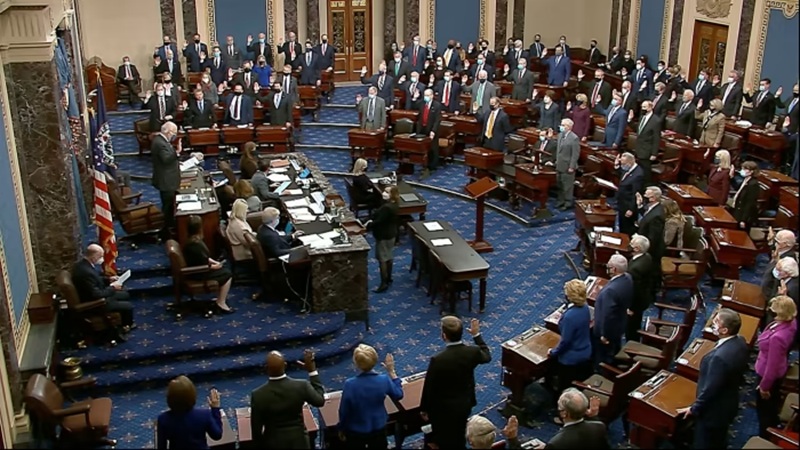
US Senate Working on A Bill to Curtail Big Tech Acquisition Flex

0

The fight to limit the intimidating power of the big tech has continued several months after it appeared to die down. The big names in the US tech space have been at the receiving end of government’s criticisms for using their financial power and influence to muzzle competition.

Prior to 2020 US elections, Democrat Senator Elizabeth Warren was at the forefront of the campaign to tame the ability of Google, Facebook, Microsoft and Amazon to bully competitors with their financial muscle. The campaign, which has become more like a moral cause, wants the giants to be held accountable on every move that results in stifling competition and promoting monopoly.

After many antitrust hearings and fines involving the big tech, debates on the best way to curtail their excesses have gone on in and outside the Congress for long. Now, members of Congress are working on a bill that will stem the tide, at least, one aspect of it.

The antitrust bill being pushed by a group of House Democrats, would force the biggest tech companies to change parts of their business models and curtail large acquisitions, according to copies obtained by CNBC.

CNBC reported that while the drafts could still change significantly prior to their introduction, as currently written, they could require business model overhauls for Apple and Amazon by limiting their ability to operate marketplaces for products and apps while selling their own goods and apps on those same stores.

They would also make it harder for those companies plus Facebook and Alphabet (Google’s parent company) to complete large mergers, and would force them to make it easier for users to leave their platforms with their data intact.

The draft bills come after a 16-month investigation by the House Judiciary subcommittee on antitrust into the four companies, which culminated in a nearly 450-page report from Democratic staff last fall. While Republicans on the subcommittee diverged from some of the Democrats’ more extreme proposals, several agreed with the main findings of monopoly power and anticompetitive behavior in the Democratic report and on the need to rein in Big Tech’s power with antitrust reform.

Facebook, Google, Amazon and Microsoft have all been caught in questionable acquisitions that stirred antitrust inquiries.

Democrats have been spearheading the push to curtail the influence of the big tech, while Republicans have been sitting on the fence, not openly supportive of their colleagues’ efforts nor the big tech.

The drafts don’t indicate whether any Republicans are supporting the bills.

What the draft bills say

Specifically, the five discussion drafts would prevent platforms from owning businesses that present a conflict of interest, bar large platforms from favoring their own products over those of competitors that rely on their sites, make it harder for large platforms to complete mergers, raise filing fees for acquisitions and mandate ways for users to transfer their data between platforms.

One of the bills, sponsored by Rep Joe Neguse, D-Colo., appears to be companion legislation to the bipartisan Merger Filing Fee Modernization Act in the Senate, which passed in that chamber on Tuesday as part of a larger $250 billion tech and manufacturing bill. That bill would raise the fees companies pay to notify the Federal Trade Commission and Department of Justice Antitrust Division of large mergers with the goal of raising money for those agencies.

The other four drafts obtained by CNBC include:

Ending Platform Monopolies Act: Sponsored by Rep. Pramila Jayapal, D-Wash., the vice chair of the subcommittee, this bill would make it unlawful for a platform with at least 500,000 monthly active U.S. users and a market cap over $600 billion to own or operate a business that presents a clear conflict of interest. The draft defines an unlawful conflict as one that incentivizes a business to favor its own services over those of a competitors’ or disadvantage potential competitors that use the platform. Lawmakers have previously expressed concern that both Amazon and Apple, which run their own platforms for sellers and developers, respectively, could undermine competition due to a conflict of interest for their own competing products or apps.

Platform Competition and Opportunity Act: This proposal from Rep. Hakeem Jeffries, D-N.Y., would shift the burden of proof in merger cases to dominant platforms (defined with the same criteria as the previous bill) to prove that their acquisitions are in fact lawful, rather than the government having to prove they will lessen competition. The measure would likely substantially slow down acquisitions by dominant tech firms.

Platform Anti-Monopoly Act: This bill, proposed by Subcommittee Chairman David Cicilline, D-R.I., would prohibit dominant platforms from giving their own products and services advantages over those of competitors on the platform. It would also prohibit other types of discriminatory behavior by dominant platforms, like cutting off a competitor that uses the platform from services offered by the platform itself, and ban dominant platforms from using data collected on their services that isn’t public to others to fuel their own competing products, among several other prohibitions.

Augmenting Compatibility and Competition by Enabling Service Switching (ACCESS) Act: This proposed bill from Rep. Mary Gay Scanlon, D-Pa., would mandate dominant platforms maintain certain standards of data portability and interoperability, making it easier for consumers to take their data with them to other platforms.

It is not clear if the bill will get the backing of Republicans, it will put a permanent nail to one big part of American tech industry antitrust issues.

Join Me Tomorrow As I Keynote FinBiz2030

0

Good People, remember to join me for Finance and Business 2030 (FinBiz2030) tomorrow. Launched in London, FinBiz2030 is a joint initiative of One Young World and Chartered Accountants Worldwide. Nigeria’s high priest on keeping good balance sheets and  P&Ls,  The Institute of Chartered Accountants of Nigeria (ICAN), is the Nigerian host.

Join us on Saturday, 12 June 2021 for a conversation on business sustainability, resilience and innovation. Nations rise when pioneering innovators emerge! And we want them to run the playbooks sustainably. Register free here.


Agrific Launches Platform To Facilitate Agro-Commodity Trading in Africa

0

We welcome the Block Process Limited team to Tekedia Mini-MBA even as they announce the launch of Agrific – a technology-driven agro-trading market place for agriculture commodities in Africa.

Agrific is a B2B2C platform that offers on-demand commodity supply-chain, connecting producers and offtakers with a platform that supports a fair exchange of value.  Agrific’s platform serves to build relationships between local farmers and major processors, aggregating commodities while paying attention to the unique specifications of the buyers. The system allows off-takers to fund the process of buying and selling what farmers have already harvested. This will give every farmer that has produced high quality farm produce, the opportunity to sell to major buyers through Agrific’s portal

Agrific firmly commits to the transformation of food and agriculture to achieve the SDG’s, by build an all in one import and export portal to facilitate international trade between Nigeria and the rest of the world  riding on a model that matches farmers to processors and off takers by eliminating several layers of intermediaries. By doing this, Agrific optimizes market access to African farmers and also improves their income by at least 45%.

Agrific’s unique proposition lies in its end-to-end integration, firmly consolidating all value chain actors in one platform inclusive of logistics, quality assurance, payment protection and insurance of all traders through its trusted partners.

The central system of the platform is a pipeline through which agro-commodities agreed to be sold, accessed and certified to be of the quality assured. Sellers have the luxury of customizing their catalogue with an alert system that enables them to engage real-time with potential buyers who are interested in the commodity they aggregate.

Buyers, depending on the quantity or quality needed, can either trade on the central system or use the demand-supply feature of the platform to buy their desired product.

To learn more about Agrific, please visit https://agrific.co

At Tekedia Institute, we are co-learning with Agrific Team and Linda I.A Obi as they begin this playbook for Africa. Welcome to the Institute.

Biden Reverses Trump’s Executive Orders on Chinese Apps, As China Announces Anti-Sanctions Law

0
The brand is growing

The US government is taking a new approach to its bilateral relationship with China, particularly on technology.

On Wednesday, the White House released a statement detailing president Joe Biden’s new executive order, easing the uncertainties of apps of Chinese origin operating in the United States, and altering former President, Donald Trump’s many executive orders targeting Chinese tech companies.

The shift from his predecessor’s approach comes with two new executive orders requiring the Commerce Department to review apps with ties to “jurisdiction of foreign adversaries” that may pose national security risks.

In August, Trump had issued executive order mandating short video app, TikTok to sell to US entities, as part of wider aim to stop the Chinese companies, including WeChat from operating in the United States. The second of Trump’s executive order announced in January, targeted eight Chinese services including WeChat’s payment feature, Tencent’s QQ messenger, and Ant Group’s Alipay wallet.

“The following orders are revoked: Executive Order 13942 of August 6, 2020 (Addressing the Threat Posed by TikTok, and Taking Additional Steps To Address the National Emergency With Respect to the Information and Communications Technology and Services Supply Chain); Executive Order 13943 of August 6, 2020 (Addressing the Threat Posed by WeChat, and Taking Additional Steps To Address the National Emergency With Respect to the Information and Communications Technology and Services Supply Chain); and Executive Order 13971 of January 5, 2021 (Addressing the Threat Posed by Applications and Other Software Developed or Controlled by Chinese Companies),” the statement said.

The bone of contention has been national security and protecting the privacy of American consumers from the Chinese military. While there was a bipartisan support for the move to protect Americans from data harvesting through tech companies by China, Trump style of stopping it was under question.

A District Court Judge had in November, enjoined the Commerce Department from barring data hosting, content delivery services and other technical transactions within the United States for TikTok.

TikTok has become a darling video platform, commanding millions of users, especially young people. Its popularity played a huge role in the ruling.

The judge ruled that Trump’s order would “have the effect of shutting down, within the United States, a platform for expressive activity used by approximately 700 million individuals globally. Over 100 million of these TikTok users are within the United States, and at least 50 million of these US users use the app on a daily basis.”

However, the ruling was just a reprieve, TikTok’s future in the US was still hanging on uncertainty until now.

While Biden reversed Trump executive orders, he also introduced new rules in their stead, elaborated to govern software applications and gadgets coming from other nations, not just China.

  • In evaluating the risks of a connected software application, several factors should be considered. Consistent with the criteria established in Executive Order 13873, and in addition to the criteria set forth in implementing regulations, potential indicators of risk relating to connected software applications include: ownership, control, or management by persons that support a foreign adversary’s military, intelligence, or proliferation activities; use of the connected software application to conduct surveillance that enables espionage, including through a foreign adversary’s access to sensitive or confidential government or business information, or sensitive personal data; ownership, control, or management of connected software applications by persons subject to coercion or cooption by a foreign adversary; ownership, control, or management of connected software applications by persons involved in malicious cyber activities; a lack of thorough and reliable third-party auditing of connected software applications; the scope and sensitivity of the data collected; the number and sensitivity of the users of the connected software application; and the extent to which identified risks have been or can be addressed by independently verifiable measures.

Meanwhile, SCMP reported that China’s top legislative body has passed an anti-sanctions law, providing legal backing for sweeping retaliation against any individuals, their families and organizations responsible for imposing foreign sanctions against the country.

The legislation was passed on Thursday at the closing session of the National People’s Congress (NPC) Standing Committee, but details of the law were not made public. The law was effective from Thursday.

It was the pattern that China had followed to counter Trump’s move to sell TikTok in August. China announced new restrictions on artificial-intelligence technology exports that further complicated the sale of TikTok’s U.S. operations, making it difficult for the US to singlehandedly make decisions on the sale of the video app.

The United States has been confronting Chinese cross-border operations with sanctions. The new law thus signals China’s readiness to protect the operations of its tech companies among other interests abroad, especially in the United States, even though Biden is taking a different route from Trump’s aggressive sanctions.

Skype Begins Collecting VAT for Nigeria

2

Skype has started collecting VAT for Nigeria.  It is important to note that the government has not even done anything but these global firms are already moving ahead to rectify the tax paralysis. While many do not think that Nigeria needs to ask for this small money, I want to continue to encourage the government to make its case. Nigeria carries the African flag as the largest economy and we have the capacity to be heard.

I expect Google to follow on its Play Store and just like that, we could get extra $millions. Expect Netflix to fix its own issues. This is not protectionism; this is fair commerce and there is nothing wrong with that.

Sure – I get it, it changes nothing because the money will be mismanaged. That is a topic for another day. But today, we simply want the money shipped to Nigeria first.