DD
MM
YYYY

PAGES

DD
MM
YYYY

spot_img

PAGES

Home Blog Page 572

Adeleke’s Three-Year Projects: On Allocation and (In)Equality

0
Osun local government

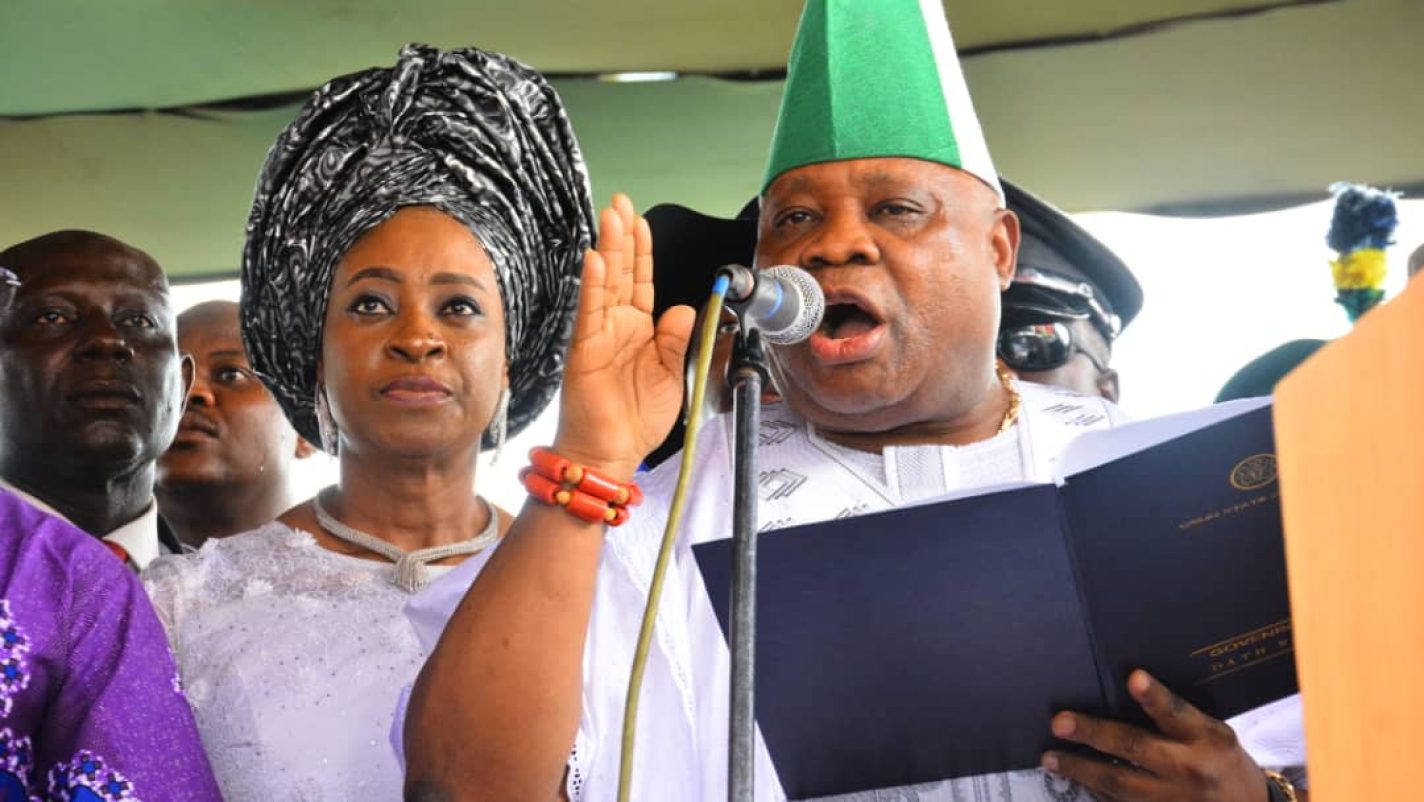
When Senator Ademola Jackson Adeleke took office as governor of Osun State in November 2022, expectations for rapid development were high. Almost immediately his administration announced water provision in all 332 wards, a promise designed to signal that even the most remote communities would feel a change in daily life. Within his first year, a N100 billion infrastructure plan was rolled out. It included new flyovers, forty-five township roads, rehabilitation of thirty-one schools and extensive upgrades of primary health centres across the state.

In March 2025 the government unveiled Phase Two of its infrastructure programme valued at N159 billion. This second phase earmarked over N101 billion for road construction, N2.76 billion for the refurbishment of 124 primary health centres and precise figures for a handful of high-profile schools. Ede High School Hall and Pavilion was allocated N50.2 million, Agbonran School of Science in Ede South N200 million, Ogedengbe School of Science in Ilesa N137 million and Oranmiyan Memorial Grammar School in Ile-Ife N149.5 million. The Imole Agropreneur initiative, launched in late 2024, promised to open 31,000 hectares to mechanised farming and agro-processing, a signal that agriculture remains central to Osun’s long-term economic vision.

Distribution Across the State

A closer look at where projects are sited reveals both a wide reach and recognisable patterns. Osun Central has benefited from significant carriageway work. The Osogbo–Ikirun–Ila-Odo road remains the flagship corridor linking the capital to key markets, while township arteries such as Oja-Oba and John Mackay Street have been resurfaced. In Boluwaduro the Iresi Township road has been rehabilitated, providing relief for agrarian communities.
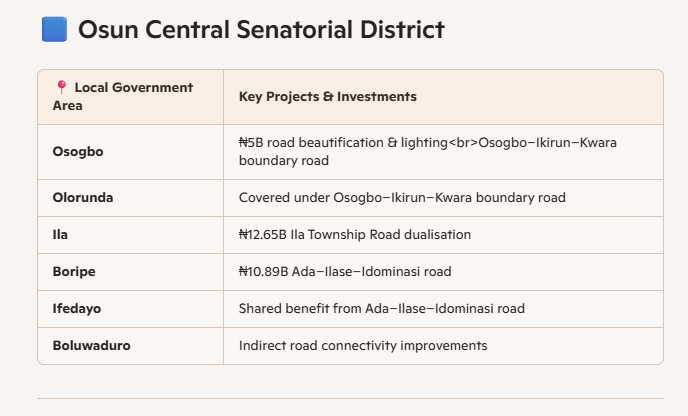
Osun East has witnessed improvements on a smaller but notable scale. In Ile-Ife, the Enuwa–Oniyangi–Ita-Osun link has improved local traffic, while Ilesa has seen work on the Atakunmosa Market road and Obiteni–Omo Ofe route. Two major secondary schools in this zone, Ogedengbe and Oranmiyan, have secured explicit allocations for full renovation.

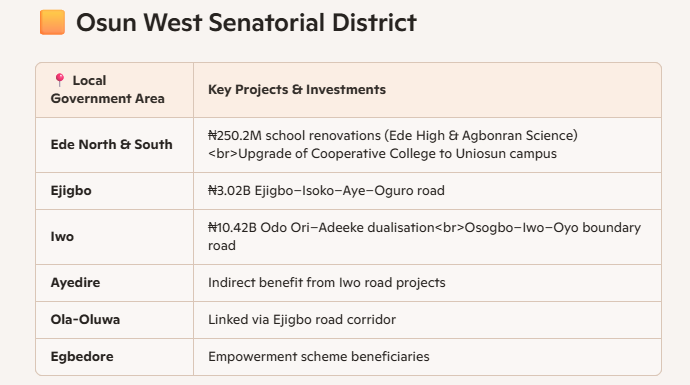
Osun West has attracted dense urban attention. Ede North and South boast a cluster of resurfaced roads, including Akankan–Obada, Anu-Olu–Obada–Alusekere and Ogberin–Akala–Oloki, alongside the Akoda–Ido-Osun dual carriageway stretching roughly twenty-three kilometres. Iwo has received the Ansarudeen Junction–Hospital Road upgrade and a planned dualisation linking Odo-Ori to the palace area. The borehole initiative claims to touch every ward across all thirty local government areas, though assessments of functionality have been mixed.
Balancing Equality and Equity

On paper these investments suggest that the administration has attempted an even hand. In practice the distribution reflects population density and political calculus. Osogbo, as the capital, absorbs the lion’s share of major carriageways and beautification. Ede, the governor’s hometown, is heavily represented in road resurfacing and school renewal. Iwo and Ila benefit from new dualised corridors while some smaller local governments appear only in aggregated project lists with few headline announcements.
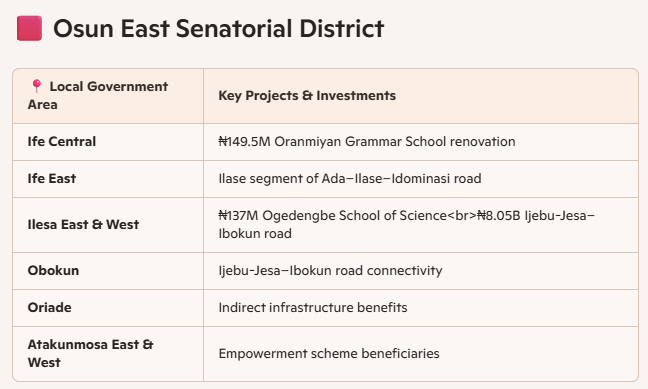
Equity sometimes justifies unequal spending when economic hubs require heavier investment. However, perceptions of fairness matter in a state with diverse constituencies. Residents in Oriade or Ifedayo occasionally point to limited visible footprints, fuelling quiet concerns that resource flows tilt toward the inner ring of LGAs. A statewide commitment to balanced visibility will determine whether the narrative remains one of inclusion or of quiet grievance.

Transparency and the Way Forward

One persistent gap is the lack of detailed contract disclosure. Apart from select school figures and the primary health centre totals, there is little itemised cost information per kilometre of road or per project site. Citizens are left to piece together press statements rather than access a public dashboard of spending and completion rates. In an era when open governance strengthens trust, such opacity can erode otherwise genuine achievements.
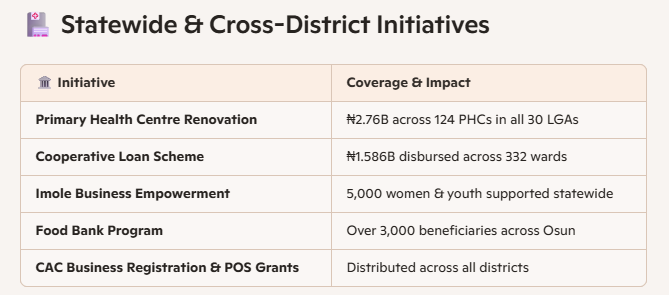
Adeleke’s administration deserves credit for packaging road, education, health and agricultural interventions into coherent phases. The focus on Osogbo’s urban competitiveness and the bold agricultural pivot can create long-term growth if consistently funded. Yet the next frontier is evidence-based equity. Publishing ward-by-ward audits of borehole functionality, real-time road progress reports and transparent contract sums would convert political messaging into verifiable fairness.

The governor’s first three years prove that ambition is not lacking. The real test lies in demonstrating that every naira has translated into concrete, evenly spread development. Equality of access will not be declared by press releases alone but by clear, accessible data showing that communities from Iwo to Ifedayo share in the dividends of public investment.
A Look At Warnings From Max Keiser and Robert Kiyosaki About Europe’s Economic and Social Decline

0
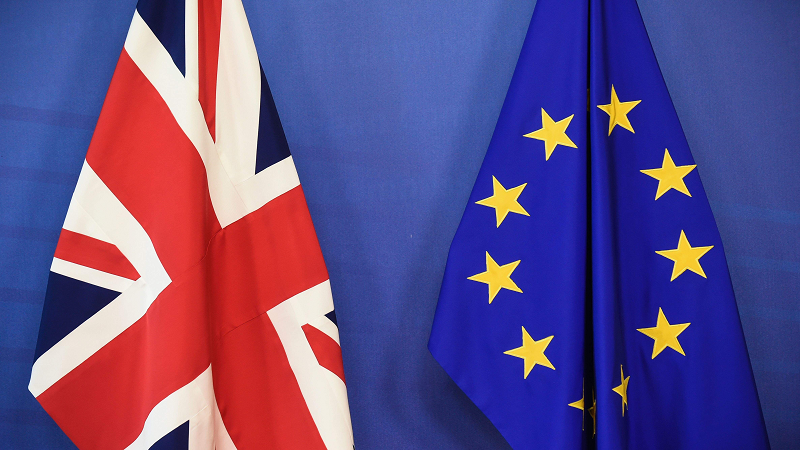
EU and UK has been policing US digital firms

Robert Kiyosaki, author of Rich Dad Poor Dad, has warned that Europe is facing severe economic and social turmoil, citing collapsing bond markets, failing energy policies, and rising unrest in countries like France, Germany, and the UK.

He claims France is on the brink of bankruptcy, Germany’s manufacturing sector is crippled by energy issues, and UK bonds have dropped over 30%. Kiyosaki argues that the traditional 60/40 portfolio (stocks and bonds) is no longer safe, urging investors to turn to gold, silver, and Bitcoin to protect their wealth.

He also notes a global loss of confidence in Western nations’ ability to manage debt, with Japan and China reportedly selling US Treasuries in favor of precious metals.

Max Keiser, a Bitcoin advocate and advisor to El Salvador’s President Nayib Bukele, amplifies Kiyosaki’s warnings, framing Europe’s struggles as part of a “Fourth Turning,” a generational cycle of systemic crisis.

Keiser suggests investors move their wealth to Bitcoin and consider relocating to El Salvador, the first country to adopt Bitcoin as legal tender, as a safe haven from collapsing fiat systems. He highlights El Salvador’s progress, including a 98% drop in homicides and President Bukele’s 92% approval rating, positioning it as a stable, Bitcoin-friendly hub.

Some crypto educators, like NianNian Academy, acknowledge these concerns but advocate for a balanced approach, questioning whether the world faces a “monetary reset” or a deeper crisis first. Critics on X have drawn parallels to historical empire collapses, citing excessive debt, wars, and detached leadership as recurring themes.

However, skepticism exists about Keiser’s claims, with older posts from 2021 accusing him of misleading statements, such as claiming to have bought a home in El Salvador when it was allegedly in Costa Rica.

While Kiyosaki and Keiser’s warnings reflect real economic pressures—bond market declines, geopolitical tensions, and debt sustainability issues—their apocalyptic tone and Bitcoin-centric solutions are debated. El Salvador’s Bitcoin experiment, including its strategic reserve and new laws allowing banks to hold crypto, is seen as innovative by supporters but risky by others.

Kiyosaki’s claim that the 60/40 portfolio (stocks and bonds) is failing reflects real pressures in bond markets, with UK bonds reportedly down over 30% and European markets facing volatility. This suggests declining confidence in fiat-based assets, pushing investors toward alternatives like gold, silver, and Bitcoin.

Investors may need to reassess risk in traditional portfolios, potentially diversifying into hard assets or cryptocurrencies. However, Bitcoin’s volatility introduces its own risks, requiring careful due diligence.

Keiser’s push for Bitcoin aligns with El Salvador’s adoption of it as legal tender and its strategic reserve policies. If global distrust in fiat currencies grows, Bitcoin could gain traction as a decentralized store of value. Increased adoption of cryptocurrencies may accelerate, but regulatory crackdowns or market crashes could undermine this trend.

Keiser’s call to “flee to El Salvador” suggests a shift of wealth to jurisdictions with crypto-friendly policies and perceived stability. El Salvador’s falling homicide rates and Bitcoin integration make it attractive to some. Wealthy individuals or institutions may explore relocating assets or operations to countries like El Salvador, but logistical challenges and skepticism about Keiser’s motives warrant caution.

Kiyosaki’s assertion that Europe is “toast” and Keiser’s “Fourth Turning” narrative point to a broader decline in Western financial systems, exacerbated by debt, energy crises, and geopolitical tensions. Reports of Japan and China selling US Treasuries suggest a shift in global economic power.

Emerging markets or crypto-friendly nations like El Salvador could gain influence if Western economies falter. However, this risks destabilizing global trade and alliances, potentially fueling protectionism or conflict.

El Salvador’s Bitcoin adoption, low crime rates, and Bukele’s high approval rating position it as a potential model for small nations seeking economic sovereignty. New laws allowing banks to hold crypto further this narrative.

Warnings of collapse and calls to flee to Bitcoin or El Salvador could amplify public fear, especially amid real issues like inflation and energy costs in Europe. X posts comparing current crises to historical empire collapses fuel this narrative.

Keiser’s suggestion to move to El Salvador could appeal to crypto enthusiasts or digital nomads seeking low-cost, stable environments. El Salvador’s safety improvements and crypto infrastructure make it a candidate. A niche but growing trend of “crypto migration” could emerge, reshaping demographics in places like El Salvador.

Document Your Tekedia Mini-MBA Journey: Request Your Verified Certificate

0

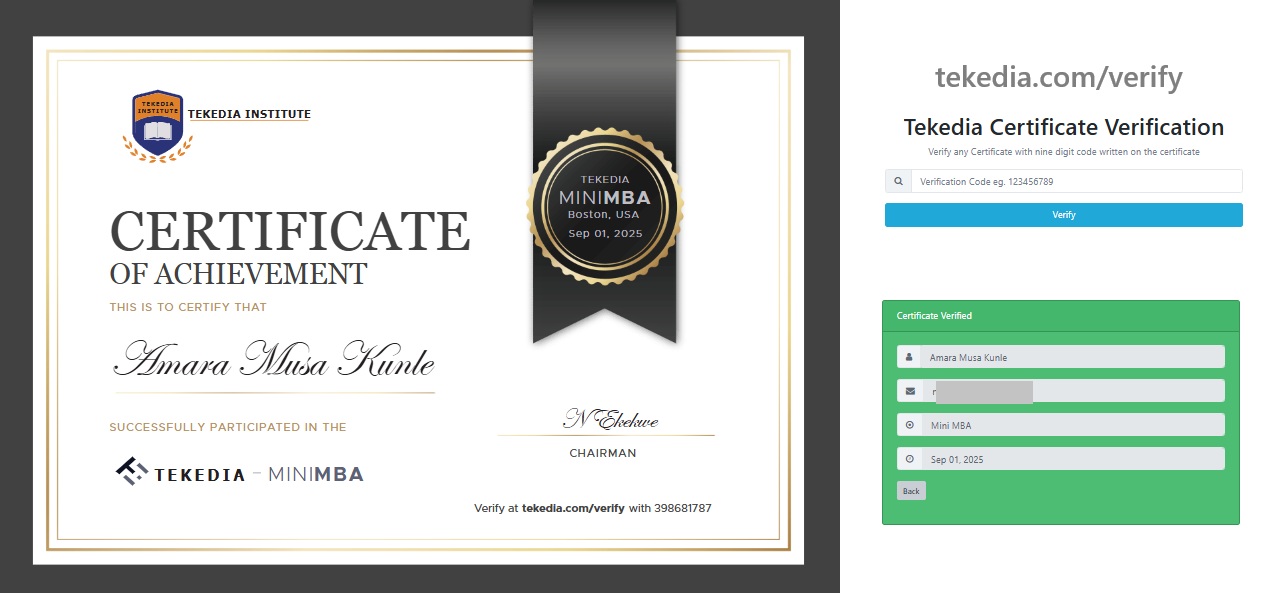
My Fellow Co-learners, congratulations again for completing Tekedia Mini-MBA yesterday. The certificates are now ready, and you can request yours. This is one thing we do not fully automate here. Yes, we want you to write and request for it, and until you do, you will not get it.

Remember: the graduation is not just the end of the program; it is the beginning of a new chapter in the lives of innovators, builders, and leaders. At Tekedia Institute, we remain humbled by the journey our learners have undertaken. For months, you immersed yourself in the mechanics of markets, the constructs of strategy, and the evolving frontier of Artificial Intelligence. Today, as a graduate of Tekedia Mini-MBA, you are equipped with the capabilities to lead, redesign sectors, and create value across economies.

The next step is to document that journey with a tangible symbol – your Tekedia Mini-MBA certificate. This certificate is more than paper; it is a credential engineered for the modern business age. Each certificate carries a unique code, enabling employers, partners, and collaborators to instantly verify its authenticity. In a world where trust is currency, Tekedia ensures your achievements are protected and verifiable.

We invite all graduates to request their certificates. The process is seamless, and once received, you hold not just proof of completion, but also a lifelong marker of professional advancement. At Tekedia, we design for the future, and our auto-verifiable certificates exemplify that future where credentials travel across borders with credibility.

Request yours today. Celebrate your learning. Document your achievement on your LinkedIn profile. And let the world know: you are Tekedia-trained, and you are #ready2lead. Congrats again.

Ethereum Flip-top Bitcoin on 7-Day CEX Spot Trading Volumes

0

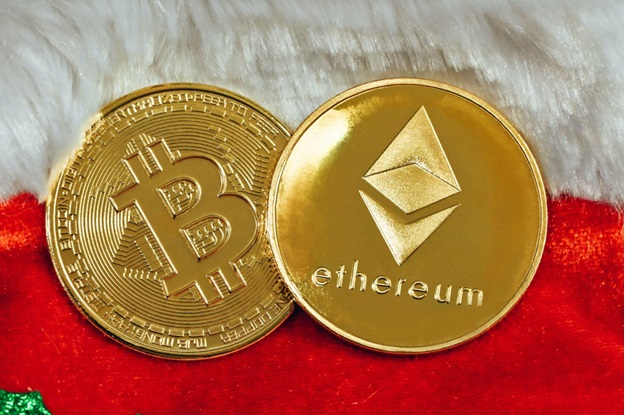
Ethereum (ETH) surpassed Bitcoin (BTC) in 7-day centralized exchange (CEX) spot trading volume for the first time in over seven years, with ETH recording nearly $480 billion compared to BTC’s $401 billion.

This shift, often referred to as a precursor to “the flippening,” was driven by strong institutional demand, including significant ETH purchases by corporate treasuries like BitMine Immersion and SharpLink Gaming, and $3.95 billion in net inflows to U.S. spot ETH ETFs, contrasting with $301 million in outflows from BTC ETFs.

Ethereum’s outperformance, with a 105% year-to-date price gain versus BTC’s 18%, reflects its appeal as a high-beta asset in a risk-on environment, bolstered by its DeFi utility, staking yields, and upgrades like Dencun and Pectra. The ETH/BTC ratio reached 0.039, signaling growing market confidence in ETH, though Bitcoin retains its dominance as a store of value.

The surge in ETH trading volume signals growing investor confidence in Ethereum’s ecosystem, driven by its utility in DeFi, NFTs, and smart contracts. This could foreshadow a broader shift in perception, with ETH increasingly viewed as a competitive alternative to BTC, not just a complementary asset.

Ethereum’s DeFi ecosystem leverages smart contracts—self-executing code on the blockchain—to enable trustless, transparent, and permissionless financial tools. Here’s a breakdown of DeFi’s utility, particularly in the context of Ethereum’s role in the recent ETH trading volume surge:

Key Aspects of DeFi Utility

Platforms like Aave and Compound allow users to lend crypto assets to earn interest (e.g., 3-10% APY on stablecoins) or borrow against collateral without credit checks. For example, users can deposit ETH as collateral to borrow USDC, enabling leverage or liquidity without selling assets.

DEXs like Uniswap and SushiSwap enable peer-to-peer trading of tokens without intermediaries. Users swap ETH for other tokens (e.g., USDT, DAI) using automated market makers (AMMs), which rely on liquidity pools.

Users can stake ETH in DeFi protocols or Ethereum’s proof-of-stake network to earn rewards (e.g., 3-5% annualized staking yield). Yield farming involves providing liquidity to pools for additional token rewards.

DeFi supports stablecoins like USDC and DAI, pegged to fiat currencies, for low-cost, near-instant cross-border transactions. Ethereum hosts over 60% of stablecoin supply (e.g., $80 billion in USDC). This enables efficient remittances and payments, increasing ETH demand as gas fees.

Platforms like Synthetix allow users to create and trade synthetic assets (e.g., tokenized stocks, commodities) using ETH as collateral. Perpetual futures on dYdX offer leveraged trading. This expands investment opportunities beyond crypto, attracting institutional and retail interest, boosting ETH’s CEX volume.

ETH’s role as the primary currency for DeFi transactions (e.g., gas fees, liquidity provision) drives demand on centralized exchanges, where users buy ETH to participate in DeFi. The $480 billion 7-day CEX volume in August 2025 reflects this.

DeFi’s high yields and diverse use cases attract institutions, as seen with ETH ETF inflows ($3.95 billion). Firms like BitMine Immersion buying ETH signal DeFi-driven demand. Ethereum’s Dencun (2024) and Pectra (2025) upgrades reduced transaction costs and improved scalability.

DeFi democratizes finance, allowing anyone with an internet connection to access sophisticated tools, boosting ETH’s global adoption. DeFi’s complexity and regulatory uncertainty pose risks, but Ethereum’s dominance mitigates this through robust security and developer activity.

DeFi’s growth fuels ETH’s price (up 105% YTD in 2025) and volume, challenging BTC’s store-of-value narrative with a utility-driven one. Ethereum’s DeFi utility lies in its ability to power a wide range of financial services—lending, trading, yield generation, and more—driving its recent CEX volume surge and reinforcing its position as a high-utility blockchain asset.

Strong institutional interest, evidenced by corporate ETH purchases and significant inflows into ETH ETFs, suggests Ethereum is gaining traction as a portfolio asset. This could pressure Bitcoin’s dominance if institutions diversify away from BTC’s store-of-value narrative toward ETH’s broader use cases.

While ETH’s volume spike fuels speculation about “the flippening” (ETH overtaking BTC in market cap), Bitcoin’s $1.2 trillion market cap still dwarfs ETH’s $468 billion. However, a rising ETH/BTC ratio (0.039) indicates Ethereum is closing the gap, potentially challenging BTC’s dominance if trends persist.

BTC’s lower volume and ETF outflows reflect a more cautious market stance, possibly due to its role as a stable store of value in a volatile crypto market. If risk-on sentiment continues, ETH’s higher beta could sustain its momentum, but a risk-off environment might favor BTC.

Increased ETH liquidity on CEXs could reduce volatility and improve price discovery, benefiting traders. However, it may also signal speculative fervor, raising risks of a correction if macroeconomic conditions tighten.

Overall, this milestone highlights Ethereum’s growing influence but doesn’t guarantee a permanent shift. Bitcoin’s entrenched position and distinct value proposition suggest coexistence, though ETH’s momentum could reshape market dynamics long-term.

Presale Spotlight: Avalon X’s RWA Utility vs Ethereum L2s

0

Ethereum is still the centre of DeFi discussion, now trading above $4,300 in 2025 and still dictating the sentiment of all other alts. DeFi has witnessed the Ethereum ecosystem expand with Layer 2 technologies that lower costs and increase throughput, but despite the promising underlying technology, it still falls within the infrastructure category.

This is where Avalon X (AVLX) enters with a new model, an RWA token connecting crypto assets with the $379 trillion global real estate market, but with physical exposure and digital utility.

Ethereum Price & the Expansion of Layer 2s

Ethereum price is a reflection of Ethereum dominance within DeFi and NFT worlds, and Layer 2 offerings such as Arbitrum and Optimism offer inexpensive transactions. Analysts anticipate the price of ETH to gain from this scaling effort, although the upside is still linked with larger adoption cycles.

The advantage of Ethereum is that it is a general-purpose chain. That said, compared to a concentrated RWA token like Avalon X, direct real-world exposure is not unlocked by the ETH. That contrast is why many investors track both narratives: digital infrastructure growth versus real-world tokenization through presales.

Source: Tradingview

Avalon X: Backed by Grupo Avalon’s Real Estate

Avalon X (AVLX) builds its credibility through Grupo Avalon, a developer with close to $1 billion in its real estate project pipeline. Its track record includes $110 million in completed sales, $548 million in active developments, and $385 million in its pipeline. This foundation gives the RWA presale a level of substance that speculative projects often lack.

Presale launches AVLX at only $0.005 during Stage 1, with exposure to luxury real estate and lifestyle benefits. Token holders receive access to reduced-stay rates, personalized service, and entry to a raffle of a deeded townhouse within the gated Eco Avalon project, locked up on-chain for visibility.

Avalon X has undergone a CertiK audit that instils trust in its smart contract architecture. For a space that has been accused so often of promising all and delivering little, independent validation makes a big difference. Through the merging of audit-supported security and the proven experience of Grupo Avalon, this RWA token sets itself apart from speculative projects.

Dual Rewards: Staking and Presale Bonuses

Avalon X encompasses mechanics that go beyond possession. There is a staking income of up to 15% available to investors, and presale levels offer up to a 25% bonus AVLX. This combination of staking revenue and additional allocation makes the presale more than a speculative sale; it is a yield model of a structured kind.

The tokenomics bring discipline: a static supply of 2 billion tokens, of which 60% go to presale and 7% are reserved for burns. These only guarantee scarcity at a later date and fortify the AVLX price proposition against inflationary models.

$1 Million Giveaway Sets the Stage

The project has launched a $1 million giveaway designed to drive presale interest and reward early adopters. The prize pool includes:

  • $1 million in AVLX tokens
  • A fully deeded Eco Avalon townhouse

Eco Valley Townhouse Giveaway

This is a one-time distribution that highlights exclusivity. After being distributed once, no other pool shall be generated, affirming the scarcity backing long-term AVLX price growth.

Why Avalon X Could Outpace ETH Price Gains

Real-world asset tokenization is projected to grow to $16 trillion by 2030 and potentially $30 trillion by 2034. Avalon X positions itself at the centre of that movement, bringing property access, lifestyle perks, and disciplined tokenomics into one package.

While the ETH price continues to benefit from L2 adoption and remains the backbone of decentralised infrastructure, Avalon X taps into a different story, bridging blockchain with tangible real estate.

With Grupo Avalon’s billion-dollar pipeline, 15% staking rewards, 25% presale bonuses, CertiK audit, fixed supply, a 7% burn allocation, and a headline $1M giveaway, AVLX is being highlighted as the RWA token to watch in 2025.


Join the Community

Website: https://avalonx.io/

$1M Giveaway: https://avalonx.io/giveaway

Telegram: https://t.me/avlxofficial

X: https://x.com/AvalonXOfficial