Many of us believe that forgiveness is a religious obligation. As Christians, we are made to believe that if you fail to forgive someone for the pain he or she caused you, God will fail to forgive us for causing Him pains too. We also learnt that people who do not forgive others will not inherit the Kingdom of God. We also learnt that if you do not forgive, blessings will never come your way. Those that are more spiritual than many of us can also tell you how forgiveness cleanses and frees the soul so that the forgiver benefits more from the act than the person that was forgiven. All these points out the importance of forgiveness. And they are true; at least to the best of my knowledge.
But, then, are the points listed above the only benefits of forgiveness? Is forgiveness all about spirituality? Do we only have to forgive because we want to make Heaven or reap abundant blessings here on Earth? What other benefits does forgiveness have?
Fortunately, forgiveness is a virtue with benefits that span across all aspects of our lives. It doesn’t start and end with religion and spirituality. Our health, relationships, and growth depend on that simple act.
Forgiveness in Health
Forgiveness, as we all know, is the replacement of negative emotions towards wrongdoings with positive ones. It is letting go of the anger you have for an offense and grudges you bear the offender. This means that when you fail to forgive, you plunge yourself, and not the person that is not forgiven, into toxicity. You allow yourself to be eaten up by anger and pain, and if you leave them to stay longer, you are the one that will be miserable. Of course, when anger becomes too intense, it leads to crime, high blood pressure, anxiety, loss of control of your actions, loss of creativity, depression, wrong perception of objects and sounds, and so on. Imagine the impact these will have on your health and wellbeing just because you decided to hold onto your anger. By the end of the day, you will gain nothing but lose it all.
Forgiveness in Social Life
One thing you will agree with me about is that you avoid people you hold grudges for. You distance yourself from anything that has to do with them. You may even begin to say negative things about an offender without realizing the damages you are causing your image. Because of your constant complaints about wrongs done to you, other people will begin to avoid you too. Even if the offender was wrong, people expect you to forgive and move on. But because you failed to do so, you will be left alone to wallow in your bile. No one wants to relate with a grouch.
Forgiveness in Business and Career Growth
One of the reasons we are always advised to forgive others is to keep doors open for transactions. Like we know, the person you meet today can be the person that will win you that contract tomorrow. Many people have lost business opportunities because they didn’t know how to subdue their negative emotions and let go. Some bosses have also lost good employees because they want to “deal” with them for offenses they could have easily have overlooked. If we can remember that people will continue to offend us, we will not hesitate to ignore some offenses.
But there is something about forgiveness that needs to be touched here. A lot of misinterpretations have been given to that term. Some definitions see forgiveness as a replacement of negative actions with positive ones. Well, allow me to say that forgiveness is not measured by actions. You don’t have to exhibit positive actions to show that you have forgiven a person. For instance, no one is asking you to start relating with a person that hurts you after you forgave him or her. No one is also saying you must present gifts to people to show that they have been forgiven. Of course, you should exchange pleasantries with the person, speak well about him or her, if you have to, attend functions together, but remember to keep a measurable distance to avoid being hurt again. After all, you need to protect your sanity.
Forgiveness is a personal thing. It is a transformation of your mind. You are the one to reap its benefits. At the same time, you are the one to suffer the consequences of unforgiveness, if you hold onto your anger.
This is hard news and a big revelation: “The Nigerian National Petroleum Corporation (NNPC) has said that it will remit nothing into the federation account in the month of May due to costs incurred from subsidy payments on petrol. The NNPC made this known in a letter written to the Accountant-General of the Federation, where it explained that it recorded a value shortfall of N111bn in February 2021. The shortfall, the NNPC said, will affect its contributions to federal allocations to states for April and May.”
The letter, seen by PREMIUM TIMES, was dated April 26 and signed by NNPC Chief Financial Officer, Umar Isa. Those copied in the letter include the Minister of Finance, Budget, and National Planning; the Director General, Nigeria Governors Forum; the Director Home Finance; and the Chairman, Commissioners of Finance Forum.
“The Accountant General of the Federation is kindly invited to note that the average landing cost of Premium Motor Spirit (PMS) for the month of March 2021 was N184 per litre as against the subsisting ex-coastal price of N128 per litre, which has remained constant notwithstanding the changes in the macroeconomics variables affecting petroleum products pricing,” the NNPC said.
“As the discussions between Government and the Labour are yet to be concluded, NNPC recorded a value short fall of N111,966,456,903.74 in February 2021 as a result of the difference highlighted above. Accordingly, a projection of remittance to the Federation for the next three months is presented in the attached schedule.
“Accordingly, the AGF is invited to note that the sum of N111,966,456,903.74 will be deducted from April 2021 Oil and Gas Proceeds due to the Federation in May 2021, which will translate to zero remittance to the Federation Account from NNPC in the month of May 2021.”
What can Nigeria do now to fill the void or do we expect another level of strikes as state workers go unpaid for months? These are real economic fractures because such calls from NNPC make it evident that Nigeria is not properly designed.
I mean, how can you just sleep month-long, only to wake up and travel to Abuja, drop your bank account number, and magically someone pays you, because you are a governor of a state. Within three days, you share that money. And then begin to sleep again, waiting for another end of the month. Twenty six states in Nigeria did not record FDI in 2020; Adamawa was among the outperformers for attracting just $20,000.
Twenty-six Nigerian states recorded zero foreign investment in the whole of 2020, figures released by the National Bureau of Statistics show.
The report on capital importation into the country, compiled by the Central Bank of Nigeria, was released on Friday by the NBS.
Will President Buhari use this letter from NNPC to call our parliament to begin a conversation on fiscal federalism towards deepening our productivity by exploiting our comparative advantages? This letter from NNPC will become more common as very soon, the world will move on from oil. So, now is the moment for Mr. President to begin to create Nigeria’s future if he wants to predict that future.
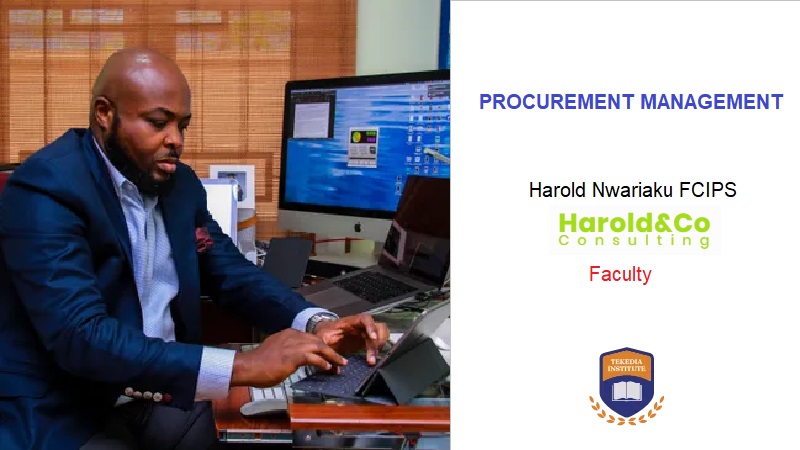
Just to update that our esteemed faculty, a zen-master of corporate procurement management, is finalizing his course on Procurement Management. This course is extremely important because How, Where, What & When you buy could become a competitive advantage for any business. Tekedia Institute Harold Nwariaku FCIPS is a leader in this space.
Mr. Nwariaku was formerly the Procurement Portfolio Manager, Guinness Nigeria Plc; Senior Manager Procurement, MTN Nigeria; Senior Purchases Manager W/Africa, Procter & Gamble; and today is the Lead Consultant at Harold & Co Procurement/Supply Chain Consulting.
Harold is a graduate of University of Nigeria Nsukka (BSc Accountancy) and Cranfield University (MSc Logistics & Supply Chain Management).
In markets, it is all about demand and supply, managed through allocation of factors of production. Procurement is a very critical part of that system. This course will help innovators, project champions, CEOs, members, etc run an efficient procurement process within their supply chain systems.
Experience a world-class education. Learn from the best, learn at Tekedia Institute Mini-MBA.
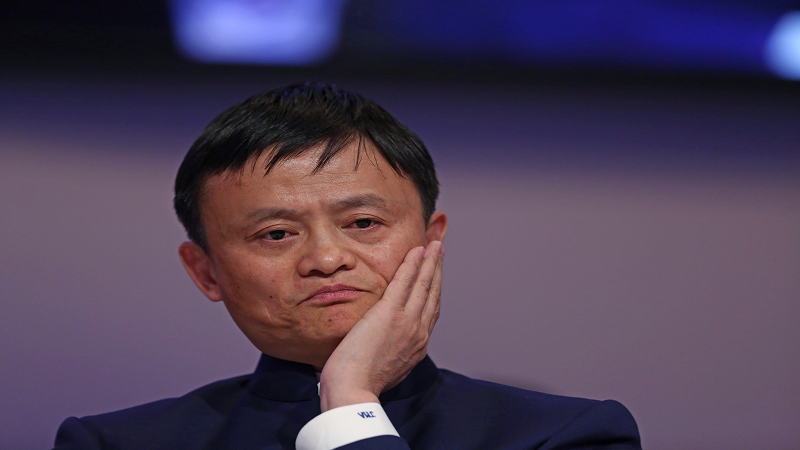
Just when it seems Jack Ma’s troubles with the Chinese authorities are over, a fresh one has begun. Wall Street Journal reported Tuesday, citing sources, that Beijing has launched another probe on Ant Group, with focus on how Jack Ma won speedy permission for stock listing last year.
WSJ’s report said the central-government investigation, which started early this year, focuses on regulators who greenlighted the initial public offering, local officials who advocated it and big state firms that stood to gain from it. Mr. Ma’s relationships with these state stalwarts are being examined as part of the scrutiny, according to the people familiar with the matter.
China’s recent change of attitude toward its online industry has more than a regulatory message, as it also signals a deterrent warning to big shots in the tech industry who would attempt dissent. Mr. Ma has been on top of the list following his outburst late last year, when he criticized regulators for having a “pawnship” mentality of using collateral instead of advanced credit ratings and scolded watchdogs for not knowing the difference between regulation and supervision.
The criticism ignited a clampdown that is not only hunting Mr. Ma and his conglomerate, but the entire Chinese tech industry.
The probe means uncertainty continues to loom over the future of Ant and controlling shareholder Mr. Ma. The usually flamboyant entrepreneur has kept a low profile since the IPO was stopped last-minute in November. He won’t be allowed to leave China until Ant completes a business overhaul ordered by regulators and the government’s investigation is over, the people say.
WSJ’s report gives further details of the probe that will likely make life harder for the embattled tech billionaire.
The Events Behind The Probe
In the eyes of China’s top leadership, Ant’s business model, in which lending is driven by big data, endangers the country’s financial system—in part because the company’s banking partners assume most of the risk. Leaders are also concerned that those who stood to benefit from what would have been the world’s largest IPO include a coterie of well-connected individuals and institutions, some influential political families in China and big state funds.
Mr. Ma managed to push the Ant IPO application through various levels of securities regulators in a relatively short time—even as banking regulators were voicing concerns about the business model and were preparing tougher regulations for companies like Ant. The wait to be listed in China is often many months or longer.
“What happened is deeply embarrassing for regulators because they should have more effectively coordinated before approving the IPO,” says Martin Chorzempa, a research fellow at the Peterson Institute for International Economics who specializes in China’s financial-technology sector.
“By not doing so,” he added, “they were stuck in a lose-lose situation of either the last-minute pause or, worse, forcing massive losses on IPO investors by changing the regulatory stance post-IPO.”
Since halting Ant’s IPO late last year, President Xi Jinping has presided over one meeting after another in which he stresses that big technology firms must be prevented from using their size, capital and troves of data to engage in anticompetitive practices. He has urged underlings to target the financial sector this year for any impropriety.
Alibaba Jack Ma
Listing standards and procedures set by both the China Securities Regulatory Commission and stock regulators in Shanghai are now under scrutiny.
One focus is Shanghai’s STAR Market, where Mr. Ma had planned to list Ant, along with Hong Kong’s stock exchange. Initially, the STAR board was seen as a savvy choice. It was created at the height of the U.S.-China trade war to help Chinese tech companies raise money and better compete with their American peers, and local officials and securities regulators knew its importance to the top leadership: Mr. Xi himself had announced the decision to launch in late 2018. According to officials with knowledge of the process, one of the few people he had discussed the STAR plan with before the announcement was Shanghai Communist Party chief Li Qiang.
Mr. Li is seen as a rising political star, trusted by Mr. Xi. But as a former governor of Zhejiang province, home to Mr. Ma’s empire, Mr. Li has also been supportive of the entrepreneur and his businesses.
In 2018, the Shanghai government signed a strategic-cooperation agreement with both Ant and Alibaba Group Holding Ltd., the e-commerce giant founded by Mr. Ma. In a meeting with Mr. Ma around that time, according to a release by the Shanghai government, Mr. Li and Shanghai’s mayor both pledged to “fully support” Mr. Ma’s business in the city. Inside Ant, the code name for the company’s listing plans was “Project Star.” And Mr. Ma’s plan to list Ant on the new Shanghai board sailed through the regulators.
The local securities watchdog in Zhejiang spent about a week in mid-2020 reviewing and advising on the IPO plan. On Aug. 25, Ant submitted its listing prospectus to the STAR Market and to the stock exchange in Hong Kong. Less than a month later, Shanghai regulators completed their audit of the application, enabling Ant to jump ahead of earlier applicants.
The probe also examines how an array of state funds, including massive sovereign-wealth fund China Investment Corp. and the country’s largest state insurers—among them China Life Insurance Co.—got to invest in Ant, the people familiar with the matter say. The mandate of CIC, for instance, is to invest overseas rather than domestically.
Mr. Xi has been wary of his government’s financial stewardship since coming to power in late 2012. A stock-market crash in 2015, which reverberated around the world and prompted massive state intervention, deeply embarrassed the leader. More recently, an enormous state firm tasked with cleaning up bad debt, China Huarong Asset Management Co., itself has been mired in hundreds of billions of dollars in debt due to a history of mismanagement.
The way Ant’s IPO application was handled fueled Mr. Xi’s concerns that the state’s interests weren’t being adequately protected.
Complaints to regulators about Ant’s IPO-marketing process didn’t markedly slow down the approval process. At issue was the way the company used its popular Alipay payment app to raise nearly $9 billion from individual investors in five mutual funds that planned to subscribe to the IPO. Some banks complained that the arrangement essentially meant the company was underwriting its own IPO.
Ant at the time denied any impropriety, saying the mutual funds operated independently and made their own investment decisions, and that the related details were fully disclosed. Having looked into the matter, the China Securities Regulatory Commission in late October greenlighted the Hong Kong portion of Ant’s listing plan—the last regulatory approval needed for the stock sale.
“The Ant IPO incident shows that certain rules and regulations are still lacking as we develop the financial markets,” says an adviser to the State Council, China’s cabinet. “Financial security must be ensured.”
In a January speech at the Central Commission for Discipline Inspection, Mr. Xi singled out the financial sector as an area of focus his year.
“It’s necessary to continue to cement the main responsibilities of financial-management departments, regulatory agencies, local party committees and governments,” he told the country’s top graft busters.
The probe of the Ant approvals started soon after. It isn’t clear whether any individual involved in approving or otherwise facilitating Ant’s IPO will be held accountable, the people familiar with the investigation say.
So far, the probe has led the China Securities Regulatory Commission to tighten the STAR Market’s listing requirements to ensure that only companies whose main business is technology are traded there. After Ant’s IPO plans were scuttled, the five mutual funds that had raised funds to invest in the deal returned more than $3 billion to investors who wanted their money back.
An upshot, say analysts: Ant, which is being revamped as a financial holding company subject to the same kind of regulations as banks, is unlikely to gain approval to list on STAR in the future.
In Shanghai, the mood has shifted. At the city’s Pudong International Airport, a poster by the local government pledges adherence to Mr. Xi’s directives. It features chess pieces, including a white king with the words “strengthening implementation of antitrust laws” running along its base. The king hovers over a black knight with a horse’s head.
As a First Bank shareholder, I have been concerned for the health of the elephant. Recent events have not been encouraging – and things just keep evolving. But it has moved to another level now. People, the Central Bank of Nigeria has sacked the board of First Bank and its holding company, over “ bad credit decisions, significant and non-performing insider loans and poor corporate governance practices. The shareholders of the bank and FBN Holding Plc also lacked the capacity to recapitalize the bank to minimum requirements. This conclusions arose from various entreaties by the CBN to them to recapitalize”.
And stunningly, the bank reinstated Adebola Adeduntan as the GMD/CEO, a day after he was removed by the board. Notice that Ibukun Awosika, the former Chairman of First Bank board, has been cut; she initiated the huge change that has triggered the recent upheavals.
First Bank of Nigeria Limited has appointed Gbenga Shobo as its managing director/chief executive officer effective from April 28.
Mr Shobo, who until now was the lender’s deputy managing director, will take over leadership from Adesola Adeduntan, who will be retiring in accordance with the bank’s term limits for chief executives, having headed it since 2016.
“His appointment has proven the resilience of our succession planning mechanisms and the value we place on our long-standing corporate governance practices, which underpin the institution’s enduring sustainability and 127-year legacy,” Ibukun Awosika, chair of the bank’s board of directors, said Wednesday in a statement reported by The Cable.
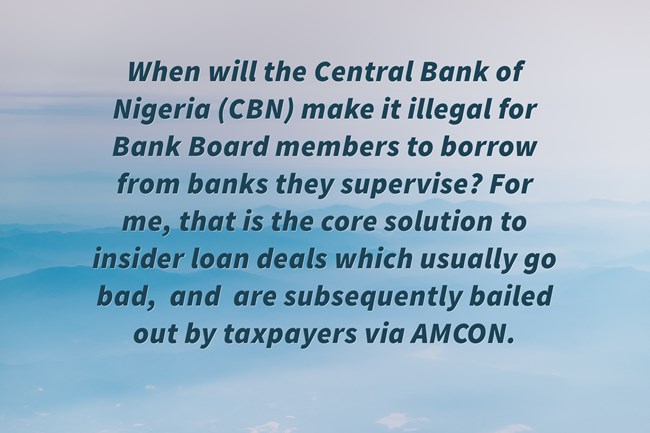
The apex bank needs to listen to my old proposal: ban bank directors and their associated companies to ever borrow from banks they supervise while actively serving. My non-academic data shows that 90% of all bank problems in Nigeria are related to insider-deals, typically coming from loans given to directors and their cohorts. Because our managers are yes people, those things happen. These loans always underperform.
The Central Bank of Nigeria has directed the Oba Otudeko owned Honeywell Flour Mills to repay a loan to First Bank within 48 hours, according to a memo seen by TechCabal.
In the letter seen by TechCabal dated April 26, 2021, the CBN stated, “Consequently, the company (Honeywell Flour Mills) is required to fully repay its obligations to the bank within 48 hours, failing which the CBN will take appropriate regulatory measures against the insider borrower and the bank.”
Insider lending is when a bank makes a loan to one or more of its own officers or directors.
Oba Otudeko serves as the chairman of FBN Holdings PLC, the holding company which owns First Bank. Otudeko also served as Chairman of First Bank until 2010 and is also the Chairman of the Honeywell Group.
While insider borrowing is legal, it is subject to several regulations. One such regulation is that insiders do not get any special treatment, incentive rates, or other benefits not offered to regular bank customers.
I find it repulsive when AMCON takes poor people’s commonwealth to bailout “fake billionaires” who continue to live large. My solution would be: you cannot borrow from a bank while on its board. Do that, and Nigeria will solve most of these issues!
Can we make it illegal for bank directors to borrow from banks they actively supervise?
The full statement by Emefiele below…
1.0 Good afternoon ladies and gentlemen.
2.0 The media has been awash with commentaries on the purported management changes at First Bank of Nigeria Ltd (FBN) and the related regulatory inquiry by the Central Bank of Nigeria (CBN) to the Board of First Bank of Nigeria Limited. It has therefore become necessary for me to address the public to clear any misconceptions.
3.0 Ordinarily the board is vested with the authority to make changes in the management team subject to CBN approval. However, the CBN considers itself a key stakeholder in management changes involving FBN due to the forbearances and close monitoring by the Bank over the last 5 years aimed at stemming the slide in the going concern status of the bank. It was therefore surprising for the CBN to learn through media reports that the board of directors of FBN, a systemically important bank under regulatory forbearance regime had effected sweeping changes in executive management without engagement and/or prior notice to the regulatory authorities. The action by the board of FBN sends a negative signal to the market on the stability of leadership on the board and management and it is in light of the foregoing that the CBN queried the board of directors on the unfortunate developments at the bank.
4.0 As you may be aware, FBN is one of the systemically important banks in the Nigerian banking sector given its historical significance, balance sheet size, large customer base and high level of interconnectedness with other financial service providers, amongst others. By our last assessment, FBN has over 31m customers, with deposit base of N4.2trn, shareholders’ funds of N618bn and NIBSS instant payment (NIP) processing capacity of 22% of the industry. To us at the CBN, not only is it imperative to protect the minority shareholders, that have no voice to air their views, also important, is the protection of the over 31m customers of the bank who see FBN as a safe haven for their hard-earned savings.
5.0 The bank maintained healthy operations up until 2016 financial year when the CBN’s target examination revealed that the bank was in grave financial condition with its capital adequacy ratio (CAR) and non-performing loans ratio (NPL) substantially breaching acceptable prudential standards.
6.0 The problems at the bank were attributed to bad credit decisions, significant and non-performing insider loans and poor corporate governance practices. The shareholders of the bank and FBN Holding Plc also lacked the capacity to recapitalize the bank to minimum requirements. This conclusions arose from various entreaties by the CBN to them to recapitalize.
7.0 The CBN stepped in to stabilize the bank in its quest to maintain financial stability, especially given FBN’s systemic importance as enumerated earlier. Regulatory action taken by the CBN in this regard included:
i. Change of management team under the CBN’s supervision with the appointment of a new Managing Director/ Chief Executive Office in January 2016.
ii. Grant of the regulatory forbearances to enable the bank work out its non-performing loans through provision for write off of at least N150b from its earning for four consecutive years.
iii. Grant of concession to insider borrower to restructure their non-performing credit facilities under very stringent conditions
iv. Renewal of the forbearances on a yearly basis between 2016 and 2020 following thorough monitoring of progress towards exiting from the forbearance measures
8.0 The measures had yielded the expected results as the financial condition of FBN improved progressively between 2016 when the forbearance was initially granted to the current financial year. For instance, profitability, liquidity and CAR improved whilst NPL reduced significantly.
9.0 Notwithstanding the significant improvement in the bank’s financial condition with positive trajectory of financial soundness indicators, the insider related facilities remained problematic.
10.0 The insiders who took loans in the bank, with controlling influence on the board of directors, failed to adhere to the terms for the restructuring of their credit facilities which contributed to the poor financial state of the bank. The CBN’s recent target examination as at December 31, 2020 revealed that insider loans were materially non-compliant with restructure terms (e.g. non perfection of lien on shares/collateral arrangements) for over 3 years despite several regulatory reminders. The bank has not also divested its non-permissible holdings in non-financial entities in line with regulatory directives
11.0 Following further review of the situation and in order to preserve stability of the bank, so as to protect minority shareholders and depositors, the Management of the CBN in line with its powers under BOFIA 2020 has approved and hereby directs:
i. Immediate removal of the all directors of FBN Ltd and FBN Holdings Plc
ii. The appointment of the following persons as directors in FBN Ltd and FBN Holdings Plc
Holdco
Chairman – Remi Babalola
Dr. Fatade Abiodun Oluwole
Kofo Dosekun
Remi Lasaki
Dr Alimi Abdulrasaq
Ahmed Modibbo
Khalifa Imam
Sir Peter Aliogo
UK Eke – Managing Director
Bank
Chairman – Tunde Hassan-Odukale
Tokunbo Martins
Uche Nwokedi
Adekunle Sonola
Isioma Ogodazi
Ebenezer Olufowose
Ishaya Elijah B. Dodo
Sola Adeduntan – Managing Director
Gbenga Shobo – Deputy Managing Director
Remi Oni – Executive Director
Abdullahi Ibrahim – Executive Director
12.0 The CBN hereby reassures the depositors, creditors and other stakeholders of the bank of its commitment to ensure the stability of the financial system. There is therefore no cause for panic amongst the banking public, given that the actions being taken are meant to strengthen the bank and position it as a banking industry giant.