DD
MM
YYYY

PAGES

DD
MM
YYYY

spot_img

PAGES

Home Blog Page 5823

Your Nigeria’s Missing Power

1

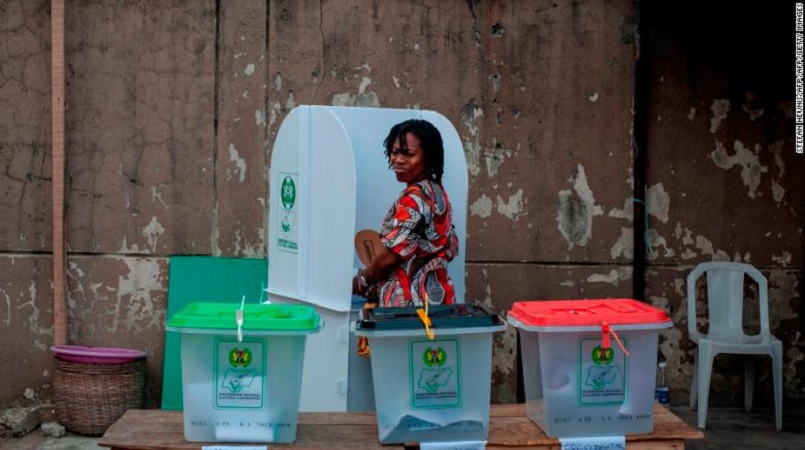
It is not rocket science and data does not lie: if all registered voters who refuse to go and vote in Nigeria are lumped under a political party, Good People Party (GPP), all candidates of GPP would have won all the presidential elections since 1999. Yes, the power remains with the citizens despite the rigging: GPP would have won over PDP, APC, or whatever  party incarnation. The politicians know this, and do everything to ensure you do not vote, because if you do not vote, the party faithfuls will anoint one of their own.

The number of registered voters for Lagos and Kano States were 6.5 million and 5.4 million respectively for the 2019 presidential election. Out of those, about 1.1 million  voted in Lagos while Kano had 1.9 million.  Simply, 5.4 million voters in Lagos sat out. Those votes belonged to the GPP, and if the GPP had received them, it would have won Lagos, over APC!

Note that having only 6.4 million people as registered voters (with only 1.1 million voting)  is also a concern as Lagos has at least 10 million people who are eligible to vote. The implication is this: about 10% of eligible voters actually vote in the nation’s largest city.

Why am I making this post? I am responding to those who think Nigeria’s problems are so unique that you must be living in Nigeria to understand them. America wanted change and they went out to vote. Yes, as I noted here, I voted against Trump because I hated his education policy which failed to understand one thing: in a class of 40 students, 4 black and 4 latinos might have needed affirmative action to get in, but on graduation day, 8 of them possibly would not have ended the bottom of the class.

So, that they needed help to get in was due to the system not being fair to them. If that is the case, you cannot abolish affirmative action without fixing first the systemic discrimination the black and latino kids face in America. It has nothing to do with lack of merits: it is simply this: even the “merit system” is tainted.

In Nigeria, we want change, and yet no one goes out to vote. That is why the “minority” of party faithfuls who always show up will continue to decide the destiny of all.

Your vote remains the missing power Nigeria needs to be transformed. Learn to use that power if you want a different nation.


How African Economies can Achieve higher incomes under the AfCFTA

0

One of the objectives of the African Continental Free Trade Agreement (AfCFTA) is to “create a single market, deepening the economic integration of the continent” There is empirical evidence that the attainment of economic integration among a group of nations brings about a closing up of income gaps among the poor and richer nations participating in such an arrangement.

The majority of countries in Africa are classified as low-income countries and few in the middle-income group, hence, the successful implementation of the  AfCFTA could lead to convergence to higher national incomes among the participating countries. The success of the European Economic Community in attaining a convergence at a higher GDP per capita among its country members is evidence that AfCFTA could replicate similar success.

An Example of Economic integration and Income Convergence: The European Economic Community

An example of income convergence in a regional common market is the European Economic community created in 1957. The goal of attaining economic and social cohesion in the EEC is contained in Article 130a of the Single European Act of 1986 which reads “To promote its overall harmonious development the community shall develop and pursue its actions leading to the strengthening of its economic cohesion”. A Study by Cinzia Alcidi- Director Center for European Policy Studies- reveals that there has been commendable income convergence at higher income per capita among the EEC member countries. For instance, member countries from Central Eastern Europe such as Romania, Estonia, Latvia, and Slovakia witnessed income growths of up to 30% and 40%  in 2000 (compared to their pre membership incomes). However, countries along Southern Europe such as Greece, Spain, Cyprus, and Portugal witnessed a decrease in income growth rates. While the North-western member states also grew in incomes. Overall, data reveals good economic cohesion in the EEC.

How African Nations can achieve convergence at higher income under the AfCFTA

While the  creation of a Common market in Africa presents     an opportunity for economic integration which could help the poorer countries in Africa to catch up  with the richer countries, certain structures must be built to make this objective a reality:

Reducing the barrier to the movement of goods and people

Although the AfCFTA seeks to eliminate tariffs on over 90% of traded goods with pending negotiations for trade in services, tariffs are not the only barrier to trade. There are several non-tariff barriers that include the high cost of transport of goods across Africa. Although these costs are sometimes lower for intra-regional trade where road transport is an option, they are higher for inter-regional trade. Also, the fact that not all African countries provide visa-free or visa-on-arrival access to travellers means that the movement of people is restricted. There is however a pending Protocol on the Free Movement of People by the African Union.

 Enhanced Access to Capital

Capital is needed to build the economy, by providing physical and social infrastructure which will support the creation of new businesses as well as sustaining economic activities. The African Union should be committed to providing financial support for poorer countries to develop critical infrastructure in the areas of transport and power. The presence of infrastructure will improve the chances of attaining economic integration in the continent and consequently stimulating growth among all countries.

Reduced protectionism

Protectionism may hurt the attainment of economic integration in the continent.

While protectionism may protect infant firms and preserve jobs, it prevents firms from attaining efficiencies made available only through competition. Protectionism can also encourage retaliation from other countries which could lead to economic loss to the countries involved. As such governments should support the growth of firms by providing grants and access to technical support which will enable their growth in the market.

Time for Corporate Nigeria To Speak On The State of the Nation

1

I think it is time for Corporate Nigeria to make a comment on the state of the nation. I understand that many of us need things from the government and would not like to be misquoted. But it comes a time when a nation is under severe stress for the leaders of the private sector to speak out. In Georgia in America, sports teams and corporate America have made it clear: politicians, we are disappointed with your new voting laws. Can the bank CEOs, cement bosses, oil & gas leaders, etc tell the government to get itself in order?

Doctors on strike. Judges on strike. Polytechnics on strike. University joining. One police station off per week. This is a failing state.

Can Corporate Nigeria develop a “Contract with Nigeria” where it could articulate to hire and employ 2 million youth over two years with clear demands on what it needs from the government? We can do it by reallocating factors of production in a measurable way to bring hope to young people. It’s time – Nigeria is waiting for Corporate Nigeria as Abuja and state capitals have failed.

Recent Funding Raised by African Startups

1

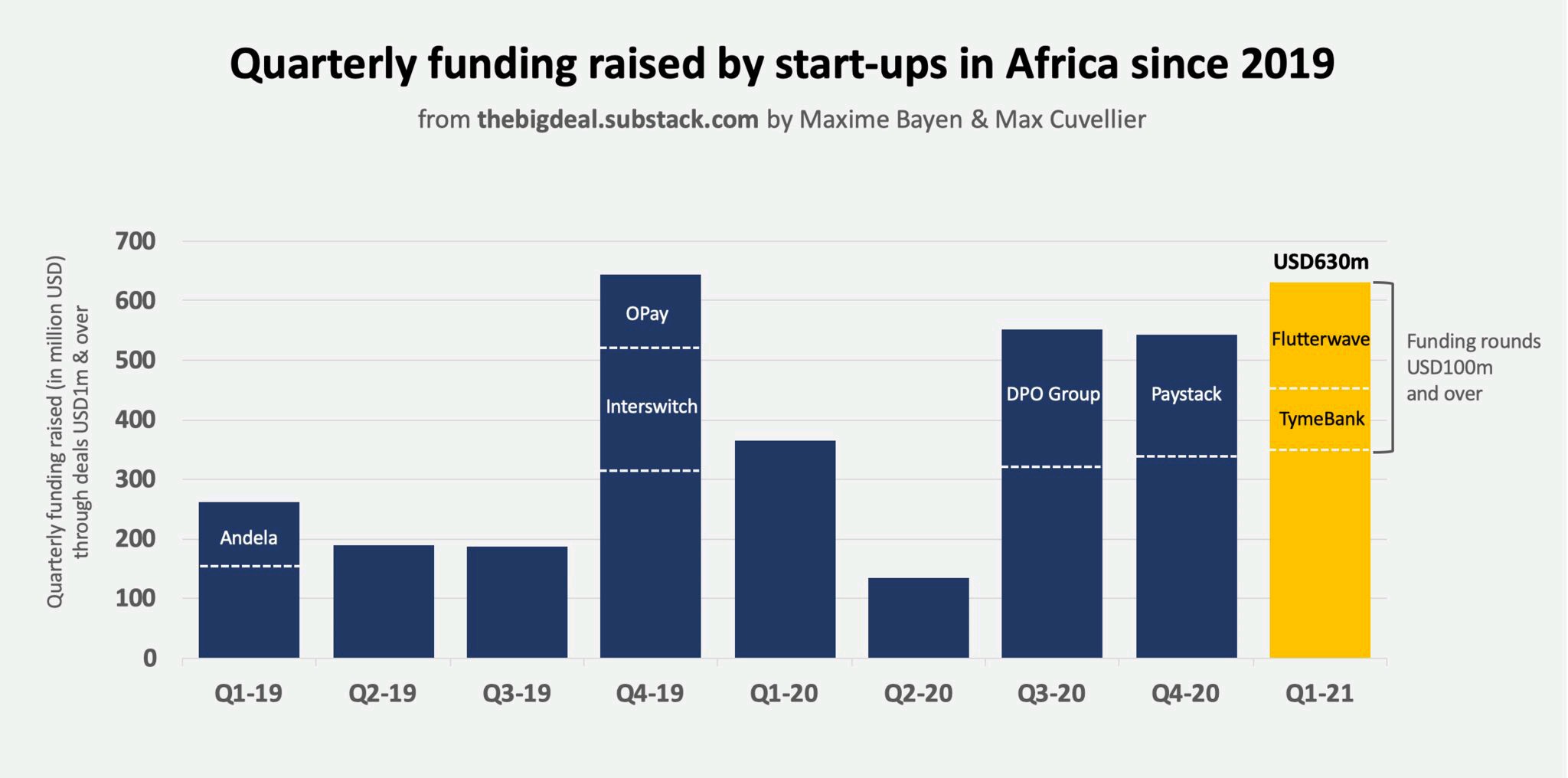
Looking at the fundraise from African startups, you may struggle to see a clear trajectory. It goes up and down, though towards the end of 2020 and early 2021, a muted trajectory emerged. . Yet, while everyone likes to write on fundraise, the most catalytic thing is not funding, but unleashing human capital in ecosystems. Andela might not have raised tons of money recently, but Andela’s impact is HUGE. 

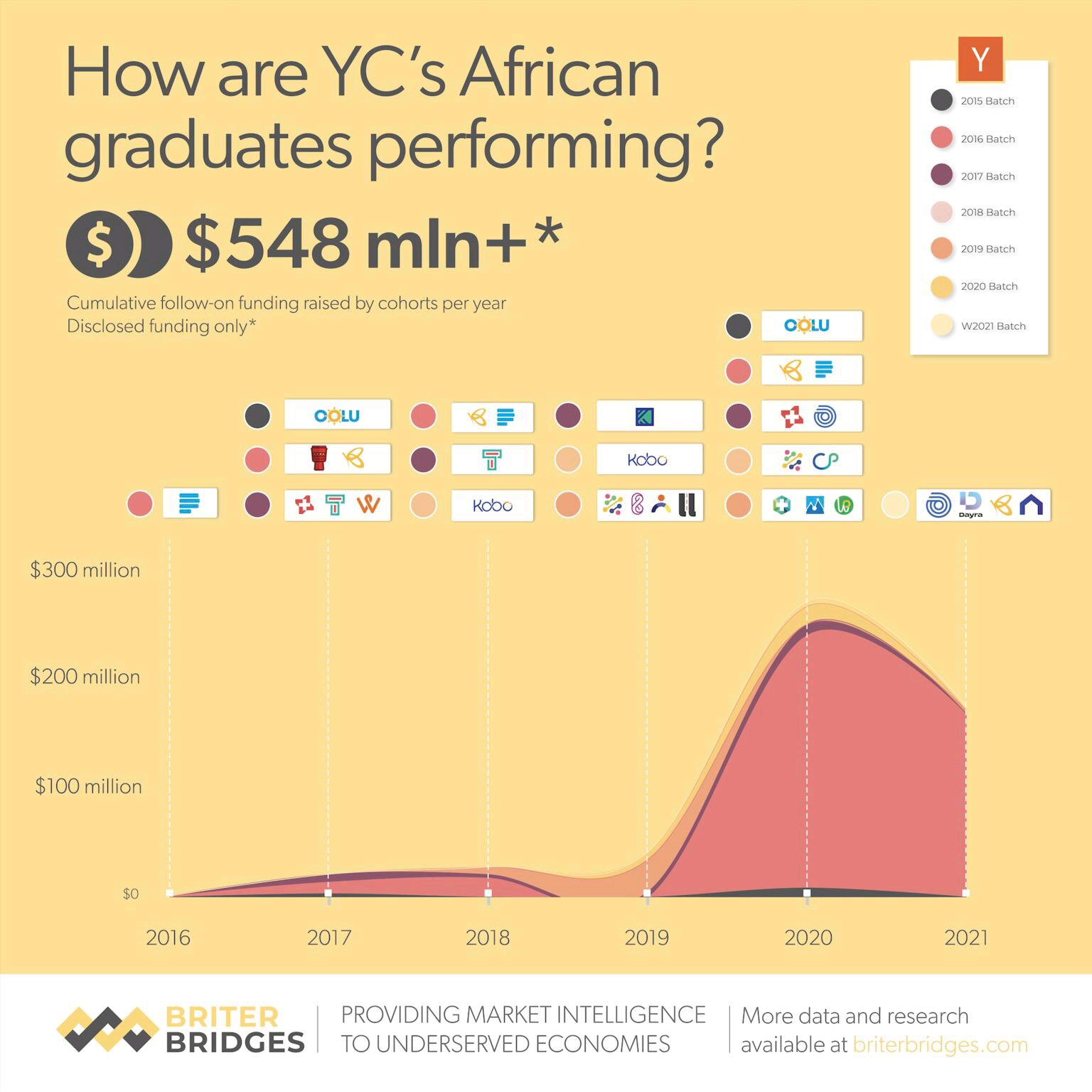
How? When it released those young people, they moved into markets and started doing amazing things in companies.  And the big one: Y Combinator is not extremely outperforming when you look at the data. Sure, it has got Paystack and Flutterwave, but there are other hot startups in Africa which are doing amazingly great which did not pass through it. Its batting average looks like others. So, do not make it look like YC is the only path.

Meanwhile, I am still waiting for a paper from an Economics professor in Africa who can pick the data, and quantitatively explain how these startups have improved human welfare and broad standard of living. (PhD Econs students, a good thesis topic.) That is the real deal, besides piping dollars from America into Africa.