DD
MM
YYYY

PAGES

DD
MM
YYYY

spot_img

PAGES

Home Blog Page 5856

5 Components of Emotional Intelligence

0

Emotional intelligence is the ability of a person to manage his emotions and that of people around him. It involves being able to control your feelings at dire moments. A person is said to be emotionally intelligent if he doesn’t lose his temper at the slightest provocation. Hence, people that lack emotional intelligence are those that pick offences easily and waste no time to react.

The importance of emotional intelligence is too great to be enumerated. Its benefits can never be over-emphasised. People that have mastered this skill have been able to prevent harming themselves and those close to them. The skill is needed by everyone irrespective of who they are or what they do. Some people think that it is not necessary to develop this skill because “if you don’t say ‘I am’, nobody will say ‘you are’”. They believe that tolerating ‘nonsense’ leads to more ‘nonsense’. So they lash out immediately at people that trigger them. But what people with this kind of mindset fail to understand is that exhibiting violence never pays. Instead of this sort of attitude attracting respect for the person, it attracts hate and loneliness.

Developing emotional intelligence helps people to build good relationships, grow their businesses, build their careers, and improve their leadership skills. It also attracts respect, as mentioned previously, and companionship. The simple truth is that no one wants to relate with a person that easily blows his top. No one wants to be cautious while dealing with his fellow man. So, there are only two options open for everybody: to become emotionally intelligent and grow, or to lack the skills and stagnate.

Developing emotional intelligence is not an easy game. It never comes easy. Some people, naturally, keep their cools irrespective of circumstances but some are easily triggered. For members of the latter group to control their outbursts, they need to evaluate themselves critically, regulate their emotions, develop social skills, become empathetic, and find factors that will motivate them.

a. Self-Awareness: This simply means knowing yourself. It means analysing yourself critically to ascertain what you are capable of. This, here, is the first stage towards developing emotional intelligence. If you notice that you are easily “pissed off” by what others say, it means you lack this skill. If you find out you can’t “tolerate bullshit”, this essay is for you. If you don’t understand why you’re easily agitated by other people’s words and actions, you need to develop this skill as soon as possible. So, start by being honest with yourself. Don’t excuse your actions by blaming the other party. Accept your shortcomings and be ready to work on them.

b. Self-Regulation: This stage is where you actually begin to hold yourself accountable for your outbursts. Set values and make efforts to stick to them. For instance, you can tell yourself you will never argue with your supervisor even if he was wrong and make efforts to stick to that. You need to make efforts to develop self-control. But remember, that Rome wasn’t built in a day. So don’t expect you can master this skill by putting in little effort within a short time.

c. Develop Social Skills: You need to learn how to interact and communicate with people. Remember that your facial expressions, tones, gestures, voice pitch, turn-taking skills, listening skills, eye contacts, and so on add to your message. Make efforts to develop these skills so your audience doesn’t misjudge you.

d. Empathy: Sometimes understanding other people’s feelings and perspectives goes a long way in preventing unnecessary drama. This is most important for people that felt they are being insulted or overshadowed when their ideas or submissions are challenged or they are asked for clarifications. The easiest way you can achieve empathy is by putting yourself in someone else’s shoes. If you can feel where it bites them, you may understand where they are coming from.

e. Find your Motivation: Motivation here means finding out why you need to acquire emotional intelligence. If you need that skill because you are tired of losing customers, that’s your motivation. If you need it because you want to maintain good relationships, that’s your motivation too. The good thing about motivation is that it spurs you on when your interests or desires begin to wane. So, find the reason, or reasons, you want to become emotionally intelligent and allow it to stimulate you.
In Oct 2020, I Predicted That “Flutterwave should be worth at least $1 billion”

1

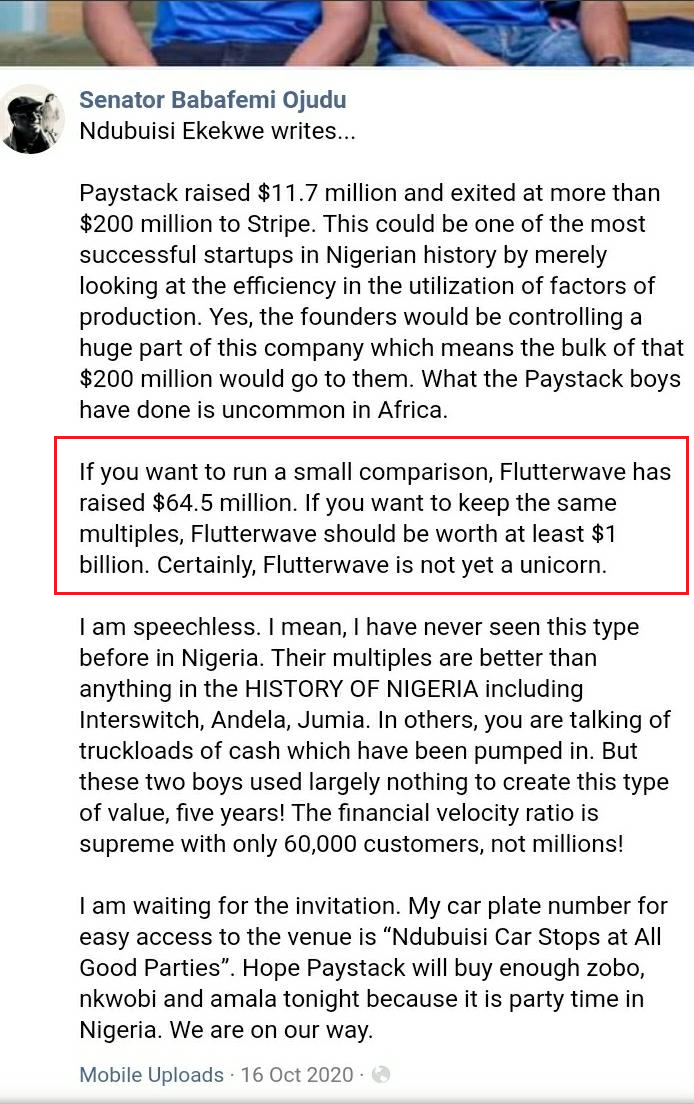
In October 2020, I wrote “If you want to run a small comparison, Flutterwave has raised $64.5 million. If you want to keep the same multiples, Flutterwave should be worth at least $1 billion. Certainly, Flutterwave is not yet a unicorn.” I had used Paystack numbers to extrapolate on the valuation of Flutterwave. That number came close to $1 billion but I quickly held by noting that Flutterwave was not yet $1 billion. But when it raised $170 million, this week, it completed.

Read this comment from Ladi:

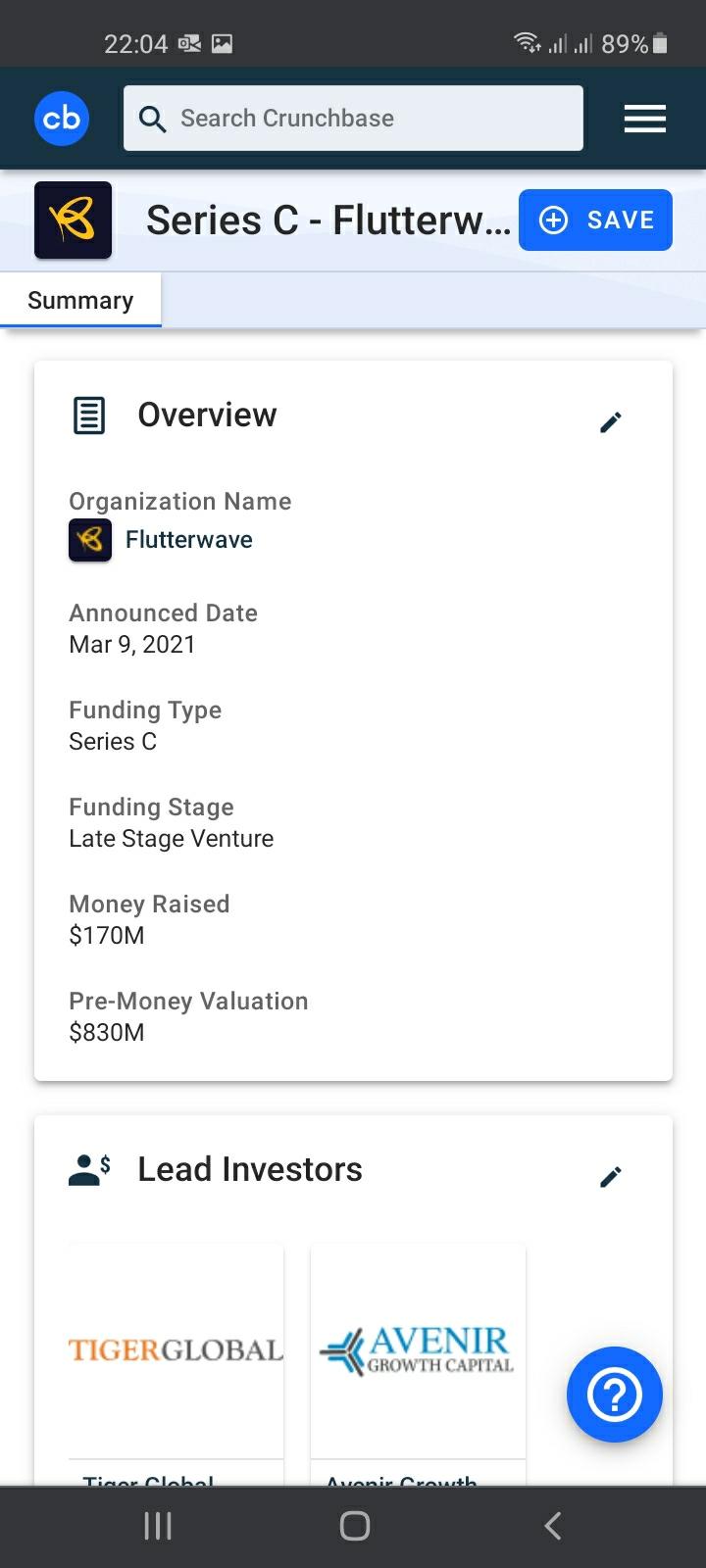
The recent $170m Series C funding (Total Funding = $234.7m) informed the $1 billion at 10 March March 2021 valuation ($830m before the $170m Series C Funding) – see attached as exhibit.

Your comments around October 2020 refers to Series A and B funding ($64.5m) only.

This critical factor was absent at the time of your submission and basing a company”s valuation on parallel (black) market exchange rate to USD is a fantasmal joke that’s not even funny at all.

It clearly seems that you’re trying to retrospectively fit the $1 billion valuation into a 2021 conjecture – by fire and by force Prof.

Velocity, Harvard Business Review or One Oasis valuation modelling have nothing to do with black market valuation; the $170m Series C funding fully explains causality ($830m + $170m).


He was referring to this post which was copied by a Senator

My response: “That makes me a zen master if I predicted months ago that Flutterwave should be worth $1 billion. I have even forgotten I wrote that. Thanks for sharing. So, I need to celebrate that call. I did say it was not $1b, so, the $170m completed it. I do not see what to fault there. I wrote that many months ago after extrapolating from Paystack number!

Another comment: Well done. The image above fully accounts for the difference. You have not yet demonstrated any model efficacy – One Oasis. Please do and don’t refer to black market valuation please.

My response: I do not know which image. You hard pre-money $830m which the $170 completed to $1b. I wrote it was $1b but quickly noted, it was not a unicorn. That $170M completed it. On model efficacy, you have no basis to judge. So, I leave it that way.

On black market, it is a number and we use it provided you declare it. You can also use official provided you declare it. They are numbers, just make it clear which one you are using. Bloomberg, Reuters, etc use black market rates and that I am using it should not be a taboo.

Yet, picking an Oct 2020 article to challenge one with more insights you have in March 2021 is another black market deal. You could have challenged me then. Do you not think an official rate would have focused on March 2021 and leave Oct 2020 alone? Read the full article which Senator Ojudu shared here – https://www.tekedia.com/paystack-is-the-most-successful-nigerian-tech-startup-on-large-value-creation-for-investors/ . I think I did very well, predicting March 2021. A hedge fund would have been happy to extend my contract.


Comment on the article: Uber and Lyft raised billions which continues to be debt their debt burden and they are still operating in the red. People should question what a business that’s on the market needs infusion of capital for. I dont consider funding as profit. A business that is on the market should be able to expand from market adoption, without such large infusion of cash, unless it is building infrastructure to meet demand. Lets just stop seeing fund raising as success. It’s not.

My response: You have a point but it misses how digital companies are valued and modelled. You are using an industrial age mentality to examine digital native companies. Amazon is worth $1.54 trillion today but was profitless for ages as it pursued that inflection point to make it a category-king.

Until you get to that state, no steady state has been reached as the golden virtuous circle of network effect cannot set in at scale with near-zero marginal cost. To assure that the money Uber raised is not lost, it did not drop to zero on IPO day. In other words, it created value after all “mass investors” have looked at it.

Next time I visit Nigeria, I plan to visit Nigerian Senate to have a chat on how we need to look at digital firms. It is not about profit. Amazon, an online firm, is America’s second largest employer.

Wish President Buhari can see this. We need to change how we look at these things in Nigeria. We can create 10 million in 4 years and employ everyone!

Valuing on Momentum and Perception

1

Last month in Harvard Business Review, I shared a small window on how I examine companies. I am proud that more companies and people are using the One Oasis and Double Play Strategies. More than five VCs have reached out and like a happy village boy with blessings, one paid me $$ to explain the constructs deeper.  When I look at companies, I examine its momentum (in physics, mass x velocity). A company must have velocity (not just speed) which is speed with direction to become exciting to me. 

As I noted when I wrote on Flutterwave, I explained that except Zenith and GTBank in the Nigerian Stock Exchange, that its $1 billion valuation was more than any of the trading banks there, using N480/$ black market rate. A commenter disputed the basis of that call; I responded thus, using Access Bank.

  • UBA – N239 billion
  • Access –  N275.475B
  • Stanbic – N444.240B
  • First Bank FBH – N260.241B
  • As it stands today, at N480/$, Flutterwave is more than all those. Except Zenith and GTBank, FLW is ahead. (Source: Nigerian Stock Exchange)

If NSE investors said Access is worth N275.475B and FLW investors said it is worth $1billion, everything else is irrelevant. That one is public and one is private cannot change the numbers. In short, if FLW goes public now, it would be worth more. If Tesla is not public, people will still argue that it cannot be worth twice  of Toyota because it sells less than 10.5 million cars to what Toyota sells.

Those valuation models you quoted are modelling Needs and Expectations; great companies are modelled on Perception. Revenue, income, etc are great but industry trajectory and momentum (mass x velocity) are key. If you have speed instead of velocity, you have no direction as a firm. FLW has velocity and most banks run on speed!

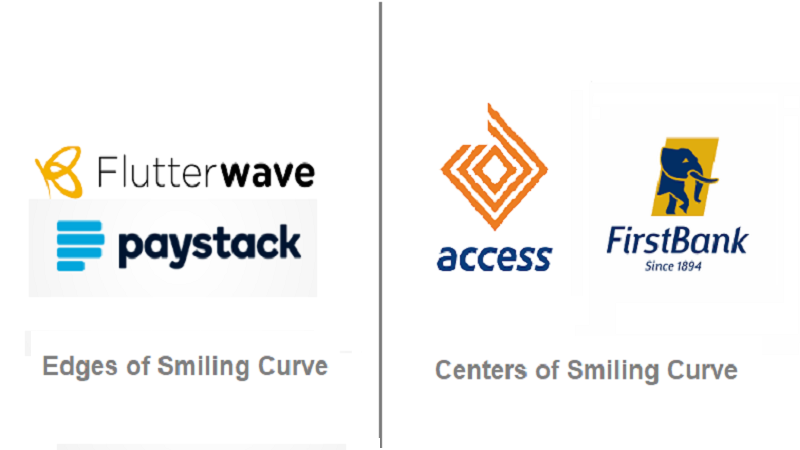
Velocity brings the edges of the smiling curve while speed keeps you at the center. Extra value is captured at the edges. It is the same thing which makes Paypal ( $282.93B) more valuable than Goldman Sachs ($117.59B).

It comes down to this: new basis of competition and the ability to turn your consumers to customers, and those customers to FANS. Yes, velocity makes consumers become Fans, and fandom unlocks Perception during valuation, as huge leverageable factors emerge. 

During a Tekedia Live session last week, Akintunde said it brilliantly” “Beatitude of Business – Blessed is the business that converts its customers to fans.” Build at the edges even if you have things at the center.

Tekedia Mini-MBA Congratulates Our Fintech Faculty, Olugbenga GB Agboola, CEO Flutterwave

0

Tekedia Institute congratulates our Fintech Faculty, Olugbenga GB Agboola, for taking Flutterwave to the unicorn mountain, where special species of startups gather. Qualification remains a valuation of at least $1 billion. As we open registration for the 5th edition of Tekedia Mini-MBA (June 7 – Sept 1, 2021) today, we cherish that tradition of using business leaders to educate a generation of innovators and growth champions. May the butterfly of Flutterwave fly into more territories, and bring prosperity and goodness to people, communities and nations. Congrats, our esteemed Faculty.

With your support, we are serving 36 countries and will have more learners and companies finish from our school than any university in Africa this year. On Tuesday, when our Beijing-based faculty, Dr Chan, was teaching, someone asked him a question from a remote part of China. We were thrilled and that is the level of what your support has done to our Institute. We THANK YOU.

I invite the world to register and join our June edition here – https://school.tekedia.com/course/mmba5/

  • Prof Ndubuisi Ekekwe
  • Lead Faculty, Tekedia Institute