DD
MM
YYYY

PAGES

DD
MM
YYYY

spot_img

PAGES

Home Blog Page 5899

Religion, Society and Balance

2

Religious matters are always handled with care. Challenging or undermining religious beliefs have led to crisis. People have been indoctrinated to defending their faith to the point of giving their lives to protect it. The reason behind this is that a person’s religious belief controls how he lives his life. It influences his decisions and determines his reality. In other words, a person’s religious doctrine forms the core of his life; the totality of everything he knows and believes in. Challenging or undermining it, is therefore, challenging or undermining his existence. As a result, people become emotional and irrational when religious matters are being discussed.

In actual sense, religion, sociologically, is one of the social institutions. It is the institution that embodies a person’s belief about his relationship with supernatural beings. It is designed to develop people’s ideology about these supernatural beings and the powers they have over human beings. It is a system that comprises how humans revere these higher beings and the rewards and punishments that come from obeying and disobeying them, respectively. Put simply, religion dictates how humans should live their lives to please the supernatural beings in return for rewards.

The importance of religion can never be overemphasized. As an agent of socialisation, it has the ability of passing on desirable virtues to people. Most people today would not have lived peacefully with their neighbours if not that religion insisted so. With its lessons about the good and the evil, religion has been able to subdue a lot of evils in the society. Apart from these, religion provides stability in people’s lives. By giving them something to believe in and reminding them that the supernatural will provide their needs, religion has become a point of succour for many. It is also known to help with humanitarian services, which includes providing for the poor, the aged, and the sick. All these make religion an indispensable part of mankind.

Unfortunately, despite the advantages and importance of religion to mankind, a lot of problems have developed from it. These include inciting violence, encouraging laziness, and causing poverty.

Inciting Violence and Division

Cases of religious crisis have been reported and are still being reported in different parts of the world. The fear of oppression and the quest for supremacy are the major causes of these crises. Religion has also given room for segregation, nepotism, and marginalisation. People favour those they share the same religious beliefs with to the detriment of others. Insurgency and terrorism across the globe have also been linked to religious extremism. It is, therefore, unfortunate that religion, which should project peace, is the cause of violence.

At the family level, religion has caused division and crisis as well. Parents have disowned their children because they broke out of their family’s religion. There are cases of parents killing their children because they left or decided to leave the family’s religion or denomination. How about those that received prophecies that their family members are the sources of their misfortunes? Blames for these are, however, reserved for religious leaders, who implant fear and hatred in the minds of their followers.

Encouraging Laziness

The belief in the absolute control of human destinies by the supernatural has turned many people lazy. There are people today that still believe humans are in no position to decide for themselves. Some relax and wait for their “destiny helpers” to locate them. Others believe that unless a person is at peace with the supernatural he reveres, he can never progress. There are those that believe in the “what would be would be” ideology, hence staying back and waiting for appointed time things will begin to flow well for them. The consequence of this mentality is that those who believe their lives have been planned for them do not struggle to improve on themselves. Note that this essay is not condemning believing and trusting in divine beings or seeking divine help, but against people not working hard because they believe in miracles.

Causing Poverty

Despite being a nation with religious strongholds, Nigeria is still battling with poverty. Researchers have discovered that extreme obedience to and dependence on religious beliefs are some of the major causes of poverty in the country. As implied earlier, religion has caused many people to believe they were destined to become rich or poor, whether they worked hard or not. Some religious doctrines encourage poverty by professing it as the gateway to glorious afterlife. Some people have also been discouraged by their religion to avoid certain occupations or practices that would have pushed them from the poverty line.

Another major concern is the belief that every misfortune a person encounters is caused by supernatural manipulations. People with this mentality either believe those around them caused their misfortune (through evil manipulations) or that a supernatural force is fighting them. The problem here is that they fail to evaluate situations critically and objectively and hence fail to pick lessons they contain. People like this continue to make the same mistakes they would have avoided if not for their religious beliefs.

Religion is a beautiful and wonderful agent of socialisation, considering that it teaches virtues and instils discipline. However, its ability to influence people’s way of life, thoughts, ideologies, actions, and opinions has made it a dangerous control device in the hands of the wrong party. The best way to discourage its use by these manipulators is to break out of their hypnosis and demand for explanations to every doctrine.

Testimonials From Tekedia Mini-MBA Edition 4

0

The quality of our program is so amazing that more than 93% of members complete on time. We posted our Week 1 on Monday and as I write, some have finished nearly 7-9 hours of videos there. Read some testimonials on the Board from our members. These are members with their photos , Facebook, LinkedIn, etc profiles set. Learn from the BEST.

“Am very impressed by the quality of facilitators and level of knowledge they are sharing with us. Top notch!!!. I have been  motivated to watch and follow through from the start (Prof. Ndubuisi Ekekwe) to the end (@Bola Adesope). Believe, this course is worth taking. Am looking forward to spending more time on this platform in the subsequent module. #Building a community of Innovators. Thank you.” – Niwa

“I enjoyed the Design Thinking class. It is very detailed, the case studies make it even more interesting. I have had Design Thinking classes before now, but this is the first time any facilitator will be breaking it down this much. Thank you, Mr. Aderinola Oloruntoye.” – cerio

“I really enjoyed the Innovation and digital transformation  lessons. really detailed and motivating” – ever

Source – (source)

Registration continues, join today.

Nigeria Floats Infra-co with $2.6 Billion

0

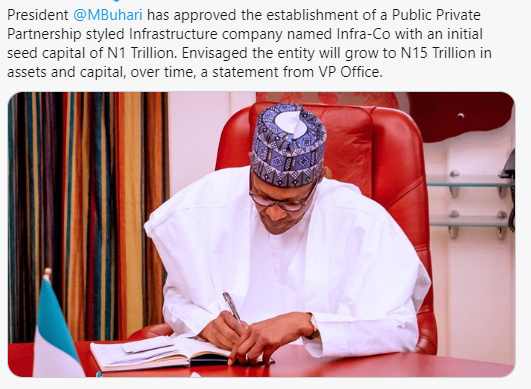
Mr. President has approved the establishment of an Infrastructure Company -a wholly focused vehicle designed to deepen critical infrastructure investments in Nigeria. The playbook would be Public-Private Partnership and the government is dropping N1 trillion (about $2.6 billion). While we can hail this move, the fact remains that Nigeria’s banking sector is underperforming in this domain.

This hail mary pass (as in American football) of scaling bureaucracy here and there is a sign that our banking sector is seriously lacking in this space. But you cannot blame the banks – no person will put money for decades-long  risks when inflation and forex are out of control. So, the banks stay with their trade services, funding importers with a risk tenor of 6 months while Abuja looks for playbooks to build infrastructure.

What this does is that it makes infrastructure investment challenging for Nigeria. Watch this Infra-co, its numbers will over time experience pressure. It is fundamental: in 2020, 83% of Nigeria’s revenue was spent on servicing debts. So, there needs to be a redesign since more debts will mean more pressure on the meagre national revenue. 

At the end, building our infrastructure is connected to the stability of our currency since long-term investments are perceived from the angles of currency & inflation stability, among others.

Yes, we hit a new milestone in 2020: 83% of revenue was spent on servicing debts: “total revenue earned in 2020 was N3.93 trillion representing a 27% drop from the target revenues of N5.365 trillion. However, debt service for the year was a sum of N3.26 trillion or 82.9% of revenue. Nigeria’s debt service cost of N3.26 trillion has now dwarfed the N1.7 trillion spent on capital expenditure of N1.7 trillion incurred in 2020.”

Comment on LinkedIn Feed

Comment #1: Why don’t we still have a government backed public listed infrastructure company that focuses on road construction? The company raises construction capital from an IPO and revenue is generated from tolls or is there something I’m missing out?

My Response: These things are really hard. Look at NBET Plc, etc. Investors are not stupid. When maturity moves in decades, the stability of Naira becomes an issue. So, you do not want to get in and hold a zoombie in your hand. Nigeria’s best investment is stabilizing the exchange rate of Naira. That is the real infrastructure. If that happens, what you just noted will become possible. Without it, our playbook runs in months, not years.

Comment #2: I would look towards hashtag#india for some of their ideas that got put into play decades ago. Infra, farm sector, industrial projects…..are typical areas that need either special vehicles and agencies, or they need a serious policy push. Check IDBI, NABARD, PFC.
For policy push, look at the rural banking and Agri banking push for the public sector banks in those decades.
Happily, times have changed and the world of finance, lending, and even policies has moved on. Nigerian market, Nigerian banking sector, and Aso Rock……carry enough capacity to make some big impact in the desired economic development spaces.
And yes, enough opportunity to partner with experienced global institutions in respective fields.
The 2.6bn and the Infra-co are good steps.

Nigeria Hits A New Milestone With 83% of Revenue Spent on Debt Servicing in 2020

How the Indian Premier League Reinvented the Cricket League

0

The Indian Premier League reinvented the system of the cricket business on a very basic level. It started by changing its method to alternatives and reorienting from clients to noncustomers of the business. IPL match betting is your chance to get the most compelling odds.

IPL costs 5-6 billion: how did the league achieve this?

The return of Chennai was particularly notable from the point of view of the interest of the fans. 10,000 spectators came to the first pre-season training session of the team. The two-year ban did not prevent the Super Kings from becoming the most expensive brand of IPL participants – 65 million according to Brand Finance.

According to their data, the league’s brand value as a whole grew by 37% at the end of the 2018 season. It reached an all-time high of 5.3 billion. Top international companies operating in the Indian market and local brands are building their marketing plans to get the most out of the IPL season.

  • For example, in 2017, separate advertising campaigns at the start of the tournament were simultaneously launched.
  • They were the local Amazon office, the Indian departments of popular companies. For the local market, the start of the IPL is analogous to the Super Bowl.
  • Simultaneously with the signing of a new media contract, IPL also renewed the agreement with the title sponsor.
  • The Chinese smartphone manufacturer Vivo paid 13 million, and under a new five-year agreement, it will pay 61.5 million each year – almost five times more.

Major contract with Star India brings money and popularity

Star India, combining all the rights, focused on the Indian regions. In India, according to 2007 data alone, there are more than 30 languages ??spoken by more than a million people, except for state Hindi. There, speakers are only about 40% of the population. The new broadcaster chose four languages ??in addition to English from Hindi and launched broadcasts in the desired regions with commentary on them.

  • For the final match, Star expanded its coverage to eight languages. The move brought 22% audience growth over the previous season.
  • The popularity of broadcasting in rural areas, where two-thirds of the population of India live, has steadily grown with broadcasts from Sony.
  • In addition, starting in 2016, Indian companies that are engaged in audience research have been calculating in more detail areas remote from large cities.
  • First, they covered restaurants and bars, then households. The copyright holders received a big plus in statistics and additional income.
  • Now Star India has taken a major step towards a new audience, especially in the southern regions of India.

Only TV broadcasts on Star in the 2018 season were seen by 450 million people (9% growth compared to last year). It was separately watched the final 173 million (+ 43%). Broadcaster does everything to make the broadcasts attractive. For example, cricketers are constantly giving interviews right during the match, being on the field.

During each game, the owner of the rights has 47 minutes of advertising time. Star’s revenue for the first season on a five-year contract was about 300 million (50% more than last season of Sony). If the rate of growth continues, by the end of the agreement Star will help out about 4 billion.

The cross-platform OTT service Hotstar, which is also part of the holding with Star India, has powerfully grown its online audience. By the middle of the 2018 season, it attracted 150 million new users. The parent company has invested heavily in the technical modernization of Hotstar. By the way, sport was a reason, but not the only reason for investment. Hotstar also has other attractive exclusives.

https://text.ru/antiplagiat/6021367f9e227

Mobile Internet good enough to banish Lagos’ early morning cold buckets of water

0

Once upon a time, while Lagos was still capital, Nigerians came from far and wide in the nation and set up shop. This hasn’t stopped. Lagos is still the ‘commercial’ capital of the country. In those days though, the business district had pivoted from Ikeja to Marina. The new growth of business hub and premium residential was happening in Victoria Island and Ikoyi, but prices were still affordable to the middle income earner.

Comfortable (not necessarily rich) entrepreneurs and sole traders from the four corners… be they Igbo, Ibibio.. Uhrobo.. Benin.. Esan.. or even Tiv.. Idoma.. Agede… rented business apartments which they operated from for the most time, and went ‘home’ two or three weekends a month.

Things have changed. Business for some has become more challenging.  Accommodation at premium Lagos  business districts has skyrocketed… and parallel.. the advent of internet, improvement in smartphones, and both software and hardware tools for the ‘connected office’ has gradually increased the feasibility of remote working.

The business case is pivoting in favour of working from home supplemented by business trips, while relinquishing a second point of presence in Lagos.

The problem is fit-for-purpose affordable overnight stay in Lagos for the SME business traveller is elusive. Federal Palace, Eko, Radisson or Sheraton are completely beyond reach. Even stays at Southern Sun, Golden Tulip, Blowfish or Ibis are not regularly sustainable.

Instead modest income business travellers have to opt for a ‘local’ hotel or guest house. You pay for what you get (or perhaps, save on what you don’t get!).

If you have to walk through an outside bar to get to reception the first thing that will strike you is the number of individuals in (scruffy) casual wear loitering about not buying anything. If there is a popular football match on, then as a guest, you can forget about getting a good vantage point for the screen. These will usually be taken up by a groups of  ‘area boys’ all sharing one large bottle of water as a token effort at patronage.

Unless a family member of ownership, the employees are probably very poorly paid and have no enthusiasm for improving the service or removing any undesirables. Lifting the pen to sign a new guest seems so much effort, it appears as the pen must weigh several tons.

Hallways will be the hottest part of the building due to lack of A.C. or ceiling fans, and maybe poor ventilation. Bulbs only occupy some of the fittings, because staff have been told not to replace all, or because repeat guests have learned from past experience, if a bulb goes in their room, it’s just less assignment to remove one from the hall rather than embark on an expedition to secure staff assistance. Bulbs are always naked, and never have a shade or cosmetic surround.

Hallways frequently have this pungent odour, like it has just been fumigated (‘fleeted’) or they deliberately pick the most nasally offensive floor cleaner in all Nigeria because for sure, they want you to be in no doubt they clean regularly… because on the balance of everything else, you would be excused for thinking they don’t!

Rooms are basic, and damaged or defaced fittings will be neglected. If the AC works, there is still too many unmanageable openings that allow localized pockets of warm air. Insist on one with a good standing fan if you don’t want to be eaten alive by mosquitoes.

Forget plumbed hot water. If there is a shower head in the bathroom, understand this is for decorative purposes only! The (cold) water pressure in the building is rarely sufficient to drive water to the shower head, particularly at times of peak use. There will always be one or more buckets in the bath tub intended to assist bathing. Sometimes they have enjoyed a former life as a container for chemicals, building materials or dry goods. Those that need to rise and leave early know from experience it is best to fill these buckets the night before, to ensure they leave in the morning fresh

I’m not even going to get started about delays and other dramas linked to ‘NEPA taking light’ and ‘onning the gen’. I could get a whole article out of that topic, just on its own!

Immediately outside a Nigerian ‘local’ Hotel. Building can’t be shown for legal reasons.

Seasoned budget travellers however know all the bargain basement venues in town, and over a period have made notes on which rooms in specific establishments on balance offer the best chance of a good night’s sleep and the promise of leaving the next morning fresh. Over time, staff have warmed to them. So they just phone around in advance and book the best available room.

Finally, we come to the issue of internet access. Many of the budget establishments have a wifi service. Having one, and making any meaningful use of it though, are two very different things. Forget scheduling your time to do work (dependant on the wifi) during your stay. No hope.

The hotel is invariably trying to shoe horn a service intended to support home or small office use, to serve a much larger user group than intended. This is then exasperated by the same ‘area boys’ that block the display screen view at popular times, hogging the bandwidth with their smartphones. They may disperse discretely when an owner shows up, but will be aware of spots off the premises which still offers signal.

Management have an amateur approach to network management, and either don’t change the password regularly, or have it set as an unsecured network, with no password at all.

Don Rancadin, a self proclaimed guru for analysing Internet access for the traveller, and a ‘gadget accumulator’ just says ‘Hotel Wifi Sucks’… ‘even 5-star resorts seem like digital slums’. This was in 2016, and up to now, the best protocol available has been largely the same. This is the 5 star landscape in the US, not Nigeria.

Discussions on ‘Nairland’ berate the quality of internet even in the flagship hotels of Lagos compared to those of a similar standard abroad. Bargain basement options is a load of hurt that brings things to a whole new low for internet service.

If the traveller has any ideas about logging into a remote corporate CRM for instance, better to set the alarm clock for 3:30am when user levels have dropped so the connection can achieve anything meaningful.

While there are various disruptive accommodation options in the marketplace, like ‘RENT SMALL SMALL’ there is still nothing that compares to the very local hotel/guest house on price. These are tough times when travelling sole traders need to be frugal.

https://technext.ng/2019/04/26/meet-rentsmallsmall-lagos-based-startup-making-rent-payments-flexible-lagosians/

While I can’t offer a solution to the comfort maladies for the budget business traveller, there may however, be something new on the horizon that sometime soon shall improve their business connectivity on the move.

Invariably, Mobile Network Operators (MNOs) in Nigeria will begin to roll out 5g and Lagos is probably the prime location of demand, and is likely the be the first, possibly accompanied by Abuja, to get the service.

The Nighthawk M5 5G WiFi 6 Mobile is a new mobile router by Netgear that combines the superior bandwidth and connection quality of the anticipated 5G mobile protocol with the connectivity distribution potential of the new WiFi protocol – WiFi 6E.

The device runs on the Qualcomm® Snapdragon™ X55 5G Modem-RF system which offers a Peak Download Speed of 7.5 Gbps and a Peak Upload Speed of 3 Gbps

Qualcomm® Snapdragon™ X55 chip is manufactured on an ultra small 7nm die process

The bandwidth coupled with  WiFi 6E is capable of supporting up to 32 simultaneously connected devices operating at a similar performance level to what is common for FTTH right now.

‘The 6 GHz spectrum should work similarly to WiFi 6 over 5 GHz but offers additional non-overlapping channels. As the Wi-Fi Alliance puts it, Wi-Fi 6E allows for “14 additional 80 MHz channels and 7 additional 160 MHz channels.” These channels wouldn’t overlap with each other, which will help reduce congestion, particularly in areas where lots of networks are operating.

All the devices communicating on the 6 GHz spectrum would also be Wi-Fi 6 devices. There wouldn’t be any older devices using standards like Wi-Fi 5 (802.11ac). All devices on the 6 GHz channels will be speaking the same language and can use Wi-Fi 6’s new congestion-busting features.’ – How to Geek

With a standard 5G sim card running with ‘best in market’ Nigeria MNO 5g service inside this Netgear router, Nigerias weary budget business traveller can have solid high speed access anywhere he or she goes, independent of what the budget accommodation can provide.

If the router comes locked to a network, the same techies that unlock smartphones can handle that. It’s the same job. Even if the service from the MNO is marketed with the intention to serve in a 5G smartphone, it doesn’t matter. The 5G sim card can’t tell the difference between a smartphone and a 5G router device.

This is not intended to be a plug for Netgear but simply an indicator of things to come for Nigerias weary budget business traveller. Comparable products are in the market by other manufacturers and more will come.

Human productivity increases over time, even by modest increments, have the capacity to improve income.

It will not be all plain sailing. Initially at least, the weary traveller may come to enjoy the full potential of the device while in Lagos, but 5G may take longer to roll out to his or her regional home.

But perhaps eventually, it will enable them when in Lagos, to move past paying for accommodation which will inflict cold buckets of water on them in the depths of dark early mornings.

Referenced content/acknowledgements :

https://www.howtogeek.com/519823/wi-fi-6e-what-is-it-and-how-is-it-different-from-wi-fi-6/

https://www.xda-developers.com/qualcomm-snapdragon-x55-5g-modem-2019-android-smartphones/s been announced ahead of MWC

https://www.netgear.com/home/mobile-wifi/hotspots/mr5200/

https://www.theverge.com/2020/4/23/21231623/6ghz-wifi-6e-explained-speed-availability-fcc-approval