DD
MM
YYYY

PAGES

DD
MM
YYYY

spot_img

PAGES

Home Blog Page 5935

DuckDuckGo Records First-ever Day of Over 100m User Search Queries

0

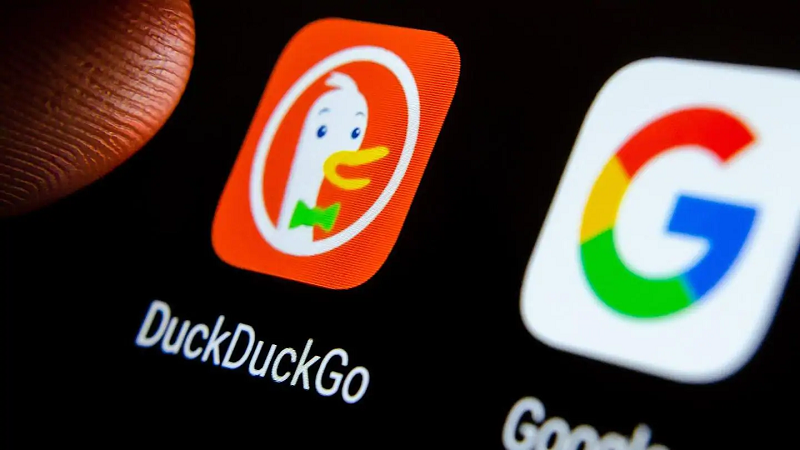
Privacy-focused search engine DuckDuckGo reached a major milestone in its 12-year-old history this week when it recorded on Monday its first-ever day with more than 100 million user search queries.

DuckDuckGo builds its search index using its DuckDuckBot Crawler, indexing Wikipedia, and partnering Bing.

The record comes after a period of sustained growth the company has been seeing for the past two years, and especially since August 2020, when the search engine began seeing more than 2 billion search queries a month on a regular basis. The numbers are small in comparison to Google’s 5 billion daily search queries but it’s a positive sign that users are looking for alternatives.

DuckDuckGo’s popularity comes after the search engine has expanded beyond its own site and now currently offers mobile apps for Android and iOS, but also a dedicated Chrome extension.

“More than 4 million users installed these apps and extension,” the company said in a tweet in September 2020.

But the search engine’s rising popularity is also due to its stated goal of not collecting user data and providing the same search results to all users.

“Each time you search on DuckDuckGo, you have a blank search history, as if you’ve never been there before,” the company explained in their privacy blog.

As it highlighted last year, this lack of granular data sometimes makes it hard for the company to even estimate the size of its own userbase.

But in a statement to BleepingComputer, DuckDuckGo said that it recorded a 62% growth in average daily searches in 2020. And so far in January 2021, it receives an average of 90 million search queries per day.

For instance, on January 11th, the search engine company received 102,251,307 daily search queries, which is a record.

But this dedication to privacy has also helped the company gain a following among the privacy-conscious crowd. DuckDuckGo has been selected as the default search engine in the Tor Browser and is often the default search engine in the private browsing modes of several other browsers.

With the increasing reports of data breaches, people’s data being used for political purposes, or their behavior tracked throughout the internet, more and more people are switching to the privacy-centric search engine.

“While we don’t track our users, we study user adoption through national surveys. What we’ve learned from those surveys is that our overall growth is driven by people who want more privacy online via word of mouth conversations,” the company told Bleeping Computer.

The WhatsApp effect.

DuckDuckGo’s historical milestone comes in a week when both Signal and Telegram, two other privacy-centric apps, also announced major periods of growth.

Telegram announced on Monday that it reached 500 million registered users, while Signal’s servers went down on Friday after seeing “millions upon millions of new users” in a sudden influx the company said exceeded even its most optimistic projections.

Both spikes in new users for Signal and Telegram are a direct result of a major public relations snafu at Facebook after the company announced last week it would be blocking access to WhatsApp accounts unless users agreed to a new privacy policy that granted Facebook access to more WhatsApp user data.

On Friday, Facebook delayed the new privacy policy by three months, but by that point, the damage had been done, and hundreds of millions of users were reminded of their right to privacy, flocking to Signal and Telegram.

DuckDuckGo said its success is also connected to recent WhatsApp/Facebook controversy.

“The recent Facebook/WhatsApp privacy policy announcement seems to have had some impact increasing search similar to how it has driven people to private messaging alternatives like Signal. We’ve seen this happen before when a high profile privacy issue is exposed, we generally see an increase,” the company said.

Web data analysis firm StatCounter said DuckDuckGo has become the second most used search engine on mobile devices in the US, UK, Canada and Australian markets.

Despite the increased growth, Google still dominates web search with 94% market share in the US, DuckDuckGo commands 2.25%, while Yahoo has 1.94%. however, these developments show that Google could find itself in the shoes of WhatsApp, especially as the Silicon giant is facing multiple antitrust cases.


Join 2021 First Tekedia Live – The 2021 Winning Playbooks

0

Dear Member,

Happy New Year once again. At Tekedia Institute, we expect 2021 to be a year of accelerated growth. There are many leverageable factors which have been unlocked as the world digitizes and new business frameworks evolve, while confronting Covid-19. Productivity is expected to improve as technology accelerates the efficiency on the utilization of factors of production. 

 In our 2021 Outlook – Growth After a Redesign webinar (video below), we shared some anchors and pointers. A new Tekedia Live is planned to discuss the Winning Playbooks we need to pay attention to, as we formulate business strategies in the new year. The virtual event, comprising presentation and Q/As, is scheduled as follows: 

  • Topic: The 2021 Winning Playbooks
  • Presenter: Prof Ndubuisi Ekekwe, Lead Faculty, Tekedia Institute
  •  Date: Saturday, Jan 23, 2021
  • Time: 4pm – 5.30pm WAT
  • Zoom Link: check here on Friday

This is an open event, rated E for Everyone. Let’s begin strong. Come with your business questions and let us co-share and co-learn.

Registration for Tekedia Mini-MBA (Feb 8 – May 3, 2021) continues. Click here to register and get the early bird benefits – https://school.tekedia.com/course/mmba4/ . Please tell your friends, colleagues and associates!

Nigeria Hits A New Milestone With 83% of Revenue Spent on Debt Servicing in 2020

1

The best part of Integrated Science in the junior secondary is the course on optics. Your teacher possibly used the word “mirage” as he/she explained optical illusion. Those days it was really cool, returning back to the village to “show off” before the non-initiated with big words from social science and integrated science. Today, you would be fine if you drop “mirage” for Nigeria’s economic strategy.

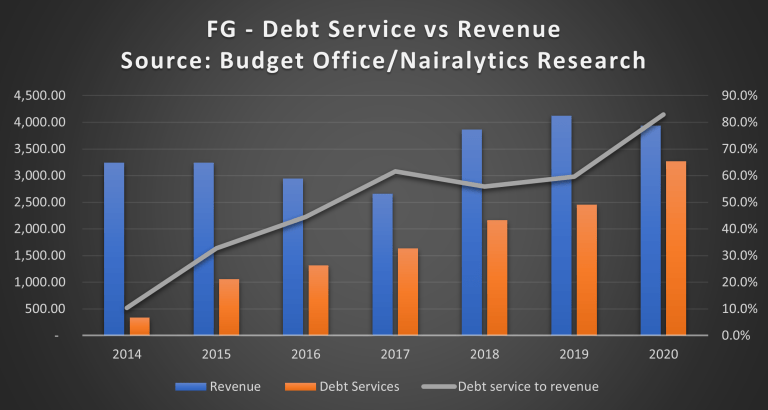
Yes, we hit a new milestone in 2020: 83% of revenue was spent on servicing debts: “total revenue earned in 2020 was N3.93 trillion representing a 27% drop from the target revenues of N5.365 trillion. However, debt service for the year was a sum of N3.26 trillion or 82.9% of revenue. Nigeria’s debt service cost of N3.26 trillion has now dwarfed the N1.7 trillion spent on capital expenditure of N1.7 trillion incurred in 2020.”

According to the data seen by Nairametrics, total revenue earned in 2020 was N3.93 trillion representing a 27% drop from the target revenues of N5.365 trillion. However, debt service for the year was a sum of N3.26 trillion or 82.9% of revenue.

Nigeria’s debt service cost of N3.26 trillion has now dwarfed the N1.7 trillion spent on capital expenditure of N1.7 trillion incurred in 2020. This is also the highest debt service paid by the Federal Government since we started tracking this data in 2009.

The total public debt (External and Domestic) balance carried by Nigeria as of September 2020 stood at N32.22 trillion ($84.57 billion). Included in the total debt is a domestic debt of about N15.8 trillion.

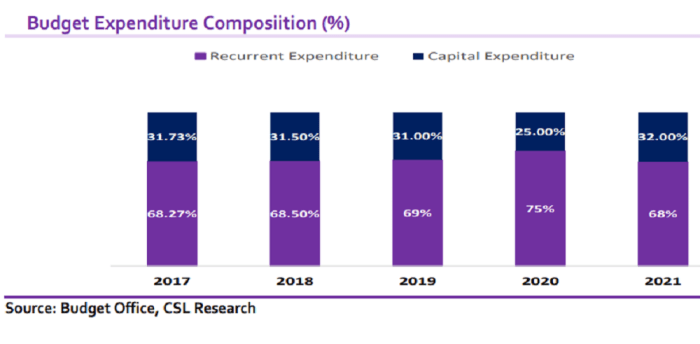
The experts at CSL Stockbrokers Limited explained the implication brilliantly: “The significantly higher recurrent component of the budget continues to drag the country’s economic growth, resulting in poor infrastructural development. Spending more on capital projects can promote industrialization, improve local purchasing power and help the federal government’s diversification drive.”

I am apolitical and follow the facts, and I can tell you that no business in this world can survive on that debt service to revenue ratio. You can extrapolate that to any nation. In our land, any optimistic exuberance may be irrational because the avalanche of challenges are palpable, from severe pressures on dwindling oil revenues, limited  private investments, eroding consumer spending power, deteriorating currency, paralytic insecurity and declining foreign investor participation. Yet, Nigeria has the young people – and we still believe.

Because of these issues, some young Nigerians are trying alternative worlds as confident in the Naira drops. Nigeria has risen on cryptocurrency adoption. Yet, Swiss banks are sounding a warning that Bitcoin could make way just as Myspace made way for Facebook. In other words, it could wipe out anything people put in it if something new comes. So, there is risk everywhere and one thing we can hold is to make Naira resilient to avoid this possible risk on our young people.

“There is little in our view to stop a cryptocurrency’s price from going to zero when a better-designed version is launched or if regulatory changes stifle sentiment…..Netscape and Myspace are examples of network applications that enjoyed widespread popularity but eventually disappeared,” UBS strategist.

Fixing Nigeria will be challenging and the nation has to open new playbooks to make it happen. One construct which is evident is to get the National Identify Number (NIN) massively adopted so that we can deepen our credit system. Besides the credit system, NIN has the following use cases according to Nairametrics:

  • Voters card registration: NIN is now accepted as a means of identification for obtaining the Permanent Voters Card (PVC) in Nigeria.

  • Bank account opening and reactivation: NIN is being used to access a wide range of services in banks and the financial services industry, ranging from documentations for the opening of an account, means of identification for payment of second or third party cheques, to reactivation of dormant accounts.

  • Consular services at Nigerian embassies and missions: As a bonafide citizen of Nigeria, NIN is now being used as a means of identification to access a wide range of services at Nigerian Embassies and Missions abroad, amongst others.

  • International passport: The Nigeria Immigration Services has made NIN compulsory as a means of identification for anyone that wants to apply for fresh or renewal of international passports in Nigeria.

  • Driver’s license: It has become compulsory for anyone that wants to apply for or renew his or her driver’s license to show his or her NIN as a means of identification. According to the Federal Road Safety Commission (FRSC), no vehicle registration or renewal can be done without providing NIN as part of its requirements – no waiver allowed.

  • Government-related jobs and grants/loans: Most government-related jobs cannot be secured without NIN as a vital means of identification. As a matter of fact, you even need to provide your NIN in the prescribed job forms to apply for the job.

  • Tertiary admissions: Most tertiary institutions, in addition to other means of identification, accept NIN for the processing of admissions and registrations of new students.

Nigeria needs to get into a working state. Yes, we need to move from inventive thinking into innovation thinking. Without making changes, Nigeria could experience a lost decade.

Why Nations Remain POOR [Video]

Grant Fundraising Course At Tekedia Institute

0

She knows where all the grant funds are located! And she is helping to help our members deepen capabilities on that nexus. When we reached out to her, we explained that the Venture Capital and Private people asked us to speak with her. In short the CEO of TrustBanc Capital Azeez Lawal educated me on where the alternative funds are. Yes, Tekedia members need that knowledge.

A graduate of University of Benin, Victoria Madedor works with Bank of Industry Investment & Trust Company, and will provide a roadmap on fundraising from DFIs (development finance internationals), Governments, Grants, etc. People, there are many initiatives within the government which many are not aware. I want our members to be on top of all.

Learn from the practicing experts – register today.

Tekedia Mini-MBA Edition 4

Uganda’s Internet Shutdown: The Economic Sabotage Beyond the Political Interest

0

On January 13, two days before Uganda’s presidential election, Uganda Communications Commission sent a letter to all telecom providers in the country, ordering them to shut down all internet access points.

“In exercise of its functions under sections 5(1) and 56 of the Uganda Communications Act of 2013, Uganda Communications Commissions hereby directs you to implement a temporary suspension of the operation of all your Internet Gateways and associated access points. This suspension should take effect at 7pm this day of 13th January 2021 and continue until otherwise directed,” the notice signed by the Commission executive director, Irene Kaggwa sewankambo said.

What followed this notice was a total shutdown of the internet in the East African country, and the resultant consequence goes beyond the people’s inability to share the presidential election events online. Over the next four days, businesses depending on the internet were forced to halt operation as internet service providers who have no choice complied with the order.

In an evident ploy by the government to control information going out of the country during the election, Ugandan authorities gave no consideration to the would-be impact of the order even on the polls. The incumbent, President Yoweri Museveni, who was seeking a sixth term in office, was determined to hold on to power at all costs.

The 76-year old who has ruled Uganda for 34 years was facing ten other contestants led by popular singer, Bobi Wine, 38, who has gained global attention due to his bravery against Museveni’s brutal regime.

As the voting commenced, many polling stations were forced to use manual voting and checks after the biometric machines failed to register ballots because of the internet shutdown. But that’s just part of many of the bitter experiences many Ugandans have come in terms with due to lack of access to the internet.

World Bank data shows that three-quarters of Ugandans are under the age of 30 and have never known another president apart from Museveni. This generation of people started to embrace the internet in the late 2000’s, using it to develop new ideas and spur economic growth.

Ugandan leader

Uganda boasts of entrepreneurship and an ecosystem comprising some of the youngest in the African continent. With a median age of 17, about 77% of the country’s population is under the age of 25, and the tech-savvy generation Z has pushed their tech ecosystem to the notice of international investors.

As of august 2020, Uganda had a total of 190 disclosed startup funding rounds, with a value of $55 million.

COVID-19 outbreak reinforced the commitment of most of the startups and companies to develop digitally. E-commerce platforms like Bringo Fresh, The Online Butchery, payments’ Xente, were among those who became popular online during the coronavirus-induced lockdown in Uganda.

While the companies were relishing their newly found digital fame that has kept them in business, the government decision to shut down the internet has come as a shock that could undermine their future prospects.

Though it isn’t the first time the government is shutting down the internet. In 2016, as the election neared, the government ordered that social media platforms in Uganda be closed until the election was over. It was a pattern many entrepreneurs were expecting the government to follow this time. Unfortunately, it’s a total shutdown of the internet, and the businesses have a high price to pay for it.

“This put our businesses in bad shape, and if the internet isn’t turned on soon, some businesses will be in a really bad situation,” Rapa Thomson Ricky, the co-founder and director of taxi-haling company Safe Boda said.

Ricky said Safe Boda generates over a million mobile transactions with its network of 22,000 drivers in the Kampala metropolitan Area, using the internet. And it has stayed in business through commission derived from each ride. That’s how the startup keeps its business afloat even in the face of the pandemic.

“We are small companies, just waiting for when the Internet returns and we can’t be sure when that will be. Even if we are making Ush50 off transaction, the cumulative effect of this gets big over the number of days we are not running and our riders are not able to earn,” he added.

E-commerce store Jumia, is among those badly hit by the internet shutdown. The chief executive officer Ronnie Kawamara said hundreds of orders including food deliveries as well as parcels of non-food items were either left in transit or not sent due to the arbitrary internet shutdown.

Other businesses including telcos and hotels said the order was shocking and unexpected, as they were only expecting social media channels to be shut down like in the past.

Internet rights groups said the government’s shutdown of the internet in 2016 cost Ugandan economy $2 million, and it set a trajectory that birthed the Jan. 13 order.

Uganda has 17.5 million internet users, who by the order, the government restricted from accessing services. E-commerce, digital platforms and e-payment systems were also shut out of business.

The order has been rescinded, but it sets economic-sabotaging precedent that may dampen the interest of investors in the untapped Ugandan tech-ecosystem.