DD
MM
YYYY

PAGES

DD
MM
YYYY

spot_img

PAGES

Home Blog Page 5942

The Impact of Covid-19 On Rural Education in Nigeria: The Role of Private Sectors [Capstone]

0

At Tekedia Institute, we admire those doing amazing things. Joshua Chukwu is a teacher in Ogun State, Nigeria, where he works to educate the next generation of our continent. Joshua received a full scholarship from the Institute, and is sharing a capstone, a critical part of his learning, with the public. His work is titled “The Impact of Covid-19 On Rural Education in Nigeria: The Role of Private Sectors”. You can download it here

CONCLUSION:

The covid’19 pandemic has revealed the dearth in Nigeria’s education system, most especially rural education. Children in rural education account for over 60% of the school children in Nigeria. If education at the grass root is not given maximum attention it becomes difficult for any developmental strides to be recorded. The role of private sectors in making up for the lapse of government and ensuring that children in low-income communities continue to learn cannot be overemphasized. The private sectors through various NGOs continue to do so much for rural education in Nigeria. More private sectors need to come on board and join in providing support for children in low-income communities to continue to learn.

Capstones are like university themed final year projects’ within Tekedia Mini-MBA but delivered via our Certificate program. Most times, members work on company related assignments with guidance from our Faculty. 

Many companies including Symplifix have turned their capstones into ventures, raising millions of naira in the process. One is an assistant to the governor of Anambra state. It is a powerful tool: you take time, think over the business, and design a framework based on all that you have learnt, to advance the company. Then send it to your boss; promotions follow, most times!

Congrats Joshua, and thanks for approving for it to be shared publicly. Teachers always share!

Tekedia Institute Has Scholarships for Tekedia Mini-MBA

4

Good People, just a note that Tekedia Institute General Scholarship Fund continues to do well. At the moment, we are directing general scholarships to professionals working in orphanages, NGOs serving those with physical challenges and teachers (pre-K, primary and secondary) in rural parts of sub-Saharan Africa. Just ask your principal or head of the NGO to write our team. Our team will do some verifications.

(For private scholarships, they are directed based on donors’ instructions.)

I want to thank the donors including the person who wired N400,000 this morning with instruction “anonymous”. We copied loud and clear. Take this as our Thank You since we cannot even write to you.

Meanwhile, registration continues for Tekedia Mini-MBA (Feb 8 – May 3, 2021): online, self-paced, $140 (or N50,000 naira). Click and register by tomorrow for early benefits.

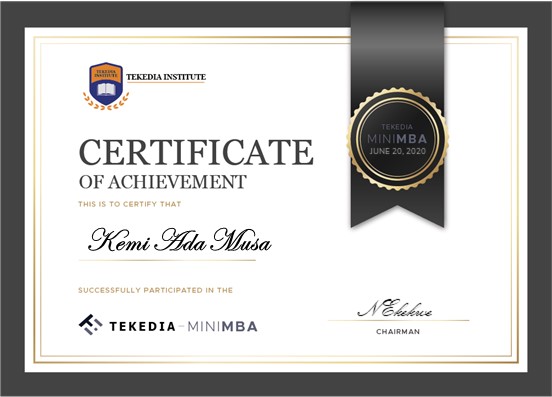
Sample certificate to be issued to co-learners

What Happened To Nigeria?

3

War is evil and do not pray for it for your enemy. As I continue reading New York Times archives to understand Nigeria in the 1960s, I see pictures that push me to ask “What happened to Nigeria? How did we miss it as a nation?” You read of bravery and uncommon creativity. Stories of the palm oil, rubber, etc yield-improving innovations.

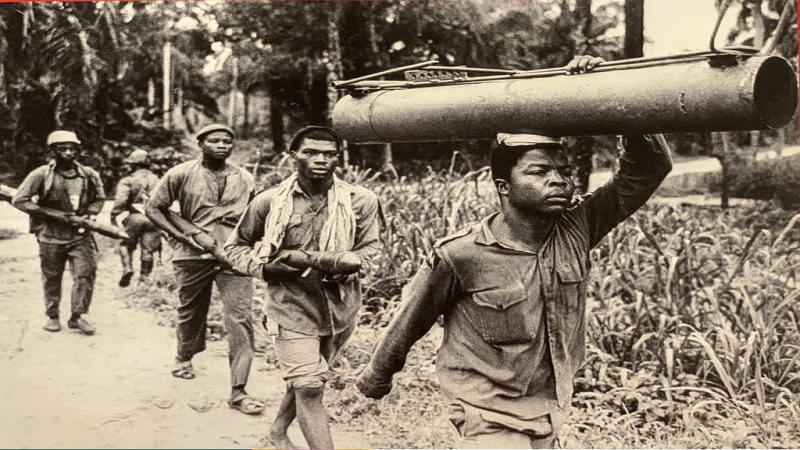
On Biafra war, the story of how a recruiter would go to workshops, recruit young men and put them in weapons development programs, and within months those men will create extremely sophisticated tools for warfare will put a chill. In most cases, none of the men had entered a secondary school as it was a luxury then.

They used pencils and created maps with young people, usually below 23, leading ambushes, carrying the mortar, trekking miles from the factory to installation! The women used local herbs to make food last longer before spoiling!

They innovated on silos, irrigation, etc, building better ways to preserve groundnuts. The kola nuts and cocoa flourished. They created local vaccines, etc. Practically, Nigeria was like the America we admire today.

What happened? Where are the children of these Nigerians? Did crude oil take our brains?

Comment on LinkedIn Feed

Comment #1: We stopped thinking Prof Ndubuisi. We wanted ready made resources. We switched to plan B and deprived plan A of our resources, energy and thinking cap. The young started sleeping and lazying away as that generation aged away. May we not wait for problems (war) to bring out the innovative spirit in us.

The Outliers in Liberal Democracy – Trump, Kagame, Biya, Museveni

1

I was in a hotel in Kampala fourteen months ago. I saw his picture with the inscription General Yoweri Museveni. Yes, the Ugandan President is also a general! They said he has “won” the recent presidential election, and will keep an office he assumed in January 1986. While you may be offended by that outcome in the age of Facebook, remember that Paul Biya of Cameroon has been in the presidential palace since 1982. Paul Kagame of Rwanda is also there, since April 2000.

Those things do not look right. But look deeper. The fact is this: in a world that is becoming more democratic, it is easier to have such outliers, simply because no military general will dream of a coup as it is certain that the world will reject it. So, the only playbook is this: do a jamboree of an election, and with that hold on to power.  The United Nations will issue its press release. The AU, US, EU, etc will do their versions. And after 7 days, the world moves on. You keep the palace.

That was what happened in the United States before Twitter and Big Tech decided to “act” government and “regulators” by banning politicians, disconnecting corrosive websites, etc. Largely, in a world which is attaining a steady state of liberal democracy*, the orthodox democratic institutions are evidently unable to deal with outliers. U.S. institutions struggled to manage Trump’s statements because they were not designed for outliers like Donald J Trump. 

Likewise, African Union, UN, etc, cannot change the course of Uganda because they are not designed for such. That explains why Museveni, Biya and Kagame will continue to hold power, since from all angles they are running democratic states, and the institutions have no processes to curtail their ambitions.

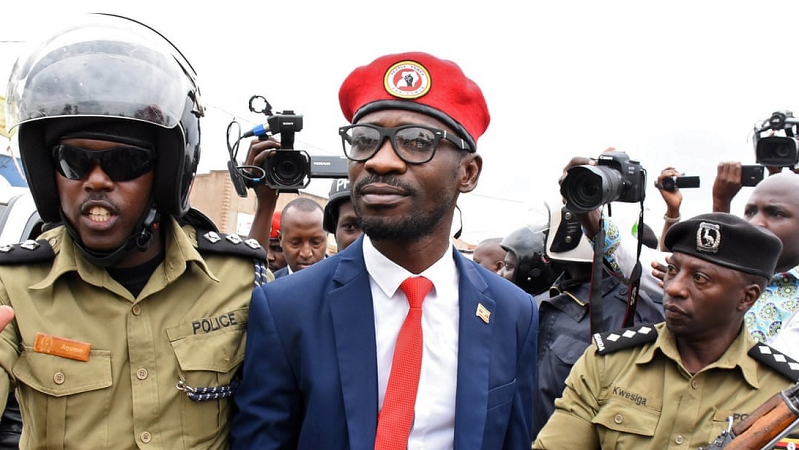
Bobi Wine lost before the voting; he simply provided a cover for the “democratic” dictator to continue his records.  His country will need a “Twitter effect” to normalize the equilibrium. If not, another player will continue and juice the party for Museveni. Interestingly, the Twitter Effect may not come from governments!


*This is what Liberal Democracy means which some of these countries may claim they are practicing as there are elections in the process.

 It is characterised by elections between multiple distinct political parties, a separation of powers into different branches of government, the rule of law in everyday life as part of an open society, a market economy with private property, and the equal protection of human rights, civil rights, civil liberties and political freedoms for all people. To define the system in practice, liberal democracies often draw upon a constitution, either codified (such as in the United States) or uncodified (such as in the United Kingdom), to delineate the powers of government and enshrine the social contract. After a period of sustained expansion throughout the 20th century, liberal democracy became the predominant political system in the world (wikipedia)

Left to Right: These Nigerian Facilities Management Companies Won’t Exist in Next 5 Years

0

Facilities Management Industry is one of the emerging industries in Nigeria. For more than 10 years, private and public stakeholders have been struggling to make the industry well known and appreciated by the facilities users. Asking the meaning and essence of facilities management would reveal a number of surprising answers from people and business owners, who have not seen the need for the industry. Some are equating facilities management with estate management and project management.

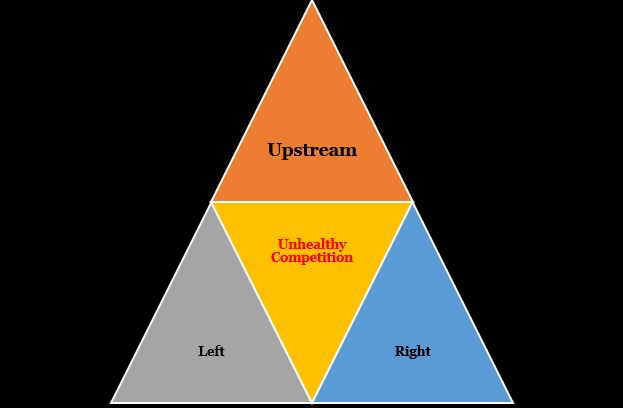
Previous analyses carried out by our analyst established that practitioners need continuous knowledge and skills acquisition towards inclusive value creation and growth. These analyses have also pinpointed areas that players, especially those at the upstream [players with a clear solution delineation and constant innovation] of value capturing, need to work on in order to increase the chance of those at the downstream [players with undefined solution and low in developing innovative solutions].

From left [downstream players] to right [upstream players], the industry is having an unhealthy competition. Unhealthy competition, according to a number of sources, is not appropriate for an emerging industry. Our analysis of the industry in the last few years has indicated this competition permeates most in Lagos, where many players locate their headquarters.

The nature of unhealthy competition is better understood within the context of creating and delivering solutions. In our experience, downstream players are competing with upstream players by offering solutions they lack the required strategic capital to execute. They are going head-to-head with the established players by acquiring integrated facilities management solutions that need sophisticated strategic capital. Upstream players are competing with downstream players by getting contracts that downstream players should have for rapid scale up.

Little attention is being paid to knowledge production and codification for existing and future practitioners. Collective efforts towards industry growth are minimal. There is a need for knowledge co-creation and sharing among the practitioners and key executive members of the upstream and downstream players. Players and professionals should take cue from South Africa, Egypt and Kenya, where collective efforts paid off after many years of creating and sharing knowledge.

If this competition continues, our analyst expects extinction of a number of players in the downstream by 2025. The players that would be hit hardest are those who offer soft solutions such as cleaning and procurement. These players hardly innovate and communicate with the prospective clients. Instead of concentrating and massing their strategic resources towards delivering these solutions sustainably, they have been discovered to expend them on solutions that should be offered by those at the upstream of the industry.