
DD
MM
YYYY

PAGES

DD
MM
YYYY

spot_img

PAGES

Home Blog Page 5953

Key Factors That Will Shape Payment of Return on Investment to Investors by Nigerian Agritech Companies in 2021

0

No one can say the founders of Agritech companies have their passion and skills translated to businesses in a wrong country. They discovered lack of information, insufficient financial support to smallholder farmers, market access and transportation challenges as frictions that must be fixed for everyone to have food and for the manufacturing industry to have ram materials for production. Throughout the developing world, Agritech companies operate with the framework of connecting investors with the smallholder farmers in the rural areas. When investors subscribed to agricultural production and distribution package, the financial proceeds are remitted to the farmers for farming and distribution activities.

Usually, investors are assured of security of their money and return. According to various sources, return on investment could be as high as 35%. In our analysis of 20 companies using average and static approaches, 30.05% was found as ROI. This promise remains unrealistic when one considers economic recession, unstable macroeconomic and microeconomic policies, and how the COVID-19 pandemic is testing the promise.  The pandemic has led to a number of uncertainties in many industries without the exemption of agriculture industry. Investors thought that the sector may save them from the harsh impacts of the recession and the pandemic.  Despite the uncertainties, Onyeka Akumah, co-founder and CEO of Nigeria’s Farmcrowdy believes that the potential for sizeable returns for investors in Agri-tech startups are as big as the sector.

Since Nigeria is experiencing a number of economic downturns, which have been used by local and international bodies for classifying the country among low-growth economies, our analyst hypothesized the companies’ ROI in this regard. This was done with a view of finding linkages between real and nominal Gross Domestic Product contribution [using crop production, livestock and fishing categories being used by the National Bureau of Statistics for measuring agriculture industry contribution to overall GDP], and ROI [average and static approach] of some companies.

Groupfarma, Farmsponsor, Requid, Thrive Agric, Farmcrowdy, Farmpower, Farm Agric FarmKart, Goldvest, Foxygreen, Kenfarms & Agrovet, Shopagric, Farmnow, Farm4me, Farmkonnect, Abadini, Green fold, Farmtrove, DivaRice and Eatrich are analysed. Our analyst also analysed real and nominal GDP growth of crop production, livestock and fishing. These categories were used because select companies are providing solutions that resonate with the categories. While using the real and nominal GDP growth, attention was paid to the current and constant basic prices. Nominal GDP is the market value of goods and services produced in an economy, unadjusted for inflation. Real GDP is nominal GDP, adjusted for inflation to reflect changes in real output. Trends in the GDP deflator are similar to changes in the Consumer Price Index, which is a different way of measuring inflation.

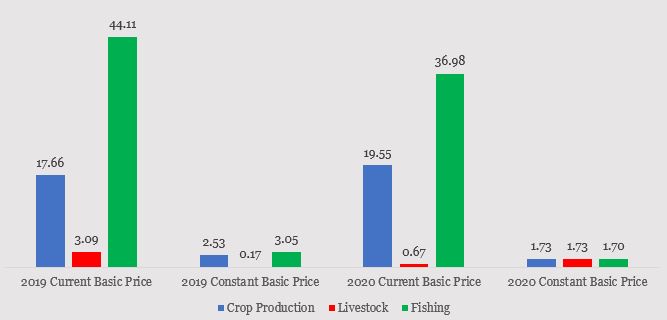
From 2019 Q1-Q4 to 2020 Q1-Q3, analysis reveals N20.5 million as average of the current basic price of all categories [crop production, livestock and fishing], while it was N1.8 million for constant basic price. Analysis of the select 20 companies’ ROI shows that on average the brands promise 30.05% within the average of 8 months and 2 weeks farm cycle.  While other brands seem to have normalised solutions [common solutions], FarmKonnect has a number of unique packages which could not be analysed with other 19 brands. Therefore, for the benefit of a strong inclusion in the average and static ROI approach, standard package of FarmKonnect was factored into the analysis.

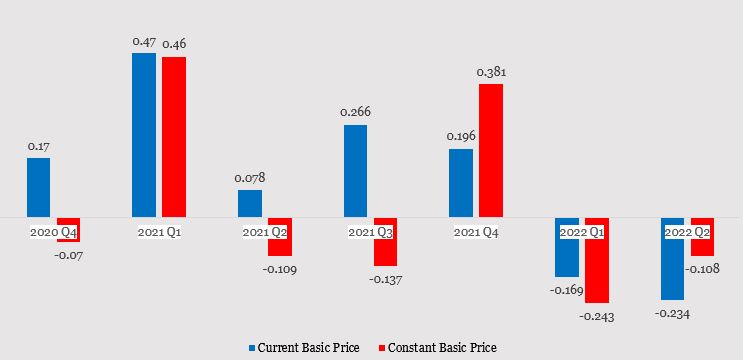
Our analysis indicates that these companies had less than 50% capacity to pay the average ROI [30.05%] when the current and constant basic prices were considered. With the current basic price of the chosen measurement categories of the agriculture industry, the companies 15.02% capacity of paying the return and capital. It was over 48% for constant basic price. Analysis further reveals that the 48% capacity threshold was lower than the return on investment promised by Farm4me [73%], Requid [60%], Kenfarms & Agrovet [55.66%], and higher than what Farmtrove [38.25%], Abadini [30.83%], Shopagric [26.08%], Farmcrowdy [25.5%], Groupfarma [24%] Goldvest [20.04%] and Farmkonnect [30%] proposed to investors.

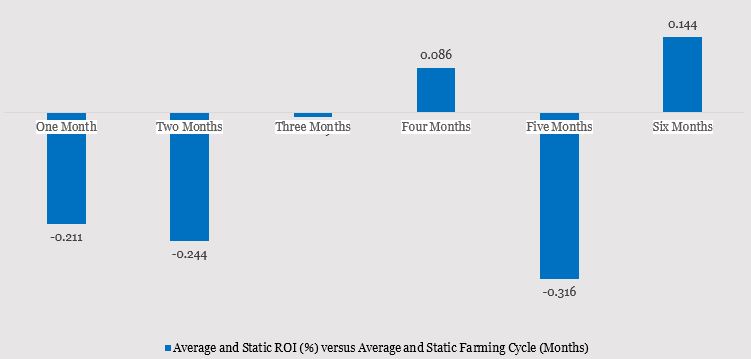
The impact of the two basic prices in the future is presented on Exhibit 2. Examination of the payment capacity within the context of the farm cycle period shows that one month of farming activities increases likelihood of paying the return by 13.4%. However, out of 140 months and 3 weeks of farming cycle, analysis shows that these companies only had a capacity of paying in 21 months.  This result indicates that Nigerian Agritech companies have been defaulting in paying ROI to investors since July, 2019. This is further justified with our check which reveals that the public had significant interest in return on investment along with Thrive Agric and Farmcrowdy more than others.

Exhibit 1: Average Nominal and Real GDP in Million [2019-2020]
Source: National Bureau of Statistics, 2019-2020; Infoprations Analysis, 2021

Exhibit 2: Real and Nominal GDP versus Return on Investment Projected Linkage
Source: National Bureau of Statistics, 2019-2020; Infoprations Analysis, 2021

Exhibit 3: Return on Investment and Farming Cycle in the Future
Source: Companies’ Websites, 2021; Others, 2021; Infoprations Analysis, 2021

With the current farming cycle months [use for payment in month] and consideration of the ROI of the selected companies, investors would not have their capital and returns in January, February and March, 2021. During these months, our analysis suggests that the players will have some challenges due to the ongoing pandemic and economic recession. However, in April 2021, analysis indicates less issues with the payment. If policies and measures being formulated and implemented by the government at state and federal levels fail to yield positive results for the agriculture industry, analysed companies would not be able to fulfill their promise in May, 2021. But, in June 2021, our analysis suggests a positive situation for the players.

The Implications and the Need for Regulation

The emerging insights have many implications for the sector, especially promise ROI of companies. It has emerged that players need to factor the two basic prices into their ROI percent formulation framework. This is more imperative for the players that provide solutions that resonate with crop production, livestock and fishing. It is obvious that the current economic uncertainties being driven by the recession and the pandemic are having significant impacts in the sector. Therefore, the current ROI should be adjusted to fix the reality of the business environment. Before the sector is turned to the Ponzi Scheme sector, the government needs to devise means of regulating activities of the players and investors. The Securities and Exchange Commission, and the Corporate Affairs Commission are needed for sustainable investor protection.


The Dean of Sales Will Teach The Art of Sales Excellence in Tekedia Institute

0

He is a dean of mastering sales in Africa. He knows the mechanics and pillars of sales excellence. He has written about them and taught them in leading companies in Africa, and beyond. Banks know him, MNCs always have him, and startups follow his philosophy: build quality contacts, connect, and sell at scale.

He is coming to Tekedia Mini-MBA to help our members acquire one of the most important capabilities in business: selling things! He wrote the book –  The Critical Pillars of Sales Excellence: How to Prospect, Sell and Win Customers.

Ferdinand Ibezim, a Tekedia Institute Faculty, will teach Mastering The Art of Sales Excellence in Tekedia Mini-MBA. Innovators and growth champions, you need to attend this class to master the physics of sales; the videos are amazing and you would be sold to start selling! When salesmen deliver sales classes, markets move.

Learning sales – yes, how to sell things – is science at Tekedia Institute. Register and join. Class begins Feb 8.


Scholarship Endowment At Tekedia Institute by Most Supm. AP. M.O Owotuga Foundation

0

Tekedia Institute is proud to announce that Late Most Supreme Apostle Matthew Omodayo Owotuga Foundation, in honor of Late Most Supreme Apostle Omodayo Owotuga, who passed about a decade ago, has endowed a scholarship fund in the Institute. The Foundation trustees noted that this act of generosity and benevolence was born out of commemorating and promoting the legacy of Late Most Supreme Apostle Omodayo Owotuga. Twenty five people would be sponsored yearly, starting this year.

As an Institute, we are humbled on how citizens, institutions and communities have found us as a trusted partner to support and empower people through knowledge. Thank you.

In our scholarship administration, we work with external organizations like Youth Up to help us select the right people to attend Tekedia Mini-MBA and Tekedia Advanced Diploma programs.

For 2021, we expect more people to graduate from Tekedia Institute than any university in Africa. And we also expect to offer more scholarships than most institutions as corporate organizations and individuals continue to support our vision: to discover and make scholars, noble, bright, and useful.

If you operate a non-profit which serves less privileged including orphans and motherless children, or you run an early childhood school, in a rural community in Africa, we have scholarships to help prepare your staff.

Tekedia Mini-MBA is an innovation management 12-week program, optimized for business execution and growth, with digital operational overlay. It runs 100% online. People from 35 countries now attend it. All contents are self-paced, recorded and archived which means participants do not have to be at any scheduled time to consume contents.

Why January is the Best Month for Job-Hunting

0

Job hunting is never an easy thing. As a matter of fact, finding a job has been described as a job on its own. The only difference between it and the regular job is that you spend without receiving. Furthermore, it is usually frustrating and demoralizing when searching for a job because of the numerous disappointments and rejections associated with it. Nevertheless, one cannot do without a job.

Job hunting is not reserved for people that newly finished school. It is also not for people that have no jobs. Fully employed workers hunt for jobs from time to time as they seek better opportunities. Freelancers are perpetual job hunters and, so, need to constantly search for jobs. Nevertheless, finding a new job could be more frustrating when it is not done strategically. One of the strategies for landing a good job is finding out when to search for them. Specifically, you need to find out the best month to apply for your desired jobs. So far, January has been specified as the best month for searching for and applying for jobs.

Why January is the Best Month for Job Hunting

January, being the first month of the year, is usually slow and exciting at the same time. It comes with promises and apprehensions. Many use the activities of the month to determine what will become of the year. Among the things that happen this month are massive job, openings, job hunting, and job applications. Three reasons have been discovered to cause high rate of job vacancies published at the beginning of the year.

a. New Set of Company Goals
Companies usually set new goals at the beginning of the year. This is done as a result of experiences, feedbacks, and mistakes of the previous year. Most times, these goals are set towards the end of the year but they are targeted at being rolled out at the beginning of the following year. When new goals are set, more employees are likely needed to fill up positions that will actualize them.

b. Internal and External Reshuffling
Promotions, retirements, transfers, resignations, and dismissals usually take effect at the beginning of the year. Most employees that are unsatisfied with their present jobs tend to reflect on their career at the end of the year. Newly promoted officers also tend to resume their new offices in January. In a situation where the internal and external movement of these officers left some openings, the company will wish to fill them up. Since notifications of these reshuffling usually happen towards the end of the year, recruitment for those that will fill up resultant openings will most likely take place at the beginning of the following year.

c. Implementation of Budget
Companies draft and approve the budgets for oncoming years towards the end of the year. For instance, a company’s budget for 2021 must have been adopted around November 2020. If the company wishes to recruit more staff, the budget would have reflected that. Technically, it is only when the salaries for the new staff are reflected in the year’s budget will arrangements be made towards new recruitment. Hence, if this budget is approved in November, the recruiting team will set to work in December or January.

Things to Bear in Mind

1. Many people search for jobs in January, so expect competition. This is not to discourage you but to let you know that the existence of several vacancies is not a guarantee that you will land a good job. This is just to tell you to beef up your skills (including interview skills), resumes, and cover letters.

2. Hiring might start in February or March. The fact that openings are advertised in January does not mean you will be hired that same month. Be patient as you apply; you might be called for an interview later.

3. Be sure of the type of work you want to go into before January so you will know where to look. Until you are sure of what you want, you will be disorganized while jobs are being taken by others. By the time you must have realized what you did to yourself, the good jobs would have been taken. In addition to this, you need to know platforms that advertise the type of job you need. This will help you to find good jobs immediately they are posted so you will be among the first to apply for them.

4. Find the fiscal year of the industry of your interest. Remember that different industries or companies have different financial years. For instance, in education, years (commonly known as sessions) run from September to July/August. So, if there will be job openings in schools as a result of expansion or reshuffling, it will happen between August and September.

5. Observe the peak period of your desired industry. Every industry has a time its products and services are in high demand. It is easier to wangle your into a company in the industry if you couldn’t meet up the early year rush. This is simply because, when demands are high, these companies seek more hands to meet supplies.

6. That jobs are usually advertised at the beginning of the year does not mean you only carry out your job hunts during that period. Sometimes, massive recruitment spills into February and March. Furthermore, when companies, after recruitment processes, fail to fill up all vacancies, they come back for urgent recruitments. It is difficult to state when this will happen but it usually takes place during the second quarter (April to June). Urgent vacancies can also come up in other months of the year, both for managerial and entry-level positions. So, don’t relax or fall into despair if you miss the January rush because there is still a lot of hope.

New WhatsApp Policy: Facebook’s Quest for User-Data May Cripple the World Largest Chat App

0

WhatsApp’s new policy which is forcing users to agree to share user information with Facebook, its parent company, has drawn serious concern from both WhatsApp users and antitrust bodies around the world.

On January 4, the chat messaging app announced that the new policy will require collecting some private information for ad and marketing purposes, and any user who declines to provide the information will not be able to create an account.

“You must provide your mobile phone number and basic information (including a profile name of your choice) to create a WhatsApp account. If you don’t provide us with this information, you will not be able to create an account to use our Services. You can add other information to your account, such as a profile picture and “about” information,” the new policy says.

The new rule which is billed to take effect from February 8 also said that the use of some features of WhatsApp will require additional personal information. And a user who chooses not to provide the information will not be able to use the feature. For example, you cannot share your location with your contacts if you do not permit us to collect your location data from your device, the policy says.

Tesla founder and CEO Elon Musk was among the first to respond to the development, urging people to switch to Signal, a non-profit chat app that cares less about user data. And Signal has promptly responded by condemning Facebook’s private data-driven business model.

“Facebook is probably more comfortable selling ads than buying them, but they’ll do what they have to do in order to be the top result when some people search for ‘Signal’ in the App Store,” Signal said in a statement on Sunday.

Facebook founder and properties

Twitter founder and CEO Jack Dorsey shared a screenshot of Signal topping the App Store, in the wake of the uproar generated by WhatsApp’s new policy.

Other instant messaging apps have also ceased the event to promote their services. On Sunday, Telegram tweeted a GIF of pallbearers, in a mock campaign against WhatsApp as the messaging app trends on Twitter.

When a Twitter user said: “Some of us clicked agree already, [talking about the new WhatsApp policy] should I burn my phone?” Telegram responded: “No, that’s bad for the environment. Simply uninstall it and move on with your life. Just like your exes, it wasn’t good enough for you – you deserve better.”

Many WhatsApp users are not on Facebook. The new rule means your WhatsApp personal information will be shared with third parties on Facebook, and that many people like Musk are not ready to do so.

Musk has always been critical of Facebook founder and CEO Zuckerberg’s user-data driven business model, but this time, he got the support of many.

Last year, Apple introduced new privacy rules that denied Facebook access to iPhone users’ private data. The new policy which came with iOS 14 prevents apps from tracking users using their unique device identifier without their explicit permission.

Facebook has been using IDFA to personalize ads in third-party apps, and Zuckerberg said the change in iOS 14 will greatly hurt his social media platform’s earnings. His efforts to get Apple to review the policy failed.

This new WhatsApp policy means that Zuckerberg is looking for alternatives to the restricted iPhone IDAF, and sees the chat app as another way to generate user data for targeted ads. But it is a dangerous move that may backfire.

With the number of users indicating interest in making a switch to other chat apps, WhatsApp is on the verge of losing the vast majority of its close to 2 billion users.

As the momentum garners, regulators around the world are studying the new policy to see if it violates the use of any private data rules, as it means sharing user information with businesses and third party services providers that transact business on both WhatsApp and Facebook.