DD
MM
YYYY

PAGES

DD
MM
YYYY

spot_img

PAGES

Home Blog Page 5956

Nigerian Agritech Sector in the Midst of Customer Sentiments and Systemic Half-Truth

0
Source: Google Review, 2021; Infoprations Analysis, 2020

Between 2016 and 2019, there were significant changes in the agriculture industry. From the players at the upstream to those at the downstream, investors and consumers witnessed massive improvement in returns and food sufficiency in some parts of the country. However, the emergence of COVID-19 in the early 2020 impacted and still affecting the industry. The industry contribution to the Gross Domestic Product between Q1 and Q4 during the year was not encouraging despite various interventions from the government.

Agritech, one of the sectors in the industry, was not spared from the negative impacts of the pandemic. Before the pandemic, the sector was the favourite of investors, especially the middle-income earners who want extra income. The critical trust they have in the sector before the pandemic was largely due to the innovative ways of farming activities driven by new technologies being used by the players and promise of sustainable return on investment.

The pandemic struck and operational activities were disrupted. The outcome was the inability to pay the investors as scheduled. A significant number of the players experienced this, which further increased customers and members of the public’s fear about the credibility of the players. This and other issues ravaging the sector contributed to the position of a writer who noted that the Nigerian agritech/fintech startups have a big customer education problem.

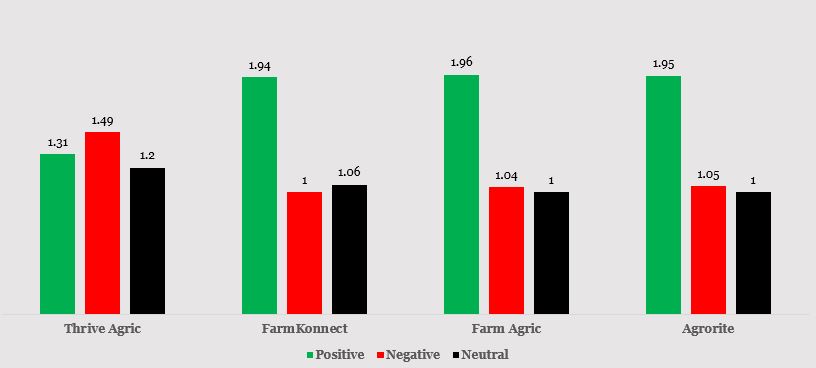
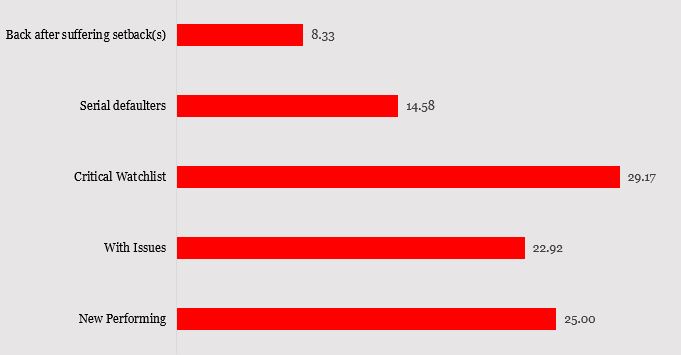
Some of the issues raised by the writer were examined and analysed by our analyst using recent customer reviews of some of the players. Customer feelings about Thrive Agric, FarmKonnect, Farm Agric and Agrorite are mined and analysed. Our analyst also examines an online forum’s rating of the players. Analysis of 48 players reveals that 29.17% are on the critical watchlist, while 22.92% are having serious issues as at January 7, 2021 [see Exhibit 2]. According to the forum, players on the critical watchlist are those found as suspected scammers. Those found for not paying their investors as promised are tagged as serial defaulters. The forum states that Goldvest, Foxygreen, Kenfarms & Agrovet, Shopagric, Farmnow, Farm4me, Farmkonnect, Abadini, Green fold, Farmtrove, DivaRice and Eatrich are the new performing farms [still under observation for now].

In our analysis, it emerged that customer attitudinal dispositions in terms of being positive, negative and neutral towards processes, solutions and employees are impacting the players. For instance, one of the results establishes 76.5% higher risk of negative disposition on the smart farming and digital finance solutions.

Exhibit 1: Sentiment Dominance by Brand
Source: Google Review, 2021; Infoprations Analysis, 2020

Note: 2 is expected score of sentiment dominance

Exhibit 2: Number of Performing Agritech Companies and Those with Problems
Source: Nairaland, 2021; Infoprations Analysis, 2021

The Complaints and Insurance Companies

When the pandemic started and operational activities were disrupted, expectation among the investors and business analysts was that the companies should be able to pay their investors having insured investors’ funds [as stated in their marketing communication materials] with insurance companies. However, an insurance professional bemoaned the fact that various Agritech platforms use insurance protection claim to lure investors. A national newspaper also described the insurance statement of the companies as half-truths. There is no doubt these two positions and the negative reviews in the public domain would continue to have damaging impacts on the players’ equity and profitability.

What Should Be Done?

There is a need for the integration of customer reviews into the management of investors’ complaints. This is necessary as our analysis shows that employees in charge of managing customer reviews on an online forum [Google Review] are not using the right response strategies. Our expectation is that when this is considered in addition to internal processes and people that need reengineering customers would have increased satisfaction with direct returns to the players.


 

Internal Audit and Risk Controls for SMEs At Tekedia Institute

0

We are truly honoured that a Director in African Export-Import Bank (Afreximbank) has developed a course at Tekedia Institute for SMEs in Africa and beyond. Our Faculty is Mr. Abel Osuji, the Director of Internal Audit of Afreximbank. The focus of this course is to help small and medium scale enterprises to design and deploy internal audit systems and risk controls to ensure business sustainability and longevity.

We already have risk management courses but this particular one is focused on SMEs. If you run a company, I invite you to take this course. You will learn how to protect your assets. They say in football, the best defense is offence. Yes, prevention is certainly better than prosecution. I have made it a required course in startups in our portfolio because I want them to prevent surprises!

Mr. Osuji is a Fellow of the Institute of Chartered Accountants of Nigeria (ICAN) and holds a Certified Risk Analyst with experiences in some of the finest global institutions including EY.

Learn from the best; register for Tekedia Mini-MBA 

Rise Higher To The Mountaintop

0

It takes a man/woman who has reached the topmost mountain to know the deepest valleys. My wish for you in this 2021 is that as you rise higher, the mountains will become taller and the valleys will become mountains. Thou will not trip and fail; you will keep rising, leaving the solid bounds of any valley, for the mountaintop of success. Stay humble, and make men and women lift you higher.

African Universities Would Be More Relevant With Emphasis On Creativity, Entrepreneurship – Prof Oluwatosin Ijabadeniyi

0

Oluwatosin Ijabadeniyi is a Nigerian professor at Durban University of Technology, South Africa. He has a PhD in Food Science and has taught in the university in Nigeria and South Africa in the last 17 years. In a chat with Rasheed Adebiyi, he shared his views on how to make African universities solve the myriads of problems confronting the continent and some other issues. Here are the excerpts.

Tekedia: Could you tell us about yourself?

Oluwatosin Ijabadeniyi: Oluwatosin Ijabadeniyi is a Professor at the Department of Biotechnology and Food Technology, Durban University of Technology, South Africa. Oluwatosin holds a doctoral degree in Food Science from University of Pretoria, South Africa. He had his M.Tech (Food Microbiology) and B.Tech (Food and Industrial Microbiology) from Federal University of Technology, Akure, where he lectured from 2001 to 2011. Since 2001, he has conducted research and lectured internationally in the area of food quality and safety. His first science book (edited) titled “Food Science and Technology, Trends and Future Prospects” was published in December 2020. He has also published several scientific publications and four inspirational books. He is also an alumnus of UC Davis Institute for Innovation and Entrepreneurship, University of California, Davis USA. Oluwatosin who is the founder of Operation Transform International and Food Safety Africa was appointed Visiting Professor (April to June, 2019) at the Department of Food Science, University of Manitoba, Canada. Oluwatosin has passion for empowering people about innovation, investment and all round excellence. He currently lives with his family in Durban, South Africa.

Tekedia: You have had a wide experience teaching in African universities especially in Nigeria and South Africa. How do you think the tertiary education in Africa could be rejigged to make it solve the myriads of problems confronting the continent?

Oluwatosin Ijabadeniyi: The curriculum in African universities should place emphasis on innovation i.e., creativity + entrepreneurship. Our universities shouldn’t be ‘degree factory’ but places where critical thinkers and thought leaders are made. This can only happen when students are taught how to think and not what to think. Universities should prepare their students to be able to take up in-demand jobs of the future and out-compete Artificial Intelligence. It is also important to emphasize to students that greatness is not how much money you have rather it is serving others.

Tekedia: What does it feel like teaching and living in South Africa?

Oluwatosin Ijabadeniyi: I am happy to be teaching and living in South Africa. South Africa has given me opportunity to reach my potential and to contribute to the development of Africa’s future leaders.

Tekedia:  You have a YouTube Channel where you engage in knowledge sharing and interviews. What is the motivation behind the programme?

Oluwatosin Ijabadeniyi: The main purpose of my YouTube channel (which includes interviewing guests) is to share wonderful and amazing pieces of information Information that will encourage people to exceed expectations and never give up in each area of their life be it, spiritual, family, physical, intellectual, social, financial and career. I also use it to showcase Africans making a difference in their communities while at the same time disseminating knowledge.

Tekedia: What exactly are the things you miss about Nigeria?

Oluwatosin Ijabadeniyi: I miss my extended family back home, though we communicate often. Nigeria is rich and blessed with many delicacies which I miss so much. Thankfully, we get a few local food items here but not everything I would love to eat. Generally speaking, I miss being at home and enjoying the camaraderie because there is nowhere like home.

Tekedia: Thank you for your time

Oluwatosin Ijabadeniyi: You are welcome

Are You Paying Attention To Observe The Burning Bush In That Company?

1

He was on Horeb, and saw a burning bush: the bush was on fire but it did not burn up. So he thought, “I will go over and see this strange sight—why the bush does not burn up.”

First, his attention was needed for a very important message. He needed to be consumed by something uncommon. Secondly, his bravery was tested: he went over instead of running away when he saw the burning bush.

Then, his God called him “Moses! Moses!” and revealed a mission.

In companies, only undistracted and attentive people are typically called to execute higher missions. These are people who can unlock new market opportunities and extract values from shifts in customer preferences. Companies typically put the selected ones through tests with uncommon KPIs and targets to see how they respond. 

Some workers give up while others take the challenges. Usually, in the middle of that challenge, glory comes [Moses was chosen to lead his people]. In business, the role could be a CEO, Executive Director, etc!

What is the burning bush before you in that company? Without awareness and observation, you may not even know the company is asking for your attention to be called to LEAD.