The innovators are back – and Nigeria has the finest in the world when it comes to finding how to collect money from its citizens and companies: stamp duty on electronic transfer, multiple levies, etc. Yes, when it comes to taxes, fines, levies, etc, Nigeria is innovating just fine. What we have struggled with is how to boost the economy with growth policies.
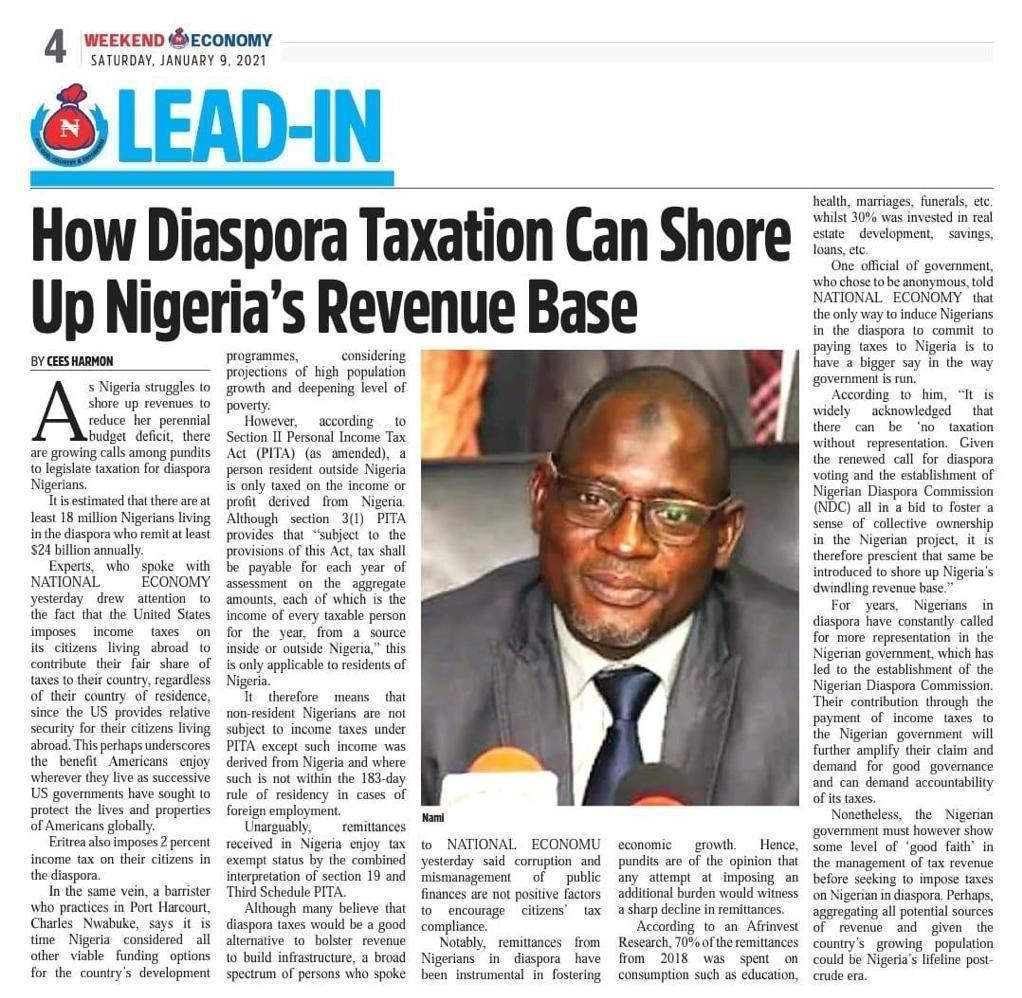
Now, the latest conversation is to tax Nigerians in diasporas. I must confess that it is not a bad idea provided the money would not be managed by politicians. I prefer we channel the tax money to venture funds, private equity funds or investing ecosystems to build a new economic architecture of Nigeria. Of course, if you do it that way, it is no more a tax since politicians will not be deciding how the funds are used!
Nonetheless, if they have a tax treaty where other governments would recognize the Nigerian diaspora tax, to avoid double taxation, it is a slam dunk. Simply, instead of sending $1,000 to the American government as tax, you can send $100 to Nigeria and keep $900 in the US. The payer cannot and should not pay more than $1,000 to avoid double taxation. If you do not make it that way, it would be challenging to expect the diasporas to respond.
Yet, I expect Nigeria to have a remittance tax since taxing diasporas via the typical tax legal ordinance has no chance. Government can simply have a regulation: if you send $1,000 from the US to Nigeria, the Central Bank of Nigeria will keep 3% of that money as a remittance tax.
Yes, once we are done with pension funds, then dividends & dormant account balances, and finish selling some campuses (other assets like power, etc are already gone), there would be nothing left. The only remaining option then would be remittance taxation. So, Nigeria will tax remittance but via a different protocol within this decade unless something changes in our economic system.
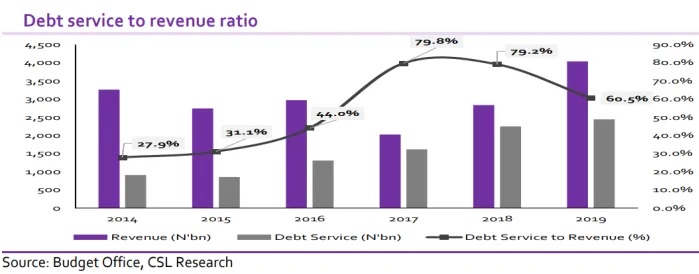
Simply, we cannot use 60% of our revenue to service debts and expect to have a future as a nation.
In 2014, the ratio was about 28%; then it rose close to 80% during the recession and now we are at 60%. When 2020 data comes out, it may be close to 90% considering that revenue was severely affected during the lockdown.
When a year is going to an end, it is a tradition among people throughout the world to make resolutions for the coming year. Over the years, the argument has been that people do abandon their resolutions. A recent study of 800 million activities of the people who made resolutions at the end of a year for the coming year indicates that most abandoned their resolutions on January 19 of the new year. Another research linked this to too much ambition. Though, the focus of this piece is not about giving insights on how to make resolutions, it is imperative to make reference to it as it has been established that the first days of a new year are better utilised for seeking information on resolutions realization. For the people who want to implement new processes towards business and personal development, being on the Internet, exploring information, is essential.
Background
In this regard, our analyst examines information seeking behaviour of people in Nigeria between January 4 and January 8, 2021. Like other countries in the developing world, the Internet is being used for information seeking, gaining knowledge and understanding a specific topic in Nigeria. This has been made easy with the various search tools developed by companies such as Google, Bing, Yahoo among others. While on the Internet, some people receive information, gain knowledge and understand a problem or an issue consciously or unconsciously. Indeed, the Internet is critical to human survival on the digital sphere. In 2020, there were 85.26 million mobile internet users in Nigeria. This figure is projected to grow to 151.3 million by the end of 2025.
A number of the Nigerian users employ different phrases while seeking information on the Internet. In our previous analysis, these users were found to have a strong preference for ‘how to’ and ‘what is’ phrases than ‘who is’ phrase. The preference for the ‘how to’ and ‘what is’ is an indication that the phrases were better in delivering the relevant information during the period. In our 2018 analysis, we discovered that 42% of Nigerians’ searches were on how to kiss a girl in the last 24 hours. These results are not quite different from what we found within 5 days of 2021.
Analysis
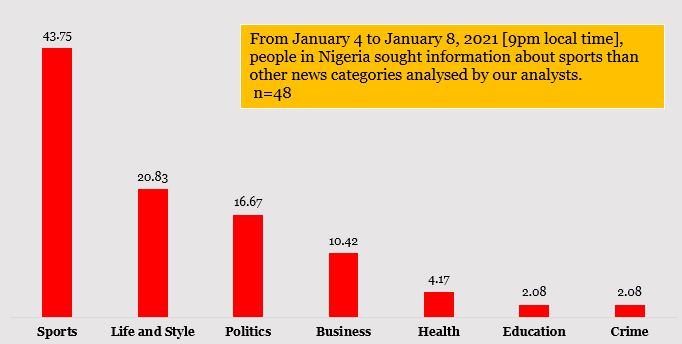
From January 4 to January 8, 2021, people in Nigeria searched sports, life and style related information or news more than other categories, our analysis reveals. On the first day [January 4, 2021], the match between Southampton and Liverpool was considered most important, followed by the news that Jack Ma’s, whereabout was not known for two months. Other three information/news were on business, life and style and sports [football]. On January 5, 2021, English Premier League matches were searched mostly including Georgia runoff election in the United States of America, denial of breach of agreement with the Academic Staff Union of Universities in Nigeria by the Federal Government. During the day, people also developed interest in knowing UK lockdown due to a second wave of COVID-19. Nigerians and other nationals ended the day with the interest in understanding FA Cup matches.
Life and style information/news occupied the public mind. Charlie Charlie Challenge, a social media event, enveloped the searches. Political information [Trump’s refusal to accept Joe Biden’s victory] followed and then sports [football]. Surprisingly, interest in health information surfaced. A number of the Internet users want to know brain aneurysm, a life-threatening condition. In all, the users developed interest in 17 trending issues during the day, mostly sports, life and style and politics. Elon Musk and his company, SpaceX occupied first and third top searches on January 7, 2021. Like the other days, sports, life and style and politics dominated the day and the majority of the information/news sought and read related to these categories. On January 8, 2021, the interest in life and style, and politics surpassed other categories our analyst examined.
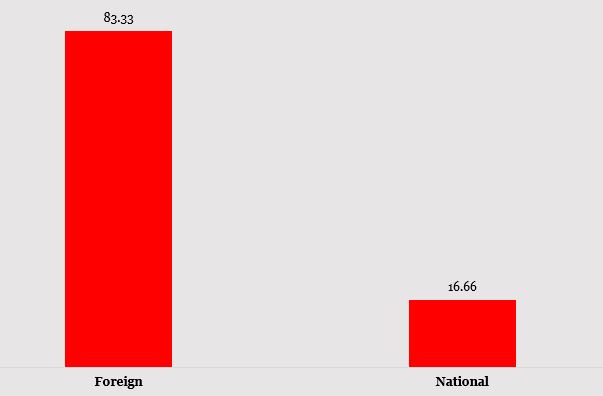
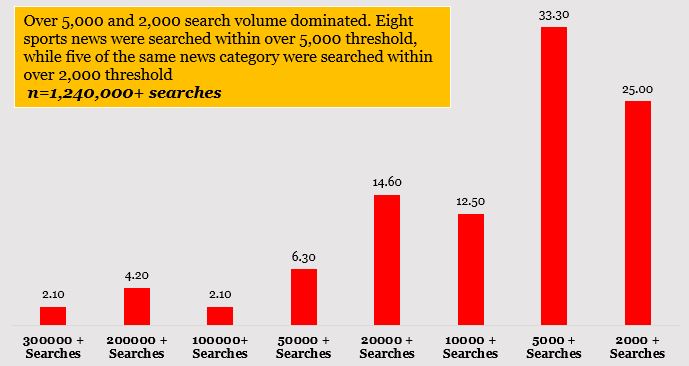
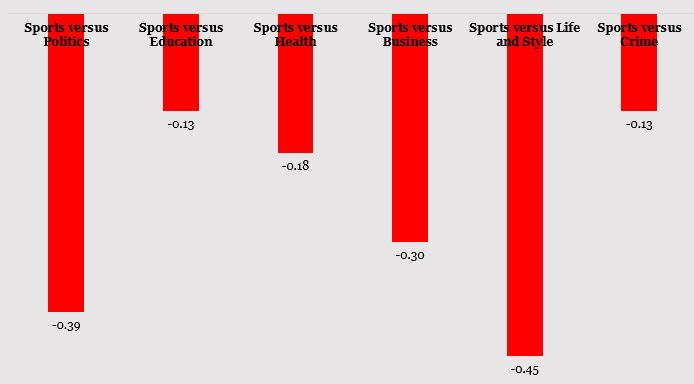
In spite of the high search volume of these categories, our analysis indicates no connection between information/news category and search volume. We discovered the same result for foreign information/news seeking and reading, and search volume. From the first day of our analysis to the last day, analysis suggests growth of passive information acquisition about issues and needs in Nigeria [see Exhibit 1].
Exhibit 1: Category of News Searched by People in Nigeria
These results have suggested that people searched and read what appealed to them during the period of analysis based on their needs. It is understandable that everyone has right to information seeking and use them in personal and business life using his or her discretion. However, there are implications of what our analysis reveals.
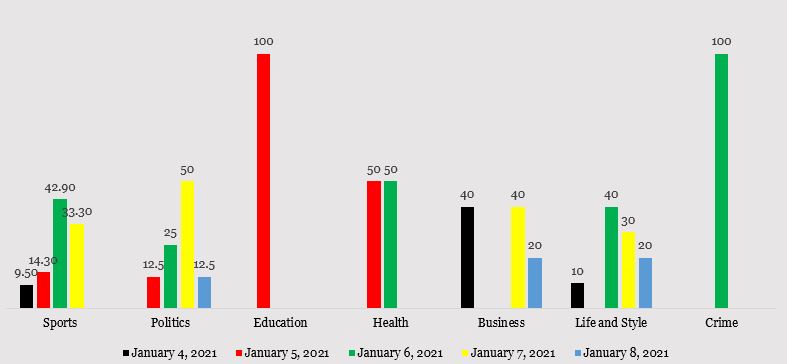
It is clear that people prioritised self-esteem and belongingness over physiological, safety and self actualisation needs. Everyone to watch foreign football matches, understand American politics and active in the social media space at the expense of knowing one or two things that could lead to business creation or investment opportunities exploration. Looking at data on Exhibit 4, it is glaring that Nigerian public was passive on critical information/news categories. It is appalling that a significant information was not sought and read about education, health, business and crime. Linking the interest in sports with the searching of betting and gambling shows that interest in understanding betting was high on January 6, 2021, the day the interest in football was also high. Mostly, people in Osun, Oyo, Rivers, Lagos and Federal Capital Territory had interest in betting. For gambling, people in Abia, Akwa Ibom, Osun, Oyo, Rivers, Lagos and FCT had interest in it on January 4, 2021 than people in other states across the country.
Exhibit 4: Active and Passive Information/News Seeking
Source: Google, 2021; Infoprations Analytics, 2021 Note 1:Sports (n=21), Politics (n=8), Education (n=1), Health (n=2), Business (n=5), Life and Style (n=10), Crime (n=1) Note 2:Numbers on the Exhibit are in percentages
What is your business strategy? No matter what it is, it must give you the most optimized way, to combine and recombine factors of production, to deliver products and services to customers, to fix their frictions, at the least possible cost, while in return, enabling you to capture rewards, as revenues and more, from those customers. You got business objectives, your strategy must provide the course of action or decision mechanisms to actualize them.
Do them right, the total efforts, financially quantified, of all the factors of production will be less than what the customers have paid you for those products and services; the delta is your “profit”.
So, there is an optimization for that delta: maximize what the customers can pay or/and reduce the total cost of those factors of production, ceteris paribus.
How has 2020 changed your strategy – and your outlook in Nigeria, Africa? I have a video below.
Code
Description
Cost
MINI
Tekedia Mini-MBA. And WhatsApp School
US$170 or N120,000 naira
MINF
Annual Package: 3 consecutive MINI, and 2 optional capstones.
$340 or N180,000
MINR
(optional) Homework review; faculty will review your homework with feedback.
$30 or N10,000
CAPS
(optional) Tekedia capstone is a research paper, analogous to final college project.
In 2021, I challenge you to live your life. We are all different and unique. Be inspired and be challenged by others, but do not fit their lives into yours. Until you take charge of yourself, life would be a rolling rock. He is now a CEO, a bank manager, a professor, a sports legend, etc; but here I am.!
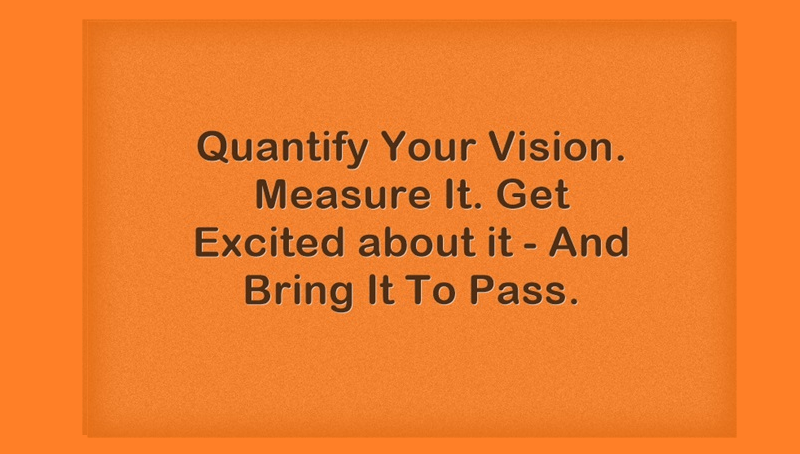
Those should inspire, but yet, should not matter. What should matter is your VISION for yourself. Create one . Quantify it. Measure It. Get Excited about it – and bring it to pass.
To create that Vision, we have introduced a new course –Human Productivity Innovation – in Tekedia Mini-MBA. Dotun Moses Jegede, PhD, FIODN, RODP , a Senior Partner of Dee Bee Consulting and a pastor in Deeper Life will teach the course. His course provides a framework to help members innovate on their careers, and thrive.
Let us return to business and look at how the Inversibility Construct applies to President Trump who loses his most prized possession in politics. Yes, without Twitter, he would not have been a president. I make that point as old century media powers would have filtered him out. The media moguls were the gatekeepers; they decided what the world consumed. There is a lesson on that dynamics within the digital business ofaggregation construct.
For the Inversibility Construct, you need to turn a typical frustration in the meatspace into strength in the digital space. That means, you need to INVERSE the experiences of people, so that what annoys them in the physical becomes strength in the digital space. I provide some examples:
People hate crowded shopping malls; make people to like crowded shopping malls via your products (Amazon, Konga)
People hate crowded classrooms; make a classroom where everyone is happy when it is crowded (Udacity, Facyber)
People hate crowded bank halls; make products where everyone enjoys the service when the bank hall is crowded (Paypal, Paystack)
People hate crowded motor parks with passenger hailers; make a hailer which people like because it is crowding many people together (Uber. Little Cab)
Yes, Vanguard, New York Times, and Punch were in charge of the news to break, and the elements in the political world to champion. Because they were the gatekeepers, they controlled and influenced demand (the readers). Then, it was “Blessed is he who is a friend to a media publisher!”
Being published in the Guardian Nigeria newspapers was a career turning point for most people 40 years ago. Simply, the supply of newspaper space was extremely limited, and only few articles made it past the editors.
But today, in the digital era, supply is unbounded and constrained, shifting the power from New York Times, Punch and Washington Post to companies like Twitter, Facebook and LinkedIn. These entities are the gatekeepers now. They control and influence demand and magically become exceedingly powerful. The problem of today is no more supply of contents, but aggregating the amalgam of contents which come out daily. So, the world congregates in ecosystems where those contents are aggregated, pushing power from suppliers to those who control demand.
If the New York Times drops Trump’s subscription (if he has one), the world would not blink. But with Twitter pulling the account, it is a big deal. Without Twitter and Facebook, Trump goes into a political existential threat because he cannot influence demand (his base) and without the base, he loses influence. The power is not just in his written words or the spoken words. Rather, on the platform where they were put. He can build a website but would that site give him 87 million followers? That is the issue.
That is why social media platforms are extremely powerful – and why companies must pay attention to them: they can make you and they can destroy you. The deceleration and acceleration are asymmetric: take more than a decade to build 50,000 followers; lose all those customers in one day. In Trump’s world, 87 million people; today, he has zero! Here, we see the new order in the powers of the future.