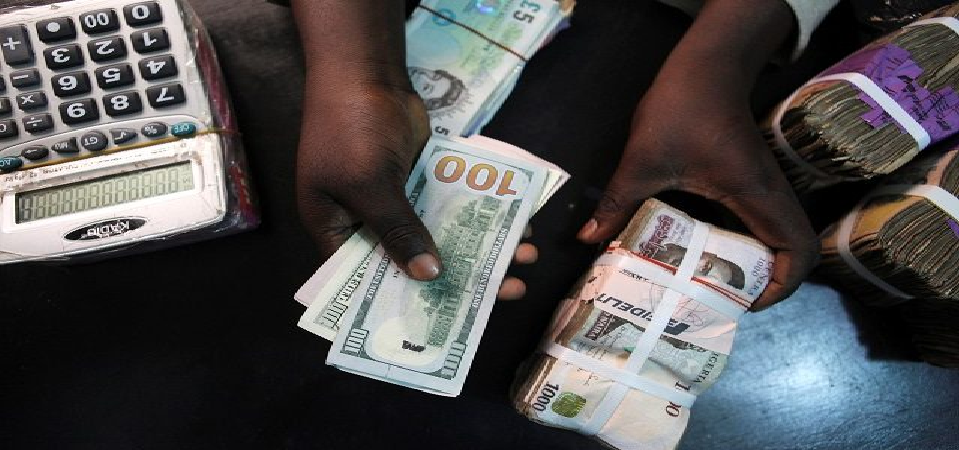
I closed the year for clients in my Private Client Services – Corporate this morning. It was a two-hour presentation where I offered perspectives on how 2021 would be. I have modelled PCS-C after private banking where you serve special bank customers in personalized ways. Specifically for Nigeria, I told our business leaders that Nigeria would be devaluing the Naira very very soon. I expect the next exchange to be in the range of N405 to N415.
This is not a debatable matter because some of the loans which Nigeria took require that recalibration. Yet, I expect the Naira to become more stable due to the new remittance policy where banks pay recipients in US dollars. That policy will provide more US dollars supply and stabilize the forex equilibrium rate.
The Central Bank of Nigeria (CBN) team just ended a great week on policies. I think they deserve our commendations. I understand that the economy is still hurting. But over the last few days, the CBN is recalibrating. I am reversing my projection on the continuous deterioration of Naira against the US dollars at scale; the marginal loss remains due to our poor productivity quotient and overall poor balance of trade.
The CBN under Governor Emefiele ran a solid good monetary policy under President Jonathan. But at the inception of the President Buhari administration, he cannibalized what was working. It was very strange and I have written here to show my frustration on the evolution of these policies.
But today, they are getting back to the fundamentals. I expect more funding for startups. I also expect more remittance hitting Nigeria. In short, the biggest export Nigeria has run for years now is the human capital. And those citizens reward the nation via remittance. I estimate about $1.8 billion – $2.2 billion monthly remittance into Nigeria. If that happens, that means more foreign currency will be in circulation, giving Naira a breathing space.
To allow our members to speak freely and ask questions, we do not record the conversations. Only me is identified. My overriding message is that private companies will do well mainly due to productivity which digitalization has unleashed in most sectors.
I have opened applications for a new batch into my Private Client Services: Startup Growth. This service offers founders, CEOs and entrepreneurs 24/7 access to me. We talk over business mechanics, strategies, growth and wins. We bring our people, invisible but great, to make those wins happen. This call is global as PCS has founders from the United States, Germany, Nigeria and beyond.
If you are an innovator and doing something amazing in any part of the world, you would like to be part of our portfolio. You have an option to be completely “invisible” with no one knowing we are working together. When banking talks of private banking, we talk of private client services for startups, and if you get in, we charge no fees.
As we look at the projection on Naira, I invite you to check our 2021 Outlook (video below). I expect 2021 to be a year of accelerated growth due to the fact that technology through digitization has brought higher productivity in markets.
Naira will stabilize but that stabilization will be towards the end of Q1 2021, and I expect that to happen above N405 per US$1 at the official rate.
I have opened applications for a new batch into my Private Client Services: Startup Growth. This service offers founders, CEOs and entrepreneurs 24/7 access to me. We talk over business mechanics, strategies, growth and wins. We bring our people, invisible but great, to make those wins happen. This call is global as PCS has founders from the United States, Germany, Nigeria and beyond.
If you are an innovator and doing something amazing in any part of the world, you would like to be part of our portfolio. You have an option to be completely “invisible” with no one knowing we are working together. When banking talks of private banking, we talk of private client services for startups, and if you get in, we charge no fees.
All portfolio companies are admitted intoTekedia Mini-MBA at no cost.
We work with unrivaled tenacity, bringing all our assets and networks to ensure growth takes place. It is hard to get in because we do not accept payments; we win only when you have won.
As you build, we want to work with you. Though we come with humility to learn on what you do and have done, our value addition is unbounded.
We have advised Fortune 500 CEOs, and some in the richest 1% club. You will like to build with me. If you run a startup that utilizes technology, and is looking for an invisible or visible growth-maker, click and email my team with a description of what you do, or simply send us a link of your website.
(this is an ongoing application call; apply anytime)
There is no greater liberation than owning your time, and no great success has been achieved without knowing that time is scarce even in its limitless form. But managing time does not mean spending less time on something; it’s simply knowing what to spend time on, to advance your mission.
Do not be like the lifeless feather which when tossed into the stream wanders wherever the stream current moves it. Be like the dragonfly which even though enjoying the mild current defines its path.
Does being a renowned writer make someone a philosopher, who should be trusted on putting matters in perceptive? Because we keep seeing Prof. Wole Soyinka on the round table with European philosophers discussing critical topics and most of the time they just intellectually derail him. Probably they have been given the wrong tool to the wrong man or wanted a face of black on the table or it is just an extension of trying to let black see that they are not that intelligent after all. Because, come to look at it, M.I and Vector (lyricists) must have had more contribution to literature today than Wole Soyinka but can not just be invited to an intellectual round table which sees them more as a clown.
If I am wrong about the above, then I can only be right about Chimamanda Adichie being in the best position to define Feminism for us. Feminism is being defined by a lot of people today, both male and female. Most times the male paints it black, and I will like to listen to those that see it as sound for a good discussion on the topic. Yet I can’t vouch for the correctness of those that do paint it black, because if it is out of hatred and not logic then they are wrong.
It is simple to get going in this definition. Thanks to Beyonce in a song ‘Flawless’ which featured Adichie’s speech on feminism, anyone can get hold of the definition. Adichie is an internationally recognized writer, a Nigerian with scholarships, an open feminist, and a happily married woman with beautiful wards. It is noteworthy, and in the sense of fairness to add that Adichie is not one of those irrational feminists that just want to talk down men. Adichie’s position is about ‘equality’, and that might just be why we are calling her out since she is an epitome of scholarship which her view on this contradicts ours: we have always not seen gender ‘EQUALITY’ but ‘EQUITY’. Someone has to be right.
Lets review her speech that defines feminism:
…Because I am female
I am expected to aspire to marriage
I am expected to make my life choices
Always keeping in mind that
Marriage is the most important
Now marriage can be a source of
Joy and love and mutual support
But why do we teach to aspire to marriage
And we don’t teach boys the same?
We raise girls to each other as competitors
Not for jobs or for accomplishments
Which I think can be a good thing
But for the attention of men
We teach girls that they cannot be sexual beings
In the way that boys are
Feminist: the person who believes in the social
Political, and economic equality of the sexes
There is a clear part where feminism was defined, however, we are dealing with a writer here, which we expect style, logic, and classic technique of communication. The preamble is to let us understand and put the definition into the right perspective and context, and you will agree that this was achieved.
The contextual statement: “But why do we teach to aspire to marriage
And we don’t teach boys the same?”
If we ask this question from our mothers, some probably might meet us with a face of guilt. But is that called for? The biological structure of a woman made her reproductive maturity fast and life cycle short. When a woman might lose her potency at the age of 40, a man might have his forever. So logically, I can leave a man to 40 when he is no more ‘foolish’ to start talking about marriage. I can’t do that to a woman. Is this men’s fault? This is so simple a logic, but we live in a world where common sense is an outlaw needed to be waded off. Adichie might realize this later in her motherhood and do the needful, but will she come back to you that have lost your procreation cycle to ‘feminism’? You know for a man, what is expected is deep thinking, not deciding on the surface, and since they have been the head of the home for years they might be the one that passes down the ‘marriage preparation’ thingy in the family system. However, It can’t be skipped, the fact that women have the power to multitask more than men; these are opposite but complimenting abilities in our homes. Keep men in the house, he might burn down the kitchen while watching a movie and installing baby diapers, but women do that perfectly. Abilities, totally not the same, but complimenting and equally important.
If the same question above was asked of a father, it will also contradict the shallow stance of Adichie. ‘who told you that boys don’t get ‘marriage’ talks from their parents?’. A good parent will teach boys how to behave in a marriage, be responsible to the children, respect and care for the wife. The failing marriages today can not be only blamed on men alone because most times, the men are out to fend for the family. So what are the mothers passing down to the boys? However, from the last generation where women work like men and the system tries to equate them, children are left to be trained by the wind and TV and they today become terrible parents. So again, I say, can we talk more about gender roles and relationships with their uniqueness?
Feminist: the person who believes in the social
Political, and economic equality of the sexes
The analogy that Adichie drew before this definition is what crumbles feminism and makes it dangerous, just like some other implication of women when it comes to decision making which can be shallow thoughts powered by emotions. I can’t believe that Adichie’s speech was made in a public place and wasn’t challenged. I can’t deny that in some aspect or situation women make better decisions than men, so why can’t we focus our energy on the aspect where women make better decisions and allow them to run the place? Why do we have to mix things up and ruin things that can’t be corrected in the future? Or, how can you come back after 40 years to start having babies like a 25-years old, when all a man is to do in the process is to give sperm, a cell that will always be with him forever?
so, from the definition up there, we can say feminism is a shallow movement, entitled, and an extension of nagging that many men will still be clear of like they do ignore women so that they won’t get into unnecessary rash bashing. however, the existence of what is called ‘feminism’ today is wreaking the fabric of our society the more (That is a topic for another day)
Poom! And the man fell facedown, causing pandemonium, disrupting the bubbling sunny afternoon in Oshodi Lagos. A crowd gathered and carried him off to the roadside. They brought a bag of pure water (sachet water), and the people didn’t waste time emptying it on the man who’s now lying supine. He didn’t move a hand, only that he had a pulse.
“Let’s take him to the hospital,” some suggested. “No, wait. Let’s get him food first,” others said. And the dying man raised up his hand in agreement, “food first.” As they brought him a plate of food, he eased up and ferociously devoured it, not even his trembling hands could restrain him. The crowd shook their heads as they watched him eat, not because they were surprised, but because hunger has become the unfortunate norm that millions of Nigerians are, without choice, reckoning with.
In June 2018, Nigeria overthrew India to assume the world headquarters of abject poverty. This means, according to the World Bank, that 87 million Nigerians, approximately 45 percent of her population, live below the poverty line of $1.90 per day. It is a milestone of a situation that’s virtually effective in the stomach of every Nigerian except for a few.
But there was hope that the figures will change for better in the nearest future based on government economic policies. In June 2019, the figures did change, but not for the better. The World Poverty Clock reported then that over 4 million more Nigerians had been added to the already existing 87 million, bringing the number to a staggering 91 million and counting, who were not thinking of buying cars or houses, but the necessities of life – food, clothing, and shelter.
These basic needs rest on $1.90 that is sometimes not assured, and the results are better imagined than experienced.
“I can count the number of times that I have eaten in four years,” said Stanley, a Lagos resident who has been without a job since 2016. “I’m not talking about clothing and shelter, those are luxury. I could wear one clothing for weeks, sleeping here today and there tomorrow.” It sounded like an exaggeration, but Stanley insisted on what he disclosed.
With his shirt hanging loosely on his skeletal body, you wouldn’t doubt if he is telling the truth. And his pathetic story of survival through unrivalled hopelessness resonates with so many others.
There was a report of a young man living with his parents because he couldn’t get a job years after graduation, and he decided to start a petty business and settle down. Eventually, the business turned bad, hunger came, and his wife left him.
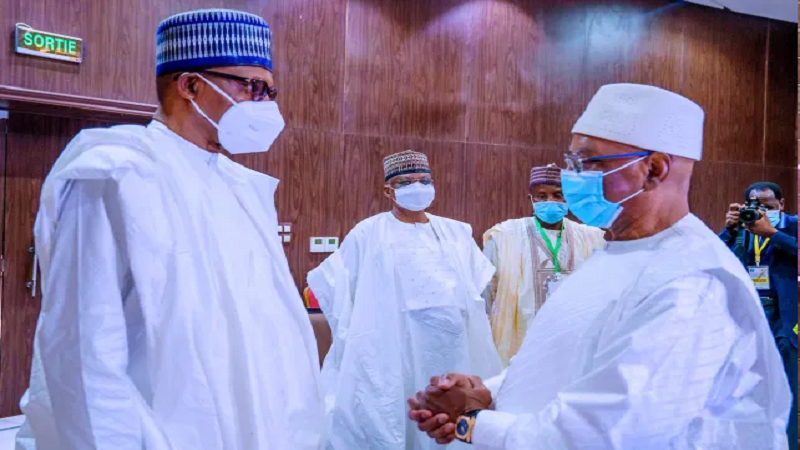
Nigerian leaders
Since 2015, Nigeria has recorded an unprecedented rate of job loss, spiking her unemployment and hunger rate.
Nigeria’s Bureau of Statistics (NBS) put the unemployment rate above 27% in its Q3 2020 report. During this period, the Nigerian government was putting measures which include Trader Moni, N-Power, Farmer Moni, and Market Moni schemes in place to alleviate the rising strains of penury. It was hoped that in time, Nigeria would drop the ‘world poverty capital’ tag as the economic policies of the government yield positive results.
Unfortunately, things took a further dive down the drain, escalating the already bad situation. In early 2020, following the outbreak of the COVID-19 pandemic, a new wave of economic challenges hit Nigeria, as oil prices plummeted due to the impact of safety measures taken by governments around the world to contain the spread of the virus; the measures included lockdowns and travel restrictions that grounded economic activities globally. Like other countries, Nigeria initiated a lockdown that lasted from March to June.
Nigeria’s GDP fell 23% during the lockdown.
Agri-food system GDP also slumped 11%, as the hospitality sector was most affected by the restrictions. The culminating impact of the lockdown plummeted household income by a quarter, leading to a nine percent increase in the national poverty rate.
Consequently, the pandemic ushered in a new phase of economic hardship which dragged the hope that many will be lifted out of poverty, further down the abyss of misfortune. According to the World Poverty Clock, the number of people living in extreme poverty in Nigeria moved up more than 87 million, representing 43% of the population.
For people like Stanley, it means the chances of seeing food have become slimmer.
“Sometimes it takes as long as two days before I could eat, so I go to where they sell food and beg people buying food to buy for me. I don’t need meat. I only want food in my stomach,” he said.
“Some will ask me to eat what I want; others will wave me off or tell me that they don’t have the money.”
Job loss and economic hardship emanating from COVID-19 birthed a situation that plunged many Nigerians into a deeper food crisis, generally described as a “hunger virus” with its depth exposed few months after the lockdown was lifted. Following the #EndSARS protests, a campaign against police brutality in Nigeria, vandalism orchestrated by hoodlums led to the discovery of warehouses filled with food palliatives sponsored by private sector-led Coalition Against COVID-19 (CACOVID-19), as part of private sector donation geared toward easing the strains of the pandemic.
The CACOVID food palliatives were believed to be hoarded by the authorities in different states across Nigeria, who were supposed to distribute them to the people. Following the discovery, there was an unprecedented invasion of the warehouses by Nigerians looking for food. In places like Jos, Plateau State capital, the alarming number of people who besieged the food warehouse gave the impression that everyone in the city has no food to eat. In the Gwagwalada area of Abuja, where stampedes resulted in deaths. It was the same story of starvation being demonstrated through desperation for food even in the face of a possible danger of some of the foods being unhealthy for consumption.
Nigerian past and present rulers
“We need our palliatives. It is our right. My neighbour almost died of hunger because of COVID-19,” said Ojo, one of the Nigerians looking for the palliatives. “He used to work as a security guard at a government institution, but he was sacked. What do you want him to do? I gave him beans and rice, he almost died of hunger.”
For other Nigerians walking in the same terrain of starvation, the quest to put food on the table has become a clarion call that doesn’t depend on one’s earnings anymore. On social media, SOS calls for food are alarmingly increasing daily, with people begging and sharing their bank account numbers online for as low as N1,000.
“Good evening sir. How are you doing? Please sir I just want to beg you to assist me with small money to buy food for my family. I am a teacher in a private school. It is not easy sir. Please don’t be offended. I kneel down to beg you, sir,” Divine Azoug begged a philanthropist on Twitter.
As the economic situation bites harder, there were a series of disheartening stories of unbearable cases of hunger. There was a report of a man who drank Dettol in Aba because he couldn’t bear the hunger anymore and wanted to end his life. Others, who still have the mettle to keep going, couldn’t stop crying out for help.
“I’m so sorry to beg for financial assistance here. Since the lockdown, I have not got food for my family. I am a teacher in a private school. For three months I have not been paid my salary and no one has been paid either,” another Nigerian begged on social media.
A medical doctor narrated on Twitter how she normalized the high blood pressure of a patient by merely giving him N1,000, a typical situation with the increasing number of Nigerians who don’t know where their next meal will come from. Like Stanley, many of them have resorted to begging because other dignified choices have been exhausted.
“I used to borrow like N10,000 from my friends and paid back when I made the money from my small business. Now, nobody has. Everybody is crying. So instead of N10,000, I ask for N1,000 or N500. But before you know it, the money becomes too much from different people, and there is no means of paying back because my business is not moving,” Ebenezer, a father of three and petty trader, said.
“It’s telling terribly on us. Most times, my wife and I must starve to save the little we have for our three kids. As you can see, we are losing weight,” he added.
For Many, the hope of sustenance lies in the willingness of others to give; family, friends, and those who have something to spare.
“I will use the N10,000 to buy food so that my family can have something to eat in the meantime. I lost my job in July due to the COVID-19 lockdown and since then things are very tough for me and my family. God bless you, sir,” Oladoyin explained to a philanthropist who wanted to know what he would do with the money he begged for.
Unfortunately, in some cases, the helpers eventually lost their jobs along the way and joined the increasing number of unemployed Nigerians looking for food. To survive, many have learnt to feed on any food that doesn’t kill instantly.
A dead whale washed up on a beach in Okpoama and Onyekia communities in the Brass Local Government Area of Bayelsa State. Within hours the giant mammal was reduced to nothing by hungry Nigerians. The National Agency for Food and Drug Administration and Control (NAFDAC) had repeatedly warned that eating washed-up aquatic animals poses a great risk to health. But to many who do not know where their next meal may come from, it is better to die of food poison than of hunger. So, such a whale was a “gift from God.”
As Nigerians adopt skipping meals as a mechanism to survive their hunger crisis, the starvation is creating other problems that the government is said to be paying less attention to – hunger stunting physical and mental well-being.
According to Move for Hunger, when you are hungry, your body produces cortisol, a stressor that signals to your body to eat. This stress when prolonged has deteriorative qualities and the effects of food insecurity on a person’s psyche become more impactful than you can imagine. While hunger does not directly cause mental ill-health, it can significantly increase the risk of developing one through malnutrition, vitamin deficiency, poor physical health, and proneness to diseases.
“Hunger is linked to poor concentration, memory disturbances, short attention span, restlessness, anxiety, mood disorders, ADHD, and a host of other problems,” a psychiatrist, Dr. Taiwo Afe, said.
He explained that a condition of food deficiency could impact mental health negatively.
“When glucose stores are low, many body functions either use alternatives or synthesize a form within the body mechanisms. But the brain is heavily dependent on glucose, hence, many processes for behaviour control are dysfunctional, resulting in disorganized behaviour.
“Ordinarily, when glucose stores are low, some compensatory sympathetic mechanisms that excite and enhance aggression are activated,” he added.
The multidimensional consequences of hunger are particularly evident in the behavioural attitude of Nigerians. It is always anger and fights, murmuring and curses, and sometimes, stealing, at home, markets, and on streets.
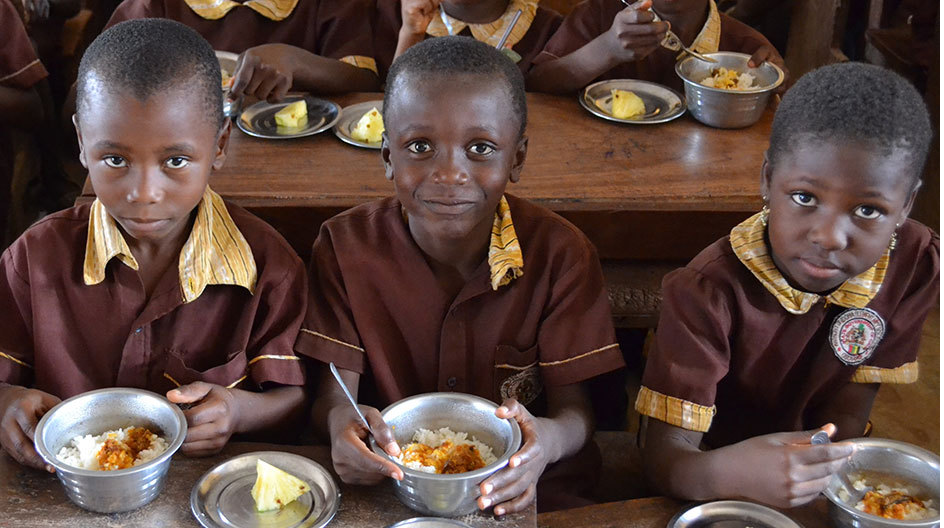
school kids feeding
The World Health Organization’s 2019 report on mental health noted that one in four Nigerians – some 50 million people – suffer from mental health. The overwhelming situation resulted in the call for Nigeria to reform its mental health law to meet the standard of WHO’s mental health action plan, which aims for 50% of countries to have developed or updated their law in line with international and regional human rights instruments by 2020. With fewer than 300 psychiatrists in a country of 206 million people, the increasing cases of mental health in Nigeria are pointing to a developing epidemic that is deeply rooted in hunger.
As Nigerians keep strategizing to feed daily, deteriorating economic situations keep stymieing their chances. Stanley mentioned how he would hope on birthdays, weddings, and weekend parties just to get a meal. But the parties have reduced drastically because party makers are also trying to survive. Those who have what it takes to pull it off are separated by the wall of class distinction that keeps the hungry ones away.
Scanty parties were attributed largely to the economic downturn of the country and partly to the border closure which disrupted the ECOWAS-based food supply chain and spiked Nigeria’s food inflation. The NBS October 2020 report put the food inflation rate at 17.38%, indicating a significant increase in food prices, especially rice, the most staple food in Nigeria. A 50kg bag of rice is sold for about N31,000 the same amount as the monthly minimum wage.
Sunday, a taxi driver with five kids lamented, “We are finding it hard to cope. A bag of local rice is now N30,000. I cannot afford to buy it. My children like rice but as it is, I cannot afford to provide it to their satisfaction. So, we have learnt to skip meals, eating mostly twice in a day.”
Sunday’s family is just one among many in Nigeria whose children have learnt to skip meals just because there is not enough. In some states, parents who depended on the government’s school feeding programme to feed their children were forced to go back to their meal skipping pattern as coronavirus forced schools to close nationwide.
“Before the lockdown restrictions I was a petty trader of household items but now all my items have been sold and I can’t go to the market to buy more. Even the savings we had have all been used to cater for the family. My husband’s hands are also tied because he cannot go out to sell his farm produce. The future looks very bleak.
“Sometimes we go to bed without dinner and I can say that the same is true for the majority of people in our community. If something is not done quickly, a whole lot of us will die of starvation,” a Nigerian woman, who did not want to be identified, lamented.
The impact of meal-skipping on children has been observed to go beyond stunted growth to poor academic performance.
The Children’s HealthWatch explained that food insecurity has negative effects on early childhood. The report stated that hunger is detrimental to the development of skills crucial for school success including memory, emotional stability, and social skills. On the other hand, adults who are underfed lose considerable weight due to insufficient calorie intake.
According to the USDA Dietary Guidelines, the recommended calorie intake for sedentary females aged 26 to 50 is 1,800 per day. For sedentary males of the same age, the recommended calorie intake is 2,400. But in the face of food insecurity, adults of this age range are forced to lower their calorie intake far below what is recommended, resulting in emaciation, a typical feature of most Nigerians.
Though there were measures mapped out to tackle the menace of hunger and malnutrition, not much success has been recorded. In April 2016, Nigeria adopted a new National Food and Nutrition Policy (NFNP) to curb the upsurge in stunting and malnutrition among other food-related concerns rising in the country.
The policy, driven by the Ministry of Budget and National Planning and supported by other stakeholders including the state governments had the goal to attain optimal nutritional status for all Nigerians by 2024. The key targets include reducing the stunting rate among under-five children from 37% in 2030 to 18% by 2025, reducing childhood wasting, including Severe Acute Malnutrition (SAM) from 18% in 2013 to 10% in 2025, among others.
These new programmes came after the National Strategic Plan of Action for Nutrition and the National Strategic Health Development Plan for 2009 to 2015, which were formulated as a guide for the health sector component of the National Food and Nutrition Policy, failed to address the challenge.
In the wake of COVID-19 and the crisis in northern Nigeria that have escalated the situation of hunger and malnutrition in the country, especially among children, the WHO and UNICEF are worried that the lax approach by the government will harm the economic future, health and education prospects of the country.
The International Committee of the Red Cross (ICRC) reported that the number of children treated in 2020 by the outpatient nutrition programme grew by 20%, while the number of severe malnutrition cases rose by 10%, compared to the same period last year. The low productivity it yields in adulthood is estimated to account for as much as 11 percent of Gross Domestic Product in economic losses.
To address the upsurge, the government has once again unveiled a plan. In December 2020, the National Council on Nutrition approved a five-year plan to reduce hunger and malnutrition. The plan was geared toward the implementation of intervention programmes, designed to address hunger and malnutrition across all sectors in Nigeria. The action plan titled, ‘National Multi-Sectoral Plan of Action for Food and Nutrition (NMPFAN) 2021-2025,’ was approved by Vice President Yemi Osinbajo, and backed by Nigeria’s Governors Forum, the health ministry, Ministry of Budget and National Planning, and the Nutrition Society of Nigeria, among other stakeholders.
The goal is to reduce the proportion of people who suffer malnutrition by 50%, and the stunting rate among under-five-year-olds to 18% by 2025, through the scaling up of priority high impact nutrition-specific and nutrition-sensitive interventions. The plan is to be implemented through the adoption of extensive advocacy programmes by stakeholders of the NMPFAN, across all levels of government and sectors in the country.
While nutrition-based advocacy programmes are important in addressing the concerns of food shortage, experts are urging the government to give more attention to social and economic development programmes, as it would help families to earn decent living. However, the chances for a near economic future that will guarantee food security are slim as Nigeria is confronting its worst recession in decades.
The World Poverty Clock put Nigeria’s poverty Target Escape Rate at 0.3 people/sec while the Current Escape Rate is -5.8 people/min. Last year, the UN’s report for developing countries like Nigeria seeking to escape multidimensional poverty indicates a bleak future. The report said that the Zero Hunger Target of Sustainable Development Goals (SDGs) by the year 2030 has been severely undermined in the last three years, adding the consequences of COVID-19, and its second wave that may force the government to initiate another lockdown, Nigeria’s hunger crisis is expected to deepen soon.