DD
MM
YYYY

PAGES

DD
MM
YYYY

spot_img

PAGES

Home Blog Page 5961

Congress Certifies Biden’s Win, Forcing Trump to Pave Way for Orderly Transition

0

Despite the insurrection that greeted the ratification of U.S. President-elect Joe Biden’s Electoral College win on Wednesday, Congress has certified him as the 46th president of the United States.

The Vice President Mike Pence who presided over the Congress issued a statement after the counting affirmed Biden’s votes.

“The announcement of the state of the vote by the president of the Senate shall be deemed a sufficient declaration of the persons elected president and Vice President of the United States, each for the term beginning on the 20th day of January 2021 and shall be entered together with the list of the votes on the journals of the Senate and the House of Representatives,” Pence said after the count of all the State’s Electoral College votes.

The Senate and House rejected objections to throw out Georgia and Pennsylvania’s electoral votes for Biden. Other states, Arizona, Nevada and Michigan where Republicans objected to were also upheld after the motion failed before it reached debate.

Only seven senators supported the objection while 92 voted against it. In the House, 138 Republicans voted to uphold the objection while 282, including 64 Republicans voted against it.

Senate Majority Leader Mitch McConnell indicated that there would be no further objections to the way for Congress to finish the count and certify Biden as president and Harris as the vice president.

The ratification was done after Congress reconvened following the attack by pro-Trump rioters at the Capitol, which disrupted the process earlier on Wednesday.

In defiance of Trump’s continuous attempt to overturn the outcome of the election, thereby subverting the will of Americans who voted for Biden, Pence broke camp with Trump.

The President has been counting on his vice following the failure of his past efforts, which largely were rejected by courts, to change the result of the election to favor. Pence who played cool until the final days and sided with the majority of American voters declared Biden the winner.

“The announcement of the state of the vote by the president of the Senate shall be deemed a sufficient declaration of the persons elected President and Vice President of the United States, each for the term beginning on the 20th day of January 2021 and shall be entered together with the list of the votes on the journals of the Senate and the House of Representatives,” Pence said after the ratification.
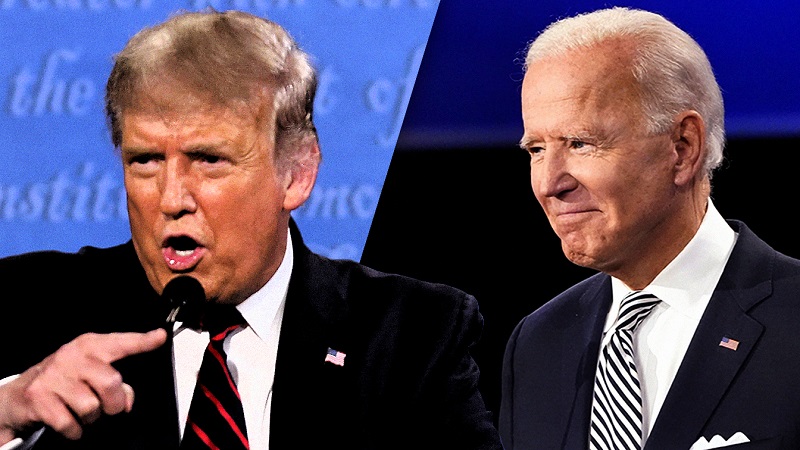
Following this announcement, the siege around the electoral will of Americans ended. Trump who is under fire even from members of his own party, and is facing the threat of 25th Amendment and impeachment, was forced to accept the decision of the Congress. He said there would be an “orderly transition of January 20.”

“Even though I totally disagree with the outcome of the election, and the facts bear me out, nevertheless there will be an orderly transition on January 20th. I have always said we would continue our fight to ensure that only legal votes were counted.

“While this represents the end of the greatest first term in presidential history, it’s only the beginning of our fight to Make America Great Again,” Trump said in a statement posted on Twitter by White House spokesman Dan Scavino after Congress certified Biden’s win.

However, the event of Wednesday has casted a monument of dent on Trump’s legacy, as more and more people within and outside the United States are rising to condemn the riot at the Capitol, fueled by his post-election utterances and actions.

Trump’s camp is getting smaller as many of his close allies are deserting him. Report from White House said officials are resigning in the wake of the Capitol insurrection. Facebook, Twitter, Instagram and Snapchat have all temporarily suspended Trump’s accounts, and his last three posts have been removed for stoking violence.


Nigeria’s NCC Clears Air on SIM Mass Disconnection

0
National ID Card, Nigeria

The recent decision of the Ministry of Communication to link phone numbers with the National Identity Numbers of subscribers have moved from backlash to many rumors. Recently, the news reported that the Nigerian Communication Commission has disconnected millions of subscribers who did not link their NIN to Subscriber Identification Module (SIM).

That has rekindled the uproar that has followed the development, as thousands of subscribers scramble to register for NIN and avoid disconnection amid COVID-19 surge.

Civil society groups have gone to court to stop the Ministry and the NCC from cutting subscribers off from telecommunication services owing to the registration.

The Commission has however moved to clarify matters on the disconnection controversy. In a statement signed by Dr. Ikechukwu Adinde, Director, Public Affairs, Nigerian Communications Commission on Thursday, the regulator said the claim of mass disconnection is unfounded.

It added that there has been erroneous assumption that, among other issues, every SIM connection has a unique human subscriber, and it is fueling the rumor that the Commission is massively cutting subscribers off.

The attention of the Nigerian Communications Commission (NCC) has been drawn to numerous publications in both print and electronic media regarding the unfounded fears of mass disconnection of telephone subscribers as a result of the ongoing linkage of SIM Registration Records with the National Identity Number (NIN).

It is therefore necessary for the Commission to issue this clarification in order to allay the fears of subscribers and the general public.

Most of these publications are based on the erroneous assumption that for every network or SIM connection, there is one unique human subscriber.

However, with the advent of social media and App-driven digital environment, network subscription went beyond human subscribers to include machines like PoS, Routers, Wi-Fi devices, electricity meters, CCTV, tracking devices etc.

A recent survey conducted in Nigeria has shown that on average, there are now approximately 4 to 5 SIMs to every human subscriber. This explains the basis of allowing the linkage of up to 7 SIMs to 1 unique NIN in the recently launched Federal Government Portal.

Thus, if there are 43 million Nigerians with NINs, this could account for about 172 million SIMs already linked to NINs. It is very important to emphasize that the current exercise of linking NIN to SIM(s) is for the common good of all Nigerians, as it has far reaching benefits.

Apart from enhancing our general safety, this will help in such vital exercises like National Budgeting, Policy Planning, Social Intervention programs and many more.

The Honourable Minister of Communication and Digital Economy has assured that the Government will continue to review the exercise in the light of experiences to ensure its smooth implementation.

We call on all our media partners, publishers and reporters to always endeavour to seek clarification from the Commission before going to the press, especially on sensitive issues,” the statement said.

However, the concern of insufficient registration facilities still lingers as it instigates mass gathering amidst rising cases of COVID-19.

The Ministry of Communication, the NCC and telcos are yet to work out a framework that will quell crowding in registration centers, which is also giving rise to reports of extortion by some staff of the Nigerian Identity Management Commission (NIMC) as people rush to beat the February deadline.

Elon Musk Topples Jeff Bezos, Becomes World’s Richest Man

0

Elon Musk has broken the world’s attention from the avalanche of chaos currently sweeping through the United States. The South African born American tech genius has toppled Jeff Bezos to emerge the richest man on earth.

Tesla shares rose 4.8% to add the disruptive fortune to Musk’s coffers, and he usurped Amazon founder Jeff Bezos who has held the top spot since October 2017..

Musk’s fortune soared by more than $150 billion in the past year.

Bloomberg Billionaire Index analyzed his journey to the top, and predicted a brighter future propelled by Democrats’ senatorial election win in Georgia.

A 4.8% rally in the electric carmaker’s share price Thursday boosted Musk past Amazon.com Inc. founder Jeff Bezos on the Bloomberg Billionaires Index, a ranking of the world’s 500 wealthiest people.

The South Africa-born engineer’s net worth was $188.5 billion at 10:15 a.m. in New York, $1.5 billion more than Bezos, who has held the top spot since October 2017. As chief executive officer of Space Exploration Technologies Corp., or SpaceX, Musk is also a rival to Bezos, owner of Blue Origin LLC, in the private space race.

The milestone caps an extraordinary 12 months for Musk. Over the past year his net worth soared by more than $150 billion in possibly the fastest bout of wealth creation in history. Fueling his rise was an unprecedented rally in Tesla’s share price, which surged 743% last year on the back of consistent profits, inclusion in the S&P 500 Index and enthusiasm from Wall Street and retail investors alike.

Bezos would still hold a wide lead over Musk had it not been for his divorce, which saw him cede about a quarter of his Amazon stake to his ex-wife, MacKenzie Scott, and his philanthropy. He donated shares worth about $680 million in November.

The jump in Tesla’s stock price further inflates a valuation light-years apart from other automakers on numerous metrics. Tesla produced just over half-a-million cars last year, a fraction of the output of Ford Motor Co. and General Motors Co. The company is poised for further near-term gains as Democrats captured both Georgia Senate seats and handed control of Congress to the party that advocated for quicker adoption of electric vehicles.

Musk, 49, has benefited from Tesla’s stratospheric rise in more than one way. In addition to his 20% stake in the automaker, he’s sitting on about $42 billion of unrealized paper gains on vested stock options. Those securities come from two grants he received in 2012 and 2018, the latter of which was the largest pay deal ever struck between a CEO and a corporate board.

Despite his astronomical gains, Musk has said he has little interest in material things and has few assets outside his stakes in Tesla and SpaceX. He told Axel Springer in an interview last month that the main purpose of his wealth is to accelerate humanity’s evolution into a spacefaring civilization.

“I want to be able to contribute as much as possible to the city on Mars,” Musk said. “That means just a lot of capital.”

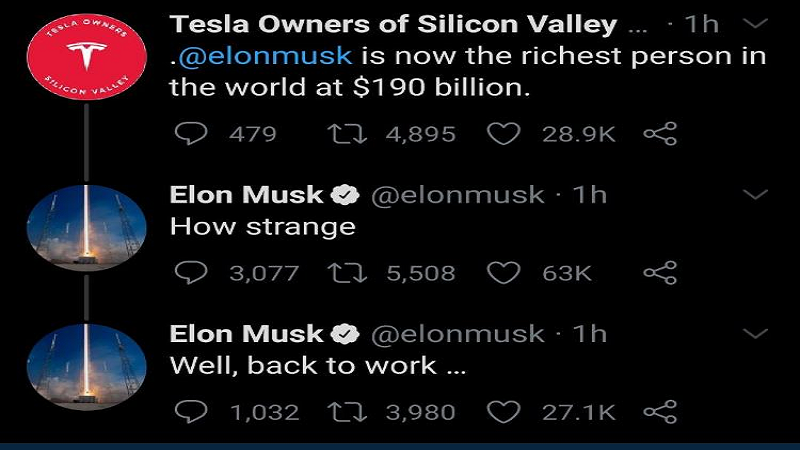
Musk tweeted “How strange,” after reports of his new status were published, then added “Well, back to work.”

The world’s 500 richest people added a record $1.8 trillion to their combined net worth last year, equivalent to a 31% increase. The gains were disproportionately at the top, where five individuals hold fortunes in excess of $100 billion and another 20 are worth at least $50 billion.

Less than a week into the new year the rankings have already been upended by extraordinary rallies. China’s Zhong Shanshan has vaulted past Warren Buffett to claim the sixth slot after shares of his bottled-water company surged, adding $15.2 billion to his fortune.

Musk’s early year fortune that shot him to the top of the Billionaire Index followed the pattern of Bill Gates in January last year.

Six Types of Crowdfunding

1

One of ways of raising capitals for starting and expanding businesses is through crowdfunding. This is a fund sourcing approach, whereby a large number of investors contribute money to sponsor a business in return for something or nothing. Crowdfunding has its perks and drawbacks as mentioned here. However, it is a project that is worth giving a try.

But for crowdfunding to be most successful, the entrepreneur needs to consider some things. One of them is the model to opt for. Some types of crowdfunding require returns on investment (ROI) while others don’t. Further, each type has advantages and disadvantages. Hence, considering the one you can opt for will be necessary as you make your plans towards the project.

Types of Crowdfunding

There are several types of crowdfunding but they all follow one or two basic formats. The basic types of crowdfunding, therefore, are peer-to-peer lending, equity crowdfunding, reward-based crowdfunding, donation-based crowdfunding, profit-sharing, and hybrid models.

  • Peer-to-Peer Lending

This is in the form of a loan. It is borrowing from the crowd with the intention of paying back with interests. Put differently, peer-to-peer lending, also known as debt crowdfunding, is borrowing money from many investors, whose money will be repaid with interests. This is more like borrowing from the traditional banks except that a large number of investors are involved here, and the capital sourcing is usually done online.

The benefit of this type of crowdfunding is that SMEs and start-ups have access to loans without providing collaterals. This is also beneficial to entrepreneurs that could not meet requirements requested by traditional banks for accessing loans. Hence, entrepreneurs could set-up their businesses through loans even when they don’t have the wherewithal to obtain loans. However, it is possible the investors may demand for higher interest than what the bank would have asked for. Another disadvantage here is, like other crowding funding types, investors may demand to know everything about the intended business. This could cause the entrepreneur to divulge all secrets regarding his business and, thereby, risking having his ideas stolen by competitors and idea thieves.

  • Equity Crowdfunding

This type of crowdfunding is similar to selling and buying stocks of companies. Here, investors raise money for the entrepreneur in return for shares. In this case, the ROI is shares or stakes in the company even though the business is not registered with the stock exchange. So, after contributing for the business, the investors become part owners of the company.

The benefit of this type is that shareholders act as the promoters of the business. Just imagine if you have two hundred investors in your business and the two hundred own shares in it; this means you have two hundred advertising outlets. This is because the investors will want the business to grow because they are, partially, its owners too. Further, the entrepreneur has control over how much the investors contribute since he decides how many shares to sell and how much each will cost. However, the entrepreneur will encounter challenges with finding investors in this case because it’s a long term investment, which ROI might not come immediately.

  • Reward-Based Crowdfunding

This is also referred to as seed crowdfunding. This involves borrowing from the public with the intention of paying back in kind. Here, investors are paid for their investment in the business with nonfinancial rewards. The reward could be provision of services at a reduced rate, being the first to access products after they are finished, free services, donating to the community, acknowledging investors, sending appreciation letters, and so on.

Entrepreneurs that opt for this type have a lot to benefit from it. First of all, the no-interest feature makes it cheaper for entrepreneurs to raise capital. Furthermore the business owner has total control over his business. However, because the ROI does not involve financial gain, investors may not be forthcoming. This means this approach might not work for entrepreneurs seeking a huge amount of money.

  • Donation-Based Crowdfunding

This is usually done for charitable purposes. It is where the public contributes funds for a project without expecting any ROI, be it in cash or kind. In donation-based crowdfunding, there is no fixed amount of money each investor should contribute. Usually, they donate small amounts of money to raise the huge sum needed. Nevertheless, beneficiaries usually encourage large donations by providing rewards for them. However, the money invested is never returned.

This type is best for humanitarian purposes. It is best for NGOs and other charity organisations for funding their projects. However, because of lack of ROI, investors do not usually contribute large sums. This makes it unsuitable for capital-intensive projects.

  • Profit-Sharing Crowdfunding

This is also known as revenue-sharing crowdfunding. As the name suggests, entrepreneurs that use this model pay back their investors by sharing profits made by the business. For this to happen, investors have to contribute a fixed amount of money. The benefit of this model is that the entrepreneur is only obligated to pay ROI from profits the business generated. This method might be most suitable for high risk businesses that may or may not generate profits. The returns are higher when profits are high and lower when profits are low. Hence, entrepreneurs are not pressured to pay back their investors: so long as profit is made, investors will be repaid. Hence, the financial performance of the company determines how investors are repaid. This is one model that favours both investors and investees immensely. However, it will be imperative to convince investors that the business will be profitable so they can part with their money.

  • Hybrid Model

As the name suggests, this model combines two or more types of crowdfunding depending on the entrepreneur’s needs and choices.

Note that choosing the type of crowdfunding that is suitable for you requires you consider the purpose and the intended investors. By purpose, you have to consider the type of project you want sponsored and its purpose. By intended investors, you need to consider if you want business moguls in your team or just anyone that has interest in the purpose. This means you need to research further on the type of investors that each crowdfunding type attracts. That way, you won’t make avoidable mistakes.

Cryptocurrency Hits Over $1tr Value As Bitcoin Continues It’s Bull Run

0
Bitcoin is soaring

Bitcoin’s volatile rally has put the value of cryptocurrencies past $1 trillion for the first time. The surge in bitcoin has boosted other cryptocurrencies following a fivefold climb in market value in the past year.

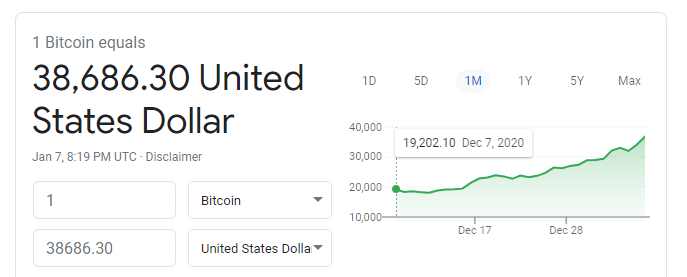
Bitcoin rose over 5% on Thursday to top $39,000 for the first time as it continues its amazing run from late last year that has placed its value at $700 billion. The digital asset has quadrupled in the past year and accounts for about two-thirds of cryptocurrency market value, followed by Ether on about 14%. Ether has risen 62% this year, according to a composite of prices compiled by Bloomberg.

Strategists attribute the rise to demand from speculative retail traders, trend-following quant funds, the rich and even institutional investors. Wall Street billionaires publicly backed the coin last year as more investors started seeing the coin as an inflation hedge.

There has also been a surge in demand of bitcoin by prominent organizations and individuals that led credence to its frenzied rally. Investors such as Paul Tudor Jones and Stanley Druckemiller were among those who joined the trend, following the step of Twitter founder and CEO, Jack Dorsey. Large financial companies like PayPal, Fidelity, MicroStrategy and Dorsey’s Square have also made moves in the cryptocurrency.

“When you look at this bitcoin rally that we have been seeing in the last couple of weeks and months, really, there’s two big elements driving it. One is the continuous entry of institutional players,” Henri Arslanian, PwC’s global crypto leader told CNBC.

Data from CoinGecko, a crypto tracker platform confirmed that cryptocurrencies hit a milestone after a fivefold climb in market value in the past year.

It has been up about 30% since the start of the year following a nearly 370% surge in the past 12 months.

Researcher Flipside Crypto said active bitcoin accounts are nearing their all-time high levels of late 2017, which is a possible sign that some holders are planning to sell. Bloomberg noted that fewer than 2% of accounts hold 95% of bitcoin supply, so a few traders can impact prices. It means the recent invasion of the coin by rich individuals and organizations may result in a few controlling cryptocurrency.

Other factors like JPMorgan Chase & Co.’s long-term bitcoin price forecast of $146,000 and the US regulatory update that allows a class of less volatile coins to be used by banks for payments, have been also fingered by traders as possibly fueling the rally.

Arslanian said regulatory measures by the government is another factor driving the surge, as it wasn’t the case in the past year, and he expects the trend to continue in coming months.


As the government gets more involved in the activities of bitcoin, more investors are seeing it as the ‘digital gold’, a safe haven asset and inflation hedge. The idea has continued to penetrate the many business minds that are looking for a secure investment place from the pandemic.

JPMorgan said bitcoin could hit $146,000 in the long term as it competes with gold as an alternative currency. But the bank’s analysts added that it has to become less volatile to reach the price, considering its wild price swings.

However, its current run is expected to attract more investors in the next few months.

“This latest bull run in January is sure to attract the asset managers’ attention to diversify even more of their assets to crypto as they are keen on finding alternative investments, such as cryptocurrency or gold, to hedge inflation and geopolitical risks,” Simons Chen, executive director of investment and trading at cryptocurrency financial services firm Babel Finance, told CNBC.

“A large number of retail investors have also joined the race recently as they fear to miss out on opportunities to make easy, quick gain from the latest bull run,” he added.

The current value of cryptocurrency reflects the rise in the use of bitcoin. The total transaction volume of the digital asset in 2020 was greater than that of Venmo, Paypal or Apple Pay.

“There was more usage of the bitcoin payment rails than some of the most popular fintech products.

“Bitcoin is transitioning from what used to be a contrarian idea or a contrarian trade to a consensus trade. I think that’s where you’re getting this re-pricing of the asset and the rapid price appreciation, as more and more folks on Wall Street come into the asset and want exposure,” Anthony Pompliano, co-founder of crypto hedge fund Morgan Creek Digital, told CNBC.

However, the short time surge of bitcoin is casting doubt in the minds of many investors who believe it wouldn’t last long.