Process efficiency is great. But a winning business model is more important. You can be efficient doing the wrong thing. It comes down to operating where you can capture value. Because of the unconstrained and unbounded nature of the web, businesses must change their operational protocols.
In 2000, assembling the top global movie producers to make short videos for a digital platform would have been a great idea (Quibi like). But in 2021, where discovery and owning the demand, not the supply, is more strategic, that model will struggle. So, today, it is a better idea to have a platform where millions of people can post videos and your algorithms sort, and pick the best, and within seconds distribute them on your platform (TikTok like).
The most catalytic thing a leader can do today is to have a responsive business model. If you miss it, everything falls because the dynamic of the internet has changed everything.
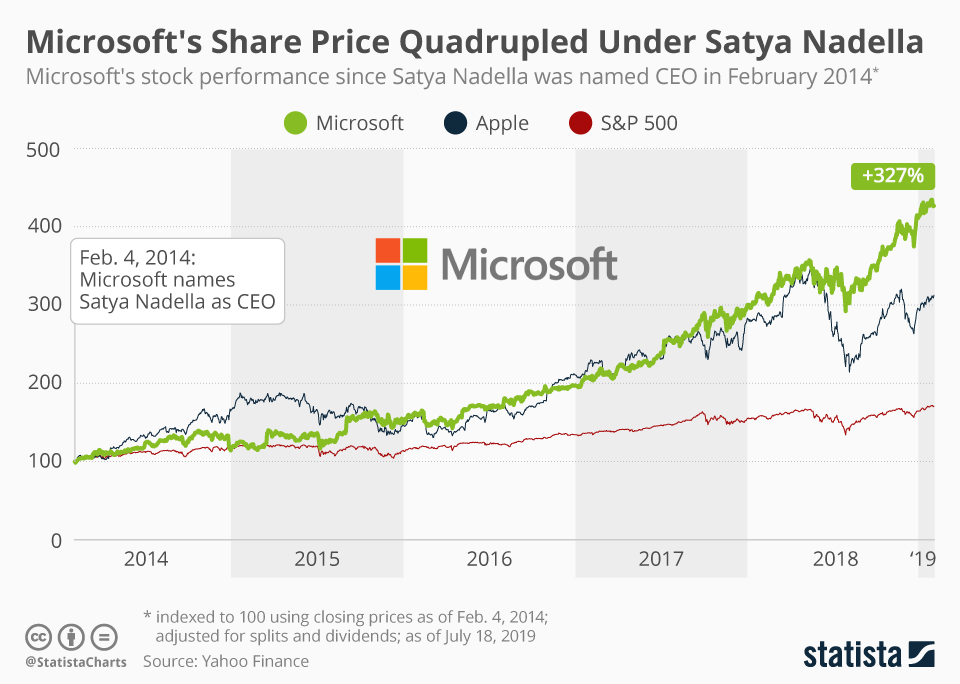
A man picked a company, and changed the business model, and within five years, quadrupled the market cap, with largely the same products. Yes, the difference between Steve Ballmer (former CEO of Microsoft) and Nadella Satya (current CEO) is this: Satya runs a model for the web era while Ballmer was old school. Ballmer focused on controlling supply of Microsoft products in a world where winning demand has become more strategic.
In 2021, I challenge you to look deeper into the business model you are running. How has the web changed the fundamental constructs?
Always remember that modern empires are going to be those who control demand, not supply. That is the grand playbook of the web economy. Upgrade as I have noted in my courseware of the same title in Tekedia Institute.
In the digital age, what matters is not who controls supply, but who controls demand. Supply is largely infinite as there are many ways to get to the web, and because it is infinite, users congregate to platforms to help them navigate and make sense of the web.
In 1980, before the digital age as we have it today, the most powerful people in media were newspaper publishers. They were the people you needed to reach to get your message to the world. They decided what everyone read on the dailies and they were powerful. They controlled supply and by controlling supply, they shaped everything including advertising.
Good People, I want to thank Corporate Nigeria for your response to Tekedia Mini-MBA. Today has been fascinating with registrations. When I see insurers, banks, retailers and even a university sending their staff, I am overwhelmed with appreciation. The thinking has been: everything has to be imported to be accepted in Nigeria.
But we are learning that if you provide quality and value, Nigeria responds. To our business leaders, we will keep justifying your confidence. Thank you for your support.
As Admin has noted, I am available for a short speech of 30-45 minutes to your team as you begin to plan the year. We have provided The 2021 Outlook: Growth After A Redesign already, and are now available for The 2021 Winning Playbook. 2021 is a year of accelerated growth and we have indicators to make that happen. Contact Admin, calendar is open until classes begin Feb 8.
Again, we appreciate how you all have responded. Thank you again.
I have since expanded it since I put it out in 2018. Some of our members might have read the updated version in Tekedia Mini-MBA courseware. But let me share this first draft, published in 2018. The One Oasis Strategy provides a really brilliant way to allocate factors of production in companies. Banks, fintechs and great companies have deployed the thesis. It will be part of my first work of 2021 in the Harvard Business Review, coming later this month.
Registration for 4th edition of Tekedia Mini-MBA (Feb 8 – May 3, 2021) begins. Tekedia Mini-MBA, from Tekedia Institute, is an innovation management 12-week program, optimized for business execution and growth, with digital operational overlay. It runs 100% online. The theme is Innovation, Growth & Digital Execution – Techniques for Building Category-King Companies. All contents are self-paced, recorded and archived which means participants do not have to be at any scheduled time to consume contents.
‘Simply, if you build your investment around that main product, you will find success, because those investments will have a clear internal “customer”, and that reduces market risks’. The best product is the oasis in your business upon which other products (inhabitants) will feed on and depend on, as in the oasis in the desert. If you make it a clear category-king, the oasis will last long to support other inhabitants in your firm. N.E.
Fiat Chrysler and PSA Group are about to finalize their merger: “ Fiat Chrysler Automobiles NV and PSA Group are poised to get shareholders’ sign-off on a combination that’s endured two years of extraordinary drama, marked by on-again off-again talks, the transformation of their industry and a global pandemic.” Possibly, this deal will help them pool resources together for the future of automobiles which to a large extent includes electric and self-driving vehicles.
Fiat Chrysler and PSA executives reckon they’ll boost returns with scale more closely resembling Volkswagen AG and Toyota Motor Corp., and have greater resources to compete with electric-car upstarts and tech-industry interlopers. But plenty of challenges await once the deal is done. Stellantis will be an amalgam of model lines with enviable positions in certain segments and areas of the world, but neither company has much of a foothold in the luxury-car business or China’s vast auto market.
“Stellantis will be a sort of conglomerate of brands, some great and some not so good and most very regional,” said Jefferies analyst Philippe Houchois. “The merger will be a good opportunity for a reset.”
They need to learn from Tesla which has transformed its industry by becoming a software company which makes cars! And it has also used the double play strategy to unlock massive value in the system. Yes, Tesla makes billions of dollars just by selling emission credits.
But Tesla is even the finest software & services company in the automobile sector. The fact is this: Tesla does not need to be overly valued just on the number of cars it has sold, just as we are not counting how many iPhones Apple has sold recently. Apple has moved into the services era, well beyond a life tethered on hardware.
I see Tesla as the only current “automobile” company in the world that has a clear playbook to make, possibly, more money on software and services than actually on sales of metals packaged as cars. First, the company is piling tons of money from regulatory credits: “In their most recent shareholder update, Fiat Chrysler Auto disclosed that as of March 31, 2020, its agreements represent total commitments of €1.1 billion”. Yes, that was how much Tesla made from FCA for selling credits which could have expired!
Besides all, Tesla plays the perception game which means it would be hard for any car company to easily catch up as it changes the basis of competition on the fly. So, for Fiat and PSA, this deal must go beyond making cars, it needs to find ways to make fans out of customers since perception is now a big component in the game of automobiles.
The new template for the industry is evident: a software company which ships cars since for Tesla you need to be on subscriptions to get some updates and some software systems are not transferable on sales.
Absolutely. We will release FSD subscription early next year.
This business model where someone can buy a car and still be paying a subscription on the car for some features is something Fiat and PSA must think deep into.
Amidst the pressure from international investors and regulatory battle in India, Reliance Jio announced it’s making all off-net domestic voice calls free, from January 1 2021. Indian Telecom Regulatory Authority (TRAI) had a plan to implement a Bill and Keep regime that would end interconnect usage charges (IUC) for all domestic calls.
The Indian behemoth said following the TRAI directive, it will make all off-net domestic calls voice calls free, as a gesture of its commitment to revert off-net domestic voice call charges to zero, as soon as the IUC is abolished.
It was a tactic used by the Mukesh Ambani-owned telecom company even before the directive of TRAI, that helped it to conquer India’s telecom industry with over 400 million subscribers.
“For context, in September 2019, when TRAI extended the timeline for implementation of the Bill & keep regime beyond January 1, 2020, Jio started charging its customers for off-net voice calls, at a rate exactly equivalent to the applicable IUC charge,” Times News noted in a report.
Jio had assured its subscribers that the charges will end as soon as the TRAI directive to abolish the IUC is implemented, a promise it has kept by making the free-call announcement.
“Today, Jio has delivered on that promise and made off-net voice calls free again,” the statement said.
The news impacted Jio’s competitor, Bharti Airtel negatively. Times News reported that its shares slumped 2% in intra-day trades on December 31 after Jio made the announcement.
Bharti Airtel scrip was last seen trading around Rs 508.95, down by Rs 7.70 or 1.5% at 1504 hours on National Stock Exchange (NSE).
Meanwhile, India’s market watchdog handed Reliance Industries 250 million rupees ($3.42 million) and Ambani 150 million rupees for fraudulent trade practices they engaged it while selling a stake in a subsidiary in 2007.
The Securities and Exchange Board of India (SEBI) accused the behemoth of taking derivative short positions in shares of separately listed Reliance Petroleum back in 2007 through third parties before it sold a 5% stake in the business.
SEBI’s decision came with consequences. Reliance was asked to surrender about 4.5 billion rupees plus 12% annual interest for what the regulator said were unlawful gains from that deal. Reliance and some third parties were also barred from trading in derivatives for one year.
Reliance has denied any wrongdoing, saying the trades examined by SEBI during that time were “genuine and bona fide transactions” and that the regulator had “misconstrued the true nature of the transactions and imposed unjustifiable sanctions.”
The group is waiting for a Supreme Court appeal hearing against the 2017 ruling that imposed the penalty.
His vision is to be developed through many sectors, as he was working to transform the Jio group into a modern business conglomerate that will represent the digital vision he pitched and supports Prime Minister Narenda Modi’s digital transformation agenda.
Ambani received a $27 billion in investment fund from US tech investors and now he is under their radar to deliver.
Jio founder
The focus has been on 5G development that he plans to roll out early this year. But other lines of investment were also incorporated into his vision that got the blessings of Silicon and Wall Street’s big names.
According to Bloomberg, these include incorporatingFacebook’s WhatsApp payments service into Reliance’s digital platform; integrating the company’s e-commerce offerings with a network of physical mom-and-pop shops across the country; selling a stake in Reliance’s oil and petrochemical units, a deal he had originally hoped would reduce debt and finance his high-tech pivot earlier this year.
Ambani’s top agenda was ridding Reliance of its $22 billion debt that he set 18-months deadline for himself. The deadline was beaten in nine months, spiking the company’s shares. But that was just part of the problems; investors are keenly watching his every move to see how he transforms $168 billion Reliance amidst COVID-19 chaos and fierce competition from Amazon and Walmart.
While the focus has been on 5G roll out, Ambani is hoping that Reliance could cash in on other subsidiaries to deliver the dream. There was a plan to saturate India with $54 Android smartphones backed by Google, which he plans to execute leveraging Reliance’s dominance in India’s telecom sector. Ambani believes the cheap phones will help Indians to embrace the digital life he is about to introduce to them.
And then there is WhatsApp Pay, backed by Facebook, which offers an opportunity of growth to Reliance’s e-commerce venture.
“Reliance views the integration with WhatsApp’s recently approved payments system as a crucial step in the development of its online shopping services,” said the people familiar with the matter.
The company plans to harvest millions of Facebook, Instagram and WhatsApp users for its e-commerce platforms. One more area that Ambani is looking at is streaming.
According to a plan unveiled by Ambani and his eldest children Isha and Akash at the end of Reliance annual shareholder meeting in July, the new tech services to be integrated into their business empire early this year include streaming platform that will bring Netflix, Disney+ Hotstar, Amazon Prime Video and dozens of TV channels under one umbrella.
However promising the plans seem, Reliance’s reputation hangs on actualizing them and so is Ambani’s relationship with those sold his dream to.
“Reliance shares rose as much as 55% this year to an all-time high in September, but they’ve since pared gains as stakeholders look for more evidence that Ambani can execute,” Bloomberg noted.
With the stakes so high, the scuffle between SEBI and Reliance is something Reliance doesn’t really need.